Fixing Contract Lifecycle Management (CLM) for SMEs: Why Your Business Is Bleeding Money Through Poorly Managed Contracts

Contract Lifecycle Management (CLM)

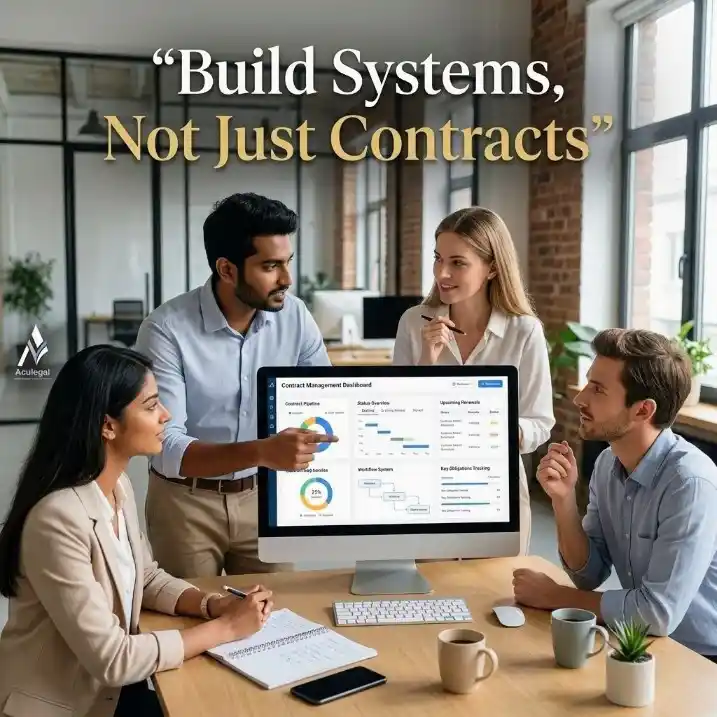
Contract Lifecycle Management (CLM) for SMEs is not a luxury reserved for Fortune 500 legal departments. It is, in fact, one of the most critical and most neglected operational systems that determines whether a small or mid-sized business grows profitably or constantly firefights legal exposure.End-to-end CLM workflow for SMEs managed through Aculegal LPO services.
Most founders and SME leaders sign contracts. They rarely manage them.

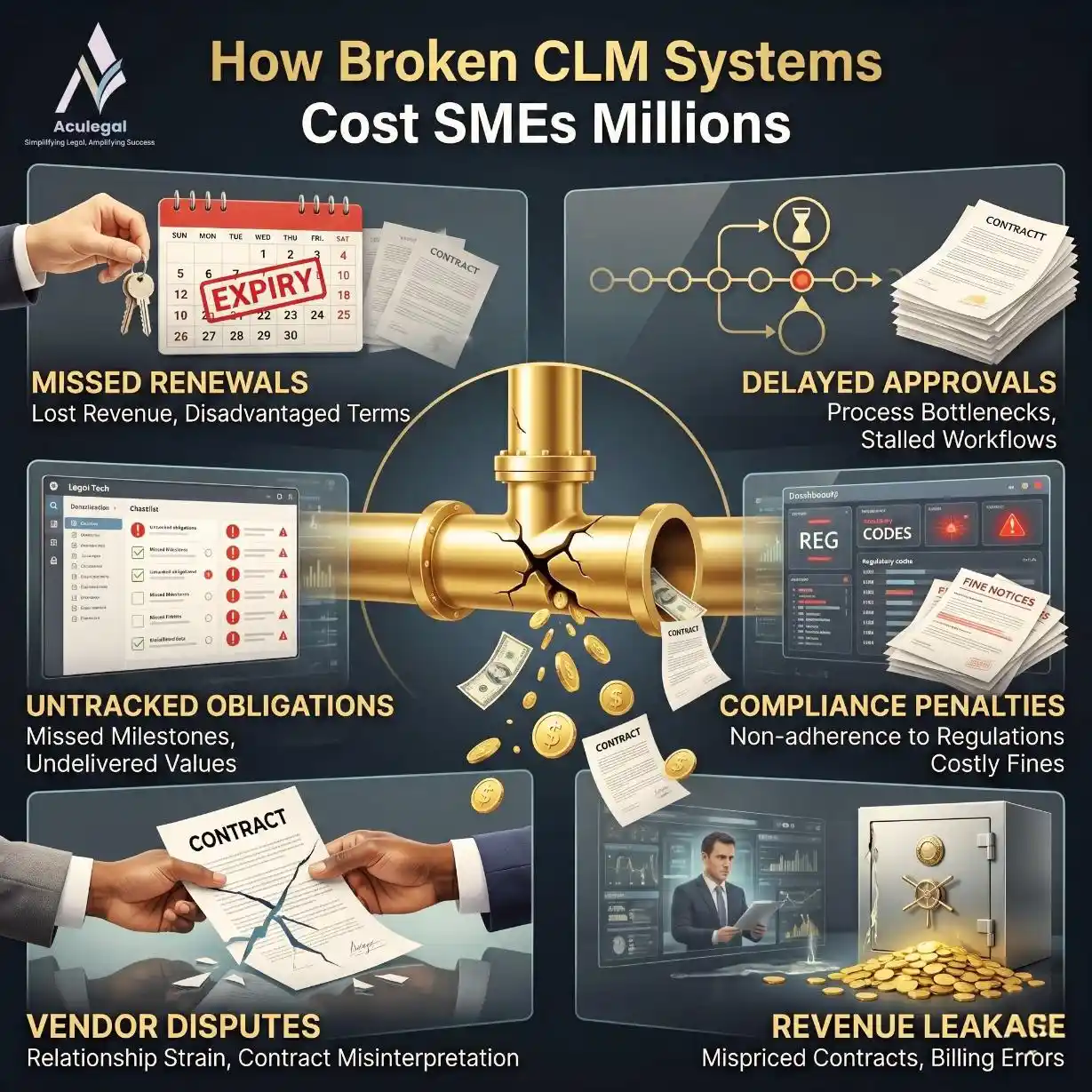
There is a significant difference, and that difference is quietly costing businesses thousands, sometimes millions, in missed renewals, unfavourable terms, unenforceable clauses, and compliance gaps.

This blog breaks down exactly where the problem lies, what a structured CLM solution looks like, and how Legal Process Outsourcing (LPO) gives SMEs access to enterprise-grade contract management without the enterprise price tag.

Why Contract Lifecycle Management (CLM) Is Broken for Most SMEsEnd-to-end CLM workflow for SMEs managed through Aculegal LPO services.

The Hidden Cost of “We’ll Figure It Out”

Here is a statistic that should stop every founder cold: according to the World Commerce & Contracting Association, companies lose an average of 9.2% of annual revenue due to poor contract management. For an SME turning over £2 million, that is £184,000 walking out the door annually, not because of bad products or poor sales, but because of broken legal processes.

The root causes are almost always the same:

  • No centralised contract repository – contracts live in email threads, shared drives, and people’s heads
  • No renewal tracking – auto-renewals trigger on unfavourable terms; deadlines slip
  • Inconsistent contract templates – each deal is drafted differently, introducing unnecessary risk
  • No post-signature obligation tracking – deliverables, warranties, and SLAs go unmonitored
  • Legal bottlenecks – every contract goes to a single solicitor or external firm, creating delays and ballooning costs

These are not just administrative inconveniences. They are business-critical vulnerabilities.

Why This Problem Is Worse for SMEs Than Large Businesses

Large enterprises have in-house legal teams, CLM software subscriptions, and dedicated contract managers. SMEs typically have none of these.

What SMEs do have is a founder wearing fifteen hats, a finance team chasing invoices, and an operations lead who “handles legal stuff” alongside everything else. This is not a criticism, it is the reality of scaling a business.

The problem is that contracts are legal instruments, not administrative paperwork. When they are treated as the latter, the business pays a price.

According to Deloitte’s Legal Operations Report, 72% of general counsel now consider contract management a top operational priority. SMEs without a structured approach are playing catch-up against competitors who have already systemised this.

End-to-End CLM and Legal Process Outsourcing (LPO) Solutions for SMEsAculegal legal professionals managing SME contracts through outsourced CLM and LPO services

What a Proper Contract Lifecycle Actually Looks Like

A complete Contract Lifecycle Management system for SMEs covers six distinct phases:

  1. Contract Initiation: identifying the need, selecting the appropriate template, and defining the scope of the agreement
  2. Drafting & Negotiation: creating legally sound, commercially balanced contracts that protect your interests
  3. Review & Approval: structured internal and legal sign-off before execution
  4. Execution: digital or physical signing with audit trails
  5. Obligation Management: tracking deliverables, payment milestones, warranties, and compliance requirements post-signature
  6. Renewal or Termination: proactive management of exit clauses, renewal windows, and renegotiation triggers

Most SMEs manage phases 1–4 in some form. Phases 5 and 6 are where value leaks and legal disputes begin.

Aculegal’s Contract Drafting & Review Services,  Link to your service page covering contract drafting, review, and negotiation for SMEs.

How Legal Process Outsourcing (LPO) Fills the Gap

Legal Process Outsourcing (LPO) is the practice of delegating specific legal functions to an external provider — functions that would otherwise require in-house legal headcount or expensive law firm retainers.

For SMEs, LPO is transformative because it offers:

  • Scalability – legal support that flexes with your deal volume, not your headcount
  • Cost efficiency – predictable fees rather than unpredictable billable hours
  • Specialist expertise – access to contract lawyers, compliance specialists, and legal project managers as needed
  • Speed – dedicated resources with clear turnaround expectations, not a backlog-heavy law firm

According to the International Association of Contract & Commercial Management (IACCM){rel=”nofollow”}, organisations that implement structured contract management processes reduce contract-related disputes by up to 50% and improve cycle times by 30–40%.

Those are not marginal gains. For a scaling SME, that is operational leverage.

The Aculegal Approach: Simplifying Legal. Amplifying Success.

At Aculegal, we have built our CLM and LPO solutions specifically for the commercial reality of founders, startups, and SMEs. That means no jargon, no unnecessary complexity, and no hourly billing surprises.

Our end-to-end CLM support covers:

  • Bespoke contract templates: tailored to your industry and deal type
  • Contract review and redlining: with commercial, not just legal, context
  • Obligation and renewal tracking: so nothing falls through the cracks
  • Third-party contract risk assessment: know exactly what you are agreeing to before you sign
  • Dispute prevention protocols: flagging problematic clauses before they become litigation

Aculegal’s Legal Process Outsourcing (LPO) Services — Link to your LPO service page detailing outsourced legal support packages for SMEs.

The Most Common CLM Mistakes SMEs Make (And How to Fix Them)

Mistake #1: Using Generic Online Templates

Free contract templates downloaded from the internet are written for the average use case. Your business is not the average use case.

Generic templates frequently miss jurisdiction-specific provisions, fail to address your specific commercial arrangements, and use ambiguous language that creates dispute risk. A contract that is almost right is legally wrong.

Fix: Commission bespoke templates from a legal team that understands your industry. This is a one-time investment that pays dividends across every future deal.

Mistake #2: Treating Contract Signing as the Finish Line

Signature is not the end of the contract process — it is the beginning of the obligation management phase. Many SMEs file the signed contract and move on, only to discover months later that they have missed a critical notice window, failed to trigger a payment milestone, or are in breach of a warranty clause they forgot existed.

Fix: Implement a contract register with automated alerts for key dates — renewal windows, termination notices, payment milestones, review periods.

Mistake #3: Negotiating on Price, Not Terms

In the excitement of closing a deal, SME founders often focus negotiation energy on price and payment schedule, accepting standard terms from the other side without scrutiny.

Standard terms — especially from larger counterparties — are written to protect the drafter, not you. Liability caps, indemnity provisions, IP ownership clauses, and exclusivity terms can fundamentally alter the commercial value of the deal.

Fix: Every material contract should be reviewed before signing, not after a dispute arises. This is where having Aculegal in your corner changes the outcome.

Mistake #4: No Version Control on Negotiated Drafts

Contract negotiations often involve multiple redlined versions shared back and forth. Without proper version control, it is surprisingly common for businesses to sign an earlier draft, one that does not reflect the negotiated terms.

Fix: Establish a clear drafting protocol with version naming conventions and a designated final-version confirmation step before execution.

What CLM Done Right Looks Like: A Practical Framework

The Three-Layer CLM System for SMEs

Building a functional CLM system does not require enterprise software or a large legal team. At its core, it requires three layers:

Layer 1 – Process Standardised workflows for every stage of the contract lifecycle. Who initiates? Who reviews? Who approves? Who tracks obligations?

Layer 2 – Templates A library of pre-approved, legally sound contract templates for your most common deal types NDAs, supplier agreements, client service agreements, employment contracts, and partnership agreements.

Layer 3 Oversight: A legal partner who provides ongoing support, reviewing non-standard agreements, advising on risk, managing disputes before they escalate, and keeping your templates current as law and business practice evolve.

This is precisely the infrastructure Aculegal provides through our LPO model, giving SMEs the legal architecture that previously only large businesses could afford.

When to Escalate: Red Flags in Any Contract

Not every contract requires the same level of scrutiny. But certain provisions should always trigger a professional legal review:

  • Unlimited liability clauses: where your exposure has no financial ceiling
  • Broad IP assignment: where your work product, innovations, or data may transfer to the other party
  • Exclusivity or non-compete provisions: which can restrict your ability to work with others
  • Automatic renewal with long notice periods: which lock you in without adequate exit opportunity
  • Jurisdiction and governing law clauses: particularly when the other party is overseas

According to the Harvard Law School Program on Negotiation, the most costly contract mistakes are made before signature, not during performance. Identifying these red flags early is where expert legal review delivers the highest ROI.Contract compliance and legal risk management dashboard for SMEs

The Business Case for Investing in CLM as a Strategic Asset

Contracts Are Not a Cost Centre, They Are a Revenue Protection Mechanism

Every contract your business signs is either protecting your revenue or exposing it. There is no neutral.

A well-managed contract portfolio:

  • Reduces dispute costs by preventing ambiguity that leads to litigation
  • Improves cash flow through enforceable payment terms and milestone tracking
  • Protects IP and competitive advantage through properly drafted IP and confidentiality provisions
  • Supports investor and due diligence readiness clean, well-organised contracts are a material factor in funding rounds and M&A transactions
  • Builds counterparty trust, professional, well-drafted contracts signal commercial maturity

The Gartner Legal and Compliance Research{rel=”nofollow”} consistently highlights that businesses with mature contract management practices outperform peers on both revenue protection and operational efficiency metrics.

For SMEs competing against larger, better-resourced businesses, CLM is not a nice-to-have. It is a strategic differentiator.SME business growth achieved through effective contract lifecycle management.

Conclusion: Stop Losing Money to Broken Contract Processes

Contract Lifecycle Management (CLM) for SMEs is the difference between a business that controls its legal risk and one that is perpetually exposed to it.

The four core takeaways from this blog:

  1. Poor CLM is expensive – the average business loses 9.2% of annual revenue to contract mismanagement
  2. SMEs are disproportionately exposed – without in-house legal infrastructure, the risk multiplies
  3. End-to-end CLM and LPO solutions give SMEs access to structured, expert legal support at a fraction of traditional law firm costs
  4. The right legal partner – one who understands your commercial context, not just the law, changes the outcome

At Aculegal, we are purpose-built for founders, startups, and SMEs who want legal that works for their business, not against their momentum.

Simplifying Legal. Amplifying Success.Business founder consulting with Aculegal legal experts for CLM and LPO solutions

Ready to Fix Your Contract Lifecycle Management?

Book your free legal consultation with Aculegal today. Our team will assess your current contract management approach, identify your biggest areas of risk, and show you exactly how our CLM and LPO solutions can protect and accelerate your business.

Book Your Free Consultation 


Sources referenced in this article:

  • World Commerce & Contracting Association – Contract Management Research
  • Deloitte Legal Operations Report – Future of Legal
  • International Association of Contract & Commercial Management (IACCM)
  • Harvard Law School Program on Negotiation
  • Gartner Legal and Compliance Research
Why Lean Startups Are Hiring Virtual Chief Legal Officers (VCLOs)

Virtual Chief Legal Officers (VCLOs)

Virtual Chief Legal Officers (VCLOs) are no longer a luxury reserved for enterprises with bloated legal budgets. Today, they’re the strategic edge that lean startups and high-growth SMEs are quietly building into their operations, and the results are reshaping how founders think about legal risk, cost, and scale.

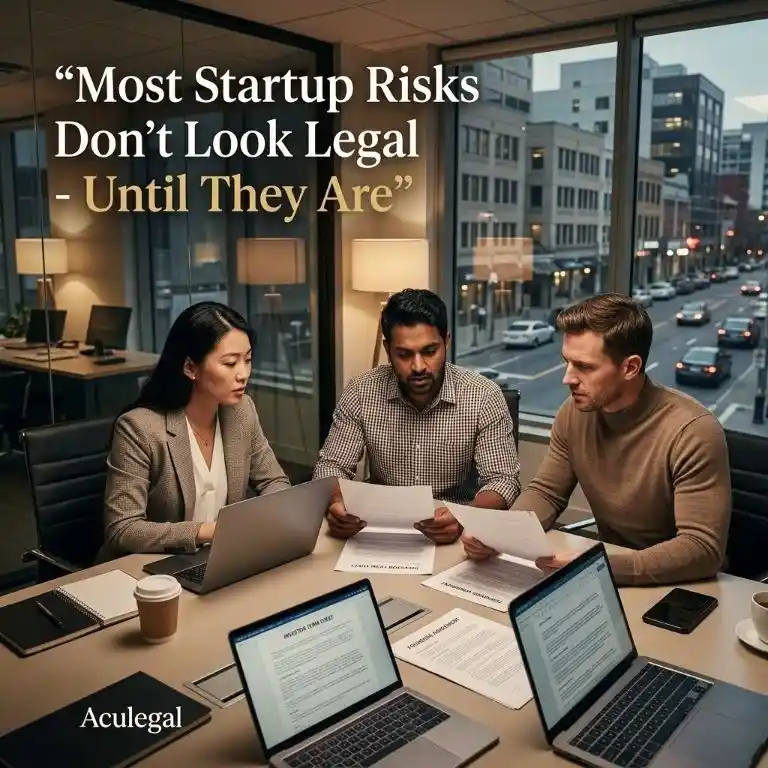
If your startup is still operating without structured legal leadership, you’re not lean; you’re exposed.Startup founders reviewing contracts and legal risks in an SME office during evening hours

The Hidden Legal Crisis Killing Promising Startups

Most founders don’t realize they have a legal problem until it’s too late.

A poorly drafted co-founder agreement. An investor term sheet signed without legal review. An employee contract that doesn’t protect your IP. Each of these is a ticking clock and when the alarm goes off, it doesn’t just cost money. It costs momentum, investor confidence, and sometimes the company itself.

According to research from Harvard Business Review, co-founder conflict and poor early-stage structuring consistently rank among the top reasons startups fail. Legal gaps are almost always underneath those structural cracks.

The conventional solution, hiring a full-time Chief Legal Officer, comes with a price tag most early-stage companies simply can’t justify. A senior CLO in India or the US can cost anywhere from ₹40–₹1.2 crore per year, not counting equity, benefits, and onboarding time.

The result? Most founders either skip legal coverage entirely or consult a lawyer reactively only when something goes wrong.

That reactive model is expensive. And it’s avoidable.

What Is a Virtual Chief Legal Officer (VCLO)?

A Virtual Chief Legal Officer (VCLO) is a senior legal professional who embeds into your company on a fractional or retainer basis, delivering CLO-level strategic thinking without the full-time cost.

Think of it this way: instead of hiring a full-time general counsel, you access the same calibre of legal leadership on demand for fundraising rounds, compliance reviews, contract negotiations, regulatory advice, and more.

VCLOs operate at the intersection of legal strategy and business outcomes. They don’t just review documents, they advise on risk, structure deals, guide policy decisions, and help leadership teams move faster with legal confidence.Virtual Chief Legal Officer advising startup founders in a modern collaborative office

This is why the VCLO model has exploded in adoption among:

  • Early-stage startups scaling past seed funding
  • SMEs entering new markets or product lines
  • Founders preparing for due diligence or investor rounds
  • Tech and SaaS companies navigating data privacy regulations

📌: Link to Aculegal’s “Legal Retainer Services” or “Startup Legal Advisory” page here.

How LPO-Driven VCLO Services Reduce Legal Overhead

One of the most powerful (and underutilized) delivery models for VCLO services is Legal Process Outsourcing (LPO). When VCLO expertise is delivered through an LPO infrastructure, companies unlock a compounding advantage: senior legal strategy at process-optimized cost.

What LPO Infrastructure Actually Does

An LPO-backed VCLO doesn’t just show up for calls. Behind the scenes, a structured LPO model means:

  • Standardized legal templates – NDAs, employment agreements, vendor contracts — built once, reused precisely
  • Dedicated legal ops support – junior legal staff handling document review, research, and compliance tracking
  • Workflow automation – contract lifecycle management, deadline tracking, regulatory calendar alerts
  • Quality controls – multi-layer review processes that reduce error rates on high-stakes documents

The net result? Your VCLO spends their time on strategy and decisions, not on $500/hour document drafting that a ₹800/hour paralegal can handle.Legal operations workflow and startup compliance management in a modern business office

The Cost Math That Changes Everything

Let’s run the numbers that most legal conversations avoid.

Legal Coverage Model


Estimated Annual Cost (India) Strategic Input
Full-time CLO


₹50L – ₹1.2Cr+ High
Ad hoc law firm retainer


₹15L – ₹40L Low (reactive)
LPO-backed VCLO (e.g., Aculegal)


₹6L – ₹18L High (proactive)

The savings aren’t marginal, they’re structural. And for a startup where every rupee has three jobs, that gap matters enormously.

According to a Thomson Reuters Legal Tracker report, companies that adopt structured legal operations  including outsourced legal models — reduce outside counsel spend by an average of 25–40% without reducing legal quality.

VCLOs Don’t Just Save Money – They Make You Move Faster

Speed is the silent ROI of VCLO services that most founders overlook.

When you have a VCLO on retainer, you don’t wait 3 weeks for a law firm to schedule a review. You get a response in hours, a decision framework by end of day, and a revised agreement by morning.

That velocity matters when you’re in a fundraising sprint. It matters when a partner wants an NDA signed before a pitch. It matters when an employee dispute needs to be resolved before it becomes a news story.

Legal velocity is a competitive advantage. VCLOs deliver it.

Startup leadership team discussing fundraising, compliance, and legal growth planningThe 5 Legal Domains Where VCLOs Create the Most Value for Startups

Not all legal work is equal. VCLOs prioritize strategically focusing their time on the areas where decisions carry the highest risk-reward ratio.

1. Fundraising and Investment Structuring

Term sheets, shareholder agreements, SAFE notes, and convertible instruments these documents define your cap table and investor relationships for years. One misaligned clause can cost you control of your own company.

A VCLO reviews and negotiates these documents with the experience of someone who has seen hundreds of deals without the $500/hour billing clock running.

2. Intellectual Property Protection

For tech startups and product companies, IP is the company. VCLOs ensure your code, brand, designs, and trade secrets are properly protected from Day 1 – through assignments, patents, trademarks, and airtight employment agreements.

According to the World Intellectual Property Organization (WIPO), SMEs that proactively protect IP grow revenues significantly faster than those that address it reactively.

3. Employment and Founder Agreements

The co-founder agreement that doesn’t address equity vesting. The employee who walks out with your product roadmap. The contractor who claims ownership of the code they wrote.

VCLOs eliminate these vulnerabilities through proactive documentation, long before disputes arise.

4. Regulatory Compliance and Data Privacy

If your startup handles user data, operates in fintech, healthtech, or edtech, or if you’re scaling into international markets — regulatory compliance isn’t optional. It’s existential.

GDPR, DPDP Act (India), RBI guidelines, SEBI regulations, VCLOs map your compliance obligations and build systems to stay ahead of them. Penalties for non-compliance can run into crores. Prevention costs a fraction of that.

5. Commercial Contracts and Vendor Agreements

Every enterprise deal you close, every SaaS subscription you sell, every vendor you onboard, these generate contractual exposure. VCLOs standardize your commercial contract stack, negotiate favorable terms, and ensure your agreements are enforceable.

High-growth startup founders planning scalable legal infrastructure in a modern office at nightWhat the Best Startups Know That Others Don’t

The highest-performing startups don’t treat legal as a cost center. They treat it as infrastructure.

Zomato, Razorpay, Zepto – every high-growth Indian startup that scaled cleanly had legal architecture in place before problems arrived. They didn’t scramble to restructure their equity, fix their compliance gaps, or clean up their IP post-Series A. They built it right the first time.

That’s not luck. That’s legal leadership.

A growing body of evidence supports this. The NASSCOM Startup India report consistently highlights that startups with structured governance and legal operations raise capital faster and at better valuations than those without.

VCLOs are how lean companies buy that structural advantage without hiring a full-time team.

Is a VCLO Right for Your Business?

Ask yourself these questions:

  • Are you raising or planning to raise capital in the next 12 months?
  • Do you have employees, co-founders, or contractors without formal agreements in place?
  • Are you handling customer data under any form of privacy regulation?
  • Have you entered or are you entering enterprise or cross-border contracts?
  • Have you experienced a legal issue that caught you off guard in the last year?

If you answered yes to even two of these, you need structured legal leadership. Not eventually. Now.

The good news: you don’t need to hire a full-time CLO to get it.

Aculegal’s VCLO Model: Simplifying Legal. Amplifying Success.

At Aculegal, we’ve built our VCLO service to meet founders where they actually are not where law firms assume they should be.

Our model combines:

  • Senior legal counsel with startup and corporate transaction experience
  • LPO-backed support teams for high-volume, process-driven legal work
  • Transparent, predictable retainer pricing – no surprise invoices
  • Business-first legal thinking – we understand your goals before we draft anything

We work with early-stage startups, high-growth SMEs, and founders preparing for funding, expansion, or exit — delivering legal leadership that scales with your ambition.

Simplifying Legal. Amplifying Success. That’s not a tagline. It’s how we’re built.

The Bottom Line

Legal risk doesn’t wait for you to be ready. The co-founder dispute, the investor due diligence, the data breach don’t schedule themselves around your runway.

Virtual Chief Legal Officers (VCLOs) give lean startups access to the same quality of legal leadership that enterprise companies take for granted at a price point that makes strategic sense.

Through LPO-driven delivery, VCLOs don’t just reduce legal overhead; they make legal a growth driver. Faster deals. Cleaner cap tables. Stronger IP. Better compliance. More fundable companies.

The startups winning right now aren’t just moving faster. They’re moving smarter with legal infrastructure built for scale.

Don’t let legal gaps become your biggest liability.Founder consulting with legal advisor for startup growth and compliance strategy

Book Your Free Legal Consultation with Aculegal

Ready to explore how a Virtual Chief Legal Officer can transform your startup’s legal posture?

Book a Free Consultation with Aculegal →

Our senior legal advisors will assess your current legal exposure, identify gaps, and recommend a VCLO engagement model tailored to your stage and goals, with no obligation.

Because the best time to get your legal house in order was before the problem arrived. The second-best time is today.


Aculegal — Simplifying Legal. Amplifying Success.


Web Sources Referenced:

  1. Harvard Business Review — Why Startups Fail: https://hbr.org/2021/05/why-startups-fail
  2. Thomson Reuters Legal Tracker — Law Department Metrics: https://www.thomsonreuters.com/en-us/posts/legal/law-department-metrics/
  3. World Intellectual Property Organization — IP for SMEs: https://www.wipo.int/sme/en/ip_business/index.html
  4. NASSCOM — Startup India Report: https://www.nasscom.in/startups
  5. Forbes — The Rise of Fractional C-Suite Executives: https://www.forbes.com/councils/forbesbusinesscouncil/2023/04/18/the-rise-of-fractional-executives/

Decoding SEBI’s 2026 SME IPO Rules: What Every Founder Needs to Know Before Filing

SEBI’s 2026 SME IPO regulations are the most significant overhaul since the SME segment launched in 2012. New profitability thresholds, tighter due diligence requirements for SME IPO approval, and stricter disclosure norms mean the window for under-prepared founders is closing fast.

SEBI’s 2026 SME IPO rules have fundamentally changed the playing field for small and medium enterprises eyeing a public listing. If you’re a founder or promoter who has been watching the SME IPO boom and thinking “we could do that” the rules you read about last year may no longer apply.

Over 365 IPOs worth ₹1.95 lakh crore were listed in India in 2025 alone. The SME segment drove a significant share of that energy. But the explosive growth also brought irregularities, opacity, and investor protection concerns, which is exactly why SEBI intervened with a sweeping regulatory reset.

The question isn’t whether your business can benefit from public capital. The question is: are you legally, financially, and structurally ready to meet the new standard?

₹1 Cr Minimum EBITDA in 2 of last 3 financial years

20%Maximum OFS cap as % of total issue size

21 Days Public DRHP comment window is now mandatory

₹2 Lakh Doubled minimum application size for investors SME founders reviewing IPO regulations and compliance risks in a modern office setting

Why SEBI Overhauled the SME IPO Framework

The SME IPO segment was designed to democratise capital access for India’s growth engine, its small and medium businesses. Between 2012 and 2024, hundreds of companies were listed, many legitimately. But the boom years also produced companies that used the SME route as an exit mechanism for promoters, not a growth catalyst for businesses.

Investor complaints mounted. Regulatory scrutiny increased. SEBI’s response, formalised through amended ICDR Regulations effective July 2025 with further April 2026 modifications, was clear: raise the floor on who gets access to public capital.

⚠️ The Core Problem for Unprepared Founders

Many SMEs that were eligible under old norms are no longer eligible today. And those who are eligible but file without proper legal structure will face SEBI clarification cycles, delays of 30–75 days per notice, and potential rejection of their observation letter.

This is not just a compliance update. It is a structural signal: SEBI wants better businesses listing, not just more businesses listing. For founders who understand this distinction and prepare accordingly, the 2026 framework is actually an opportunity.Business professionals analyzing SEBI SME IPO rule changes with compliance charts and documents

Decoding SEBI’s 2026 SME IPO Rules: The Key Changes

Here is a clear breakdown of what changed, what it means, and what you must act on before filing your DRHP.

1. Profitability Is Now a Hard Prerequisite

SEBI now mandates that any SME pursuing an IPO must demonstrate a minimum operating profit (EBITDA) of ₹1 crore in at least two of the preceding three financial years. This is non-negotiable and must be shown in restated financial statements prepared by a SEBI-registered statutory auditor.

For pre-revenue startups or businesses that are growing but still loss-making, this effectively closes the SME IPO route at least until profitability benchmarks are met. This rule alone will filter out a significant share of companies that might have listed previously.

2. The OFS Cap Limits Promoter Exit

The Offer for Sale (OFS) component is now capped at 20% of the total issue size. Individual shareholders can sell a maximum of 50% of their total holding through the IPO. These rules directly target promoter exits disguised as fundraising.

This is a meaningful shift in how SME IPOs must be structured. If your IPO plan involves significant secondary share sales by promoters, the structure needs to be revisited ideally 12 to 18 months before you intend to file.

🚫 Critical Restriction: Loan Repayment Ban

Under the new rules, funds raised through SME IPOs cannot be used to repay loans taken by promoters, promoter groups, or related parties. SEBI will scrutinise the “Objects of the Issue” section of your DRHP for any such intended use of proceeds.

3. The 21-Day Public Comment Window Is Now Mandatory

Your Draft Red Herring Prospectus (DRHP) must now be publicly available for 21 days before SEBI issues its observation letter. Stock exchanges will facilitate access via public notices and QR codes. The public can review and provide feedback.

This changes the calculus around what goes into the DRHP — and when. A document that previously might have been reviewed only by SEBI and your merchant banker is now effectively in the public domain during the scrutiny period. Every risk factor, disclosure, and related-party transaction will be visible.

4. Related-Party Transaction Rules Extend to SMEs

Post-IPO, SMEs listed on the SME exchange are now subject to Related Party Transaction (RPT) rules applicable to main board-listed companies, with a reduced threshold of 10% of annual consolidated turnover or ₹50 crore, whichever is lower.

For family-run businesses and founder-led SMEs with intertwined business relationships, this is perhaps the single most operationally disruptive change. Governance cleanup cannot begin on the day you file.

SEBI Rule Change (2026)


Old Standard New Standard
Profitability Requirement


No mandatory profitability test ₹1 Cr EBITDA in 2 of 3 prior years
OFS Limit


No cap Max 20% of total issue size
DRHP Public Window


Limited or discretionary 21-day mandatory public comment period
Min Application Size


₹1 Lakh ₹2 Lakh
RPT Rules Post-Listing


SME-specific (relaxed) Main board norms with 10% threshold
Promoter Loan Repayment


Permissible with disclosure Strictly prohibited

Legal and financial advisors conducting IPO due diligence for an SME companyDue Diligence Requirements for SME IPO Approval


Understanding the due diligence requirements for SME IPO approval is where theory meets execution. Due diligence is the comprehensive review conducted by merchant bankers, auditors, and legal advisors to verify every material disclosure in your DRHP. Under the 2026 framework, it is more rigorous, more expansive, and more consequential than ever before.

The SEBI ICDR Amendment Regulations 2026 have explicitly elevated the role of legal advisors, their mandate now includes verifying contractual arrangements, governance practices, and regulatory compliance, not just reviewing documents for form.

Legal Due Diligence: What Gets Examined

Legal due diligence in the SME IPO process is not a checkbox. It is a forensic review of your company’s legal health across multiple dimensions:

  • Corporate structure and cap table integrity: Every share issuance, transfer, pledge, or conversion must be traceable and documented. A discrepancy between SEBI data room figures and company records can delay filing by six to eight weeks.
  • Outstanding litigations and regulatory actions: The DRHP must disclose all material litigation, criminal proceedings, regulatory actions, tax claims involving the company, directors, promoters, and group companies.
  • Intellectual property ownership: If core patents or software are in the founder’s personal name rather than the company’s a common issue that must be rectified before filing.
  • FEMA and RBI compliance: Foreign investments, ESOP structures, and inter-company loans must conform to FEMA regulations. Enforcement notices in this area can stall an IPO timeline by four to six months.
  • Contracts and key agreements: Material contracts, customer agreements, supplier relationships, and lease arrangements are reviewed for change-of-control clauses and assignment rights.

Secretarial Due Diligence: Governance Under the Microscope

Secretarial due diligence reviews your company’s compliance with the Companies Act, 2013, and SEBI regulations, including board compositions, committee structures, meeting minutes, shareholder resolutions, ROC filings, and ESOP scheme documentation.

A missed Annual Return, an unresolved ROC notice, or an undocumented related-party loan can force your merchant banker to pause due diligence entirely. These are not issues that can be fixed quickly once SEBI starts reviewing.

📌 The 12–18 Month Rule

The SEBI ICDR Regulations effective 2026 create a practical reality: IPO preparation must begin 12 to 18 months before you intend to file your DRHP. Litigation must be resolved, tax demands cleared, ROC defaults remediated, and RPT documentation organised, all before due diligence formally begins.

Financial Due Diligence: The Restated Financials Standard

SEBI requires restated financial statements for the preceding three financial years, prepared by a SEBI-registered statutory auditor and reviewed by the merchant banker. These are not your standard audited accounts; they require specific adjustments and reclassifications as per SEBI ICDR norms.

Any financial disclosure that reaches the DRHP and through the mandatory 21-day window, the public must be accurate, complete, and consistent with your cap table, board minutes, and statutory filings. Inconsistencies are the most common trigger for SEBI clarification notices.

The April 2026 SEBI Relaxation: Strategic Opportunity for Eligible Companies

Amid tightening norms, SEBI also introduced a meaningful operational relief in April 2026. Companies can now revise their fresh issue size by up to 50% either upward or downward without refiling the DRHP, subject to prior SEBI approval and unchanged use-of-proceeds objectives.

This flexibility is significant for SMEs that have filed but are navigating volatile market conditions. SEBI also extended all observation letters expiring between April 1 and September 30, 2026, giving companies with already-approved DRHPs a longer runway to list. Over 24 companies with a combined fundraising target of ₹18,000 crore were at risk of losing approvals. This extension provides genuine breathing room.

✅ What This Means for Your IPO Timeline

If your observation letter was at risk of expiry, you now have until September 30, 2026, to list. If you are planning a fresh filing, the 50% issue size flexibility means you can calibrate fundraising to market conditions, but you must still comply with all 2026 due diligence requirements for SME IPO approval before filing.Startup founders facing IPO compliance challenges during legal review meeting

The Five Mistakes That Derail SME IPO Filings

Based on the new regulatory landscape, these are the most common and costly errors founders make when approaching an SME IPO:

  1. Starting too late. Treating IPO preparation as a 3-to-6-month project rather than an 18-month strategic initiative. SEBI’s due diligence clock cannot be compressed by last-minute legal fixes.
  2. Unresolved related-party transactions. Undocumented loans between founders and the company, revenue from promoter-connected entities, or RPTs without board approval consistently attract SEBI clarification notices and delay timelines by months.

  3. Intellectual property held personally. Patents, trademarks, or domain names registered in a founder’s name, not the company’s, are a red flag that auditors flag and SEBI queries.
  4. Ignoring FEMA compliance. Any foreign investment, ESOP with foreign beneficiaries, or international transaction must have a clear FEMA trail. Missing Form FC filings can trigger RBI enforcement and halt your IPO entirely.
  5. Poor cap table hygiene. Share transfer audit gaps, unrecorded ESOPs, or discrepancies between ROC filings and internal records are among the top causes of DRHP delays.Founders planning SME IPO strategy and compliance timeline with advisors

Your 2026 SME IPO Action Plan: Where to Start

The path from “we’re considering an IPO” to “we have our observation letter” is built on legal preparation, not market timing. Here is a practical framework for founders who are serious about listing in the next 18 to 24 months:

Phase 1: Eligibility Assessment (Now)

  • Verify that EBITDA meets the ₹1 crore threshold in two of the last three financial years.
  • Audit your cap table against ROC records and identify any gaps.
  • Map all related-party transactions for the last three years.
  • List pending litigation, regulatory notices, and tax demands against promoters and group companies.

Phase 2: Legal & Governance Cleanup (Months 1–9)

  • Transfer IP from personal names to the company entity.
  • Document and ratify all related-party transactions with proper board approvals.
  • Resolve outstanding ROC compliance defaults, FEMA filings, and statutory dues.
  • Appoint your Book Running Lead Manager (BRLM) before formal due diligence begins not after.

Phase 3: DRHP Preparation & Filing (Months 10–18)The

  • Commission restated financial statements from a SEBI-registered auditor.
  • Work with legal counsel to prepare the Litigations section, Objects of the Issue, and Risk Factors.
  • Prepare for the mandatory 21-day public comment window ensure all disclosures are defensible.
  • Structure the OFS component to comply with the 20% cap and 50% individual selling restriction.

Conclusion: The 2026 SME IPO Landscape Rewards Preparedness

SEBI’s 2026 SME IPO regulations are not a barrier to listing; they are a filter that separates prepared businesses from unprepared ones. The companies that will successfully navigate this framework are those that treat the IPO as a legal and governance project that begins long before a single page of the DRHP is drafted.

To summarise what every founder needs to act on:

  • Profitability is now mandatory – ₹1 crore EBITDA in 2 of the last 3 years.
  • OFS is capped at 20% – promoter exit through IPO is tightly constrained.
  • Due diligence requirements for SME IPO approval are now more rigorous – legal, secretarial, and financial diligence must be clean before filing.


  • Related-party transactions and governance must be addressed 12–18 months before the DRHP stage.
  • The April 2026 flexibility on issue size is an opportunity, but only for companies already on the right side of compliance.

India’s SME IPO market remains one of the most compelling capital-raising routes for growing businesses. The window is open. The standards are higher. The right legal counsel makes the difference.Aculegal legal advisory team helping founders prepare for SME IPO compliance


Ready to List? Start with the Right Legal Foundation.


At Aculegal, we work with founders, startups, and SMEs across India to build IPO-ready companies, from corporate structuring and due diligence to DRHP advisory and SEBI compliance.

Simplifying Legal. Amplifying Success.

Book a Free Consultation →

Legal Mistakes First-Time Founders Make (And How Smart Startups Avoid Them)

Legal Mistakes First-Time Founders Make

Introduction

Legal mistakes first-time founders make don’t announce themselves. They hide inside unsigned co-founder agreements, unprotected IP filings, and handshake deals that feel fine until they aren’t.

Here’s the uncomfortable truth: most early-stage startups don’t fail because of a bad product. They fail, stall, or lose investor confidence because of legal gaps that could have been closed at the beginning for a fraction of what they cost to fix later.

According to a CB Insights report on startup failure, issues around team, legal structure, and investor relations consistently appear among the top reasons startups shut down. Legal problems aren’t a side issue, they’re a core business risk.

At Aculegal, our positioning is simple: Simplifying Legal. Amplifying Success. We’ve seen what happens when founders treat legal as an afterthought. This blog is your roadmap to making sure that never happens to your business.

Why First-Time Founders Get Legal Wrong

Most founders are product-obsessed, sales-driven, or deep in fundraising mode. Legal feels like a cost center, not a growth lever. That mindset is the first mistake.

The reality? Legal structure determines:

  • Who owns your company (and how much)
  • Who controls decisions as you grow
  • Whether investors will touch you with a ten-foot pole
  • Whether your IP belongs to you or technically to a former co-founder

The founders who scale fastest are the ones who locked down their legal foundations before they needed to.

The 7 Legal Mistakes First-Time Founders Make

1. Skipping the Co-Founder Agreement

This is the number one legal mistake first-time founders make. Two people agree to build something together, split equity 50/50 on a napkin, and get to work.

Six months later, one co-founder stops contributing. Now what?

A proper Co-Founder Agreement covers:

  • Equity split and vesting schedules
  • Roles, responsibilities, and decision-making authority
  • What happens if someone exits
  • IP ownership and assignment

Without this document, you’re one disagreement away from a company crisis. Most investors will ask for it upfront and walk if it doesn’t exist.Two startup co-founders facing tension during an equity discussion inside a realistic startup office.

2. Choosing the Wrong Business Structure

Registering as a sole proprietor because it’s quick and cheap seems reasonable at zero revenue. It becomes a liability nightmare the moment you raise money, hire staff, or sign a major contract.

The right structure depends on:

  • Your funding goals (bootstrapped vs. investor-backed)
  • Your liability exposure
  • Your tax planning strategy
  • Whether you plan to issue equity to employees or investors

In India, most venture-backed startups operate as Private Limited Companies, primarily because it’s the structure investors expect, and because it enables ESOPs, term sheets, and structured fundraising rounds. Startup India’s registration guide provides a useful overview of entity types, but structure alone doesn’t protect you, the agreements behind it do.

3. Not Protecting Intellectual Property Early

Your product, your brand, your code, these are your most valuable assets. Yet most early-stage founders do nothing to protect them.

What you risk without IP protection:

  • A competitor registering your brand name before you do
  • A former employee claiming ownership of code they wrote
  • Investors discovering unresolved IP disputes during due diligence and pulling out

At minimum, first-time founders should:

  1. File for trademark protection on their brand name and logo
  2. Ensure all technical work done by employees or freelancers is covered by IP assignment clauses
  3. Consider provisional patent filing if your product has a unique, protectable mechanism

The Intellectual Property India portal handles trademark and patent filings, but navigating the process without legal guidance often leads to incomplete applications or missed deadlines.

Link to Aculegal’s “Trademark & IP Protection” service page.Startup founder reviewing trademark and intellectual property documents in a modern office.

4. Ignoring Employment and Contractor Agreements

Startups move fast. It’s tempting to onboard people with a verbal commitment or a casual email thread. This is one of the most common and costly legal mistakes first-time founders make.

Why it matters:

  • Without a proper employment agreement, you have no enforceable non-compete or non-disclosure clause
  • Misclassifying employees as contractors can trigger significant tax and labor law penalties
  • IP created by contractors may legally remain with the contractor if there’s no written assignment

Every person who touches your product, your data, or your customers should have a written agreement before they start. Non-negotiable.Startup founder onboarding employees with legal contracts inside a modern SME workspace.

5. Skipping Shareholder Agreements

Your cap table might look clean right now. But shareholder agreements govern what happens when things get complicated, a funding round, an acquisition offer, a shareholder who wants out.

Key clauses every shareholder agreement needs:

  • Vesting schedules – so equity is earned, not gifted
  • Right of First Refusal (ROFR) – so you control who new investors are
  • Drag-along and tag-along rights – so exits don’t get blocked
  • Anti-dilution provisions – so early investors are protected in down rounds

According to VCCircle’s startup legal basics guide, shareholder disputes are among the most common reasons Indian startups face funding roadblocks. A solid shareholder agreement drafted early prevents most of them.

6. Not Having a Founders’ Vesting Schedule

Giving away equity without vesting is one of the legal mistakes that costs founders the most financially and strategically.

Vesting schedules ensure that co-founders and early employees earn their equity over time, typically over 4 years with a 1-year cliff. If someone leaves in month three, they don’t walk away with 25% of your company.

This protects everyone:

  • Remaining founders retain meaningful ownership
  • Investors see a cap table that makes sense
  • There’s no incentive to “coast” after getting equity

Many founders avoid vesting conversations because they feel awkward. Investors use the absence of a vesting schedule as a red flag.Startup founders discussing equity vesting and long-term ownership strategy.

7. Treating Compliance as Optional

GST registration, MSME registration, FEMA compliance for foreign investment, data protection obligations, these are not optional extras. They are legal requirements that, if ignored, can result in penalties, blocked accounts, or regulatory action.

Founders often miss:

  • Annual ROC filings and board resolutions
  • Statutory registers and compliance calendars
  • DPDPA (Digital Personal Data Protection Act) obligations for startups handling user data

The Ministry of Corporate Affairs portal contains the official filing requirements, but keeping track of deadlines without a legal partner is how founders end up with penalties they didn’t see coming.

Legal Documents Investors Expect From Startups

Getting investor-ready isn’t just about your pitch deck. Before any serious investor writes a cheque, they will conduct legal due diligence, and they will expect a clean, organized legal data room.Investors reviewing startup legal documents during a funding discussion

What Belongs in Your Legal Data Room

Document


Why Investors Need It
Certificate of Incorporation


Confirms company is legally registered
MOA & AOA


Outlines the company’s scope and governance
Shareholder Agreement


Shows equity structure and investor protections
Co-Founder Agreement


Confirms equity allocation and vesting
IP Assignment Agreements


Proves your IP is owned by the company
Employment Agreements (key staff)


Confirms NDAs, non-competes, IP clauses
Cap Table


Breaks down ownership clearly
Past Board Resolutions


Shows proper governance has been maintained
Compliance Certificates


Confirms filings are up to date
Term Sheets (if any prior rounds)


History of funding and deal terms

Investors don’t just look at what’s there – they look at what’s missing. Gaps in your legal data room signal operational immaturity and often lead to lower valuations or failed deals.

The Documents Investors Will Scrutinize Most

Beyond the checklist, investors pay closest attention to:

  • Vesting schedules – Is the team actually committed long-term?
  • IP ownership – Is there any ambiguity about who owns the core product?
  • Capitalization table – Is the equity structure clean and scalable?
  • Previous agreements – Are there side deals, promises, or verbal commitments that could complicate things?

A well-structured legal foundation signals to investors that you understand how to build a real business, not just a product.

How to Build Your Legal Foundation the Right Way

Getting legal right doesn’t have to be overwhelming. The founders who do it well follow a simple sequence:

Stage 1 – Entity Setup (Day 0)

  • Choose and register the right entity structure
  • Draft and sign a co-founder agreement
  • Set up founder vesting schedules
  • Register trademarks on brand name and logo

Stage 2 – Operational Agreements (First Hire Onwards)

  • Employment agreements with IP assignment, NDA, and non-compete clauses
  • Contractor agreements with clear IP ownership terms
  • Terms of Service and Privacy Policy for your product

Stage 3 – Investor-Ready Legal (Pre-Fundraise)

  • Shareholder agreement with standard VC-friendly clauses
  • Clean cap table with full documentation
  • Legal data room assembled and audited
  • Compliance calendar running on schedule

Stage 4 – Ongoing Compliance (Always)

  • Annual ROC filings
  • GST returns and tax filings
  • Board resolutions and statutory registers
  • Regulatory updates (DPDPA, FEMA, etc.)

Each stage builds on the last. The founders who skip stages find themselves paying exponentially more to fix problems in the next one.Startup team building strong legal and compliance systems inside a growing SME office

Conclusion: Your Legal Foundation Is Your Competitive Advantage

The legal mistakes first-time founders make are predictable, preventable, and expensive to fix in hindsight. But the founders who get ahead of these issues don’t just avoid problems, they create a structural advantage.

A clean legal foundation means:

  • Investors trust you faster
  • You retain more control of your company
  • Your team’s commitments are enforceable
  • You can scale without legal drag

At Aculegal, we work with founders, startups, and SMEs to build legal structures that match their ambition, not just their current size. Whether you’re incorporating for the first time, preparing for a funding round, or cleaning up a cap table before an acquisition, we bring the clarity and precision your business deserves.

Simplifying Legal. Amplifying Success.

📞 Ready to Build on Solid Legal Ground?

Don’t let preventable legal mistakes slow your growth.

Book a Free Legal Consultation with Aculegal

Talk to an Aculegal expert today and build your startup the right way, from the start.


Due Diligence Checklist Before Raising Funds: What Investors Check – And How to Be Ready

due diligence checklist before raising funds

Most funding deals don’t fail in the boardroom. They fail in the data room. Here’s exactly what you need in order before the first investor call.

Due diligence checklist before raising funds – three months of investor conversations. A term sheet is on the table. Then, silence. Not because your product was wrong. Not because the market was off. But because your cap table was messy, your ESOP documentation was missing, and your IP assignment agreement didn’t exist.

This is not a hypothetical. It happens to startups every funding cycle. Investors walk away not from bad ideas, but from bad paperwork.

The good news? Every single one of these issues is preventable. And preparation isn’t just a safety net – it’s a competitive advantage that signals to investors you run a tight, professional ship.

Raising funds isn’t just about having a great pitch. It’s about proving your business is worth the investment, and that starts long before the first investor meeting.”
25% of fundraising rounds face delays due to missing or incomplete financial documentation
2-8 weeks typical investor due diligence timeline, legal gaps can extend this indefinitely
$120B global VC funding in late 2024, making rigorous due diligence more critical than ever

What Is Due Diligence and Why Does It Make or Break Your Round?Startup team discussing investor due diligence process in a meeting room

Due diligence is the structured investigation an investor conducts before writing a cheque. It covers your financials, legal standing, intellectual property, team structure, cap table, and compliance history. Every claim you made in your pitch deck will be verified.

Think of it as the investor’s internal audit of your startup. Everything you said, they will verify. Everything you haven’t documented, they will flag. The process typically runs 2 to 8 weeks, but can drag on indefinitely if red flags surface.

The smartest founders don’t wait for a term sheet to start preparing. They build an investor-ready legal and financial foundation from Day One or at the very least, well before they enter any fundraising conversation.

⚠️ Investor Red Flag: Irregular share allotments, backdated agreements, missing founder vesting schedules, or undocumented ESOP grants are among the top deal-killers during due diligence for Indian startups.

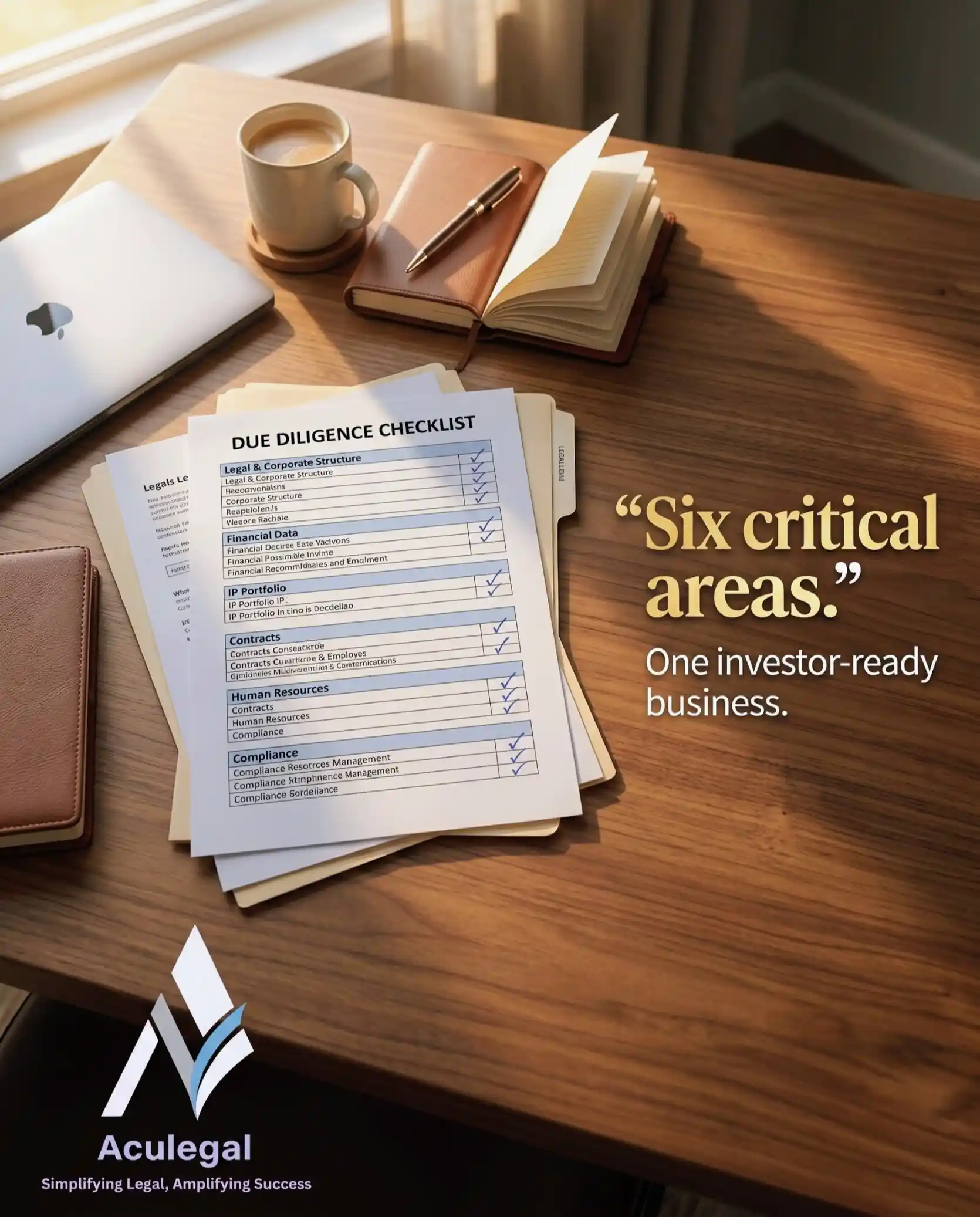
The Due Diligence Checklist Before Raising Funds: 6 Critical AreasDue diligence checklist document with startup compliance notes on desk

Use this as your pre-fundraise playbook. Work through each area systematically. Where gaps exist, address them before investor conversations begin, not during.

1. Corporate Structure & Legal Foundation

Before anything else, investors verify the basics: Is the company correctly incorporated? Are founder agreements clean? Is the entity structure compatible with VC investment?

🏢 Corporate Structure Checklist
♦ Certificate of Incorporation and updated Memorandum & Articles of Association Critical

♦ Founder shareholder agreements with clear vesting schedules (standard: 4-year vest, 1-year cliff) Critical

♦ Updated Register of Members (Form MGT-1 or equivalent) and all share allotment records

♦ Board and shareholder resolutions for all major decisions (fundraises, director appointments, major contracts)

♦ DPIIT Startup India recognition certificate (if applicable) Important

♦ Foreign ownership structure documented (if applicable) – FEMA and FDI compliance

♦ All director & KYC filings are current with the MCA (ROC) portal

One of the most overlooked issues is founders who never formalize a founder agreement or vesting schedule. Investors expect this. Without it, they will either demand it be created before closing or walk.

2. Clean Cap Table & Shareholding Structure

Your cap table tells the story of your company’s ownership. Investors will scrutinize it in detail. Any irregularities, undocumented shares, unclear classes, or missing ESOP allocations raise serious flags.

  • Fully diluted cap table showing all shareholders, classes of shares, ESOP pool, and convertible instruments
  • Documentation for every historical share issuance, transfer, or split
  • Proof that all previous investors received valid share certificates and resolutions
  • Anti-dilution provisions are clearly documented in existing shareholder agreements
  • Clarity on convertible notes, SAFEs, or CCDs issued to date

Pre-funding, a 10–15% ESOP pool is standard. Investors will ask for it and will negotiate for it to be carved out before their investment, which dilutes existing shareholders. Get ahead of this.

3. Intellectual Property (IP) Protection

For most startups, the product is the IP. Investors need certainty that your company owns what it built, not the developers who built it, not a co-founder who left, and not a third party.

  • IP assignment agreements signed by all foundersandall developers who worked on the product
  • Trademark registrations (or applications) for brand name, logo, and key products
  • Patent filings (if applicable) — provisional or complete specifications
  • Open-source license audit: ensure no viral licences (e.g., GPL) compromise your proprietary codebase
  • Non-disclosure agreements (NDAs) with all contractors, employees, and key vendors

Common Deal-Killer: Investors have walked away from otherwise strong deals when a key developer or departed co-founder had not signed an IP assignment agreement. This is non-negotiable. Fix it before fundraising begins.

4. Financial Records & Compliance

Clean financials are not optional. Investors need to see accurate, well-organised financial records to gauge profitability, burn rate, and runway. Missing statements or inconsistent numbers signal either poor governance or something being hidden.

.

📈 Financial Due Diligence Checklist
♦ Audited financial statements (P&L, Balance Sheet, Cash Flow) for last 3 financial years Critical

♦ Current management accounts month-on-month for at least the last 12 months Critical

♦ GST registration, all GST returns filed, no outstanding dues

♦ Income Tax Returns (ITRs) filed for all years the company has been operational

♦ TDS compliance records and certificates issued to employees and contractors

♦ Financial model with revenue projections, unit economics, and use-of-funds breakdown Important

♦ Bank statements at least 12 months of company accounts

Investors pay particular attention to unit economics: Customer Acquisition Cost (CAC), Lifetime Value (LTV), gross margins, and CAC payback periods. Know your numbers cold before entering any investor conversation.

5. Employment Agreements & Key Contracts

Your team is part of the investment thesis. Investors want to know key people are locked in, conflicts of interest are managed, and there are no hidden employment disputes that could surface post-investment.

♦ Employment agreements for all full-time employees, including IP assignment, non-compete, and confidentiality clauses

♦ Offer letters, appointment letters, and updated job descriptions for C-suite and key hires

♦ Contractor / freelancer agreements with IP assignment clauses

♦ Material customer contracts revenue concentration, auto-renewal, and termination clauses

♦ Vendor and supplier agreements especially for technology, cloud, and logistics partners

♦ Any pending or historical litigation, disputes, or regulatory notices

Why Proper ESOP Documentation Matters?Founders discussing ESOP structure and employee equity planning

This is where many growth-stage startups get caught. ESOPs are one of the most powerful tools a founder has to attract talent, conserve cash, and align the team with long-term success. But done without proper legal structure, they become a liability that can derail your funding round.

In India, every Series A term sheet asks about the ESOP pool. Investors typically expect a 10–15% pool to be created pre-funding. Non-compliant or undocumented grants are removed during due diligence, creating a mess that delays closings and erodes trust.

The Legal Framework: What Governs ESOPs in India

ESOP compliance in India sits at the intersection of three regulatory frameworks:

  • Companies Act, 2013 (Section 62(1)(b)): Governs the issuance of shares to employees, requiring special shareholder resolution
  • Income Tax Act, 1961 (and 2025 edition): Determines perquisite tax at exercise and capital gains at sale
  • SEBI Regulations (for listed companies): Mandates independent valuation, annual disclosures, and lock-in periods

For DPIIT-recognised startups, there are meaningful advantages: promoters and founders can receive ESOPs up to 10 years from incorporation, and employees can defer perquisite tax under specific conditions. But only if the documentation is done right.

The ESOP Documentation Checklist

Document / Filing


Purpose Priority
ESOP Scheme / Policy Document


Master document outlining eligibility, vesting, exercise price, forfeiture, and administration Critical
Board Resolution approving ESOP Scheme


Mandatory first step before any grants are made Critical
Shareholder Special Resolution (EGM/AGM)


75% shareholder majority required; filed via Form MGT-14 with ROC within 30 days Critical
Form MGT-14 (ROC Filing)


ROC filing of the special resolution, options issued before this have no legal standing Critical
Individual Grant Letters


Personalised letters to each grantee detailing number of options, exercise price, vesting schedule, and conditions Required
Employee Consent Form


Signed acceptance from each employee confirming they understand terms Required
ESOP Register (Form SH-6)


Ongoing register of all options granted, vested, exercised, forfeited, maintained, and updated Required
Form PAS-3 (post-exercise allotment)


Filed with ROC after shares are allotted following employee exercise Required
Independent Merchant Banker Valuation


Required for unlisted companies to determine fair market value of shares at exercise Important
Cap Table Integration


Fully diluted cap table updated to reflect ESOP pool, investor-facing and accurate Important
“Investors see ESOPs as essential for attracting strong teams. Non-compliant grants are removed during due diligence. ESOP pool adjustments often precede investment rounds.” Industry Standard Practice

Common ESOP Mistakes That Derail Funding Rounds

Based on recurring issues in investor due diligence across Indian startups, these are the most common and most costly ESOP errors:

  1. Granting options before shareholder approval: Options issued before Form MGT-14 is filed with ROC have no legal standing. Investors will require rectification, causing significant delay.
  2. No vesting cliff : Without a minimum 1-year cliff, early employees can leave with vested equity within months. This is a governance red flag for investors.
  3. Incorrect or missing valuation: Unlisted companies must have a merchant banker valuation for shares issued under ESOP. Without this, tax mismatches arise and investors lose confidence in your compliance posture.
  4. Outdated or missing ESOP register: The SH-6 register must be maintained and updated. Failure to do so is a direct compliance violation under the Companies Act.
  5. ESOP terms conflicting with shareholder agreements: Misalignment between ESOP policy and existing investor agreements can create disputes during secondary transactions or exits.

Regulatory Compliance: The Area Most Founders UnderestimateProfessional reviewing startup compliance and legal documents

Legal compliance isn’t just about avoiding penalties; it’s a direct signal of how professionally you run your business. Investors fund people and processes, not just products. A clean compliance record tells investors that you’re the kind of founder who takes governance seriously.

According to due diligence experts, companies must hold all necessary licences, permits, and contracts, and these must be current and accessible in your data room.

Regulatory Compliance Quick-Check

  • All ROC (Registrar of Companies) annual filings current – AOC-4, MGT-7, DIR-3 KYC
  • GST registration active; all returns filed; no outstanding demands or notices
  • PF and ESI registrations in place for all eligible employees; contributions up to date
  • Labour law compliances: Shops & Establishments Act, Contract Labour Act, Sexual Harassment (POSH) Policy
  • Data protection and privacy policy aligned with current Indian regulatory expectations
  • Any RBI or FEMA filings if foreign investors, foreign currency transactions, or cross-border payments are involved
  • All sector-specific licences: NBFC registration, food licences, healthcare permits, telecom approvals depending on your industry

Investor-Ready Signal: Rigorous due diligence frameworks now treat regulatory compliance as a proxy for execution quality. Founders who can demonstrate clean governance close rounds faster and at better valuations.

Building Your Investor Data Room: The Strategic EdgeFounder organizing investor data room and fundraising documents

A data room is a secure, organised repository of all the documents investors need to complete their due diligence. How you structure your data room tells investors as much as what’s inside it.

A disorganised data room signals a disorganised company. A clean, well-indexed data room where every document is current, labelled, and accessible signals a team that operates with precision. Experienced CFO advisors recommend using platforms like DocSend or Notion to manage and track document access.

Data Room Structure: Recommended Folder Architecture

  1. Corporate Documents: Incorporation, MoA/AoA, Board & Shareholder Resolutions, Share Certificates
  2. Cap Table & Equity: Fully diluted cap table, all share allotment records, ESOP scheme & register
  3. Financial Records: Audited accounts, management accounts, tax filings, bank statements
  4. Intellectual Property: IP assignment agreements, trademark certificates, patent filings
  5. Employment & HR: Offer letters, employment agreements, POSH policy, org chart
  6. Customer & Vendor Contracts: Material contracts, NDAs, key partnerships
  7. Regulatory & Compliance: GST, PF/ESI, ROC filings, sector licences, DPIIT recognition
  8. Litigation & Disputes: Any pending or historical legal matters (full disclosure is mandatory)

Due diligence specialists emphasise that the process will slow significantly or halt entirely if irregularities surface. Complete transparency, proactively provided, is always the stronger strategy.

When Should You Start Your Due Diligence Preparation?

The answer is: now. Not when you have a term sheet. Not when an investor asks for your data room. Now.

Top VC advisors recommend using a due diligence checklist as a monthly or quarterly operating tool, not a last-minute scramble when an investor calls. Companies that prepare early close rounds faster, at stronger valuations, with far less friction.

At Aculegal, we work with founders at every stage from incorporation to Series A and beyond to build and maintain the legal infrastructure that makes fundraising smooth. Simplifying Legal. Amplifying Success.

Conclusion: Legal Preparation Is a Fundraising StrategyStartup founders planning fundraising and legal strategy together

This due diligence checklist before raising funds is your starting point, not a one-time exercise, but an ongoing discipline. The founders who close rounds with speed and confidence aren’t just the ones with the best products. They’re the ones with the cleanest legal houses.

Here’s what to take away:

  • The corporate structure must be VC-investment compatible before you approach investors
  • Cap table must be clean, fully diluted, and accurate, including your ESOP pool
  • ESOP documentation is not optional; missing or non-compliant grants are removed during due diligence
  • IP ownershipmust vest clearly in the company; fix this before the first investor meeting
  • Regulatory compliance is a signal of execution quality; investors notice
  • Your data room is part of your pitch; how it’s organised matters

Legal preparation is not a back-office function. It is a front-line competitive advantage. Start now, stay current, and walk into every investor conversation with confidence.City road representing startup growth and investor readiness journey

Ready to Raise?

Get Investor-Ready with Aculegal

From corporate structuring and ESOP documentation to contract reviews and data room preparation, our legal team works with founders, startups, and SMEs to build the legal foundation that turns investor interest into signed term sheets.

♦ Book a Free Consultation ♦ Explore Our Services
Aculegal – Simplifying Legal. Amplifying Success.

Sources & References

  1. Kruze Consulting. VC Due Diligence Checklist: Pre-Seed to Series B & Beyond. kruzeconsulting.com (2025)
  2. 4Degrees. 2026 Venture Capital Due Diligence Checklist. 4degrees.ai (2026)
  3. Mysa.io. Startup Due Diligence: Preparation Guide + Checklist for Founders. mysa.io (2025)
  4. DealRoom. Startups Due Diligence: Guide for Founders + Checklist. dealroom.net (2025)
  5. Qubit Capital. VC Due Diligence Checklist: Guide for Startup Investment Success. qubit.capital (2026)
  6. Registration Mart. ESOPs in India: A Complete Legal and Strategic Guide for Startups (2025 Edition). registrationmart.in (2025)
  7. Naraway. ESOPs for Indian Startups: The Complete Founder Guide 2026. naraway.com (2026)
  8. Equitylist. ESOP Scheme in India: Definition, Structure, Filing Guide. equitylist.co (2026)
  9. Virtrigo. ESOP Scheme Compliance for Employee Stock Options in Indian Startups: Complete 2025 Guide. virtrigo.com (2025)
  10. Founder’s CPA. Due Diligence Checklist for Startups. founderscpa.com (2025)

What Happens If Your Business Is Non-Compliant? The Real Cost Founders Ignore

business non-compliant

Most founders don’t lose their businesses to bad products or tough competition. They lose them to a missed filing, an unsigned agreement, or a regulatory gap they assumed someone else had handled. Legal non-compliance isn’t a startup problem, it’s a scale problem. And by the time it shows up, it’s expensive.

If your business is non-compliant, you are not operating in a grey area, you are operating on borrowed time. Whether you’re a solo founder registering your first company or an SME with a growing team, ignoring legal compliance is one of the most costly decisions you can make.

This isn’t about paperwork for the sake of it. Compliance is the infrastructure of business growth. Without it, contracts fall apart, investors walk, and regulators come knocking. The good news? It’s entirely fixable if you act before it becomes a crisis.

♦ ₹25L+ Average penalty for GST non-compliance per financial year in India

♦ 62% of SME funding rejections involve unresolved legal or compliance gaps

♦ 3× more expensive to fix a compliance breach reactively vs. proactively

Why Legal Compliance Is Critical for Scaling BusinessesBusiness founders and investors reviewing compliance documents during a funding discussion

Here’s the truth no one tells early-stage founders: your legal structure is your growth structure. The moment you start scaling, adding employees, signing vendor contracts, raising capital, or entering new markets, every unresolved compliance gap becomes a liability that compounds.

Investors conduct due diligence. Acquirers run legal audits. Banks and lenders check your regulatory filings. If your business is non-compliant at any of these checkpoints, the deal stalls or dies.

According to the Ministry of Corporate Affairs (MCA), thousands of Indian companies are struck off the register annually for failing to file annual returns and financial statements. That’s not just a fine, it’s a business death sentence.

The Hidden Costs of Non-ComplianceBusiness owner overwhelmed by penalties, contracts, and financial losses from compliance failures

Non-compliance doesn’t announce itself loudly. It accumulates quietly in delayed filings, forgotten renewals, verbal agreements, and copy-paste contracts until it surfaces at the worst possible moment.

Common hidden costs include:

⚠️ Regulatory penalties and fines – GST defaults, MCA non-filings, and labour law violations carry compounding penalties that can cripple cash flow overnight.

⚠️ Contract unenforceability – Poorly drafted or unsigned agreements mean you can’t pursue clients for non-payment or enforce NDA breaches.

⚠️ Investor red flags – A messy cap table, missing shareholder agreements, or incomplete IP assignments will kill a funding round before it starts.

⚠️ Director personal liability – In many non-compliance scenarios, founders and directors are personally liable — not just the company entity.

⚠️ Operational disruptions – Licence suspensions, blocked accounts, or restricted business activities can halt operations entirely.

What Actually Happens When Your Business Is Non-Compliant?

Let’s move beyond the theory. Here’s what non-compliance looks like in practice, stage by stage, from early warning signs to worst-case outcomes.

Stage 1 – The Warning Window (0–6 Months)

In the early stage, non-compliance typically shows up as missed deadlines and informal operations. No formal shareholders’ agreement. GST returns filed late or not at all. Employment contracts that are verbal or one-page documents downloaded from the internet.

Most founders at this stage feel fine because there are no immediate consequences. This is the most dangerous period. The Securities and Exchange Board of India (SEBI) and MCA systems have enforcement lag. The consequences are silently accumulating.

Stage 2 – The Pressure Point (6–18 Months)

This is where compliance gaps start costing money. A vendor dispute surfaces, but your contract is unenforceable. An employee exits, but you have no documented IP assignment or non-compete. A notice arrives from a tax authority or regulatory body.

At this stage, founders face a choice: fix it quietly or fight it expensively. Most choose the latter not out of stubbornness, but because they don’t know where to start.

Stage 3 – The Breaking Point (18+ Months)

Unaddressed non-compliance at scale becomes existential. A funding round collapses during due diligence. A government tender is disqualified. The company faces a show cause notice, strike-off proceedings, or litigation, all simultaneously.

According to World Bank research on business environments, companies that proactively invest in legal infrastructure are significantly more resilient, more fundable, and more likely to survive economic shocks than those that do not.Founder facing business collapse during failed investor due diligence because of compliance issues

The 6 Legal Compliance Areas Every Founder Must Get Right

You don’t need to become a lawyer. But you do need to know where your exposure is. Here are the six areas where most SMEs and startups are unknowingly non-compliant:

Company Registration & Corporate Governance – Are your incorporation documents correct? Is your registered address current? Are annual returns filed on time with the MCA?

Tax Compliance (GST, TDS, Income Tax) – Monthly and quarterly filings, accurate input tax credit claims, and timely TDS deposits are non-negotiable under Indian tax law.

Employment & Labour Law – Offer letters, employment agreements, PF/ESI registration, sexual harassment policies (POSH Act), and proper contractor classification all carry legal weight.

Intellectual Property Protection – Is your brand name trademarked? Are your founders’ IP assignments in writing? Does your employment contract include IP clauses?

Commercial Contracts – Every vendor, client, and partner relationship needs a properly drafted, enforceable agreement, not a template from the internet.

Licences, Permits & Sector Regulations – Depending on your industry (fintech, healthcare, food, education), sector-specific licences and compliance frameworks apply and must be maintained.Modern startup founders reviewing legal compliance framework and business protection systems

How Startups and SMEs Can Fix Non-Compliance Without Business Disruption

The most common reason founders delay fixing compliance is fear: fear of what they’ll find, fear of the cost, and fear of the disruption. Here’s the reality: a structured legal audit takes days, not months, and costs far less than a single regulatory dispute.

Start With a Legal Health Check

Before you can fix anything, you need to know where you stand. A legal health check or compliance audit systematically maps every area of your business against applicable legal requirements. Think of it as a financial audit, but for your legal infrastructure.

The MCA’s company filing portal is a good starting point for checking your corporate compliance status, but it only tells part of the story.

Prioritise by Risk, Not by Urgency

Not all compliance gaps are equal. Some are administrative inconveniences. Others are existential threats. A seasoned legal advisor will help you triage your exposure, fixing high-risk items first without disrupting operations.

Immediate priority: Any active regulatory notices, overdue filings with penalties, or missing licences required for operations.

Short-term (30–90 days): Employment agreements, shareholder/founder agreements, IP assignments, and POSH compliance.

Medium-term (3–6 months): Trademark registration, commercial contract library, and sector-specific regulatory review.

Ongoing: Tax filing calendar, annual MCA filings, and contract renewal tracking.Legal consultant conducting a compliance audit for a startup business

Build Legal Into Your Operating Rhythm

The most legally resilient companies treat compliance not as a one-time project but as an ongoing operational function, like finance or HR. This means scheduled reviews, a trusted legal advisor relationship, and standardised internal processes for contracts, hiring, and filings.

According to the Indian Institute of Corporate Affairs (IICA), companies with proactive governance frameworks are better positioned for fundraising, mergers, and regulatory expansion than those that treat compliance reactively.

Why Growing Businesses Choose Aculegal

At Aculegal, we work exclusively with founders, startups, and SMEs, not because it’s a niche, but because we understand how growth-stage businesses actually operate. We know you don’t have an in-house legal team. We know you’re making decisions fast. And we know that the wrong legal advice at the wrong time can set a business back years.

Our approach is built around one simple principle: Simplifying Legal. Amplifying Success.

We don’t just identify compliance gaps, we fix them, fast, without unnecessary complexity or legalese. From company registration and contract drafting to regulatory filings and ongoing legal retainers, we’re built to be your legal infrastructure, so you can stay focused on building.

The Bottom Line: Compliance Is a Business Advantage

If your business is non-compliant, you are not just at legal risk; you are leaving growth on the table. Every investor conversation you have, every enterprise client you pitch, every talent hire you make, all of them will eventually touch your legal infrastructure. Make sure it holds.

The founders who scale fastest aren’t the ones who avoided legal work. They’re the ones who built it in early, fixed gaps quickly, and treated compliance as a competitive advantage, not an afterthought.

You’ve built something worth protecting. Now protect it properly.Confident founders working with legal advisors to build a legally protected scalable business

Ready to Make Your Business Legally Bulletproof?

Book a free consultation with Aculegal and get a clear picture of where your business stands and exactly what to do next.

Book Free ConsultationGet More Legal Insights

Aculegal 

Simplifying Legal. Amplifying Success. | Legal guidance for founders, startups & SMEs.

📚 Sources & References


Are Online Contracts Legally Valid in India?

online contracts legally valid in India

Every founder clicks “I Agree.” But do you actually know what you’re agreeing to and whether it holds up in court?

Online contracts are now the backbone of modern business. NDAs signed on DocuSign. Vendor agreements completed over email. SaaS terms are accepted with a checkbox. For India’s booming startup ecosystem and its growing SME base, digital agreements have become routine and almost invisible.

But here’s the uncomfortable truth: most founders treat online contracts like formalities, not legal instruments. And that’s exactly when they become liabilities.

So, are online contracts legally valid in India? The short answer is yes, but only when executed correctly. The longer answer involves electronic signatures, authentication standards, and a legal framework most business owners have never read.

At Aculegal, our philosophy is simple: Simplifying Legal. Amplifying Success. That starts with helping you understand the rules before they work against you.

The Legal Foundation: What Indian Law Says About Online ContractsLawyer explaining digital contract laws in India with IT Act reference

The Information Technology Act, 2000 – India’s Digital Contract Backbone

The primary legislation governing online contracts in India is the Information Technology Act, 2000 (IT Act). This law was India’s first formal recognition that digital transactions carry legal weight.

Under Section 10A of the IT Act (inserted by the 2008 amendment), contracts formed through electronic means are explicitly valid and enforceable. This means offer, acceptance, and consideration, the three pillars of any valid contract, can all occur digitally.

Key provisions founders should know:

  • Electronic records are admissible as evidence under the Indian Evidence Act, 1872 (Section 65B)
  • Digital signatures are legally equivalent to handwritten signatures
  • Clickwrap agreements (checkbox acceptance) can be enforceable if properly structured
  • Email-based acceptance can constitute a valid binding contract

The Indian Contract Act, 1872 remains the governing law for contract validity. Every online contract must still satisfy the essential elements: free consent, lawful object, competent parties, and lawful consideration. Digital form doesn’t override these fundamentals.

Link to Aculegal’s “Contract Drafting & Review” service page

Role of Electronic Signatures and Digital AuthenticationBusiness professionals using e-signature on a digital device with secure authentication

This is where most founders get it wrong. Not all electronic signatures are created equal under Indian law, and using the wrong type could make your contract unenforceable in a dispute.

What Counts as a Valid Electronic Signature in India?

The IT Act and its associated rules recognise two categories of electronic signatures:

1. Digital Signatures (Class 2 and Class 3) These are cryptography-based signatures issued by Certifying Authorities (CAs) licensed by the Controller of Certifying Authorities (CCA) under the Ministry of Electronics and IT. They use Public Key Infrastructure (PKI) technology and are the gold standard for legal enforceability.

According to the Controller of Certifying Authorities India, licensed CAs include eMudhra, Sify, and NSDL, the only entities authorised to issue legally valid digital signature certificates in India.

2. Electronic Signatures (Aadhaar-Based eSign) The Second Schedule of the IT Act recognises Aadhaar-based eSign as a valid form of electronic authentication. This allows individuals to sign documents using their Aadhaar OTP, making it highly accessible for B2C and SME use cases.

What does NOT qualify as a legally robust electronic signature:

  • A scanned image of your handwritten signature pasted into a PDF
  • Typing your name at the bottom of an email
  • WhatsApp consent without proper documentation trail

These methods may have evidentiary value in some contexts, but they are legally fragile. In any serious commercial dispute, opposing counsel will challenge them.

Authentication: The Overlooked Layer

Authentication is what proves who signed and when. Without it, even a valid-looking digital signature can be disputed.

Robust digital authentication includes:

  • Timestamping – cryptographic proof of when a document was signed
  • Audit trails – logs showing IP address, device, location, and sequence of actions
  • Identity verification – OTP, video KYC, or Aadhaar-linked authentication

The Ministry of Electronics and Information Technology (MeitY) has published detailed guidelines on electronic signature standards that enterprise and startup contracts should comply with. Most founders have never read them. Your legal counsel should have.

Where Online Contracts Actually Break DownConfused professionals reviewing unclear contract terms highlighting legal risks

The Enforceability Gap: When “Valid” Isn’t Enough

Here’s the real business risk. A contract can be technically valid under Indian law and still be practically unenforceable if it’s poorly drafted, improperly executed, or missing critical clauses.

Common enforceability failures in online contracts:

  1. No governing jurisdiction clause – Which court handles disputes? If your vendor is in Mumbai and you’re in Bengaluru, this matters enormously.
  2. Ambiguous acceptance mechanisms – A browsewrap agreement (where terms are buried in a footer link) is far weaker than a properly structured clickwrap.
  3. Missing consideration – Free trials and beta access must still document what each party receives.
  4. Unsigned annexures – Schedules, SLAs, and pricing documents attached to a master agreement but not independently authenticated create gaps.
  5. No version control – Updated T&Cs without proper notice and re-acceptance protocols can void your original agreement.

According to a Legal Service India analysis of contract disputes, ambiguity in digital contracts is one of the leading causes of unresolved commercial disagreements, precisely because both parties assumed the online agreement was “good enough.”

Sectors With Stricter Requirements

Not every industry is treated equally under Indian law. Some sectors require physical or wet-ink signatures regardless of what the IT Act generally permits.

Online contracts alone are NOT sufficient for:

  • Property and real estate transactions – Require registered agreements under the Registration Act, 1908
  • Negotiable instruments – Cheques, promissory notes, and bills of exchange under the Negotiable Instruments Act
  • Wills and testamentary documents
  • Power of Attorney documents
  • Court filings and notarised affidavits

If your business touches any of these areas, even indirectly, and you’ve been relying solely on digital contracts, you need a legal audit immediately.

What Smart Founders Do DifferentlyOrganized digital contract management system with professionals collaborating

Build a Contract Infrastructure, Not Just Documents

The most legally protected startups and SMEs don’t just “sign contracts.” They build a contract infrastructure, a system that governs how agreements are created, executed, stored, and enforced.

The five pillars of solid contract infrastructure:

  1. Standardised templates – drafted and reviewed by legal counsel, not downloaded from the internet
  2. Approved e-signature platforms – using recognised tools like DocuSign, Adobe Sign, or eMudhra (all of which support Indian compliance requirements)
  3. Centralised contract repository – with version history, renewal reminders, and counterparty records
  4. Dispute resolution clauses – specifying arbitration, mediation, or litigation pathways
  5. Regular legal reviews – annual or bi-annual audits of your standard contracts as laws evolve

The NASSCOM India startup legal readiness framework consistently highlights contract management as a top operational risk for early-stage companies, particularly those scaling into enterprise sales where buyers conduct legal due diligence.

The Due Diligence Test: Will Your Contracts Survive a Funding Round?Investors reviewing legal documents during startup due diligence process

Here’s a practical benchmark. When investors or acquirers conduct due diligence on your startup, one of the first things they examine is your contract portfolio.

They will ask:

  • Are your customer agreements enforceable?
  • Do your vendor contracts have appropriate IP and confidentiality protections?
  • Are your employment agreements compliant with applicable labour laws?
  • Are your founder agreements – including vesting schedules – airtight?

If your contracts were drafted informally, signed via unverified email threads, or lack key protective clauses, this becomes a valuation risk. We’ve seen term sheets restructured or withdrawn over contract compliance gaps.

India’s Evolving Digital Contract Landscape

What’s Changing and Why It Matters Now

India’s legal and regulatory environment for digital contracts is actively evolving. Founders who stay ahead of these changes protect their competitive position. Those who don’t find themselves retrofitting compliance at the worst possible times.

Key developments to watch:

  • The Digital Personal Data Protection Act, 2023 (DPDPA) Contracts that collect, process, or share personal data must now include specific consent mechanisms and data processing agreements. This affects virtually every SaaS, fintech, and healthtech startup operating in India. The Digital India Corporation has published preliminary compliance guidance that should inform your contract templates.
  • The proposed Indian Telecommunication Act, 2023 – Introduces new requirements for OTT platforms and digital service agreements that may impact how consent is captured in online contracts.
  • RBI guidelines on digital lending – If you operate in fintech or lend digitally, your loan agreements and KYC consent contracts face specific regulatory requirements beyond the IT Act.

The pace of regulatory change means that a contract that was compliant two years ago may have gaps today. Periodic legal review isn’t optional; it’s operational hygiene.

The Aculegal Perspective: Legal Clarity as a Business Advantage

Most legal advice tells you what you can’t do. At Aculegal, we focus on what you can do and how to do it safely, strategically, and scalably.

Online contracts, when properly structured, give your business:

  • Speed – Close deals, onboard vendors, and hire talent faster
  • Scale – Standardise agreements across geographies without physical logistics
  • Security – Documented, authenticated paper trails that protect you in disputes
  • Credibility – Investors, enterprise clients, and partners trust businesses with professional legal infrastructure

The question isn’t whether to use online contracts. Every modern business already does. The question is whether yours are built to protect you or quietly exposing you to risk.

Conclusion: Don’t Let “Valid” Be Your Only Standard

Online contracts are legally valid in India – when they’re properly executed, authenticated, and drafted. But validity is the floor, not the ceiling.

Here’s what to take away:

  • The IT Act, 2000 provides the legal foundation for digital contracts – but the Indian Contract Act governs enforceability
  • Electronic signatures are not all equal – digital signature certificates from licensed CAs offer the strongest legal protection
  • Aadhaar-based eSign and recognised e-signature platforms are compliant for most commercial use cases
  • Certain transactions – real estate, negotiable instruments, notarised documents – cannot rely on online contracts alone
  • The DPDPA and evolving regulations are reshaping what contract compliance looks like in 2025 and beyond

The founders who treat legal infrastructure as a growth enabler, not a back-office cost, are the ones who scale without friction, close enterprise deals faster, and survive investor due diligence with confidence.Confident business team representing growth through strong legal infrastructure

Ready to Make Your Contracts Work for You?

At Aculegal, we work exclusively with founders, startups, and SMEs to build legal infrastructure that scales with your business.

Whether you need a contract audit, investor-ready legal documentation, or expert guidance on digital agreement compliance, our team is here to simplify the complex and amplify your success.

👉 Book your free legal consultation today.

Let’s make sure your agreements are built to win.

  Aculegal

Simplifying Legal. Amplifying Success.

Sources & References:

  1. Information Technology Act, 2000 — Ministry of Law and Justice, Government of India
  2. Controller of Certifying Authorities — https://cca.gov.in
  3. Ministry of Electronics and Information Technology (MeitY) — https://meity.gov.in
  4. Legal Service India — https://legalserviceindia.com
  5. NASSCOM India — https://nasscom.in
  6. Digital India Corporation — https://digitalindia.gov.in

Why HR Alone Cannot Protect Your Business: Where Legal Risk Really Begins

Discover why HR alone cannot protect your business from legal risk. Learn where HR responsibility ends and real legal exposure begins and how Aculegal can help.

Your HR Team Is Doing Their Best – But That’s Not Enough

HR alone cannot protect your business and the sooner founders and business owners understand this, the sooner they can stop reacting to legal crises and start preventing them.

Most startups and SMEs hire an HR manager or outsource HR functions and assume that workforce-related risk is covered. It isn’t. HR professionals are trained in people management, compliance checklists, and company culture. They are not lawyers. They do not draft legally enforceable contracts. They cannot represent you in a labour dispute. And they often have no visibility into the legal exposure sitting quietly inside your employment agreements, termination processes, or contractor arrangements.

This is not a criticism of HR. It is a structural reality that costs businesses thousands, sometimes millions, in avoidable legal liability every year.

If you are a founder, startup, or SME leader, this blog will show you exactly where the gap exists, what it costs, and how to close it before it costs you.Business team unaware of hidden legal risks in HR processes

Where HR Responsibility Ends and Legal Risk Begins

This is the critical line most business owners never see until they are already in trouble.

HR manages the people side of your business. They handle recruitment, onboarding, performance management, and day-to-day policy application. They ensure company culture is maintained and that employees feel heard and supported.Visual distinction between HR functions and legal risk responsibilities

Legal protection, however, requires a different skill set entirely.

Here is where the boundary lies, and where risk begins:

Human Resources handles the day-to-day people operations of the business, from drafting internal HR policies and handling employee complaints to onboarding new hires, implementing disciplinary procedures, maintaining records, and coordinating with external vendors.

Legal Counsel, on the other hand, focuses on protecting the business from a compliance and litigation standpoint. This includes ensuring policies are legally enforceable, defending against formal labour claims, advising on evidence and litigation strategy, managing termination risk and severance, reviewing and structuring employment contracts, and vetting contractor agreements for compliance.

The moment an employee files a formal grievance, threatens legal action, or misclassification is flagged by a regulator, your HR team’s authority ends and your legal exposure begins.Hidden legal risks in employment contracts and HR practices

The 5 Legal Landmines HR Cannot Defuse for Your Business

1. Poorly Drafted Employment Contracts

Many startups use template employment agreements downloaded from the internet or copied from another company. These contracts often lack enforceable non-compete clauses, vague termination language, undefined probation terms, or missing jurisdiction-specific requirements.

What HR does: Reviews contracts for completeness of basic information.
What HR cannot do: Advise on whether the termination clause is enforceable, whether the IP assignment clause will hold up in court, or whether the non-solicitation agreement is legally compliant under local law.

According to a report by the Advisory, Conciliation and Arbitration Service, poorly drafted employment contracts are one of the leading causes of avoidable employment tribunal claims.

2. Misclassification of Employees and Contractors

This is one of the fastest-growing legal risks for startups and SMEs globally. Businesses classify workers as independent contractors to avoid tax obligations and benefits liability, but courts and regulators increasingly scrutinise these arrangements.

The risk is significant. The IRS and equivalent tax authorities around the world have the power to reclassify workers, impose back taxes, and issue penalties that can destabilise a growing business overnight.

HR may flag the operational issue. Only a lawyer can assess and restructure the legal arrangement before a regulator does it for you on their terms.

3. Termination Without Legal Cover

Wrongful termination is among the most costly legal disputes businesses face. HR teams often follow internal procedure documentation, warnings, and exit interviews, but this does not automatically mean the termination is legally defensible.

Key questions HR cannot answer for you:

  • Is the termination in compliance with applicable labour law?
  • Is your severance package legally sufficient?
  • Are you exposed to discrimination or constructive dismissal claims?
  • Is the non-disparagement clause in the exit agreement enforceable?

The International Labour Organization (ILO) highlights that unfair dismissal remains the most common form of individual labour dispute globally.

A lawyer reviews the legal exposure before you hand over the termination letter. HR cannot do that.

4. Workplace Harassment and Discrimination Claims

HR plays a critical role in receiving, investigating, and managing internal complaints. However, when a complaint escalates or an employee files a formal claim with a regulatory body, you need legal advice, not HR protocols.

The risk compounds fast:

  • Regulatory investigations can result in mandatory audits of your entire HR practice
  • Legal exposure extends beyond the individual complainant
  • Reputational damage can precede any formal finding

Having legally compliant harassment policies and properly documented investigation procedures is not an HR exercise, it is a legal one. Aculegal’s Legal Insights are designed specifically to help SMEs implement policies that are audit-ready and legally defensible.

5. Data Privacy and Employee Information Management

GDPR, POPIA, and equivalent data protection frameworks impose strict obligations on how businesses collect, store, and process employee data. Most HR teams handle data compliance operationally; they maintain records, manage access, and store sensitive files.

What they often miss:

  • Whether consent mechanisms in onboarding documents are legally valid
  • Whether cross-border data transfers involving employee data are compliant
  • Whether data retention schedules meet regulatory requirements

The European Data Protection Board has made clear that employee data is among the most regulated categories of personal information, and regulatory fines for mishandling it are not reserved for large corporations.Business professional facing financial and legal consequences

The Cost of Relying Solely on HR for Legal Protection

Let us be direct: the financial and reputational cost of legal disputes that could have been prevented is always higher than the cost of proactive legal advice.

Consider the following:

  • A single wrongful termination claim can cost anywhere from thousands to hundreds of thousands in legal fees, settlements, and lost productivity.
  • Contractor misclassification can result in backdated tax liabilities spanning several years.
  • A data breach involving employee data can trigger regulatory fines, mandatory audits, and public reporting requirements.
  • A poorly worded employment contract can make a confidentiality clause entirely unenforceable, exposing your trade secrets.

HR teams are not equipped to prevent these outcomes. They were never designed to be. The structure of most businesses treats HR and legal as separate functions, but for SMEs and startups without in-house counsel, that gap is left completely unguarded.HR professionals facing challenges in legal compliance

What the Research Says

A Society for Human Resource Management (SHRM) study found that HR professionals consistently identify legal compliance as one of their top challenges, yet most do not have formal legal training to navigate it independently.

Separately, research from the World Bank’s private sector development reports indicates that SMEs in emerging markets are disproportionately affected by regulatory non-compliance, often because they lack access to affordable, ongoing legal counsel.

The problem is not that HR professionals are failing. The problem is that founders are relying on them for something they were never trained or authorised to deliver.Business leader implementing structured legal strategy

What Proactive Legal Protection Actually Looks Like

HR alone cannot protect your business. But here is what the right combination of HR and legal support looks like in practice:

Step 1: Legal Audit of All Employment Documentation

Every contract, policy document, and NDА your business uses should be reviewed by a qualified lawyer, not just an HR manager to identify gaps, unenforceable clauses, and jurisdiction-specific risks.

Step 2: Clear Role Separation Between HR and Legal Functions

Define what HR handles internally and what triggers mandatory legal review. Terminations, contractor arrangements, formal complaints, and new-hire agreements for senior roles should always involve legal sign-off.

Step 3: Legally Compliant Policies from Day One

Workplace harassment policies, data protection frameworks, and disciplinary procedures should be drafted or reviewed by counsel — not copied from a template. Aculegal’s Business Legal Advisory services (internal link) help startups and SMEs build these frameworks without the cost of a full-time in-house legal team.

Step 4: Ongoing Legal Access – Not Just Crisis Management

The most dangerous pattern for SMEs is treating legal advice as something you access only when a crisis hits. Proactive legal relationships, where your counsel understands your business, your team, and your risk profile, are significantly more cost-effective and protective than reactive intervention.

Explore Aculegal’s Legal Retainer and Free Consultation designed specifically for growing businesses that need ongoing access without full-time legal overhead.

Simplifying Legal. Amplifying Success.

At Aculegal, we work with founders, startups, and SMEs who are building real businesses and cannot afford to be ambushed by legal risk that was entirely preventable.

We do not believe legal protection should be complex, inaccessible, or reserved for large corporations. We believe that clear, commercially-minded legal advice delivered by people who understand how businesses actually operate  is the foundation every business deserves.

HR alone cannot protect your business. But with the right legal partner, your business can be both legally protected and positioned for growth.

Conclusion: Stop Leaving Legal Risk to HR

Here is what we know for certain:

  • HR and legal are not interchangeable, they serve fundamentally different functions.
  • The gap between the two is where your business is most vulnerable.
  • Preventive legal strategy is always more cost-effective than crisis management.
  • Startups and SMEs face the same legal risks as large corporations, but with far fewer resources to absorb the consequences.

If your business does not have a formal legal review process for employment contracts, terminations, contractor arrangements, and compliance documentation, that gap is open right now.Business growth supported by strong legal foundation

📞 Ready to Close the Gap?

Book a free legal consultation with Aculegal today.

Our team works directly with founders and business leaders to identify your legal exposure, prioritise the risks that matter most, and put in place the protections your business needs without unnecessary complexity or cost.

👉    Book Your Free Consultation with Aculegal

Simplifying Legal. Amplifying Success.

Sources: 

Stop Copy-Pasting Agreements: The Hidden Risk in Standard Contract Templates

Business professionals reviewing contracts with hidden risks highlighted

Standard contract templates are everywhere. A quick Google search, a free download, a copy-paste, and suddenly your business has a ‘legal agreement.’ It feels efficient. It feels safe. It isn’t.

Every week, founders and SME owners sign contracts they don’t fully understand, using language written for a different business, a different jurisdiction, and a different deal. The consequences of broken partnerships, unenforceable clauses, lost IP, and costly litigation don’t show up immediately. They show up when it’s too late.

This blog breaks down exactly why standard contract templates are a liability dressed up as a solution and what smart business owners do instead.Businessperson signing contract with illusion of safety concept

Why Founders and SMEs Reach for Generic Contracts

The appeal is understandable. Legal fees feel like overhead when you’re burning runway or trying to close a deal fast. Free templates look professional, tick the ‘I have a contract’ box, and cost nothing upfront.

But here’s the uncomfortable truth:

  • A contract that doesn’t protect you isn’t a contract, it’s paperwork.
  • Generic templates are written to be broadly applicable, which means they’re often specifically useless.
  • A poorly drafted clause can be just as damaging as no clause at all.

According to the World Commerce & Contracting Association, poor contract management costs businesses an average of 9% of annual revenue. For a startup turning over £500K, that’s £45,000 silently walking out the door.Founder choosing quick contract solution on laptop

Common Mistakes Found in Generic Contract Templates

Most standard contract templates share the same structural weaknesses. These aren’t minor gaps they’re the clauses that end up in courtrooms.

1. Vague or Missing Scope of Work

A generic template might say ‘services as agreed between the parties.’ Agreed where? When? By whom? This is the number one source of payment disputes between service providers and clients.

Every contract must define:

  • Exactly what is being delivered
  • Timelines and milestones
  • What constitutes completion
  • What happens if the scope changesLegal document with highlighted gaps and missing clauses

2. Weak or Absent IP Ownership Clauses

This is where startups bleed the most. If your contract doesn’t explicitly state who owns the intellectual property created during the engagement, the law may side against you, especially when working with freelancers or contractors.

The UK Intellectual Property Office is clear: without a written assignment, IP typically belongs to its creator. A standard template won’t tell you that.

3. No Jurisdiction or Governing Law Clause

Standard contract templates found online are often drafted for a specific country, but they don’t say that clearly. If you’re in India, signing with a UK-based supplier, using a US-formatted template, you have three legal systems in conflict.

The governing law clause isn’t a formality. It determines which courts hear your dispute, which laws apply, and ultimately who wins.

4. Unenforceable Limitation of Liability Clauses

Many free templates include liability caps that look protective on paper but are unenforceable in practice. Under legislation like the UK’s Unfair Contract Terms Act 1977 or India’s Contract Act 1872, clauses that attempt to exclude liability for negligence, fraud, or statutory rights can be struck down entirely.

The result? Your ‘protection’ clause is void and you’re fully exposed.

5. Missing Termination and Exit Provisions

Generic agreements often either lack termination clauses entirely or rely on vague language like ‘reasonable notice.’ What happens if your co-founder wants out? What if a client stops responding? What if a supplier breaches?

Without clear exit provisions, including notice periods, payment upon termination, and return of materials, you have no clean way out.Business professional stressed over failed deal due to contract issues

The Real-World Cost: What Happens When Contracts Fail

Let’s be specific. These aren’t hypothetical risks.

Scenario 1 :- The Developer Who Kept the Code: A SaaS founder hired a freelance developer using a template from a legal website. No IP assignment clause. When the relationship broke down, the developer claimed ownership of the codebase. The founder had to pay a five-figure settlement to buy back rights to their own product.

Scenario 2 :- The Partnership That Turned Toxic: Two co-founders signed a partnership agreement downloaded from a free template site. It had no deadlock resolution mechanism. When they disagreed on a pivot, neither could force a decision. The company stalled for 18 months and eventually folded.

Scenario 3 :- The Client Who Didn’t Pay: An SME delivered a full branding project based on a loose ‘agreement’ with no milestone-based payment schedule. The client disputed the final invoice. The contract offered no legal leverage. The business absorbed a £30,000 loss.

These aren’t outliers. The Federation of Small Businesses reports that 50,000 SMEs in the UK alone collapse each year due to late payment, many of which stem from weak or non-existent contractual protections.Confident business leader reviewing structured contracts

What Smart Founders Do Instead: The Custom Contract Advantage

Businesses that scale without legal chaos share one common habit: they treat contracts as a strategic asset, not a compliance checkbox.

Here’s what a properly customised business contract does that a standard template never can:

  • Speaks to your specific deal: The payment structure, deliverables, timelines, and relationships are documented precisely, not gesturally.
  • Reflects your jurisdiction: Whether you’re operating in India, the UK, the UAE, or across borders, your contract applies the right legal framework.
  • Protects your IP: Ownership is explicit. The assignment is clear. Confidentiality is enforceable.
  • Gives you leverage: When disputes arise, and they do your contract determines who has the stronger position.
  • Scales with you: As your business grows, a legal framework built on solid contracts protects equity, investor relationships, and partnerships.Legal complexity in high-risk business agreements

When You Absolutely Cannot Use a Template

Some business situations carry risk levels that make generic agreements not just inadequate but dangerous. If any of the following apply, you need professionally drafted contracts:

  • Co-founder or shareholder agreements, especially with equity splits
  • Investor term sheets and funding agreements
  • Employment contracts with non-compete or IP assignment clauses
  • International supply or distribution agreements
  • SaaS or software licensing terms
  • White-labelling or franchise-style arrangements
  • Mergers, acquisitions, or joint ventures

The International Chamber of Commerce reports that cross-border contract disputes have risen significantly year-on-year. For growing businesses, the risk isn’t theoretical; it’s a when, not an if.

How Aculegal Helps You Get Contracts Right – From Day One

At Aculegal, we work with founders, startups, and SMEs who are done gambling with generic agreements. Our approach is built on one core belief: legal clarity is a competitive advantage.

We don’t hand you a template. We understand your business model, your risk exposure, your relationships, and your goals, and then we build legal documentation that works as hard as you do.

Our contract services include:

  • Bespoke contract drafting for service agreements, employment terms, NDAs, and more
  • Contract review and redlining before you sign anything
  • IP assignment and licensing agreements
  • Cross-border commercial contracts
  • Ongoing legal retainer for growing businesses

We also point to trusted wider reading, such as LegalZoom’s analysis of small business contract essentials, which mirrors what we see in practice daily: the difference between growth and gridlock often comes down to one document.

The Minimum Every Business Contract Must Include

Before you sign or send any agreement, run through this checklist. If even one of these is missing, your contract has a gap.

  1. Parties clearly identified: Full legal names, registration numbers, and addresses.
  2. Scope of work or services: Specific, measurable, and time-bound.
  3. Payment terms: Amount, schedule, late payment penalties, and currency.
  4. IP ownership: Who creates it, who owns it, and under what conditions.
  5. Confidentiality: What counts as confidential and for how long.
  6. Governing law and jurisdiction: Which country’s law applies and which courts decide.
  7. Termination clause: How to exit, with what notice, and what happens to work in progress.
  8. Dispute resolution: Negotiation first, then mediation, then arbitration or litigation.
  9. Limitation of liability: Legally enforceable caps based on your jurisdiction.
  10. Signatures and dates: Both parties, in the right format for your jurisdiction.

Conclusion: Standard Templates Are a Starting Point – Not a Strategy

Standard contract templates have their place as a reference, a checklist, or a rough draft. But they are never, under any circumstances, a finished legal product for a real business deal.

The hidden risks, vague scopes, unenforceable clauses, missing IP assignments, and jurisdiction gaps don’t announce themselves at signing. They appear when a deal goes wrong, a partner walks out, or a client refuses to pay.

Founders who build for scale understand this early: your contracts are the legal architecture of your business. Get them right from the start.

Key Takeaways:

  • Generic contracts are broad by design, and that breadth leaves you exposed.
  • The most common mistakes in standard contract templates include missing IP clauses, vague scope, and unenforceable liability limits.
  • Custom contracts are not a luxury, they’re a business investment with measurable ROI.
  • Aculegal helps founders, startups, and SMEs build contracts that protect and enable growth.Business growth supported by strong legal foundation

Ready to Stop Gambling With Generic Agreements?

Book a Free Legal Consultation with Aculegal Today.

Our legal team will review your current agreements, identify risk gaps, and recommend the right contractual framework for your business.Aculegal: Smart legal solutions for startups & SMEs in India & worldwide. VCLO, contracts, IP protection & compliance. Reduce risk and accelerate your growth

Web Sources & Outbound Links (all nofollow)

The Cost of Scaling Without Structure: What Every Founder Must Know Before It’s Too Late

scaling without legal structure

You landed the clients. You hired the team. Revenue is climbing. But somewhere between the pitch deck and the growth chart, you skipped a step – and that step could cost you everything you’ve built.Business growth masking underlying legal vulnerabilities

Scaling a business without a legal structure is one of the most common and most expensive mistakes founders make. It doesn’t show up immediately. There’s no alarm. No red flag on your dashboard. It quietly accumulates in unenforceable contracts, unclaimed IP, misclassified employees, and liability gaps until the day a dispute, a funding round, or a regulatory audit exposes everything at once.

At Aculegal, we’ve seen it dozens of times: a promising business brought to its knees not by bad strategy or weak product, but by legal blind spots that were completely preventable. This article is your blueprint for recognising those risks before they find you.

♦ 82%of startups cite legal disputes as a top growth disruptor

$1.8Maverage cost of a commercial contract dispute for SMEs

3 in 5early-stage founders lack proper IP or equity protections

What Happens When You Scale a Business Without a Legal Structure

Growth without structure isn’t agility, it’s exposure. When a business scales faster than its legal framework, it creates invisible fault lines across every function: people, partnerships, products, and capital.

The dangerous part? The damage isn’t always visible in the early days. Most founders are too focused on revenue to notice the legal architecture quietly crumbling beneath them. By the time the cracks appear, they’re no longer cheap to fix.Cracks forming in business foundation due to lack of legal structure

Here are the five areas where unstructured scaling hits hardest:

1. Contracts That Don’t Protect You

Many early-stage businesses operate on verbal agreements, email threads, or copy-pasted contract templates found online. When everything is going well, this feels fine. When a client disputes a deliverable, a supplier fails to perform, or a partner walks out, it becomes a crisis.

Poorly drafted or missing contracts leave businesses without recourse. Courts won’t protect what was never clearly documented. And in fast-moving industries, tech, services, and e-commerce, ambiguity in contract language is not just a legal problem. It’s a business threat.

⚠️ Warning: A contract dispute with a key client can freeze cash flow for months, even if you’re ultimately in the right. Legal clarity upfront is always cheaper than litigation later.Founder facing dispute due to unclear contract terms

Struggling with commercial agreements? Explore Aculegal’s Contract Drafting & Review Services – designed for founders who need legally sound, business-ready agreements without the corporate law firm price tag.

2. Intellectual Property Left Unprotected

Your product, your brand, and your proprietary methodology are often the most valuable assets in a startup. Yet most founders don’t register trademarks, secure IP ownership from contractors, or document trade secrets until a competitor or ex-employee exploits the gap.

According to the World Intellectual Property Organization (WIPO), SMEs that proactively protect their IP consistently outperform those that don’t in funding, valuation, and long-term market position. IP isn’t a luxury for scale-ups. It’s table stakes from day one.

Key IP risks for scaling businesses include:

  • Unregistered trademarks that allow competitors to copy your brand
  • Freelancers or agencies who retain ownership of work they created for you
  • No confidentiality agreements in place before sharing proprietary information
  • Failure to document ownership when co-founders or early employees contributed to core IPBusiness losing intellectual property due to lack of protection

3. Employment and Contractor Misclassification

Hiring fast is exciting. Hiring wrong person is expensive. Many startups blur the lines between employees and independent contractors, often unintentionally, to stay lean and flexible. But labour regulators don’t care about intent.

Misclassification can lead to back taxes, penalties, and claims for benefits that span years of engagement. The OECD’s research on non-standard employment consistently flags this as a growing area of regulatory scrutiny across markets globally. Getting workforce classifications right from the start protects your P&L and your reputation.

4. Equity and Shareholder Disputes

Nothing derails a business faster than a dispute between co-founders or early shareholders. Without a properly drafted shareholders’ agreement, you have no legally enforceable mechanism for resolving disagreements over direction, dividend policy, share transfers, or exits.

A founder’s departure without a vesting schedule or a buy-sell clause can result in someone who no longer contributes retaining significant equity, giving them the power to block decisions, disrupt fundraising, or litigate for years. Harvard Business Review has long identified co-founder conflict as one of the top causes of startup failure and most of it is contractually preventable.

5. Regulatory Non-Compliance at Scale

What was acceptable at 5 employees is often non-compliant at 50. Businesses that scale without reviewing their regulatory obligations data protection, sector-specific licensing, employment law, tax registration accumulate compliance debt that compounds over time.

Regulatory penalties are often calculated based on revenue or the number of affected parties. As you grow, so does your exposure. The International Finance Corporation notes that governance gaps are one of the most common blockers when SMEs seek institutional funding, because investors and lenders perform compliance due diligence before committing capital.

The Strategic Fix: Building Legal Infrastructure That Scales With You

The solution isn’t to slow down growth. It’s to build a legal foundation that grows with you, not one that becomes an obstacle when you need it most.

“Legal structure isn’t a cost centre. For a scaling business, it’s your competitive infrastructure.”

Think of it the way you think about your tech stack. You wouldn’t build on an architecture that collapses at 10x traffic. Your legal framework shouldn’t either.

Here’s what a structured legal foundation looks like for a scaling startup or SME:

  1. Entity Structure Review:- Ensure your business structure (Ltd, LLP, sole trader) is appropriate for your stage, liability profile, and fundraising plans.
  2. Contract Library:- Build a suite of core commercial agreements: client contracts, supplier terms, NDAs, and employment contracts, all tailored to your business model.
  3. IP Protection Plan:- Register trademarks, audit ownership of created works, and put IP assignment clauses in every relevant agreement.
  4. Shareholders’ Agreement:- Define vesting schedules, decision-making rights, dividend policies, and exit mechanisms before you need them.
  5. Compliance Audit:- Identify and close regulatory gaps based on your current size, sector, and market — proactively, not reactively.Structured legal systems supporting business growth

Why Founders Who Get Legal Right Scale Faster

There’s a persistent myth that legal structure is a “big company” concern, that early-stage businesses should move fast and formalise later. The data doesn’t support this.

Research from the Startup Genome Project consistently shows that startups with clear governance structures and documented legal frameworks are significantly more likely to successfully close funding rounds, retain key talent, and achieve sustainable growth. Investors don’t just look at your traction. They look at how you’re built.

When a business is legally structured correctly, several compounding advantages emerge:

  • Faster due diligence:- during funding rounds, because there’s nothing to untangle
  • Cleaner acquisitions:- buyers price in legal risk, and a well-structured business commands a premium
  • Stronger partner and supplier relationships:- because everyone knows exactly where they stand
  • Lower legal costs over time:- prevention is always cheaper than litigation

Legal structure isn’t the brake pedal of growth. For ambitious founders, it’s the fuel.

Final Thought: Structure Is a Growth StrategyConfident founder leading a legally structured and scalable business

The businesses that scale successfully, that survive funding rounds, acquisition conversations, regulatory changes, and co-founder crises, are rarely the lucky ones. They’re the ones who built their business on a solid legal foundation from the start.

Scaling a business without a legal structure is a risk you don’t need to take. The cost of getting it right is a fraction of the cost of getting it wrong.

At Aculegal, our positioning is simple: Simplifying Legal. Amplifying Success. We work with founders, startups, and SMEs to build the legal infrastructure that powers confident, protected growth, without the complexity or the corporate law firm price tag.

Summary of what to prioritise:

  • Audit your contracts before they become disputes
  • Protect your IP before a competitor or contractor claims it
  • Structure your equity before co-founder tensions surface
  • Close your compliance gaps before a regulatory audit finds them
  • Treat legal infrastructure as a business asset – not a bureaucratic burden