

Introduction
In the Indian business landscape, most entrepreneurs view a lawyer like an emergency room: a place you only visit when something is broken, bleeding, or under a direct legal attack. This “reactive” mindset, waiting for a legal notice or a court summons to arrive before seeking counsel, is one of the most expensive mistakes a company can make in our country.
The traditional model of litigation in India is a defensive, high-stakes game. It is about damage control, proving who is right, and trying to claw back losses after a conflict has already escalated. Preventive law, on the other hand, is the art of “legal wellness.” It focuses on identifying risks before they turn into lawsuits and building frameworks that make disputes nearly impossible to sustain.
For any business looking to protect its bottom line, the question isn’t just about winning in court; it’s about ensuring you never have to step into one. Here is why preventive law is the ultimate financial safeguard for your enterprise in the Indian context.

The True Cost of Litigation in India: More Than Just Legal Fees
When an Indian business enters litigation, the visible costs are just the tip of the iceberg. Most leaders calculate the “cost” of a lawsuit by looking at the advocate’s appearance fees or the final settlement. However, the indirect costs are often what actually cripple a growing company.
1. The Burden of Pendency and “Tareekh-pe-Tareekh”
It is no secret that the Indian judicial system faces massive backlogs. A commercial dispute can take years—sometimes decades—to reach a final resolution. During this time, your capital remains blocked, your business plans are in limbo, and the uncertainty can deter potential investors or partners.

2. The Drain on Executive Time
Litigation is a massive distraction. Every hour a Founder or CEO spends preparing for hearings or reviewing evidence is an hour not spent on innovation, sales, or scaling. For an Indian SME, losing the focus of key leadership for years can result in missed market opportunities worth far more than the legal claim itself.
3. Reputation Damage in the Digital Age
Public court records are permanent. Even if a business eventually wins a case, the mere association with a messy dispute can scare off global investors, talented recruits, and high-value clients. In the digital age, a single public legal battle can live forever in search results, affecting your brand equity across India and beyond.

What is Preventive Law? (The Proactive Alternative)
Preventive law is the legal equivalent of a “pre-flight checklist” for a pilot. It involves a systematic approach to identifying potential legal friction points and greasing the wheels before they seize up.
By implementing a Preventive Law Strategy, a business moves from being a victim of circumstances to an architect of its own security. This approach typically involves three main pillars:

Compliance and Regulatory Audits
Regularly reviewing internal policies to ensure they align with India’s evolving landscape, such as the Digital Personal Data Protection (DPDP) Act, new labour codes, and GST regulations. This ensures you aren’t accidentally breaking the rules.
India-Specific Contract Design
Moving away from “generic templates” found online and creating custom contracts that clearly define expectations, exit strategies, and Alternative Dispute Resolution (ADR) clauses tailored to Indian law.
Dispute Early-Warning Systems
Training management to recognize the signs of a disgruntled employee or a failing vendor relationship early enough to intervene before a formal legal notice is even drafted.

Comparative Analysis: The Financial Breakdown
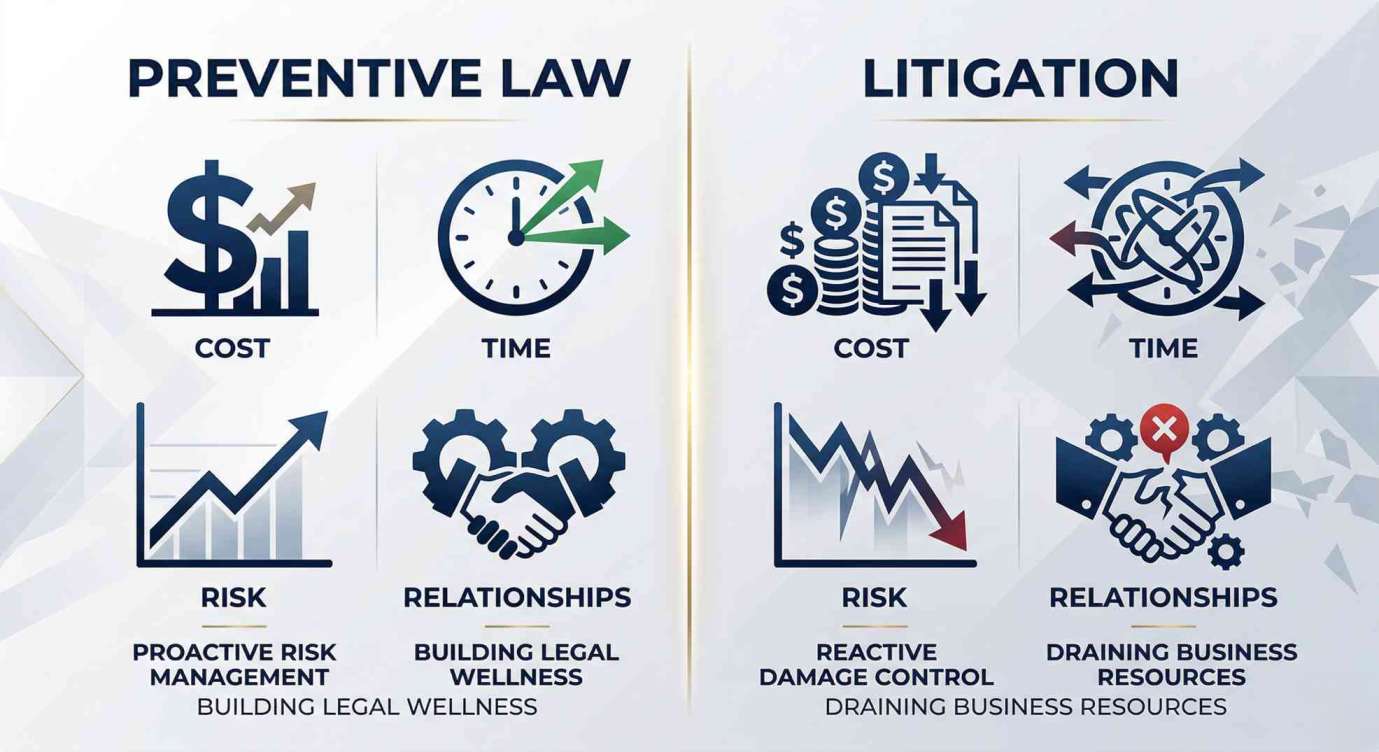
To understand why preventive law saves more money, let’s look at a side-by-side comparison of how these two approaches handle common business scenarios in India.
| Feature | Preventive Law | Litigation (Reactive) |
| Initial Cost | Low to Moderate (Retainers/Audits) | High (Senior Counsel fees/Emergency rates) |
| Predictability | High (Budgeted expenses) | Very Low (Unpredictable timelines & costs) |
| Outcome | Conflict avoidance/Settlement | Win/Loss (Often zero-sum after years) |
| Relationship | Preserves partnerships | Destroys partnerships |
| Timeline | Ongoing/Real-time | Years or Decades |
Scenario: A Vendor Contractual Dispute
The Reactive Approach: A vendor fails to deliver. You file a suit in a Civil Court. You spend ₹5,00,000 in fees over five years to recover ₹10,00,000, lose the vendor, and wait for a judgment that might still be appealed.
The Preventive Approach: Your contract included a mandatory Arbitration clause and a “liquidated damages” section. The issue is settled in a few months via an arbitrator for a fraction of the cost, and the business relationship is either salvaged or ended cleanly without the court’s intervention.
 Key Strategies to Implement Preventive Law Today
You don’t need a massive legal department to start saving money. Small, intentional shifts in how you handle operations in India can create a “legal shield” around your business.
1. Invest in High-Quality Foundational Documents
Your Founders’ Agreement, Employment Contracts, and Terms of Service are your first line of defense.
- Ensure Indemnity and Limitation of Liability clauses are specific and enforceable under the Indian Contract Act.
- Clearly define Scope of Work to avoid “scope creep” disputes with clients.
- Include Arbitration or Mediation requirements to bypass the public court system.
2. Conduct Annual “Legal Health Checks”
Just as you audit your GST filings, you should audit your legal standing.
- Are your Trademark and IP registrations up to date?
- Has your company complied with the latest Ministry of Corporate Affairs (MCA) filings?
- Are your HR policies compliant with the POSH Act (Prevention of Sexual Harassment)?
3. Employee Training and Sensitivity
Many Indian lawsuits stem from a lack of communication or procedural errors. Training your HR team on how to handle terminations, performance reviews, and workplace grievances correctly can prevent multi-crore employment suits.
4. The Culture of Documentation
In the Indian legal system, documentary evidence is king. Establishing a culture of documentation—saving emails, maintaining meeting minutes, and signing “Change Orders”—ensures that if a dispute does arise, you have the evidence required to shut it down quickly.

Why “Cheaper” Now Often Means “Expensive” Later
Many Indian business owners avoid preventive law because they don’t want to pay a lawyer “for nothing.” They see a ₹15,000 contract review as an unnecessary expense when they can find a free template online.
However, this is a false economy.
- A “free” template might lack a crucial Jurisdiction clause, meaning you might have to travel from Kolkata to Mumbai to defend a suit.
- An unreviewed commercial lease might contain hidden maintenance or escalation charges that cost you lakhs over the years.
Preventive law is an investment in certainty. It allows you to price your products accurately because you aren’t factoring in the “hidden tax” of potential legal catastrophes.

Conclusion: Securing the Future of Your Business
The shift from litigation to preventive law is a shift from vulnerability to mastery. While litigation focuses on the past (what went wrong), preventive law focuses on the future (how to stay right). For businesses focused on long-term sustainability in the Indian market, the choice is clear.
By identifying risks early, refining your contracts, and staying ahead of compliance requirements, you aren’t just “saving money”—you are building a more resilient, professional, and valuable company.
Protect Your Bottom Line with Aculegal
Don’t wait for a legal crisis to find out where your business is vulnerable. At Aculegal, we specialize in providing proactive legal strategies designed to keep Indian entrepreneurs out of the courtroom and focused on their growth.
Are you ready to build your legal shield?