How Legal Notices For Debt Recovery, Strengthen Accounts Receivable, and Enhance Balance Sheet Health

Legal notice document symbolizing debt recovery process with professional business figures in a global corporate setting.

In the fast-paced world of business, unpaid invoices can quietly erode your cash flow and growth potential. Founders and SME leaders know this reality all too well, outstanding receivables tie up capital that could fuel innovation, hiring, or expansion.

Legal notices offer a powerful, professional tool to address this challenge head-on. They signal seriousness without immediate courtroom drama, often prompting debtors to settle quickly. At Aculegal, we help businesses turn legal tools into strategic advantages and legal notices for debt recovery, simplifying legal processes while amplifying success.

This guide explores how a well-crafted legal notice drives effective debt recovery, cleans up your accounts receivable (AR), and strengthens your overall financial position. Whether you’re a startup founder chasing client payments or an SME managing supplier dues, you’ll gain actionable insights to protect your bottom line.

What Is a Legal Notice in Debt Recovery and Why It Matters for BusinessesIllustration explaining legal notice in debt recovery with document and business figure.

A legal notice in debt recovery is a formal written communication, typically drafted by a lawyer, demanding payment of outstanding dues within a specified timeframe. It details the debt amount, due date, supporting invoices or agreements, and potential consequences of non-payment.

Unlike casual reminders, it carries legal weight. It creates a documented trail that courts recognize and often serves as a prerequisite for filing suits. For businesses, this formality shifts the dynamic from polite chasing to enforceable accountability.

Why it matters:

  • Psychological impact: Debtors take attorney-backed notices more seriously than internal emails.
  • Time efficiency: Many resolve within 15-30 days, avoiding lengthy litigation.
  • Compliance and protection: Proper notices shield you from counterclaims while preserving your rights.

For startups and SMEs with limited resources, this low-cost step prevents small issues from becoming major cash flow crises.

The Problem: How Overdue Receivables Hurt Startups and SMEs

Unpaid debts create a domino effect that threatens stability. High days sales outstanding (DSO) means money you earned sits idle, forcing reliance on loans or delayed investments.

Common pain points include:

  • Strained cash flow: You can’t pay your own suppliers or employees reliably.
  • Inflated balance sheets: Overstated AR masks true liquidity, worrying investors or lenders.
  • Opportunity costs: Time spent on collections diverts focus from core operations.
  • Relationship risks: Informal follow-ups can damage client ties, while inaction signals weakness.

Statistics highlight the issue, debt collectors recover only about 20 cents on the dollar on average, and older debts become nearly uncollectible. Without structured intervention, many businesses write off significant revenue.

Founders often underestimate how quickly one large unpaid invoice can jeopardize runway or valuation. The problem isn’t just lost money, it’s distorted financial health that limits growth.Legal notice accelerating payment response between businesses in a corporate workflow

The Solution: Deploying Legal Notices as a Strategic Recovery Tool

Legal notices bridge the gap between friendly reminders and full litigation. They formalize your demand while opening doors for negotiation.

Key elements of an effective legal notice:

  • Clear statement of facts, including invoice details and amount due (principal + interest if applicable).
  • Reasonable deadline (typically 15-30 days).
  • Reference to contractual obligations or legal provisions.
  • Warning of further action, such as court proceedings or reporting to credit agencies.
  • Professional tone that maintains relationship potential.

Sending via registered post or email with delivery confirmation ensures proof of service.

Step-by-step implementation:

  1. Review all documentation and calculate exact dues.
  2. Engage legal experts to draft the notice (avoid generic templates that miss jurisdiction specifics).
  3. Send and track response.
  4. Follow up strategically, many debtors propose settlements here.
  5. Escalate only if needed, using the notice as strong evidence.

This approach recovers funds faster while demonstrating professionalism.Accounts receivable improvement dashboard showing financial health enhancement.
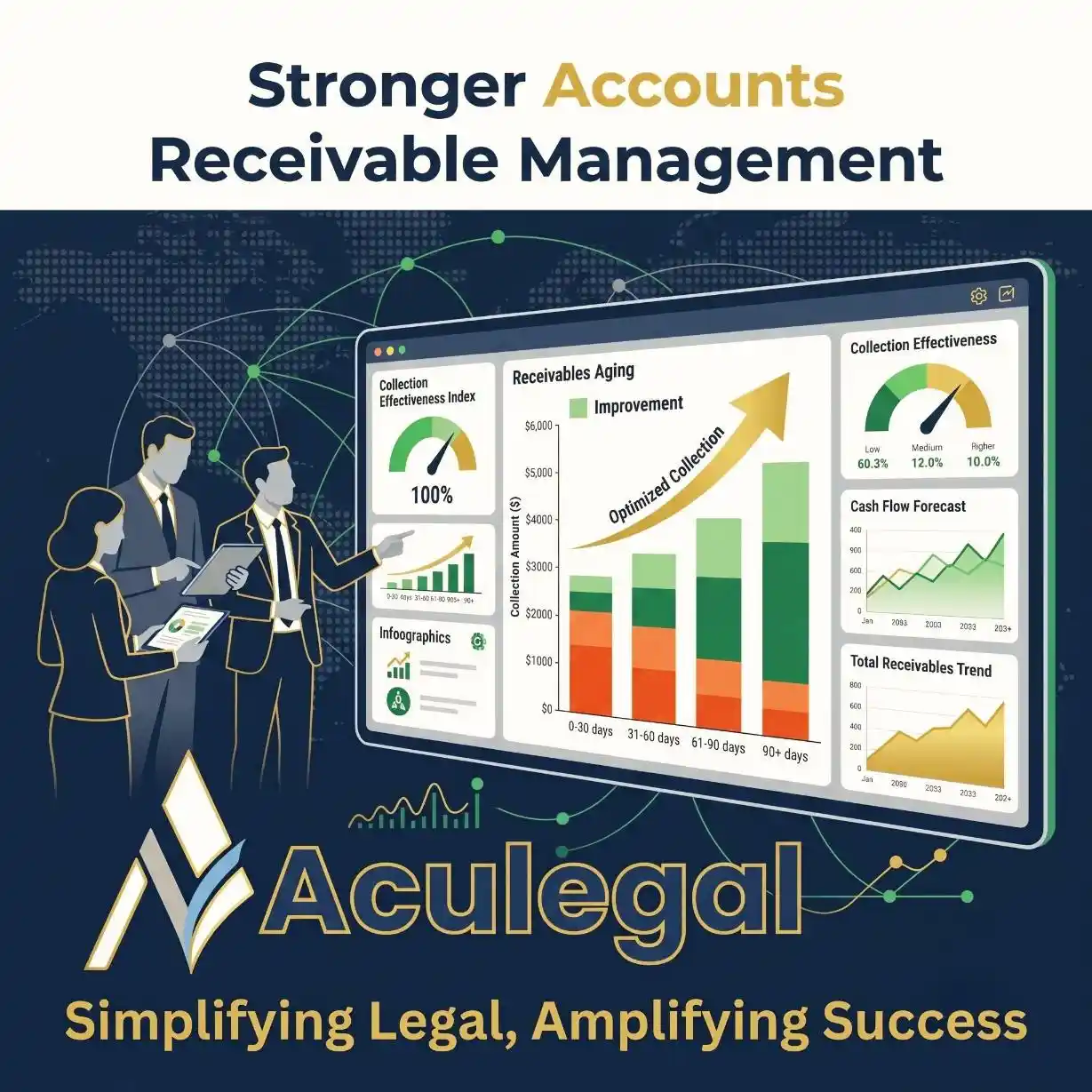
How Legal Notices Strengthen Accounts Receivable Management

Effective AR management turns receivables from potential liabilities into reliable assets. Legal notices accelerate collections and deter future delays.

Benefits for AR:

  • Faster inflows: Notices often prompt payment within weeks, reducing DSO significantly.
  • Better aging profiles: Shift overdue buckets into current status through targeted action.
  • Data-driven insights: Documented notices help identify chronic late payers for policy adjustments.
  • Negotiation leverage: Debtors respond knowing legal escalation is real.

Pair notices with automated invoicing and clear credit terms for a robust system. Businesses using formal demands early report higher collection rates and fewer write-offs.

At Aculegal, our Accounts Receivable Recovery Services integrate legal notices into tailored strategies, helping SMEs maintain healthy cash cycles without straining internal teams.

Enhancing Balance Sheet Health Through Proactive Debt Recovery

Your balance sheet tells your company’s financial story. Bloated AR inflates assets but hides liquidity risks, affecting ratios lenders and investors scrutinize.

Legal notices contribute directly:

  • Improved liquidity: Recovered cash boosts current assets and working capital.
  • Cleaner reporting: Reduced doubtful debts lower provisions, strengthening equity appearance.
  • Risk mitigation: Timely action prevents bad debt buildup that erodes profitability.
  • Credibility boost: Stronger metrics support better financing terms and valuations.

Strategic tip: Treat debt recovery as balance sheet optimization. Regular legal reviews of high-value AR prevent minor delays from becoming impairments.

This forward-looking approach aligns operations with financial health goals.

Proof: Real-World Results and Best PracticesCash flow improvement visualization showing smooth financial movement after legal intervention

Evidence from practice shows legal notices deliver results. Many B2B cases resolve pre-litigation after a formal demand, saving time and costs.

Success factors:

  • Timing: Send after 2-3 reminders, before 60-90 days overdue.
  • Professional drafting: Attorney involvement increases response rates.
  • Documentation: Maintain records for seamless escalation.
  • Follow-through: Consistent processes signal reliability.

One insight-driven approach: Segment debtors by risk and customize notices, polite but firm for good clients, stricter for repeat offenders. Jurisdictions like India emphasize notices under relevant acts (e.g., CPC or NI Act) for stronger enforceability.

Businesses partnering with legal experts see recovery rates far above industry averages, preserving relationships while securing funds.

Outbound references for deeper reading:

Common Mistakes to Avoid in Debt Recovery

Even well-intentioned efforts falter without strategy. Avoid these pitfalls:

  • Delaying action: Aging debts become harder to collect.
  • DIY legal language: Ambiguous notices weaken your position.
  • Aggressive tone: It can provoke disputes or damage goodwill.
  • Ignoring jurisdiction: Rules vary; non-compliance risks dismissal.
  • Poor record-keeping: Weak evidence undermines claims.

Aculegal’s Contract Review and Drafting Services help embed strong payment clauses upfront, reducing future recovery needs.

Integrating Legal Notices into Your Overall Business StrategyStep-by-step legal notice process workflow for debt recovery.
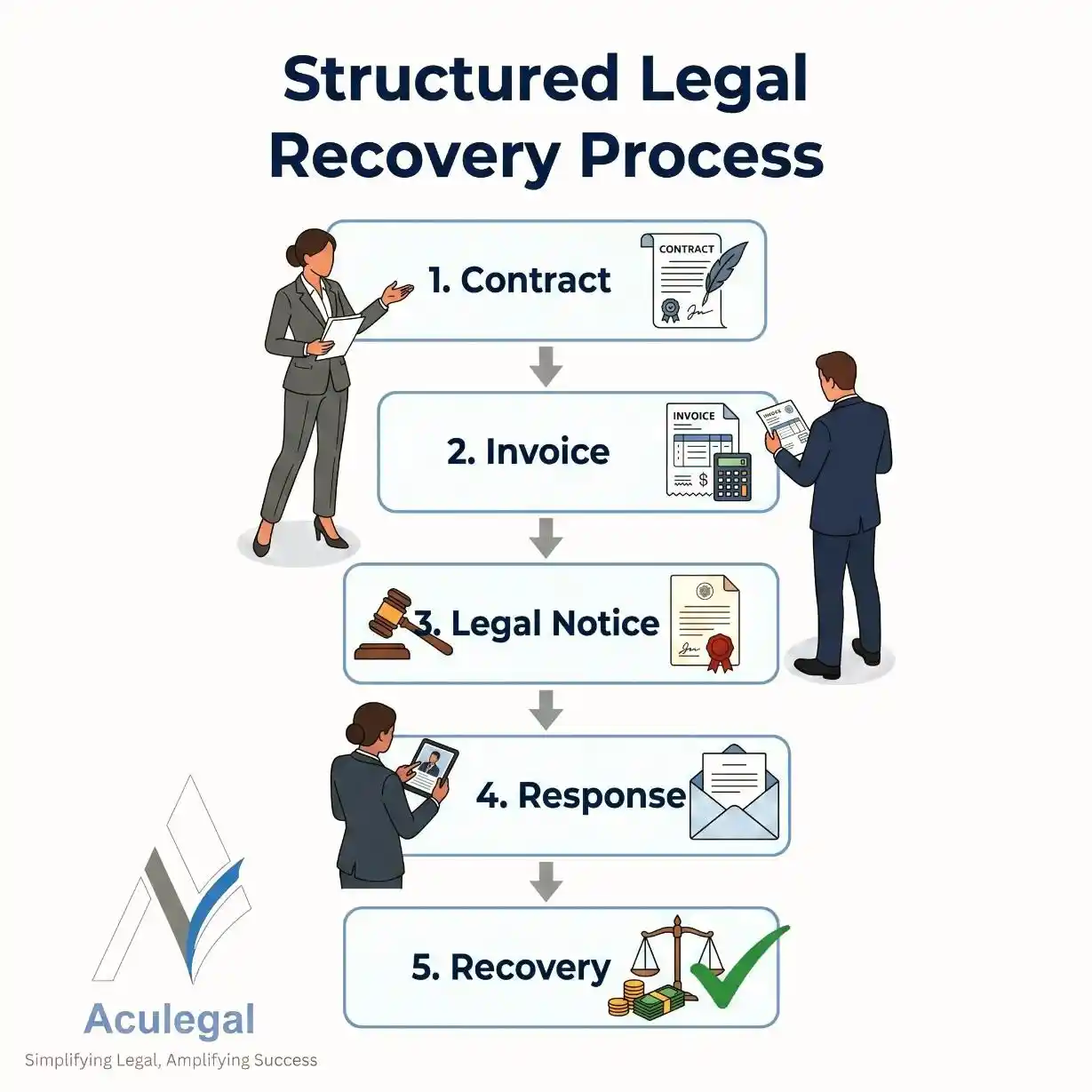
View debt recovery as part of risk management and growth planning. Train teams on escalation protocols and use technology for tracking.

Advanced tips:

  • Include notice provisions in client contracts.
  • Monitor AR metrics monthly.
  • Combine with mediation for amicable resolutions.
  • Leverage expert support for complex cases.

This integrated approach turns potential losses into opportunities for stronger client accountability and financial resilience.

For comprehensive support, explore Aculegal’s Business Dispute Resolution Services alongside recovery expertise.

Conclusion: Take Control of Your Finances Today

Legal notices deliver a proven pathway to faster debt recovery, healthier accounts receivable, and a more robust balance sheet. They empower founders and SMEs to address overdue payments professionally, protect cash flow, and maintain focus on what matters, building and scaling the business.

By acting decisively with the right legal tools, you minimize risks, strengthen stakeholder confidence, and create space for sustainable growth.Aculegal legal recovery solution representing protection of business finances and structured legal support.

At Aculegal, we specialize in simplifying legal. Amplifying success. Our team crafts tailored notices, guides escalation, and provides ongoing advisory to safeguard your interests.

📞  Ready to strengthen your receivables and financial health?

Book a free consultation today or contact Aculegal for expert debt recovery support. Don’t let unpaid invoices hold back your momentum, take strategic action now.

Why Contract Review Is Essential for Business Risk Management

Contract Review for Business Risk Management

Contract review for business risk management is not a formality, it is your first line of defence against the financial, legal, and operational threats that quietly drain growing businesses. Yet most founders sign contracts the same way they click “I Agree” on a software licence: fast, unread, and full of faith that nothing will go wrong.

That faith is expensive. According to Loio’s 2026 Contract Management Report, companies lose between 8% and 9% of annual revenue due to poor contracting practices. For a startup generating ₹2 crore a year, that is up to ₹18 lakh walking out the door through missed obligations, auto-renewals, and unenforceable clauses.

This guide breaks down exactly how contract review reduces risk across four critical dimensions, legal, financial, data security, and compliance, and what founders and SME leaders can do about it, starting today.

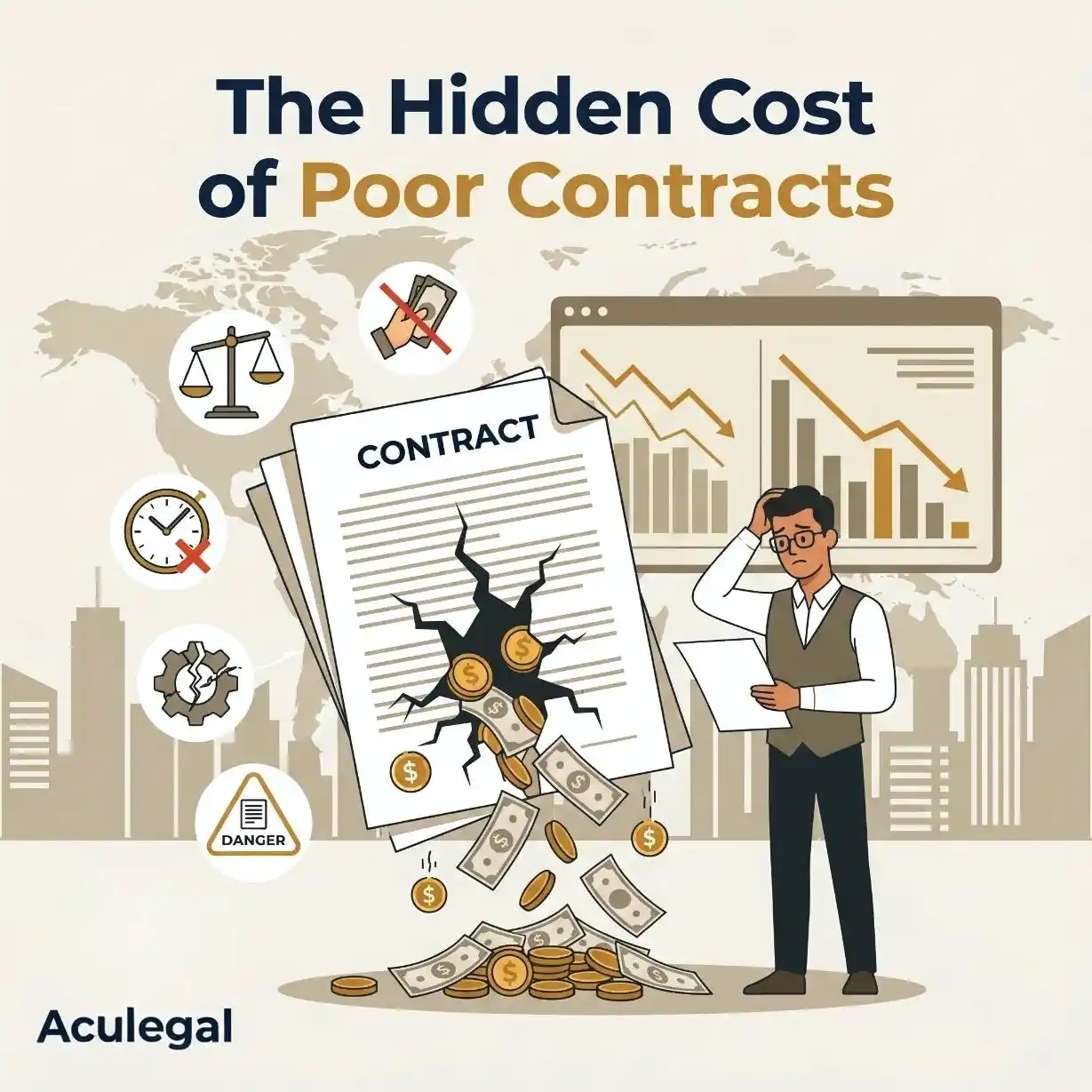
The Hidden Cost of Skipping Contract ReviewBusiness losses caused by poor contract management and overlooked contract risks

Most business disputes do not begin with fraud or bad intent. They begin with a contract nobody properly read. A vendor agreement with an uncapped liability clause. A client NDA that assigns your IP to the other party. A partnership deed that is silent on exit terms.

These are not edge cases. 64% of U.S. civil lawsuits involve contract disputes, and the pattern is identical across markets worldwide. The clause that looked harmless at signing becomes the clause cited in a ₹50 lakh claim two years later.

♦ 9.2% of annual revenue lost to poor contract management ContractSafe, 2026

♦ 92% of contract management errors are human errors Ironclad Legal Ops Field Guide, 2025

♦ 71% of businesses cannot locate at least 10% of their contracts Loio, 2026

For founders and SMEs, the risk is amplified. Unlike large enterprises with dedicated legal departments, most startups rely on founders reviewing contracts between pitch decks and product sprints — or they simply use a template from the internet and hope for the best.Startup founders making common contract review mistakes that increase business risks

⚠ Common Contract Mistakes by Startups and SMEs

• Accepting supplier contracts without negotiating liability caps

• Using generic templates that do not reflect local law or industry standards

• Missing auto-renewal clauses that lock the business into multi-year commitments

• Leaving IP ownership vague in co-founder or freelancer agreements

• Signing NDAs that restrict your own ability to operate in your market

How Contract Review Reduces Legal, Financial, Data Security, and Compliance Risks

A structured contract review for business risk management systematically addresses risk across four domains. Here is what a professional review catches, and what it protects.

1. Legal Risk: Enforceability, Liability, and IP Protection

Every contract is a legal instrument. An unreviewed contract can be unenforceable, one-sided, or actively harmful to your legal standing. A proper review examines whether clauses are enforceable under applicable law, whether liability exposure is capped and mutual, and whether intellectual property ownership is clearly assigned to the right party.

  • Uncapped indemnity clauses can expose your business to unlimited liability for third-party claims
  • Vague IP clauses in employment or freelancer contracts often result in disputed ownership of core product assets
  • Governing law provisions that force disputes into foreign jurisdictions increase cost and complexity exponentially
  • Ambiguous termination terms allow counterparties to exit without notice or penalty, leaving you stranded

One unreviewed clause in a vendor contract can cost more than a year of legal retainer fees.

2. Financial Risk: Missed Payments, Penalties, and Revenue Leakage

Contract review is one of the most direct forms of financial risk management available to a business. Ironclad’s 2025 Contracting Benchmark Report found that organisations lose an average of 8.6% of total spending annually to cost leakage, primarily from missed renewals, auto-renewals on unfavourable terms, and payment milestones that were never tracked.

A review identifies and flags:

  • Payment terms and penalties – late payment clauses that could trigger disproportionate penalties
  • Price escalation clauses – buried provisions that allow suppliers to raise rates mid-contract
  • Renewal traps – auto-renewal periods requiring 60 or 90 days’ notice that are easy to miss
  • Scope creep provisions – client contracts with ambiguous deliverables that lead to unpaid additional work

📌 Explore Aculegal Services

Contract Drafting & Review, Protect every agreement before you sign Startup Legal Advisory, Build a solid legal foundation from day one

Four key areas of contract risk management including legal financial data protection and compliance

3. Data Security Risk: Privacy Clauses and Third-Party Data Obligations

In an era of DPDP Act compliance in India and GDPR obligations for businesses with global reach, data security provisions in contracts are no longer optional. Vendor agreements, SaaS subscriptions, and client contracts increasingly involve the transfer, storage, or processing of sensitive personal and business data.

According to Lexology’s 2026 CLM Trends analysis, global regulations are becoming more stringent and proactive compliance monitoring in contracts is now critical. A review checks whether:

  • Data processing agreements (DPAs) are in place for all third-party vendors who handle customer data
  • Breach notification timelines in vendor contracts align with your own regulatory obligations
  • Subcontractor clauses prevent vendors from passing your data to undisclosed fourth parties
  • Confidentiality provisions cover not just trade secrets but also customer data, pricing, and technical IP

✓ What Good Data Clauses Look Like

A well-reviewed contract specifies: data retention limits, breach notification windows (typically 72 hours), explicit prohibition on sub-processing without consent, and indemnity from the vendor in case of their data breach. Most off-the-shelf templates contain none of these.Contract review supporting data protection and international compliance requirements

4. Compliance Risk: Regulatory Alignment and Sector-Specific Obligations

Compliance risk in contracts is industry-specific and constantly evolving. A fintech startup faces RBI-mandated contractual requirements with payment partners. A healthcare platform must ensure vendor agreements align with data localisation requirements. An e-commerce business has Consumer Protection Act obligations baked into every seller agreement.

Research from Fynk’s 2026 Contract Management Trends Report notes that 88% of SMEs believe large businesses are inflexible in contract negotiations, and in many cases, the terms large corporates push into standard agreements deliberately shift compliance burden onto the smaller party.

Professional contract review identifies:

  • Clauses that transfer regulatory liability to your business inappropriately
  • Missing mandatory disclosures required under sector-specific regulations
  • Non-compete and exclusivity provisions that may breach competition law
  • Force majeure clauses that are either too narrow (excluding pandemics, regulatory changes) or dangerously broad

Why Professional Contract Review Pays for Itself

The business case for professional contract review is straightforward. ContractSPAN’s 2025 analysis found that for every ₹1 spent on contract management and legal review, businesses recover between ₹85 and ₹170 in protected revenue. That is not a soft benefit, it is a measurable return on a specific legal investment.

For a startup or SME, the calculus is even more compelling because the cost of one dispute almost always exceeds the cost of every contract review the business ever needed. Litigation in commercial courts is slow, expensive, and reputationally damaging. Prevention is not just better than cure, it is dramatically cheaper.

💡 What a Professional Contract Review Covers

• Clause-by-clause risk flagging with plain-language explanations

• Redline suggestions for negotiation leverage

• Jurisdiction and governing law recommendations

• Data protection and regulatory compliance checks

• Recommendations on missing standard protections (indemnity, liability cap, IP assignment)Return on investment from professional contract review and legal risk prevention

When to Get a Contract Reviewed (Hint: Before You Sign)

The most common mistake is treating contract review as a reactive measure, something you do after a dispute arises. By that point, you are not reviewing; you are litigating. The right time for contract review in your business risk management process is always before signature, and ideally during negotiation so you can push back on unfavourable terms.

Key trigger points for review include:

  1. Entering a new vendor or supplier relationship, especially where the other party provides the template
  2. Hiring full-time employees or senior contractors, IP assignment and non-compete clauses deserve careful scrutiny
  3. Signing client agreements, particularly for professional services, software delivery, or long-term retainers
  4. Raising funding or entering shareholder agreements, investor terms can have decade-long consequences
  5. Renewing existing contracts, renewal is the best moment to renegotiate terms that no longer serve you

Key Takeaways

  • Companies lose up to 9.2% of annual revenue from poor contract management
  • Contract review protects against legal, financial, data security, and compliance risk
  • IP, liability, data clauses, and compliance obligations are the highest-risk areas for startups and SMEs
  • Professional review before signing is the most cost-effective risk management strategy available
  • The ROI of contract review is 85x to 170x the investment in protected revenue

Conclusion: Sign Less. Review More. Grow Faster.

Contract review for business risk management is not a legal luxury reserved for corporates with large legal departments. It is the foundational discipline that separates founders who scale from those who spend their growth capital resolving disputes that were entirely preventable.Business leaders reviewing contracts carefully before signing agreements

Every contract your business signs is a risk decision. The question is not whether you can afford professional review, it is whether you can afford to skip it. At Aculegal, we work with founders, startups, and SMEs to turn contracts from sources of hidden risk into instruments of business confidence.

Simplifying Legal. Amplifying Success.

Free Consultation Available

Get Your Contracts Reviewed by Aculegal

Don’t let an unreviewed clause become your most expensive business decision. Our team reviews contracts with speed, precision, and plain-language clarity,  so you can sign with confidence.

Book a Free Consultation 

The Rise of Legal Outsourcing: How Companies Are Reducing Legal Costs Without Sacrificing Quality

legal outsourcing

Legal outsourcing is no longer a cost-cutting workaround, it has become one of the most strategic decisions a growing business can make. Founders and SME leaders are discovering that top-quality legal coverage does not require a full-time in-house counsel or a retainer at a premium law firm.

The model has shifted. Companies now outsource contracts, compliance, IP filings, and due diligence to specialized legal service providers, getting expert outcomes at a fraction of traditional costs. And the numbers confirm it is working.

If your business is spending too much on legal, getting too little in return, or simply not getting the legal coverage it needs, this guide is for you.

$25.5B Global LPO market size in 2024

21.8% Annual growth rate of legal outsourcing through 2035

62% Companies reporting better cost control via outsourcing

$1.2M Annual savings reported by some corporate legal teams

* Sources: Research and Markets (2024); Global Growth Insights (2026); Thomson Reuters (2024)

Why Businesses Are Turning to Legal Outsourcing to Reduce CostsFounder comparing high traditional legal costs with efficient legal outsourcing solutions.

Most founders do not realize how much they are overpaying for legal services until it is too late. Traditional law firm billing, typically charged by the hour, is structured for large corporations with deep pockets, not for startups operating lean or SMEs managing tight margins.

The reality: you do not need a full-service law firm for every legal task your business faces. A significant portion of routine legal work, contract drafting, compliance monitoring, IP filings, document review, can be handled by skilled external providers at a dramatically lower cost without any drop in quality.

Yet many businesses still pay premium rates for routine work because they do not have a smarter alternative in place. That gap is precisely where legal outsourcing delivers its greatest value.

The hidden cost of legal inaction: Founders who avoid legal support altogether face a different risk, unprotected IP, poorly drafted contracts, and compliance blind spots that can result in disputes, penalties, or failed investment rounds.

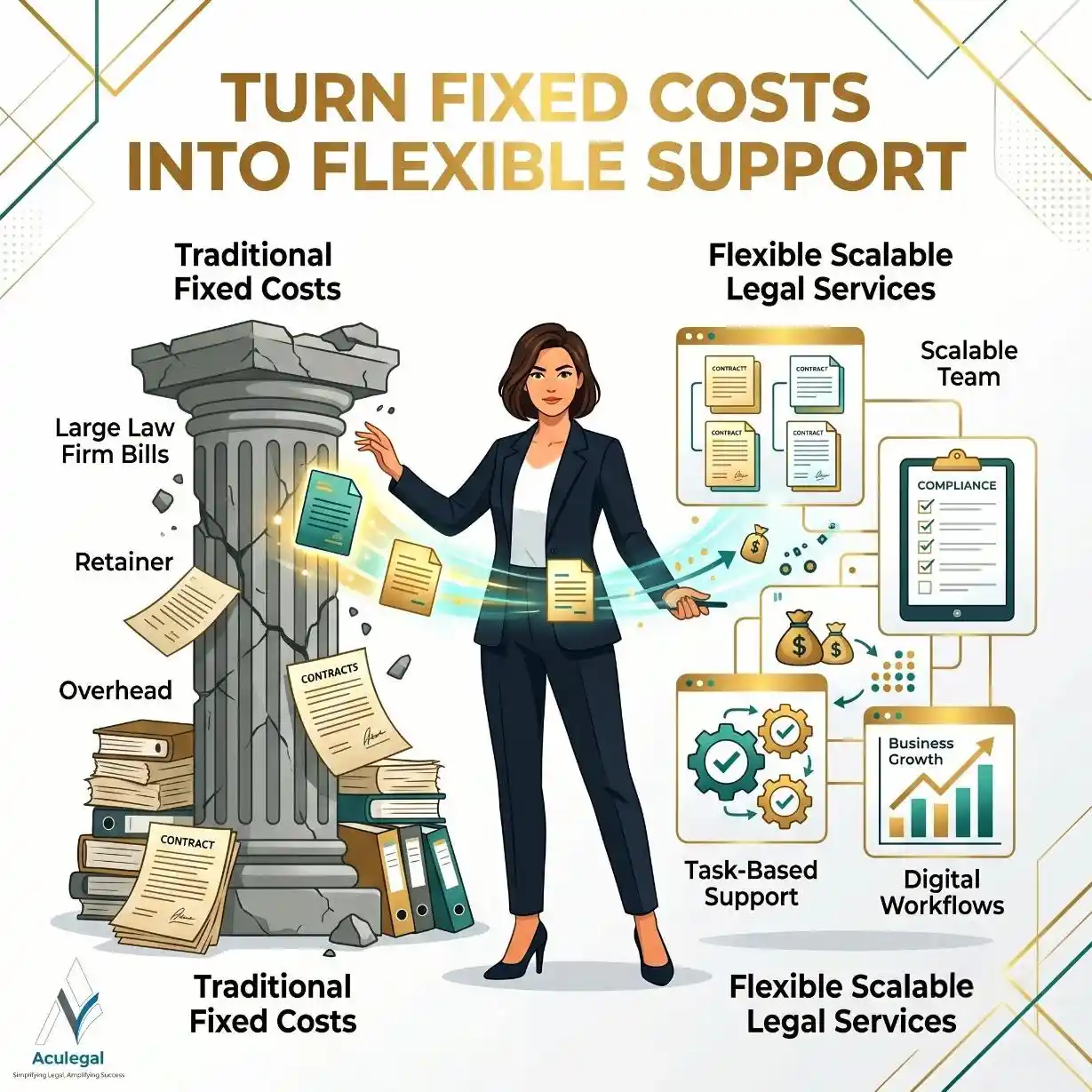
How Legal Outsourcing Helps Companies Reduce Legal CostsBusiness converting fixed legal costs into flexible outsourced legal support.

Legal outsourcing, often called Legal Process Outsourcing (LPO), refers to the practice of delegating specific legal tasks to external providers, specialists who handle that work with precision, speed, and at a lower cost than traditional law firms. It is not about cutting corners. It is about cutting waste.

Here is how the value stacks up for founders and SMEs:

1. You convert fixed legal costs into flexible spend

Hiring in-house counsel means salaries, benefits, office space, and overhead, all fixed costs regardless of how much legal work actually comes in. Outsourcing converts that spend into a variable model: you pay for what you need, when you need it. This is how startups stay lean without being legally exposed.

2. You access specialized expertise on demand

A generalist in-house lawyer often cannot match the depth of a provider who handles, say, 200 commercial contracts a month or exclusively manages trademark filings. Outsourced legal providers build deep expertise in specific practice areas, and that specialization directly improves the quality of output your business receives.

3. Your internal team focuses on high-value decisions

If you do have any legal resource in-house, even a part-time advisor or a legally literate co-founder, outsourcing routine tasks frees them to focus on strategic matters: investor negotiations, M&A diligence, high-stakes disputes. The work that genuinely requires insider context stays inside. Everything else goes out.

4. You scale your legal support without headcount

Your legal needs will surge during funding rounds, product launches, new market entries, and compliance cycles. Outsourcing lets you scale legal capacity up or down on demand without the delays of hiring, onboarding, or restructuring an in-house team.

 Corporate legal teams that outsource strategically have reported annual savings ranging from $300,000 to $1.2 million, without reducing the quality or coverage of legal services. – Thomson Reuters (2024).

What to Outsource, and What to Keep In-HouseComparison between legal tasks suitable for outsourcing and strategic legal work kept in-house.

Not all legal work is the same. The key to a successful outsourcing strategy is knowing which tasks to delegate and which ones demand internal oversight. Here is a practical framework:

Tasks well-suited for outsourcing

  • Contract drafting and review – NDAs, vendor agreements, employment contracts, SaaS terms
  • Compliance monitoring – regulatory tracking, policy updates, filing management
  • IP filings – trademark registrations, patent support, copyright documentation
  • Legal research and writing – jurisdiction-specific research, regulatory opinions
  • Document review – due diligence support, e-discovery, corporate record maintenance
  • Routine litigation support – case preparation, document management, filing assistance

Tasks best kept in-house or with trusted counsel

  • High-stakes negotiations requiring deep company context (e.g., term sheet reviews, M&A transactions)
  • Board-level governance and fiduciary matters
  • Strategic legal decisions that shape business direction
  • Sensitive disputes involving reputation risk or regulatory scrutiny

The smartest founders do not ask “should we outsource legal?” They ask, “Which legal tasks give us the best return when outsourced?” That distinction changes everything about how you build your legal infrastructure.

→ See how Aculegal handles contract review for startups 

The Quality Question: Does Outsourcing Mean Lower Standards?Professional legal outsourcing team maintaining quality, compliance, and accuracy.

This is the most common objection, and the most misplaced one. The assumption that outsourcing trades quality for cost is based on an outdated model of how legal services are delivered.

Today’s LPO providers are not freelancers improvising in the margins. They are structured legal operations with dedicated teams, quality control workflows, data security protocols, and deep domain expertise. The best providers operate to standards that rival or exceed those of boutique law firms, at significantly lower price points.

What drives quality in legal outsourcing? Four factors:

    1. Specialization – Providers who do one type of work repeatedly develop extraordinary precision in it.
    2. Process design – Good LPO providers build repeatable workflows that minimize errors and inconsistencies.
    3. Technology leverage – AI-assisted contract review, compliance tracking tools, and document management platforms accelerate delivery without sacrificing accuracy.
    4. Accountability structures – Unlike a solo in-house hire, outsourced teams come with supervision layers, review cycles, and performance accountability built in.

The right legal outsourcing partner does not lower your standards – it systematizes them.

→ Explore Aculegal’s compliance services for growing businesses

The Market Is Sending a Clear Signal – Are You Listening?

The global legal outsourcing market is not a niche trend. It is a fundamental restructuring of how businesses access legal services, and it is accelerating rapidly.

  • The LPO market is projected to reach $155.79 billion by 2035, growing at a 21.8% CAGR
  • 68% of companies that outsource legal tasks report improved cost efficiency
  • 65% of mid-sized firms now engage external providers for contract drafting, document review, and compliance monitoring
  • Nearly 80 out of 100 large legal departments have integrated external LPO services into their regular workflows

For startups and SMEs, the competitive implication is significant. Your larger competitors are already outsourcing strategically to move faster, spend less, and stay compliant. If you are still treating legal as an afterthought or an occasional expense, you are operating at a structural disadvantage.

How to Choose the Right Legal Outsourcing PartnerGlobal legal outsourcing market growth and increasing adoption by businesses.

Not all legal outsourcing providers are built the same. Before you hand over your contracts or compliance calendar to an external team, evaluate your options across five dimensions:

  1. Domain specialization – Do they have demonstrated experience in the specific legal areas your business operates in? A startup raising Series A has different needs than an SME managing a franchise network.
  2. Confidentiality and data security – Legal work involves sensitive business information. Your provider must have clear protocols for data handling, access controls, and confidentiality agreements.
  3. Communication and responsiveness – Delayed legal responses create business risk. Assess how quickly the team responds, how they communicate, and what their turnaround commitments look like.
  4. Transparency on scope and pricing – Avoid providers who cannot clearly articulate what is included, what is excluded, and what triggers additional costs. Billing surprises in legal are particularly damaging to founder trust.
  5. Alignment with your growth stage – A provider suited for a 10-person seed-stage startup may not be equipped to scale with you through Series B and beyond. Choose a partner who can grow with your business.

What the Evidence Says

The data on legal outsourcing outcomes for businesses that adopt it strategically is increasingly clear:

  • Firms that adopt advanced legal outsourcing support see on average a 30% improvement in case turnaround times and a 25% increase in client satisfaction – ALM Intelligence (2024)
  • 79% of law firms report improved cost-efficiency and client satisfaction after outsourcing – Deloitte
  • Companies that outsource compliance and contract management report reduced operational burden and measurably better service quality
  • Startups that engage external legal providers can mitigate regulatory risk and ensure professional coverage without the overhead of a full-time hire

Legal outsourcing, done correctly, is not a compromise. It is a competitive advantage.

Conclusion: Legal Efficiency Is a Business Strategy

The most successful founders and SME leaders treat legal not as a cost centre but as a strategic function. Legal outsourcing has matured into a reliable, high-quality model that delivers expert outcomes without the overhead of traditional law firm relationships or in-house hiring.

Here is what you should take away from this:

  • Legal outsourcing reduces costs without sacrificing quality – when you choose the right partner
  • The market is growing at over 21% annually – the shift toward outsourced legal is not speculative, it is underway
  • The key is knowing what to outsource (routine, repeatable tasks) and what to keep strategic and in-house
  • Quality is driven by specialization, process, and accountability – not by the size of a firm’s logo
  • The right outsourcing partner grows with your business and integrates into your operations seamlesslyBusiness owner selecting a trusted legal outsourcing partner for growth and compliance.

At Aculegal, we believe in Simplifying Legal. Amplifying Success. We help founders, startups, and SMEs build the legal infrastructure they need, without the costs, complexity, or confusion that traditionally comes with it.

📞Ready to reduce your legal costs without compromising quality?

Book a free consultation with Aculegal’s team. We’ll assess your current legal exposure, identify what can be outsourced, and build a smarter legal plan for your business.

Web Sources:

  1. Market.us — Legal Process Outsourcing Statistics and Facts (2026)
  2. Global Growth Insights — LPO Market Growth Driven by 21.8% CAGR by 2035
  3. Wolters Kluwer — Smart Legal Outsourcing Strategies for 2025
  4. Draft n Craft — Why Legal Process Outsourcing in the USA Is Booming in 2025
  5. Market Growth Reports — Legal Process Outsourcing Services Market Size & Insights 2033

Founders Build Products. Legal Infrastructure Protects What They Build.

legal infrastructure for startups

Legal infrastructure for startups is not a cost centre. It is your competitive moat, and most founders don’t realise that until it’s already too late.

You’ve built the product. You’ve closed the first customers. The pitch deck is polished, and the runway looks manageable. But there’s a question every investor will ask in the next due diligence call that no amount of traction can answer for you: Is this company legally clean?

That question exposes a gap most founders quietly carry, the gap between building a product and building a company. One runs on code and customers. The other runs on legal infrastructure.

A startup growth engine powered equally by business growth and legal infrastructure.Why Legal Infrastructure Matters for Startup Growth


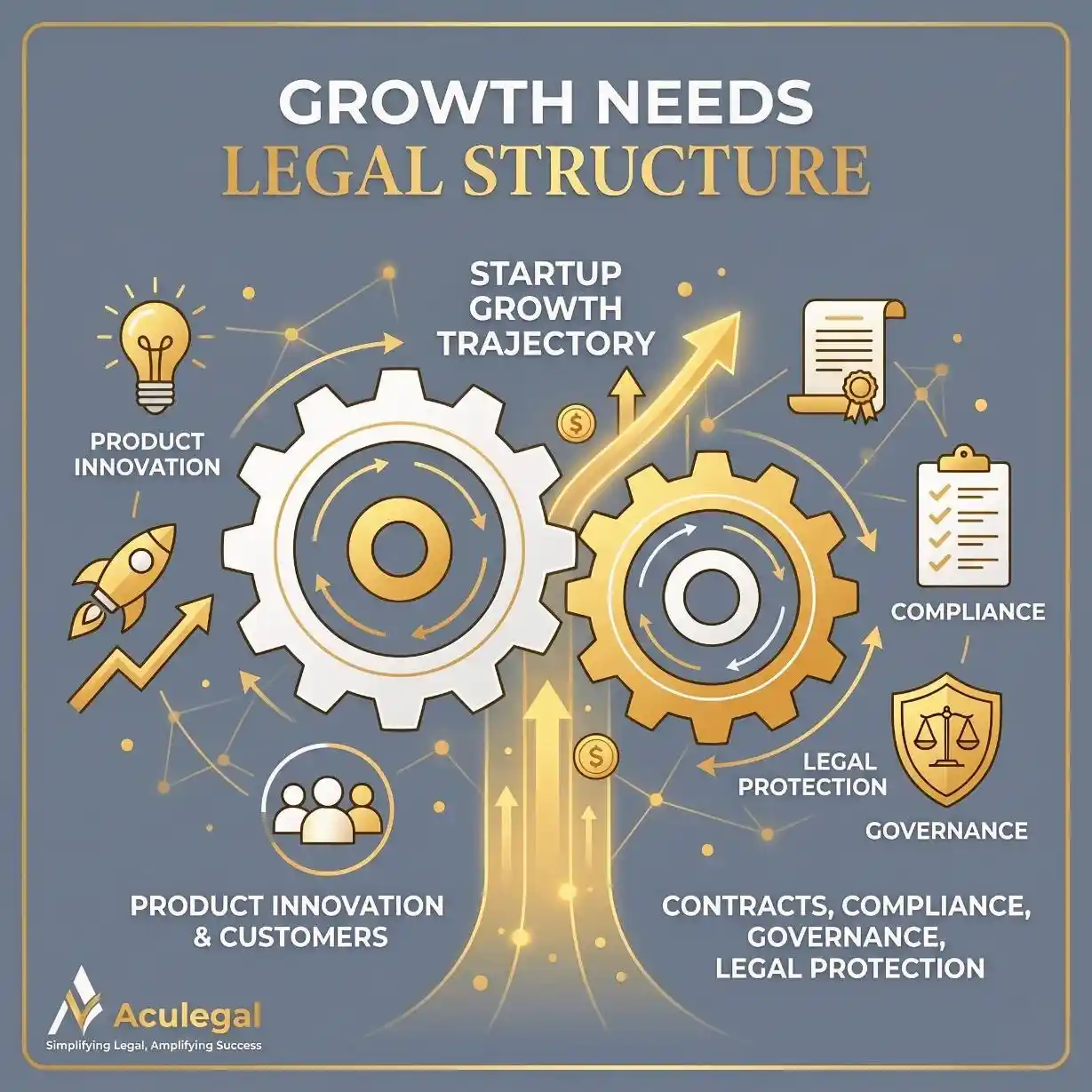
Every high-growth company has two engines running in parallel. The first is the product engine, the team, the roadmap, and the GTM motion. The second is the legal engine, the structures, agreements, and protections that make the first engine scalable, fundable, and defensible.

Most founders obsess over the product engine. The legal engine gets treated like a formality, something to sort out when there’s time, budget, or a problem to fix. That’s the trap.

TechCrunch’s analysis of common founder legal mistakes points out that “fixing these problems dwarfs the cost of avoiding them.” The founders who scale without blow-ups are the ones who treat legal structure as foundational infrastructure, not post-traction housekeeping.

The 5 Pillars of Legal Infrastructure Every Startup NeedsFive legal pillars supporting a scalable startup business.

1. Company Formation and Governance

Your corporate structure is the foundation everything else rests on. Getting it wrong at formation creates compounding problems, in fundraising, in co-founder disputes, in cap table management, and in eventual exits.

What this includes:

  • Choosing the right entity type (Private Limited, LLP, OPC) aligned with your funding strategy
  • Drafting a shareholders’ agreement that defines equity splits, vesting schedules, and exit scenarios
  • Establishing a board structure that protects founder interests while remaining investor-ready

According to LegalNodes’ investor due diligence research, around 65% of startups fail due to co-founder conflicts, most of which could have been prevented or managed with a proper founders’ agreement in place from day one.

2. Intellectual Property Assignment and Protection

Your IP is your most valuable asset. But if it isn’t formally assigned to the company, you don’t fully own it, even if you built it.

Faison Law Group’s breakdown of startup fundraising legal errors identifies unclear IP ownership as one of the most dangerous and commonly overlooked issues at the early stage. When developers, co-founders, or contractors contribute to a product without IP assignment agreements, those individuals may retain legal ownership of the code, branding, or design they created.

What needs to be in place:

  • IP assignment agreements for all founders at incorporation
  • Contractor and employee agreements with clear work-for-hire and IP transfer clauses
  • Trademark registration for your brand name, logo, and key product identifiers
  • Patent strategy assessment for proprietary technology

The moment an investor begins due diligence, or a co-founder exits, unresolved IP becomes a liability, not an asset.Intellectual property assets protected by legal safeguards.

3. Contracts That Actually Protect You

Founders move fast on relationships. Contracts follow slowly, or not at all. This is one of the most expensive habits an early-stage company can develop.

StartupNation’s roundup of founder legal errors includes a recurring pattern: founders who prioritised trust over documentation found themselves in disputes that stalled operations, damaged relationships, and cost far more to resolve than a well-drafted contract would have cost upfront.

Every startup needs solid contracts for:

  • Customer agreements – SaaS terms, service agreements, MSAs, and SLAs
  • Vendor and supplier contracts – with clear deliverables, payment terms, and IP clauses
  • Employment agreements – including non-disclosure, non-solicitation, and IP assignment
  • Co-founder agreements – equity vesting, roles, decision-making authority, and exit provisions

A contract isn’t just a legal document. It’s a business instrument that defines what success looks like for both parties, and what happens when it doesn’t.

Explore Aculegal’s Contract Drafting and Review Services for Startups and SMEs → Contracts & Agreements

Business relationships secured through professionally drafted contracts.4. Regulatory Compliance and Licensing

Regulatory exposure is the risk most founders don’t see coming, until they’re in the middle of it. Whether you’re handling customer data, operating in a regulated sector, or scaling across state or national borders, compliance isn’t optional.

Crunchbase’s analysis of regulation as a startup advantage makes a powerful point: regulation-ready startups attract smarter capital. Venture funds now assess regulatory maturity and governance readiness early in the investment process. A startup that has designed compliance into its operations has a demonstrable valuation edge over one that hasn’t.

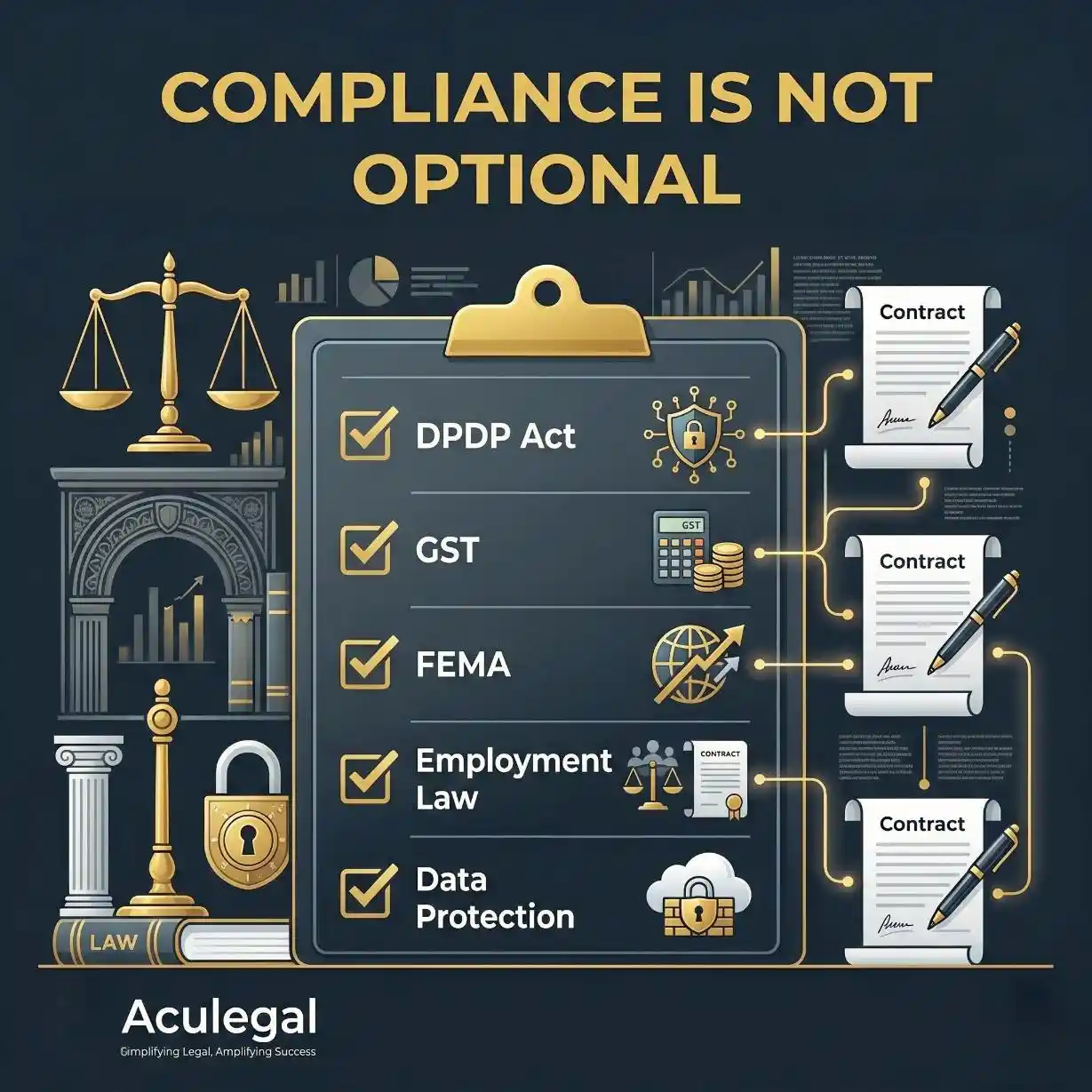
Key compliance areas for Indian startups and SMEs:

  • Data protection and privacy obligations (DPDP Act, 2023)
  • GST compliance and financial record-keeping
  • FEMA compliance for foreign investment and cross-border transactions
  • Sector-specific licensing (fintech, edtech, healthtech, and others)
  • Employment law and labour code compliance

Compliance is not a one-time event. It’s an ongoing operational function, and the earlier you build it in, the cheaper it is to maintain.

5. Fundraising Readiness: Your Legal Due Diligence Checklist

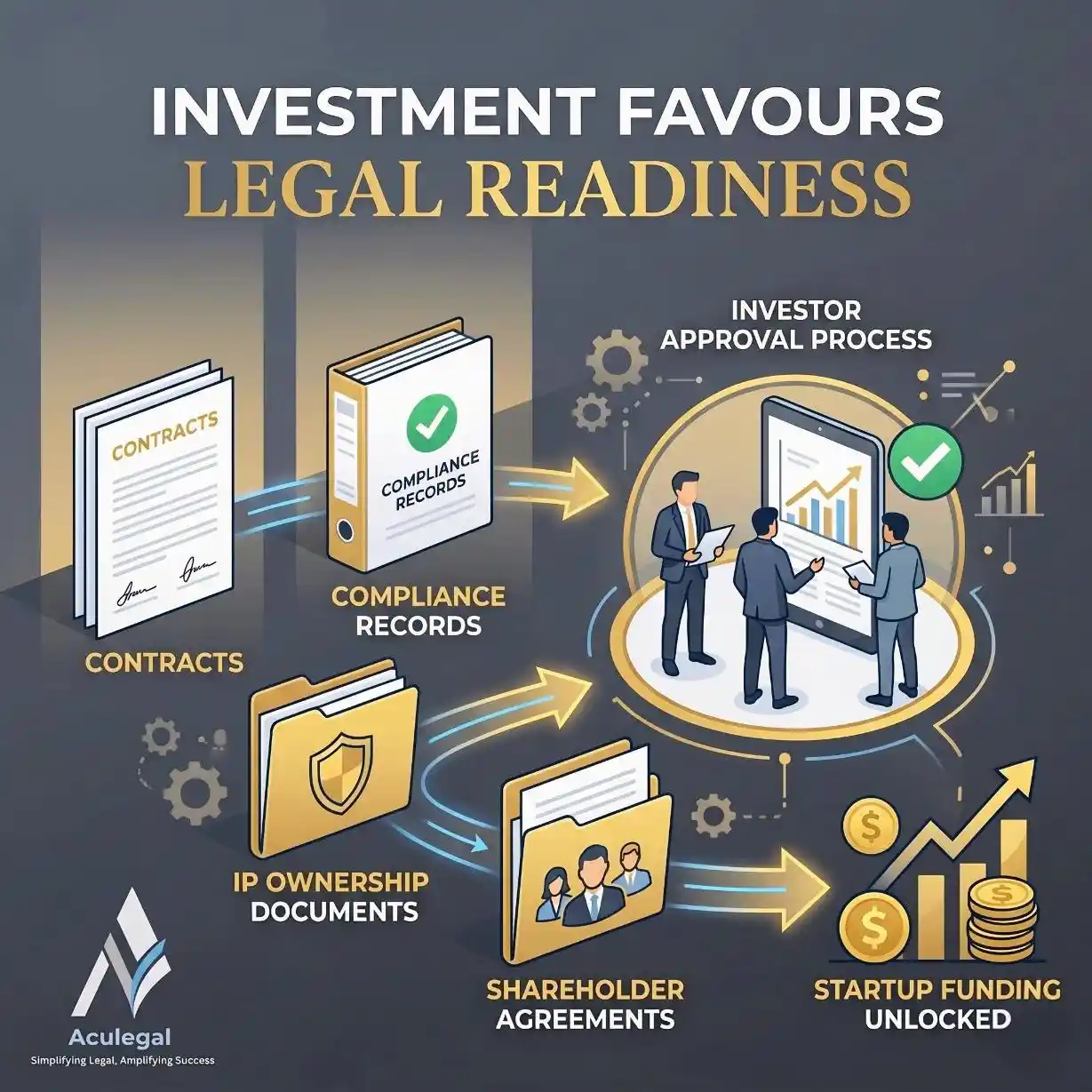
The moment you enter a fundraising conversation, you are also entering a legal audit. Investors and their counsel will examine your corporate documents, cap table, IP ownership, contracts, employment agreements, and compliance status before a single rupee is wired.

What investors expect to find:

  • Clean, properly documented equity structure with vesting schedules
  • All IP formally assigned to the company
  • No unresolved founder or employee equity disputes
  • Proper regulatory filings and statutory compliance
  • Signed NDAs and confidentiality agreements with relevant parties

Founders who delay building this legal foundation often find themselves scrambling to fix three to four years of gaps in the four weeks before a funding close, a process that’s stressful, expensive, and sometimes fatal to the deal.

Is your startup investor-ready? Book a legal health check with Aculegal → Startup Legal Audit / Investor Readiness ServicesStartup passing investor due diligence with organized legal documentation.

The Hidden Cost of Skipping Legal Infrastructure

Here’s a number worth keeping in mind: Arnold LaRochelle law firm’s research on first-year startup legal mistakes consistently shows that legal problems identified at the point of crisis cost five to ten times more to resolve than they would have to prevent, in legal fees, in equity given up to settle disputes, in time lost from building.

The startups that scale without catastrophic legal interruptions are not the ones that got lucky. They’re the ones that treated legal infrastructure as a priority from day one.

Legal neglect compounds in three specific ways:

  1. Operational paralysis – Disputes over equity, IP, or contracts can halt decision-making at exactly the moment speed matters most.
  2. Investor deal failure – Due diligence findings that surface late in a fundraising process frequently kill deals that took months to build.
  3. Founder dilution and liability – Poorly structured agreements mean founders absorb risk that should have been managed at the company level.

What “Legal Infrastructure” Actually Looks Like in Practice

For a founder in the early stages of building, legal infrastructure for startups doesn’t need to be a 200-page document or a year-long engagement. It looks like a focused, structured effort across six to twelve months to get the right things in place, and a reliable legal partner who understands your stage and your sector.

At pre-seed / early stage:

  • Company formation with the correct entity type
  • Co-founder agreement with vesting provisions
  • IP assignment for all contributors
  • Basic NDA and contractor template agreements

At seed stage / first hires:

  • Employment agreements with IP and non-compete clauses
  • Customer contracts and standard terms
  • Data protection policy and compliance framework
  • Cap table documentation and shareholder register

At Series A/growth stage:

  • Full governance documentation
  • Investor rights agreement and shareholder protections
  • Regulatory compliance audit
  • Legal health check ahead of fundraising

Each stage builds on the last. The founders who move into a funding conversation with clean legal infrastructure consistently reach a close faster, negotiate from strength, and retain more equity.

Simplifying Legal. Amplifying Success.

At Aculegal, we work with founders, startups, and SMEs who are serious about building companies, not just products. Our approach is built around one principle: legal infrastructure for startups should be a growth enabler, not a growth blocker.

We combine deep startup law expertise with a practical, business-first mindset. We speak your language, work at your pace, and structure legal solutions around where you’re going, not just where you are.

Whether you’re incorporating a new venture, preparing for your first fundraise, or cleaning up legal gaps before a growth phase, Aculegal is the legal partner built for founders who move fast and think long-term.

Conclusion: Build the Product. Protect the Company.

Every great startup story starts with a product. But the ones that make it, that raise funding, retain talent, defend their IP, and build lasting value, are the ones that built legal infrastructure alongside the product, not after it.

The five pillars are clear: company formation, IP protection, contracts, compliance, and fundraising readiness. Each one is preventable before it becomes a problem. Each one is expensive after it does.

Legal infrastructure for startups is not a luxury for later. It’s a decision you make now, and a decision that compounds in your favour every year you get it right.A startup protected by legal infrastructure creating long-term competitive advantage.

📞 Ready to Build Your Legal Foundation?

Book a free consultation with Aculegal today. Our startup-focused legal team will assess your current position, identify the gaps, and give you a clear roadmap, in plain language, without the jargon.

👉 Book Your Free Consultation →

Aculegal

Simplifying Legal. Amplifying Success.

Web Sources Referenced:

  1. TechCrunch — Startup founders often make these legal mistakes: https://techcrunch.com/2024/01/09/startup-founders-often-make-these-legal-mistakes/
  2. LegalNodes — 7 Most Common Legal Mistakes During Investor Due Diligence: https://www.legalnodes.com/article/startup-investor-due-diligence
  3. Faison Law Group — 10 Legal Mistakes Startups Make When Raising Seed or Series A: https://faisonlawgroup.com/blog/10-legal-mistakes-startups-make-when-raising-seed-or-series-a-funding/
  4. StartupNation — 15 Legal Mistakes First-Time Founders Should Avoid: https://startupnation.com/manage-your-business/legal-insurance-compliance/15-legal-mistakes-first-time-founders-should-avoid/
  5. Crunchbase — Regulation as Alpha: Why Startups Build Legal Strategy Into Their DNA: https://news.crunchbase.com/startups/legal-strategy-federal-regulation-solomon-amplify/

Your Next Business Challenge May Already Be Hidden in a Contract You Signed Months Ago

contract review for startups

Contract review for startups is not a box you tick at the end of a deal. It’s a strategic weapon, or when neglected, a slow-burning liability. The contract you rushed through six months ago may be quietly limiting your equity, exposing your IP, or locking you into terms you never intended to honor.

Most founders don’t lose their businesses in a courtroom. They lose them in a PDF. A single poorly drafted clause in a vendor agreement, a vague termination provision in a co-founder contract, or an undefined IP assignment in a freelancer agreement can unravel years of work in a matter of months.

If you’re a startup founder, SME owner, or early-stage business leader, this is the legal conversation no one’s having with you, until it’s too late. At Aculegal, we’ve seen it firsthand. And we’re here to change that.

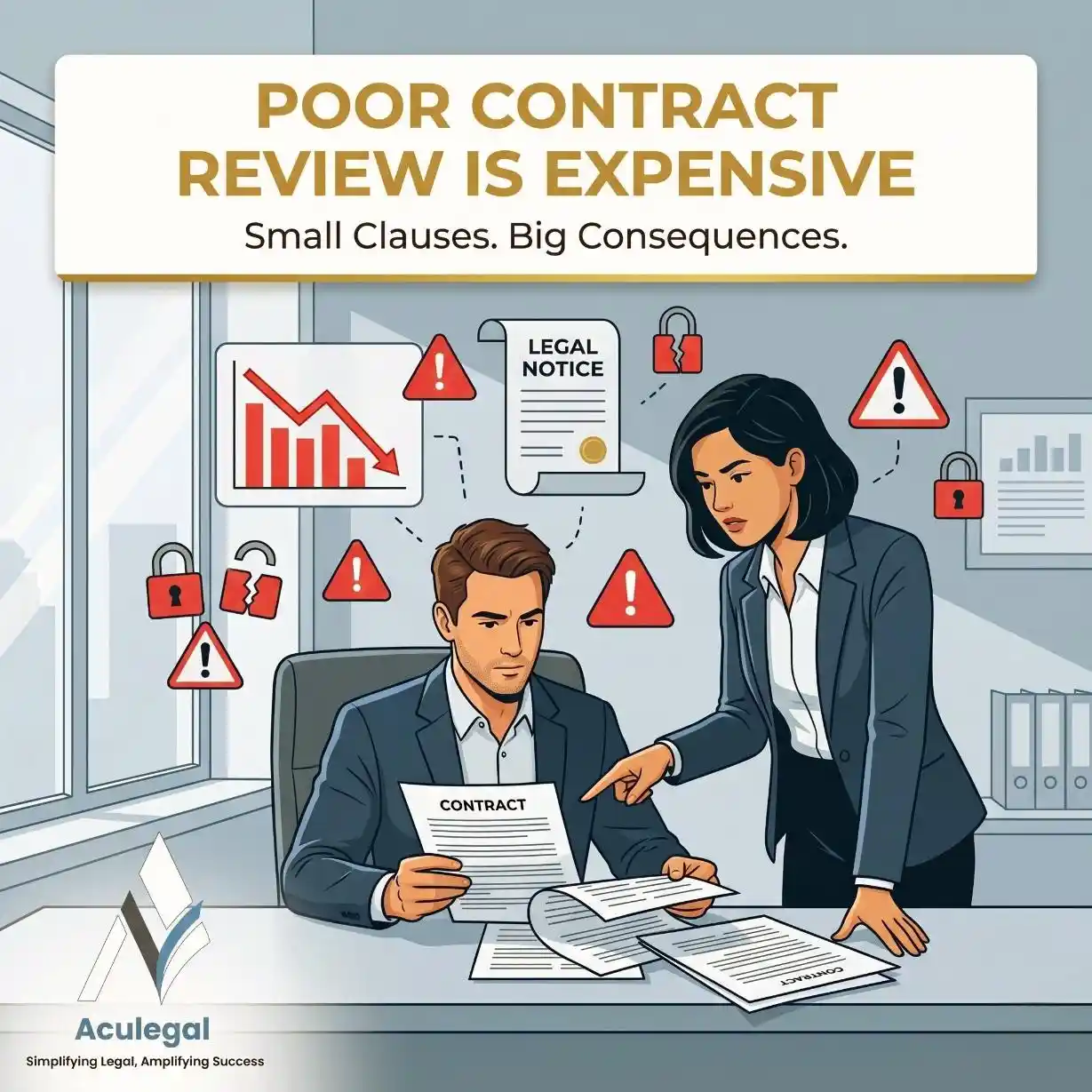
How Poor Contract Review Increases Legal and Financial ExposureBusiness owner facing financial losses due to poor contract review

Let’s be direct: most early-stage businesses treat contracts as formalities. You get a template, make minimal edits, both parties sign, and move on. That approach works until it doesn’t.

The problem isn’t just what a contract says. It’s what it doesn’t say. Ambiguous language doesn’t sit neutrally; it becomes ammunition for the side with more resources, better legal counsel, or less to lose.

57%of SMEs have experienced a contract dispute that cost them money or time

3–5×the cost to litigate a contract vs. reviewing it upfront

1 in 3startup failures involve a contractual or legal dispute at some stage

The Clauses That Are Quietly Costing YouFounder discovering hidden contract clauses creating business risks

Here are the most common contract vulnerabilities we see in early-stage businesses:

  • Undefined IP ownership clauses: When your developer, designer, or contractor builds something for you, who owns the final product? If the contract doesn’t specify, you may not.
  • Auto-renewing vendor agreements: You assumed you could cancel after 12 months. The agreement says 90 days’ notice, minimum 24 months, and you missed the window.
  • Vague non-compete or exclusivity provisions: Broad exclusivity can block you from pivoting, partnering with new clients, or entering adjacent markets.
  • No limitation of liability cap: One data breach, one missed delivery, and you’re exposed to damages that could exceed the total value of the contract.
  • Jurisdiction misalignment: Your contract says all disputes go to courts in a different state or country. Your ability to defend yourself just became exponentially more expensive.

The honest truth: These aren’t edge cases. They’re patterns Aculegal’s legal team encounters regularly in contracts submitted by founders who thought they’d covered their bases.

Why Founders and SMEs Avoid Proper Contract Review,  And Why That Logic Is BrokenStartup founders discussing common misconceptions about legal contract review

There are three reasons startups skip thorough contract review. Let’s address all three, and dismantle them.

1. “We Can’t Afford a Lawyer Right Now”

This is the most common objection, and the most costly assumption. The question isn’t whether you can afford legal review upfront. It’s whether you can afford a dispute, broken partnership, or legal claim later.

According to McKinsey’s Risk & Resilience research, the cost of resolving a commercial dispute after it escalates is typically 3–5x higher than prevention. Preventive legal review is ROI-positive, full stop.

2. “We Trust the Other Party”

Trust is critical in business. But trust doesn’t survive a change in ownership, a cash crunch, or a disagreement over deliverables. Contracts aren’t written for good days, they’re written for the bad ones.

The International Chamber of Commerce reports that the majority of commercial arbitration cases involve parties who had long-standing business relationships. Trust is not a substitute for clarity.

3. “Templates Are Good Enough”

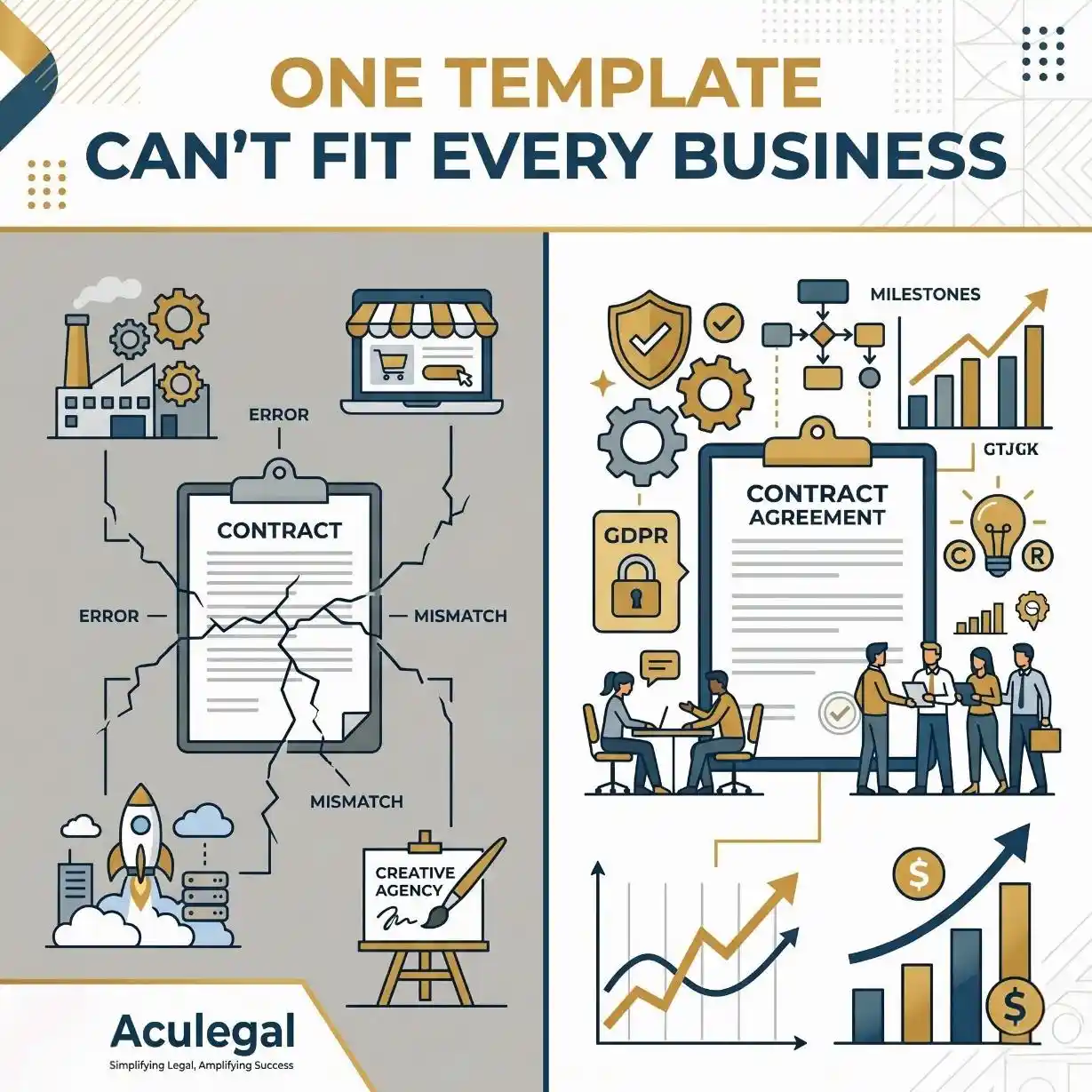
Templates are starting points. They’re built for generic use cases, not your industry, your jurisdiction, your deal structure, or your risk profile. A template SaaS agreement is not a substitute for a properly reviewed software services contract that reflects your actual obligations and protections.

Need a contract reviewed before you sign? Explore Aculegal’s Contract Review Services, which cover NDAs, founder agreements, vendor contracts, and commercial deals with fast turnaround and business-first advice.

The Strategic Framework: What Proper Contract Review Actually CoversLegal professional explaining six dimensions of contract review to startup founders

Strong contract review for startups is not just about finding errors. It’s about understanding what you’re agreeing to, strategically, financially, and operationally.

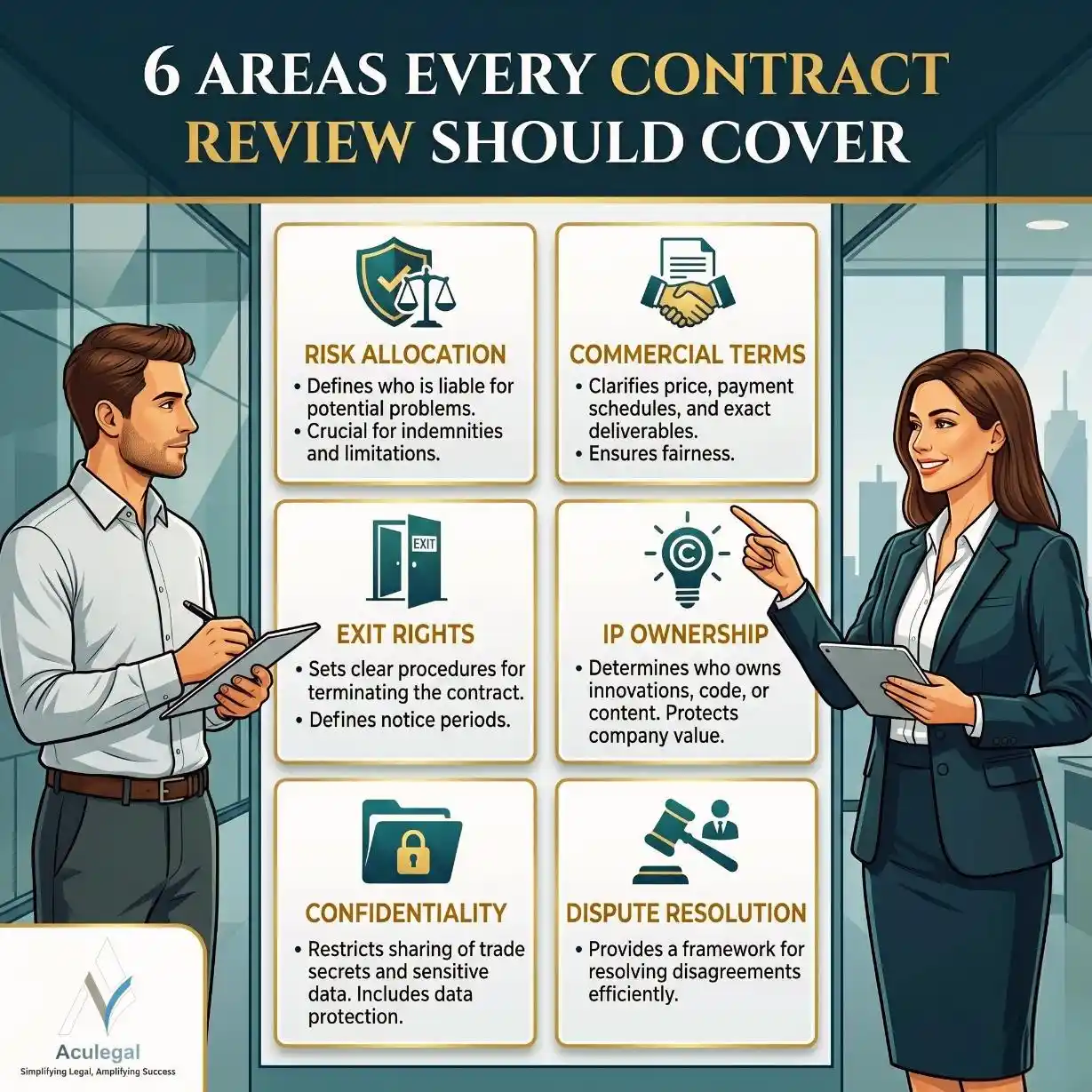
At Aculegal, a proper contract review covers six dimensions:

  1. Risk Allocation – Who bears liability for what, under which circumstances, and at what cap?
  2. Commercial Terms – Are payment timelines, milestones, and deliverables clear enough to enforce?
  3. Exit and Termination Rights – Can you exit cleanly, at low cost, without being locked in indefinitely?
  4. Intellectual Property – Are ownership, licensing, and usage rights unambiguous for all outputs?
  5. Confidentiality & Data – Is your proprietary information properly protected? Are data handling obligations clearly defined?
  6. Governing Law & Dispute Resolution – If something goes wrong, where and how will it be resolved?

Each of these dimensions represents a category of risk that could materially impact your business. Reviewing only the commercial terms, which most founders do, leaves five other risk categories unaddressed.

What “Red Flags” Look Like in Practice

Red flags aren’t always dramatic. Sometimes they’re mundane-looking phrases that carry disproportionate weight:

  • “All intellectual property created under this agreement becomes the sole property of the Client”, This can strip you of your own technology or processes if you’re not careful about scope.
  • “Either party may terminate with 30 days’ notice”, Fair on the surface; not if your deliverables require 90-day lead times or you’ve incurred upfront costs.
  • “Governing Law: Delaware / England / Singapore”, Legitimate for some deals, expensive for an early-stage Indian startup defending itself in a foreign jurisdiction.

According to the International Association for Contract & Commercial Management (IACCM), companies that invest in structured contract management report up to 9% improvement in revenue protection. Contract review isn’t overhead; it’s a value-preservation strategy.

The Hidden Cost of IP Exposure for Tech Startups and SaaS Founders

If your business is technology-driven, IP risk deserves special attention. IP ownership disputes are among the most expensive legal battles a startup can face. They can delay funding rounds, block acquisitions, and spook investors at the worst possible moment.

IP exposure typically arises from three sources:

  • Contractor agreements without explicit work-for-hire or IP assignment clauses
  • Co-founder agreements where contributions aren’t clearly attributed and vested
  • Licensing agreements with open-source or third-party software that impose unexpected restrictions on commercial use

The World Intellectual Property Organization (WIPO’s SME resource centre) highlights IP clarity as one of the top three legal priorities for growing businesses. Aculegal’s approach ensures that before you scale, you actually own what you’ve built.

Concerned about IP ownership in your tech contracts? Aculegal’s IP Advisory Services help founders lock down ownership, manage licensing risk, and structure IP clauses that protect your competitive edge.Tech startup founder protecting intellectual property and software ownership rights

When to Bring in Legal Counsel: A Practical Timeline for Founders

Most founders ask the wrong question: “Do I need a lawyer for this contract?” The right question is: “What’s the cost if this contract goes wrong without legal review?”

Here’s a practical framework for when to prioritize legal review:

Stage 1: Incorporation and Founder Agreements (Pre-Revenue)

Before you build anything or bring on team members, founder agreements and shareholder documents must be legally watertight. This is where most equity disputes originate.

Stage 2: First Vendor and Client Contracts (Early Revenue)

Your first paying customer relationship sets the tone for all future agreements. Don’t use a verbal understanding or a template when real revenue is at stake. Proper contract review here protects your payment terms, deliverable scope, and liability exposure.

Stage 3: Growth-Phase Agreements (Scaling)

Partnership agreements, SaaS subscription terms, employment and NDA frameworks, and investor side letters all require structured legal review as you scale. One poorly written partnership agreement at this stage can dilute your control or limit your strategic flexibility.

Stage 4: Pre-Investment or M&A Due Diligence

Investors and acquirers conduct legal due diligence. Every contract in your data room will be scrutinized. Problematic clauses, even from two years ago, can kill a deal or force you into renegotiations at the worst possible time.

The Aculegal Difference: Legal Advice That Speaks Business

Most founders don’t want a lecture on the law. They want to know: what does this clause actually mean for my business, my money, and my next move?

That’s the Aculegal philosophy. We don’t translate legalese into more legalese. We translate it into business decisions.

Our approach to contract review is built around four principles:

  • Speed without corners cut: We deliver reviews with context and clarity, not just a redline with no explanation.
  • Commercial awareness: Our team understands startups, funding structures, SaaS models, and growth dynamics, not just black-letter law.
  • Proactive risk identification: We don’t just flag what’s wrong. We explain the real-world consequences and offer alternative drafting suggestions.
  • Accessible, transparent pricing: No mystery billing. No hidden hourly charges that make you afraid to ask a follow-up question.

According to World Bank research on business enabling environments, access to affordable legal services is one of the defining factors in startup survival and growth in emerging markets. Aculegal exists to close that gap for Indian founders and SMEs.

Conclusion: The Contract You Overlooked Is the Risk You’re Carrying Right Now

Here’s what this comes down to: contract review for startups is not a luxury for when you have more time or more money. It is the strategic baseline that protects everything you’ve built.

The risks are real. The clauses are already in your agreements. The question is whether you find them before they find you.

Let’s recap what we covered:

  • Poor contract review exposes you to financial, legal, and IP risk that compounds over time
  • The three founder objections to legal review, cost, trust, and templates are all false economies
  • Proper review covers six dimensions: risk, commercial terms, exit rights, IP, confidentiality, and jurisdiction
  • IP exposure is a startup-killer that often hides in plain-language contractor and co-founder agreements
  • Legal review at the right stage, not just any stage, is what separates companies that scale from companies that stall

Aculegal

Simplifying Legal. Amplifying Success.

We work with founders, startups, and SMEs who want legal counsel that actually speaks their language and protects their business like a partner, not a vendor.Startup founder receiving legal guidance to prevent future contract disputes

Don’t Let a Contract Clause Be Your Next Business Crisis

Book a free consultation with Aculegal today. We’ll review your most pressing contract, flag the risks, and give you a clear path forward, in plain English, with commercial context.

Book Your Free Consultation →

References & Sources

  1. McKinsey — Risk & Resilience Insights
  2. International Chamber of Commerce — Dispute Resolution
  3. IACCM — International Association for Contract & Commercial Management
  4. WIPO — IP Resources for SMEs and Startups
  5. World Bank — Business Enabling Environment Program

Why Startups Should Stop Using Downloaded Legal Templates

downloaded legal templates

Introduction

Downloaded legal templates are costing startups more than they save.

You found a free NDA on Google. You tweaked a co-founder agreement from Reddit. You used a client contract template from a legal blog, one that was written for a business in a different country, a different industry, and a different decade.

This is how most early-stage startups handle legal documentation. And this is exactly where the cracks begin.

The hard truth: a legal template downloaded off the internet is designed for everyone, which means it’s optimized for no one. It doesn’t account for your shareholding structure, your payment terms, your IP ownership model, or the regulatory environment you operate in. When a dispute arises, and at some point, it will, that generic document won’t hold.

At Aculegal, our positioning is simple: Simplifying Legal. Amplifying Success. That means helping founders like you build a legal foundation that actually works, not one that merely appears to be in place.Hidden costs and risks of free legal templates for startups

The Real Cost of “Free” Legal Templates

They’re Not Built for Your Business Model

Most templates circulating online are written for generic B2B or B2C scenarios in Western markets. If you’re running a SaaS startup in India, a marketplace platform, or a service-led SME with complex vendor relationships, those documents weren’t designed with your operational reality in mind.

A standard employment contract template, for example, may not include clauses relevant to Indian labour law, ESOP structures, or remote-work IP ownership, all critical concerns for growing tech companies.

What gets missed most often:

  • Jurisdiction-specific clauses (Indian Contract Act, IT Act, FEMA regulations)
  • IP assignment provisions tailored to your product
  • Termination and exit clauses that reflect your actual agreements
  • Dispute resolution mechanisms that work in your geography

According to a Business Today survey, contract disputes are among the top five reasons Indian startups face unexpected legal costs in their first three years.Generic legal templates versus customized startup contracts

One Clause Can Undo Everything

Contracts are only as strong as their weakest clause. A single ambiguous term around payment liability, IP ownership, or termination notice can invalidate your entire agreement, or at minimum, make it unenforceable in court.

Here’s a scenario founders often discover too late: a co-founder leaves and claims ownership of the core product because the founders’ agreement downloaded from a template site had no proper IP assignment clause. What looked like a formality on paper becomes a multi-month legal dispute.

The Inc42 Startup Legal Mistakes Report highlights that over 60% of early-stage Indian startups have used generic contracts, and a significant portion face legal complications as a result.How one weak contract clause can create major startup legal risks

How Customized Contracts Help Startups Scale Safely

Stage-by-Stage Legal Infrastructure

A startup in pre-seed has different legal needs than one entering Series A. Customized contracts evolve with your business. They’re structured to protect you at your current stage while remaining flexible enough to adapt as you grow.

Here’s what stage-appropriate legal documentation looks like:

  1. Pre-incorporation / Ideation Stage – Co-founder agreements, confidentiality agreements, IP assignment documents
  2. Early Revenue Stage – Client service agreements, vendor contracts, employee offer letters with ESOP clauses
  3. Scaling Stage – Master Service Agreements (MSAs), SLAs, partnership agreements, data processing agreements (especially for DPDP compliance)
  4. Fundraising Stage – Term sheet review, shareholder agreements, due diligence documentation

Aculegal Startup Legal Packages

Protecting IP Before It’s Too Late

Your intellectual property, code, brand, proprietary methodology, and content are your most valuable assets as a startup. Most template contracts either skip IP clauses entirely or include boilerplate language that fails to clearly define ownership.

Custom contracts ensure:

  • All IP developed by employees and contractors is clearly assigned to the company
  • Founders’ pre-existing IP is properly disclosed and distinguished
  • Client work doesn’t inadvertently transfer ownership of your core product

As noted by the World Intellectual Property Organization (WIPO), startups that fail to address IP ownership in early-stage agreements routinely face disputes that impede fundraising and acquisition conversations later.Intellectual property protection for startups and founders

Contracts That Actually Reflect Your Deals

When you negotiate a deal with a client, partner, or investor, you’re not negotiating a generic deal. You’re negotiating your deal. A customized contract reflects the actual terms agreed upon, removes ambiguity, and gives both parties a clear framework for the relationship.

Downloaded legal templates create gaps between what was agreed verbally and what’s documented legally. That gap is where disputes live.

A well-drafted contract also signals professionalism. Investors, enterprise clients, and serious partners notice the difference between a polished, jurisdiction-appropriate agreement and a visibly generic template.

Regulatory Compliance Is Non-Negotiable

India’s regulatory environment for startups is evolving rapidly. DPDP Act (Digital Personal Data Protection Act), FEMA, SEBI regulations, GST compliance clauses; these are not optional extras. They are baseline requirements that must be reflected in your contracts if you’re doing business at any meaningful scale.

A downloaded template from 2018 or even 2022, almost certainly doesn’t account for the 2023 DPDP Act or updated SEBI guidelines for startup fundraising. Outdated templates create compliance gaps that regulators and counterparties can exploit.

The Ministry of Electronics and Information Technology (MeitY) has outlined strict data handling requirements under the DPDP Act that must now be included in vendor agreements, employee contracts, and client service agreements.Startup compliance and regulatory contract requirements in India

What Founders Get Wrong About Legal Costs

“We’ll Fix It When We Raise”

This is one of the most common and most expensive misconceptions in early-stage startup culture. Investors conduct legal due diligence. When they find poorly structured contracts, missing IP assignments, or non-compliant agreements, they don’t overlook it. They either walk away or demand heavily discounted valuations to account for legal risk.

Fixing legal issues during due diligence is 5–10x more expensive than getting it right from the start.

Legal Is an Investment, Not a Line Item

A customized legal foundation is not an expense. It’s an asset. Properly drafted contracts protect revenue, preserve equity, reduce liability, and support fundraising. That’s not a legal cost, that’s a business return.

Harvard Business Review notes that startups that invest in proper legal infrastructure early significantly reduce operational disruptions and are better positioned for institutional investment.

A Simple Framework: What Your Startup Contracts Should Cover

Whether you’re drafting your first client agreement or preparing for a funding round, here’s a baseline checklist for startup contracts:

Foundational Documents

  • Co-founder agreement with IP assignment and vesting schedule
  • Shareholders’ agreement
  • Employment contracts with IP, confidentiality, and non-compete clauses

Operational Contracts

  • Client service agreements / Master Service Agreements
  • Vendor and supplier contracts
  • Freelancer / contractor agreements

Compliance-Linked Documents

  • Privacy policy and terms of service (DPDP-compliant)
  • Data processing agreements for B2B clients
  • ESOP plan documentation

Conclusion: Build on a Foundation That Holds

Downloaded legal templates are a false economy. They save a few thousand rupees upfront and cost multiples of that in disputes, delays, compliance failures, and lost deals, over time.

As a founder or SME leader, your legal documentation isn’t paperwork. It’s infrastructure. It defines your relationships, protects your assets, and positions your business for the growth you’re working toward.Build a strong legal foundation for startup growth

Startups that scale safely are the ones that take legal seriously from day one, not as an afterthought, but as a strategic advantage.

At Aculegal, we work with founders, startups, and SMEs to build legal frameworks that are practical, jurisdiction-appropriate, and built for how your business actually operates. Simplifying Legal. Amplifying Success.

📞 Ready to Build Contracts That Actually Protect Your Business?

Stop relying on templates that weren’t built for you.

Book a Free Legal Consultation with Aculegal, and get expert guidance on the contracts your startup needs right now.

Whether you need a co-founder agreement, client contracts, or a full legal audit before your next fundraise, our team is ready to help.

👉 Explore Aculegal’s Startup Legal Services →

Published by Aculegal | Simplifying Legal. Amplifying Success.

AI + Human Expertise: The New Era of Legal Process Outsourcing

legal process outsourcing

Introduction: The Legal Cost Problem Founders Can’t Ignore

Legal Process Outsourcing is no longer a buzzword reserved for Fortune 500 boardrooms, it’s the strategic move that smart founders and scaling SMEs are making right now.

Here’s the reality: legal work is consuming an increasingly large slice of your operating budget, and traditional law firms weren’t built for the pace of modern business. Hourly billing models, slow turnaround times, and rigid retainer structures are relics of a pre-digital era.

Meanwhile, the global Legal Process Outsourcing (LPO) market is projected to surpass $40 billion by 2027, according to Grand View Research, and the catalyst is a powerful combination of AI automation and seasoned human legal expertise.

At Aculegal, our positioning is simple: “Simplifying Legal. Amplifying Success.” This blog unpacks exactly why the AI + human model of LPO is the smartest, most cost-effective legal strategy available to growing businesses today.

How AI Is Transforming Modern Legal Process Outsourcing (LPO)AI reviewing contracts with legal professionals supervising in modern office

The integration of AI into legal services isn’t a distant future, it’s already reshaping how legal work gets done, priced, and delivered. For founders and SMEs, this shift represents a rare opportunity to access enterprise-grade legal support without enterprise-level fees.

What AI Actually Does in Legal Work

AI tools in LPO environments are built for volume, precision, and speed. Here’s where AI delivers the most impact:

  • Contract review and analysis – AI can scan, flag, and summarise thousands of contracts in the time it takes a junior associate to review a dozen.
  • Legal research automation – Natural language processing (NLP) tools pull case law, regulations, and precedents in minutes, not days.
  • Document drafting assistance – Templates powered by machine learning ensure consistent language, reducing human error.
  • Compliance monitoring – AI systems continuously scan regulatory updates across jurisdictions, alerting your team to changes in real time.
  • Due diligence support – Data-room reviews that once took weeks can now be compressed into days.

McKinsey’s State of AI Report found that legal and compliance functions rank among the top three enterprise areas where AI delivers measurable productivity gains. That’s not theoretical, that’s dollars saved and hours reclaimed.

Why AI Alone Isn’t EnoughExperienced legal advisor analyzing complex contracts with AI assistance

Here’s where most tech-first LPO providers get it wrong.

AI is a tool, not a lawyer. It cannot exercise judgment, understand context, or take professional accountability for legal advice. An AI system trained on US contract law doesn’t automatically understand the nuances of your jurisdiction’s corporate governance requirements. It doesn’t know your business relationships, your risk tolerance, or the commercial realities behind a clause it flags as “non-standard.”

This is why the AI + human expertise model isn’t just a selling point, it’s the only responsible framework for delivering quality legal work at scale.

The Human Side: Where Legal Expertise Becomes a Competitive Advantage

The best LPO providers aren’t replacing lawyers with algorithms. They’re equipping experienced legal professionals with AI tools to deliver faster, smarter, and more affordable outcomes.

What Skilled Legal Professionals Bring to the Table

  • Contextual judgment — Understanding what a contract clause actually means for your business, not just what it says.
  • Negotiation strategy — Knowing which red lines to hold, which to concede, and how to frame positions commercially.
  • Regulatory interpretation — Applying the law to your specific situation, not just citing it.
  • Risk assessment — Evaluating legal exposure in the context of your industry, growth stage, and commercial goals.
  • Relationship management — Acting as an extension of your business with counterparties, regulators, and courts.

Deloitte’s report on the future of legal functions confirms that the highest-value legal work, strategy, judgment, and stakeholder management, cannot be automated. What AI removes is the low-value, time-consuming work that used to consume most of a legal team’s capacity.

The Compounding Benefit: Speed + Quality + Cost

When AI handles the heavy lifting of research, review, and drafting, human legal experts can focus entirely on strategic, high-impact work. The result for your business:

  1. Faster turnaround – Contracts reviewed in hours, not weeks.
  2. Higher accuracy – Dual-layer checking (AI + human) reduces error rates.
  3. Predictable pricing – Flat-fee and subscription models replace unpredictable hourly billing.
  4. Scalability – Legal support that grows with your business, not against it.

Why Startups and SMEs Are the Biggest WinnersStartup founders discussing legal growth strategy with outsourced legal team

Larger corporations have always had legal departments. Startups and SMEs have historically had to choose between underprotecting their business or overpaying for legal support. That trade-off no longer exists.

The Hidden Legal Risks Founders Underestimate

Most founders don’t face a legal crisis until it’s already expensive. Common scenarios include:

  • Poorly drafted shareholder agreements that trigger disputes during funding rounds
  • Employment contracts that don’t reflect actual roles, leading to termination exposure
  • IP assignments that aren’t correctly executed, creating ownership ambiguity at exit
  • Non-disclosure agreements with weak jurisdiction clauses that are unenforceable
  • Commercial contracts with auto-renewal clauses nobody noticed until the invoice arrived

According to <a href=”https://hbr.org/2021/02/why-startups-fail” rel=”nofollow” target=”_blank”>Harvard Business Review’s research on startup failure</a>, legal and regulatory non-compliance consistently feature among the top operational reasons early-stage companies fail or stall.

How LPO Levels the Playing Field

Legal Process Outsourcing gives SMEs access to the same quality of legal infrastructure that multinationals use, without the full-time salary costs or premium law firm rates.

With an LPO partner like Aculegal, your business benefits from:

  • On-demand legal support scaled to your needs and budget
  • Specialist expertise across corporate, commercial, employment, and IP law
  • Process-driven delivery that creates consistency and reduces risk
  • Technology integration that keeps your legal workflows efficient and auditable

📌 Link to Aculegal’s Corporate Legal Services page : “corporate and commercial legal support

What Legal Process Outsourcing Actually Looks Like in PracticeContract lifecycle management and legal workflow automation in modern business

Let’s make this concrete. Here are the core LPO service areas where AI + human expertise delivers the most value for growing businesses.

1. Contract Lifecycle Management

From drafting and negotiation to execution and renewal tracking, contract management is often the single biggest source of legal inefficiency in a scaling business. LPO providers use AI-assisted contract management platforms, reviewed by qualified solicitors, to ensure every agreement is watertight and commercially sound.

2. Corporate Secretarial and Compliance

Board resolutions, statutory filings, regulatory submissions, and company secretarial records are essential but often overlooked. Falling behind on compliance obligations creates real legal exposure, particularly during due diligence in funding or acquisition processes.

3. Employment and HR Legal Support

Employment law is one of the most frequently litigated areas for SMEs. Outsourcing HR legal documentation, employment contracts, handbooks, and dispute management to a specialist LPO team dramatically reduces tribunal risk and ensures you stay compliant with evolving legislation.

4. Intellectual Property Management

For tech startups, creative agencies, and product businesses, IP is often the most valuable asset on the balance sheet, and the most vulnerable. LPO services covering trademark monitoring, IP assignments, licensing agreements, and enforcement strategies protect that value systematically.

5. Due Diligence Support

Whether you’re raising investment, acquiring another business, or preparing for exit, due diligence is where legal bottlenecks destroy deal momentum. AI-assisted document review, combined with expert legal oversight, compresses timelines and maintains quality.

The Numbers Don’t Lie: What Businesses Are SavingBusiness leaders reviewing legal cost savings through AI-powered LPO services

Industry data consistently supports the business case for LPO:

  • Up to 60% cost reduction in routine legal work compared to traditional law firm rates, according to Thomson Reuters’ LPO Benchmarking Report
  • 40–70% faster document processing using AI-assisted review workflows
  • 3x improvement in contract cycle times when LPO teams replace ad-hoc internal processes
  • Significant reduction in compliance-related penalties for businesses with proactive outsourced monitoring

These aren’t marginal efficiency gains, they’re fundamental improvements in how legal work is delivered and priced.

Choosing the Right LPO Partner: What to Look For

Not all LPO providers are created equal. As you evaluate options, look for:

  • Qualified legal professionals (not just paralegals or offshore document processors)
  • Transparent, fixed-fee pricing structures
  • Sector expertise relevant to your business model and jurisdiction
  • Technology infrastructure that integrates with your existing tools
  • Demonstrable track record with businesses at your stage

The right LPO partner functions as a strategic legal extension of your team, not a vendor who processes documents from a distance.

Conclusion: Your Legal Strategy Is a Growth Strategy

Legal Process Outsourcing has entered a new era, and businesses that embrace the AI + human expertise model will build faster, scale smarter, and protect their value more effectively than those that don’t.

The choice is no longer between expensive law firms and unprotected growth. The choice is between reactive, costly, ad-hoc legal management, and proactive, efficient, LPO-powered legal operations.

At Aculegal, we believe that legal support shouldn’t slow businesses down. It should be the infrastructure that accelerates them.

Simplifying Legal. Amplifying Success.Professional legal consultation meeting with AI-enabled legal support team

📞 Ready to Rethink Your Legal Operations?

Whether you’re a founder closing your first funding round, a growing SME managing commercial contracts, or a business preparing for a transaction, Aculegal is built to support you.

👉 Book Your Free Legal Consultation with Aculegal Today

Explore our full range of services and discover how the AI + human model of Legal Process Outsourcing can become your most powerful operational advantage.

Sources referenced in this article:

  1. Grand View Research — LPO Market Forecast
  2. McKinsey — The State of AI
  3. Deloitte — The Legal Function of the Future
  4. Harvard Business Review — Why Startups Fail
  5. Thomson Reuters — LPO Benchmarking Report

Legal Process Outsourcing (LPO) for Startups: Reduce Legal Costs Without Hiring In-House

Legal Process Outsourcing (LPO) for Startups

Introduction

Legal Process Outsourcing (LPO) for startups is no longer a niche concept, it’s fast becoming the smartest competitive advantage in the business playbook.

You launched your startup to build, grow, and disrupt. But somewhere between your pitch deck and your first client contract, legal complexity crept in. Suddenly, you need NDAs, shareholder agreements, compliance reviews, IP registrations, and employment contracts, all before your team even hits double digits.

Hiring a full-time in-house legal counsel? That’s ₹30–60 lakhs per year, minimum. A senior partner at a top-tier law firm? Even more. For a founder watching every rupee, that math simply doesn’t work.

There’s a smarter way. And it’s the same approach global Fortune 500 companies have used for decades, now accessible to startups and SMEs at a fraction of the cost.

Why Startups and SMEs Are Choosing Legal Process Outsourcing (LPO) for Scalable Growth

Legal Process Outsourcing (LPO) for startups refers to the practice of delegating specific legal tasks, contract drafting, compliance management, legal research, due diligence, and more to a specialized external legal service provider.

Think of it as having a fully equipped legal department, without the overhead of running one.

According to a Grand View Research report, the global LPO market was valued at over USD 14 billion in 2023 and is expected to grow at a CAGR of 31% through 2030. Startups and SMEs are a significant driver of that growth,  and for good reason.Startup founder stressed over legal paperwork and compliance risks in office

The Real Problem: Legal Gaps Are Business Risks

Most early-stage founders underestimate legal exposure until it’s too late. A poorly drafted contract can cost you a key client. A missed compliance deadline can attract regulatory penalties. An unprotected trademark can be stolen by a competitor.

The legal risks that sink startups most often include:

  • Ambiguous co-founder agreements that lead to equity disputes
  • Contracts signed without understanding liability clauses
  • GDPR, DPDP Act, or sector-specific non-compliance
  • IP not registered early, leaving your core product unprotected
  • Employment agreements that don’t hold up when a dispute arises

These aren’t just legal problems. They’re business-survival problems.

What Does Legal Process Outsourcing Actually Cover?

LPO is not a one-size-fits-all service. For startups and SMEs, it typically encompasses a wide range of high-value legal work that would otherwise require multiple specialists.Legal professionals supporting startup contracts and compliance remotely

Core LPO Services for Startups

1. Contract Drafting and Review From founder agreements to SaaS contracts, vendor agreements to client MSAs, professional contract management ensures you’re protected at every deal stage.

2. Corporate Compliance Staying compliant with the Companies Act, RBI regulations, SEBI guidelines, or sector-specific rules is non-negotiable. LPO providers handle routine compliance calendars so nothing falls through the cracks.

3. Intellectual Property Support Trademark searches, patent filings, copyright registrations, your product is your asset. Protect it before someone else does.

4. Legal Research and Due Diligence Investor due diligence, M&A preparation, or regulatory research, LPO teams handle the heavy lifting so your core team stays focused on growth.

5. Employment and HR Legal Support Offer letters, POSH compliance, non-disclosure agreements, and termination documentation, all handled with precision.

Link to Aculegal’s “Contract Drafting & Review” service page here

The Financial Case: Why LPO Makes Business Sense

Let’s talk numbers, because this is ultimately a business decision.

In-House vs. LPO: The Cost Breakdown

Legal Requirement In-House Cost (Annual) LPO Cost (Annual)
Junior Legal Associate ₹8–15 Lakhs Not needed
Senior Counsel ₹30–60 Lakhs Not needed
Compliance Manager ₹12–20 Lakhs Included in LPO package
Infrastructure & Overheads ₹5–10 Lakhs ₹0
Estimated Total ₹55–1.05 Cr/year ₹3–15 Lakhs/year

Startup founder comparing in-house legal hiring costs with LPO servicesThe savings aren’t marginal; they’re transformational, especially in your first three to five years.



As reported by Thomson Reuters’ State of the Legal Market, organizations that use LPO models reduce legal operational costs by 25–40% while maintaining or improving legal output quality.

When Is the Right Time for a Startup to Use LPO?

The short answer: earlier than you think.

Many founders make the mistake of treating legal as a reactive function, something you address when a problem arises. But proactive legal strategy is a growth strategy.

Key Trigger Points for LPO Adoption

  • Pre-incorporation: Company structure, shareholding patterns, founders’ agreement
  • Early traction: First client contracts, vendor agreements, IP protection
  • Fundraising: Term sheet review, due diligence prep, SAFE/SHA agreements
  • Scaling: Employment contracts, data privacy compliance, cross-border contracts
  • Exit planning: M&A documentation, IP transfer, regulatory clearances

At every stage, having the right legal support on demand, at predictable costs, is the difference between a business that scales and one that stumbles.

According to Harvard Business Review, over 65% of startup failures involve legal disputes, governance gaps, or compliance breakdowns that could have been avoided with early-stage legal guidance.Startup growth stages supported by legal outsourcing services

How Aculegal Delivers LPO Differently

At Aculegal, we don’t just provide legal support, we embed ourselves into your business as a strategic partner. Our philosophy is simple: Simplifying Legal. Amplifying Success.

We’ve built our LPO model specifically for the needs of founders, startups, and growing SMEs in India’s fast-moving business landscape.

What Sets Aculegal Apart

  • Business-first mindset: Our team understands that legal advice must align with commercial goals, not just legal theory
  • Startup-specific expertise: We work across tech, SaaS, e-commerce, fintech, D2C, and professional services
  • Transparent, predictable pricing: No surprise invoices. Structured retainers designed for startup budgets
  • Speed and responsiveness: Turnaround times that match the pace of your business
  • End-to-end coverage: From incorporation to exit, we cover every legal touchpoint

Unlike traditional law firms that bill by the hour and operate in silos, Aculegal functions like a fractional legal department, giving you senior legal expertise without the senior-level price tag.

Common Myths About Legal Process Outsourcing, Debunked

There’s still some hesitation among founders about outsourcing legal work. Let’s address the most common misconceptions head-on.

Myth 1: “LPO is only for large corporations.” False. LPO was built for scale, and startups benefit even more because they can’t afford legal inefficiency at any stage.

Myth 2: “Outsourced legal teams won’t understand my business.” A quality LPO partner like Aculegal invests time in onboarding, understands your sector, and assigns dedicated teams, not random generalists.

Myth 3: “It’s cheaper to use a freelance lawyer.” Freelancers can’t provide the structured, multi-disciplinary support a growing business needs. LPO gives you depth, consistency, and accountability.

Myth 4: “Legal is a one-time need.” Compliance calendars, contract renewals, employment changes, regulatory updates, legal is an ongoing operational need, not a one-off task.

As noted by Forbes Business Council, startups that engage ongoing legal support from early stages are 3x more likely to close funding rounds without legal complications.

The Compliance Dimension: India’s Evolving Legal Landscape

For Indian startups, the regulatory environment has never been more complex or more consequential.

In 2023, India introduced the Digital Personal Data Protection (DPDP) Act, significantly raising the bar for data handling obligations. Meanwhile, SEBI continues to tighten governance standards for startups eyeing public markets, and the Ministry of Corporate Affairs regularly updates compliance requirements under the Companies Act.

Staying ahead of these changes isn’t just good practice, it’s a legal obligation. Non-compliance carries financial penalties, reputational damage, and in some cases, criminal liability for directors.

This is where LPO becomes particularly powerful. An experienced LPO partner proactively monitors regulatory changes, updates your legal frameworks, and ensures your business is always on the right side of the law.

For more on India’s evolving startup legal framework, refer to the Ministry of Corporate Affairs’ official startup portal.Aculegal legal team working closely with startup founders in collaborative office

5 Questions to Ask Before Choosing an LPO Partner

Not all LPO providers are equal. When evaluating a legal outsourcing partner, founders should ask:

  1. Do they have startup-specific experience – or do they primarily serve large enterprises?
  2. What is their turnaround time for urgent contracts or compliance queries?
  3. Is pricing transparent and structured – or are you going to be billed by the hour for every email?
  4. Do they assign a dedicated point of contact, or will you be speaking to a different person every time?
  5. Can they scale with you – from incorporation to fundraising to eventual exit?

Aculegal answers “yes” to all five. That’s not marketing, that’s our operating model.

Conclusion: Legal Clarity Is a Competitive Advantage

The smartest founders don’t wait for legal problems to find them. They treat legal infrastructure the same way they treat product infrastructure, as something that needs to be built right, from day one.

Legal Process Outsourcing (LPO) for startups is the most cost-effective, scalable, and strategic way to get there. It removes the financial burden of in-house hiring, gives you access to senior expertise on demand, and ensures your business is protected, compliant, and deal-ready at every stage.

At Aculegal, we’ve helped founders across India navigate incorporation, fundraising, compliance, contracts, and growth, all under one roof, at predictable costs, with a team that genuinely understands your world.

Simplifying Legal. Amplifying Success.Founder confidently scaling business with trusted legal outsourcing partner

Ready to Build a Legal Foundation That Scales With You?

Don’t wait for a legal problem to discover the value of legal strategy.

Whether you’re a pre-revenue startup, a scaling SME, or a founder preparing for your next funding round, Aculegal is ready to be your legal growth partner.

👉 Book Your Free Legal Consultation Today, No commitment. Just clarity.

Or explore our Startup Legal Packages, Contract Management Services, and Compliance Advisory Programs to see exactly how we can support your business.


Aculegal

Simplifying Legal. Amplifying Success.

Raising Foreign Capital Directly: The New Rules for IFSC Entities in GIFT City

IFSC share capital rules

Introduction

IFSC share capital rules for foreign capital raising just got a significant upgrade, and if you’re a founder, startup, or SME with any cross-border ambitions, you can’t afford to miss what’s changed.

India’s GIFT City International Financial Services Centre (IFSC) has quietly become one of the most strategically powerful financial jurisdictions for businesses looking to raise global capital. But most founders are still playing by the old rules — or worse, routing capital through expensive offshore structures in Singapore or Mauritius because they don’t know there’s a faster, cheaper, and fully compliant path right here in India.

The IFSCA (International Financial Services Centres Authority) has approved a sweeping set of capital-raising frameworks in 2025–2026. These aren’t incremental tweaks. They represent a fundamental shift in how IFSC-listed entities can access foreign capital, and the window for early movers is wide open.

This article breaks down what changed, why it matters, and what you need to do now.Infographic explaining new IFSC share capital rules for foreign investment in India

How the New IFSC Share Capital Rules Change Foreign Investment in India

For years, GIFT City held enormous promise but lacked the capital markets infrastructure to deliver it. That’s no longer true.

The IFSCA, in its 28th Authority Meeting (April 17, 2026), formally approved three landmark frameworks that transform GIFT IFSC into a serious global capital-raising destination:

  1. Preferential Issues and Qualified Institutions Placement (QIP) Framework
  2. Rights Issue Framework
  3. SPV and TCSP structures for leasing and aviation finance

Together, these frameworks plug the most critical gaps that had held back institutional foreign investment from flowing freely into IFSC-domiciled entities.

What Is the Preferential Issue and QIP Framework, and Why Does It Matter?Visual explanation of QIP and preferential issue framework in GIFT IFSC

Previously, companies listed on IFSC exchanges had limited mechanisms to raise additional capital post-listing. The new Preferential Issue and QIP framework under the IFSCA (Listing) Regulations, 2024 changes that entirely.

Under the Preferential Issue mechanism, listed entities at GIFT IFSC can now allot equity shares, convertible instruments, or warrants to a specifically identified set of investors. This is the instrument of choice when you want to bring in a strategic investor quickly at a negotiated price that reflects commercial reality, not bureaucratic red tape.

Under the QIP route, companies can raise capital from Qualified Institutional Buyers (QIBs), think global pension funds, sovereign wealth funds, and institutional asset managers, without the full public offer process. This dramatically reduces time-to-capital for companies that have already demonstrated market credibility.

Key conditions you need to know:

  • The issuer must not have any outstanding dues payable to IFSCA or the relevant stock exchanges
  • Allotment must be completed within one year from the date of passing the special resolution
  • The preferential issue or QIP cannot be made to any person who has sold or transferred equity shares of the issuer in the 30 trading days preceding the relevant date
  • Issuers must appoint registered investment bankers, ensure due diligence, and issue placement documents

This is not a loophole. It is a structured, compliance-grade mechanism designed to make GIFT IFSC as competitive as Hong Kong, Singapore, and Dubai for institutional fundraises.

The Rights Issue Fast-Track: Capital from Your Existing Investors, Simplified

The second major framework approved is the Rights Issue mechanism under the IFSCA (Listing) Regulations, 2024. For founders and promoters, this is significant.

A rights issue lets you raise fresh capital from your existing shareholders, giving them the right to subscribe to new shares proportional to their current holding. It’s the cleanest way to raise capital without diluting your investor base or onboarding new parties.

What makes the IFSC version particularly powerful is the fast-track, streamlined process that IFSCA has designed for it. Compared to a full public offer, the documentary and regulatory requirements are substantially reduced for eligible listed entities.

For Indian public companies that have already listed on GIFT IFSC exchanges (India INX or NSE IFSC), this creates a powerful recurring capital mechanism, one that can be activated quickly when growth opportunities arise and timing is critical.

The rules around eligibility, pricing, and disclosure are calibrated to global best practices. For issuers with a proposed issue size of USD 100 million or less, there is even an exemption from seeking an observation letter from IFSCA, further reducing administrative burden.

Direct Listing at GIFT City: Raising Foreign Capital Without a Domestic Listing FirstDirect listing mechanism at GIFT City IFSC for foreign capital raising

Here’s the piece that most Indian founders don’t know about: Indian public companies can now list their shares directly on GIFT IFSC exchanges, without first listing on NSE or BSE.

This Direct Listing Scheme, backed by FEMA rules and the Companies Act, is one of the most consequential regulatory developments for Indian startups and growth-stage companies in recent years. It allows companies to:

  • Raise capital in foreign currency (USD-denominated transactions)
  • Access a global investor base, NRIs, FPIs, and international institutional investors
  • Operate within a single unified regulatory framework under IFSCA
  • Benefit from significant tax advantages, no STT, no CTT, no stamp duty on IFSC exchange trades, and concessional tax rates on interest and dividend income

The eligibility bar? The issuer must have commenced business at least three years prior to filing the prospectus, and foreign holdings must remain within the limits prescribed under Schedule I of the FEMA (Non-Debt Instruments) Rules, 2019.

For unlisted companies, the issue price for initial listing must be determined through a book-building process and cannot be less than the fair market value.

Link to Aculegal’s “Legal Insights” advisory service page here.

Why GIFT City Is No Longer Just “Promising”, It’s OperationalGIFT City operational ecosystem with IFSC regulatory and financial infrastructure

Skeptics have been saying GIFT City is “the future” for a decade. That narrative is outdated. The ecosystem is now operational, deep, and increasingly comparable to established international financial centres.

Here’s what’s in place today:

  • Single unified regulator (IFSCA) with powers spanning RBI, SEBI, IRDAI, and PFRDA – no multi-regulator complexity for IFSC-based operations
  • Two active stock exchanges: India INX (India International Exchange) and NSE IFSC – with USD-based trading and extended market hours
  • Capital Market Intermediaries Regulations, 2025 – a consolidated, globally aligned framework governing brokers, investment bankers, custodians, credit rating agencies, and more
  • ESG-ready governance infrastructure – IFSCA has introduced ESG oversight requirements aligned with global benchmarks
  • Fund Management Regulations, 2025 – updated frameworks for private equity, venture capital, and alternative funds operating out of IFSC

The IFSCA has also introduced the concept of “accredited investors”, high-net-worth individuals and institutions that qualify for faster, simplified investment pathways. This makes GIFT IFSC increasingly attractive for structured capital raises targeting sophisticated global money.

What This Means for Founders, Startups, and SMEs

If you’re building a company with global ambitions, or if you’re already operational and looking to raise your next round from international investors, the GIFT IFSC ecosystem deserves serious attention. Here’s why:

The cost arbitrage is real. Setting up an offshore holding structure in Singapore or Mauritius involves high cost, ongoing compliance overhead, and complex cross-border tax structuring. For many companies, GIFT IFSC now offers a comparable outcome at a fraction of the cost and complexity, within India’s regulatory perimeter.

The tax environment is genuinely competitive. Capital gains on specified securities are tax-free for NRIs and FPIs in GIFT IFSC. No STT, no CTT, no stamp duty. This is not a future aspiration, it’s the current law.

The regulatory momentum is accelerating. IFSCA has gone from a startup regulator to a globally respected authority in under five years. The pace of framework development in 2025–2026 signals that the Indian government is genuinely committed to making GIFT City compete with Dubai and Singapore, not just on paper, but in practice.

The window for early movers is right now. The number of registered entities, listed companies, and active capital market intermediaries at GIFT IFSC is still relatively small. The companies and founders who establish their presence, structure, and compliance frameworks now will have a structural advantage over those who wait.IFSC compliance requirements for foreign capital raising and FEMA regulations

The Compliance Reality: What You Need to Get Right

None of this is frictionless. The new capital-raising frameworks come with meaningful compliance requirements, and getting them wrong is expensive.

Here’s what you need to have in order before you attempt to raise foreign capital through IFSC mechanisms:

  • Entity structure: Is your entity properly constituted and registered under IFSCA? IFSC entities are treated as foreign entities under FEMA. This has significant implications for your capital structure and investment permissions.
  • Listing eligibility: Do you meet the three-year business commencement threshold? Are your financials audited and compliant with applicable disclosure standards?
  • Investment banker registration: QIPs require registered investment bankers under IFSCA’s Capital Market Intermediaries Regulations, 2025, not just any domestic merchant banker.
  • FEMA compliance: Foreign investment limits under Schedule I of the FEMA (NDI) Rules must be respected. There are no exemptions for exceeding these limits, regardless of where the capital comes from.
  • Disclosure obligations: Post-listing continuous disclosure requirements under the IFSCA (Listing) Regulations, 2024 are detailed and ongoing. Non-compliance can result in delisting or regulatory action.

This is precisely where legal counsel that combines capital markets expertise with deep IFSCA regulatory knowledge becomes the difference between a successful raise and a compliance nightmare.

Simplifying Legal. Amplifying Success.

At Aculegal, we work with founders, startups, and growth-stage companies navigating the complexity of India’s evolving regulatory landscape. GIFT City and IFSC-based structures are a core part of what we do — from initial entity setup and IFSCA registration to ongoing compliance, capital markets advisory, and cross-border transaction structuring.

We don’t give you generic advice wrapped in complicated language. We give you a clear, commercially oriented roadmap, because legal clarity is not just about staying compliant, it’s about moving faster and smarter than your competition.

Our IFSC and GIFT City advisory covers:

  • Entity incorporation and IFSCA registration
  • Capital markets compliance (IPO, direct listing, QIP, preferential issue, rights issue)
  • FEMA structuring for inbound and outbound foreign investment
  • Ongoing regulatory compliance and filings
  • Cross-border M&A and investment transaction supportAculegal advisory for IFSC, GIFT City, FEMA and foreign capital structuring

Conclusion: The Rules Have Changed. Have You?

The new IFSC share capital rules for foreign capital raising at GIFT City are not a distant regulatory development to bookmark and revisit later. They are live, operational, and being used by companies right now to raise international capital faster, more cheaply, and within India’s regulatory perimeter.

Here’s what to take away:

  • The Preferential Issue, QIP, and Rights Issue frameworks are now fully operational at GIFT IFSC
  • Indian public companies can directly list at GIFT City, no domestic listing required
  • The tax advantages are significant and real, no STT, no CTT, no stamp duty for IFSC trades
  • The compliance requirements are non-trivial and require specialist legal and regulatory counsel
  • The opportunity window for early movers is open right now

Your next step is simple. If you’re a founder or business leader exploring GIFT City as a capital-raising jurisdiction or if you’re trying to understand how the new IFSC rules apply to your existing structure, book a free consultation with Aculegal today.

We’ll give you a straightforward assessment of your options, your compliance obligations, and the fastest compliant path to your capital-raising objectives.

Simplifying Legal. Amplifying Success.

Sources

  1. IFSCA Approves Capital Raising Frameworks – TaxGuru
  2. Direct Listing Scheme Explained (2025) – GiftCFO
  3. IFSC Capital Raising Rules: Preferential Issues & QIP Framework – TaxGuru
  4. IFSCA Capital Market Intermediaries Regulations, 2025 – IndiaJuris
  5. 2024 Regulatory Round-Up for Funds in GIFT IFSC – IQ-EQ

The CCFS-2026 Lifeline: How to Clear Your MCA Compliance Backlog Before July 15

CCFS-2026 MCA compliance

CCFS-2026 MCA compliance is not just a regulatory formality, it is a rare, time-bound lifeline that Indian companies must act on before it disappears on July 15, 2026. If your company has missed even one year of annual ROC filings, this blog is written specifically for you.

The Ministry of Corporate Affairs (MCA) does not often offer grace. When it does, smart founders and business owners pay attention.

Why the July 15, 2026 MCA Deadline Could Decide Your Company’s FutureMCA compliance deadline pressure and ROC filing urgency concept

Most founders launch companies with ambition and urgency. Compliance, understandably, falls to the back of the queue. But the consequences of ignoring ROC filings compound quietly, until they become impossible to ignore.

Here is the reality: millions of Indian companies are currently non-compliant with basic annual filing obligations under the Companies Act, 2013. Many of them don’t even know how exposed they are.

CCFS-2026 (Companies Compliance Facilitation Scheme, 2026) is the government’s structured response to this crisis, a 90-day window, open from April 15, 2026 to July 15, 2026, for companies to regularise pending filings at a drastically reduced cost.

Miss this window, and you’re on your own.

The Silent Accumulation: How Filing Defaults Become Business-Ending ProblemsInfographic showing accumulation of MCA late filing penalties for AOC-4 and MGT-7

Under normal MCA rules, late filing of annual returns and financial statements attracts a penalty of ₹100 per day per form, with no upper cap. Both AOC-4 (financial statements) and MGT-7 (annual return) must be filed annually.

That means ₹200 per day in accumulating penalties for a company filing both late.

Over three to five years of defaults, that can easily cross ₹2–3 lakh per company, and that’s before prosecution, adjudication, or director disqualification enters the picture.

What Is CCFS-2026 and Why Should Every Founder Care?

CCFS-2026 is a one-time MCA compliance relief scheme introduced via MCA General Circular No. 01/2026, dated February 24, 2026. It allows companies registered under the Companies Act, 2013, to file overdue statutory forms by paying only 10% of the total accumulated additional fees, a waiver of 90% of what would otherwise be owed.

This is not a minor administrative update. It is the most significant compliance amnesty since 2018.

Three Pathways Under CCFS-2026Infographic showing continue operations, dormant company, and strike-off pathways under CCFS-2026

The scheme is not one-size-fits-all. Depending on your company’s current status, you can choose from three structured paths:

  1. Continue Operations – File all pending MGT-7 and AOC-4 forms at 10% of accumulated additional fees, restore your compliance record, and move forward as an active company.
  2. Go Dormant – File outstanding returns and apply for dormant status under MSC-1, at 50% of the applicable fee. Ideal for holding companies or ventures on pause.
  3. Exit Cleanly – File pending returns and apply for voluntary strike-off under STK-2, at 25% of the applicable fee. The most dignified and legally safe closure for dead-in-practice companies.

Each path has its own compliance requirements and filing sequence. The right choice depends on your company’s operational status, debt position, and future intentions.

The Cost of Inaction: What Happens After July 15, 2026ROC enforcement action and director disqualification after CCFS-2026 deadline

This is where it gets serious. The MCA has been explicit: upon the scheme’s expiry on July 15, 2026, Registrars of Companies will initiate strict action against all entities that remain non-compliant.

Here is what that looks like in practice:

  • Director Disqualification under Section 164(2): Three consecutive years of non-filing triggers automatic disqualification of every director, banning them from any board in India for five years.
  • Full Penalties Resume: The ₹100/day/per form additional fee restarts immediately on July 16, with no relief window available. Penalties can reach up to ₹5 lakh per form.
  • Compulsory Strike-Off under Section 248: The ROC can initiate forced removal of the company from the register. Restoration after strike-off requires a fresh NCLT petition, a process that is far costlier and slower than CCFS filing.
  • Criminal Prosecution: Active prosecution under Sections 92 and 137 of the Companies Act becomes live, with no immunity available.
  • Business Paralysis: Banks check MCA compliance before approving loans. Investors scrutinise ROC filings during due diligence. Government tenders require a clean compliance record. Non-compliance kills deals before they start.

Who Is Eligible for CCFS-2026?

The scheme applies broadly to companies registered under the Companies Act, 2013, and its predecessor. However, certain categories are excluded:

Eligible:

  • Private limited companies with pending AOC-4 and/or MGT-7 filings
  • Public limited companies with filing backlogs
  • Inactive companies seeking dormancy or clean closure
  • Companies that have received adjudication notices but filed within 30 days of the notice

Not Eligible:

  • Companies already granted dormant status
  • Companies with filed voluntary strike-off applications
  • Entities identified as “vanishing companies” by regulators
  • Companies where adjudication orders have already been passed and the 30-day window has expired

If your situation falls outside the standard scheme, a separate legal remedy or NCLT route may be required. This is precisely where professional legal guidance becomes non-negotiable.

The Real Business Case for Acting Now

Let’s move beyond the legal language and speak plainly.

If you are a founder or SME owner, your compliance status is your business reputation. It signals to investors, lenders, and partners whether you run a serious operation. An MCA default is not invisible, it is on public record, visible to anyone who runs a basic company search.

Here is what CCFS-2026 MCA compliance can unlock for your business:

  • Fundraising readiness: Investors conduct MCA due diligence as a first step. A clean record opens the room; a backlog closes it.
  • Banking access: Business loans, OD limits, and current account upgrades all depend on your compliance status.
  • Government contracts: Most tender applications require a certificate of active compliance from the MCA portal.
  • Director mobility: If you plan to join another board, start a new entity, or bring in institutional co-founders, your DIN status must be clean.

The scheme window closes on July 15, 2026, with no stated extension. Acting next month is not an option, ROC portals get overwhelmed near deadlines, and filing queues extend unpredictably.

Source: ClearTax CCFS 2026 Guide

Step-by-Step: How to Use CCFS-2026Step-by-step filing process under CCFS-2026 MCA compliance scheme

Here is a simplified roadmap for companies looking to act under the scheme:

  1. Audit Your Filing Status – Log in to the MCA-21 portal and identify all pending forms, financial years, and accumulated additional fees.
  2. Complete Statutory Audits – AOC-4 requires audited financial statements. Ensure your auditor generates a current UDIN for any backlog years.
  3. File AOC-4 First – Financial statements must precede the annual return.
  4. File MGT-7 – Annual return, referencing the filed AOC-4 data.
  5. Pay at 10% of Additional Fees – The portal calculates this automatically during submission.
  6. Download SRNs and Verify Status – Confirm your company’s MCA status reads “Active” post-filing.
  7. Choose Your Path – If opting for dormancy (MSC-1) or strike-off (STK-2), initiate those applications post annual filing.

This process sounds straightforward. In practice, multi-year backlogs with missing audit reports, outdated DINs, or pending adjudication notices require expert handling. A single error in filing sequence can invalidate your immunity.

Common Mistakes That Nullify Your CCFS-2026 Benefit

Many companies will attempt self-filing and make errors that cost them the immunity the scheme was designed to provide.

Watch out for:

  • Filing MGT-7 before AOC-4 – The annual return cannot precede financial statements. Incorrect sequence = rejected filing.
  • Missing auditor UDIN – Financial statements without a valid UDIN are rejected by the MCA portal.
  • Ignoring adjudication notices – If a notice has been issued, you have 30 days to file and claim immunity. Missing that window forfeits the protection.
  • Assuming the scheme applies to all forms – Only specific e-forms are covered. Event-based forms outside the scheme’s scope are subject to full penalties regardless.
  • Waiting until July – Portal congestion in the final two weeks of any government scheme is predictable and well-documented. Early filing is risk-free; late filing is not.

Source: IBC Laws CCFS-2026 FAQ 

Explore Aculegal’s Startup & SME Legal Advisory Services →

Real Scenarios: What CCFS-2026 Looks Like in Practice

Scenario 1: The Stalled Startup A tech startup incorporated in 2021 never launched commercially. Four years of zero filings accumulated approximately ₹2.9 lakh in additional fees. Under CCFS-2026, it pays roughly ₹29,000, files all pending returns, and initiates clean closure via STK-2.

Scenario 2: The Dormant Family Business A holding company with five years of missed filings and no active operations. Under the scheme, all pending annual returns are filed at 10% additional fees, followed by an MSC-1 application at 50% of the dormancy fee. Future compliance reduces to one form per year.

Scenario 3: The Active SME with a Backlog A manufacturing SME that missed two years of filings during the pandemic. Filing now under CCFS-2026 costs a fraction of the accumulated penalty, restores MCA active status, and clears the company for a bank credit line application that was previously stalled.

Source: BCL India CCFS-2026 Overview

Conclusion: The Window Is Open. The Clock Is Running.

CCFS-2026 MCA compliance is not a nice-to-have. It is a business-critical decision with a hard expiry date of July 15, 2026.

Here is what you need to remember:

  • 90% waiver on accumulated additional fees – the most significant relief since 2018
  • Three structured paths: continue, go dormant, or exit cleanly
  • Immunity from prosecution if filed before or within 30 days of an adjudication notice
  • Zero indication of extension – July 15 is absolute
  • Post-deadline consequences include director disqualification, forced strike-off, criminal prosecution, and complete loss of banking and investor access

The companies that move now will spend a fraction of what they’d owe later. The companies that wait will spend far more money, time, and business opportunity lost.CCFS-2026 MCA compliance

🔔 Book Your Free Legal Consultation with Aculegal – Today

At Aculegal, we have guided founders, startups, and SMEs through every stage of their corporate compliance journey. From routine annual filings to complex multi-year backlog clearances, our team provides structured, expert-led legal support designed for the way businesses actually operate.

We are currently assisting clients in clearing their CCFS-2026 backlogs before the July 15 deadline. Spots are limited as the deadline approaches.

👉 Book Your Free Consultation Now →
👉 Talk to a Legal Expert →

Aculegal 

Simplifying Legal. Amplifying Success.