
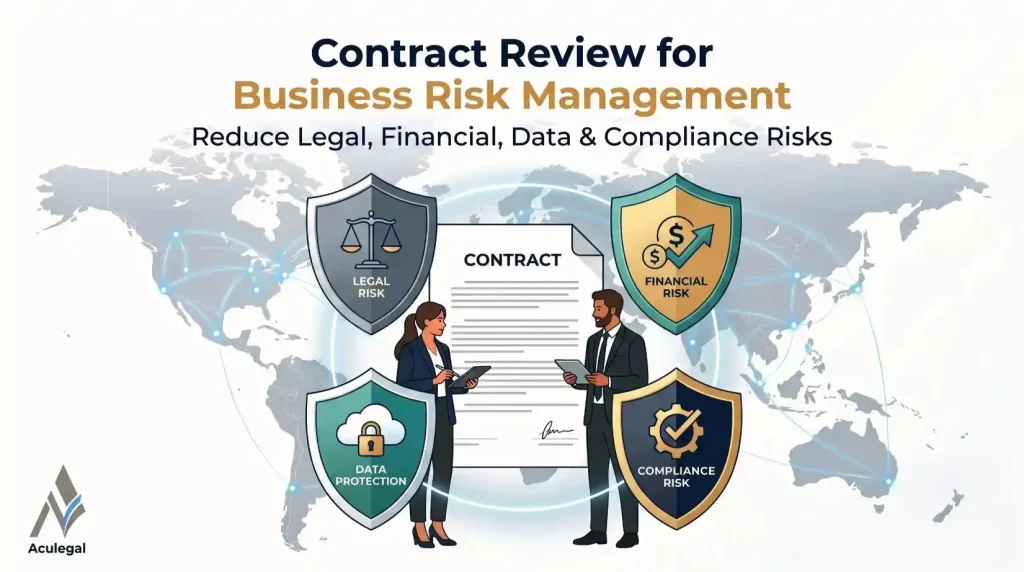
Contract review for business risk management is not a formality, it is your first line of defence against the financial, legal, and operational threats that quietly drain growing businesses. Yet most founders sign contracts the same way they click “I Agree” on a software licence: fast, unread, and full of faith that nothing will go wrong.
That faith is expensive. According to Loio’s 2026 Contract Management Report, companies lose between 8% and 9% of annual revenue due to poor contracting practices. For a startup generating ₹2 crore a year, that is up to ₹18 lakh walking out the door through missed obligations, auto-renewals, and unenforceable clauses.
This guide breaks down exactly how contract review reduces risk across four critical dimensions, legal, financial, data security, and compliance, and what founders and SME leaders can do about it, starting today.
The Hidden Cost of Skipping Contract Review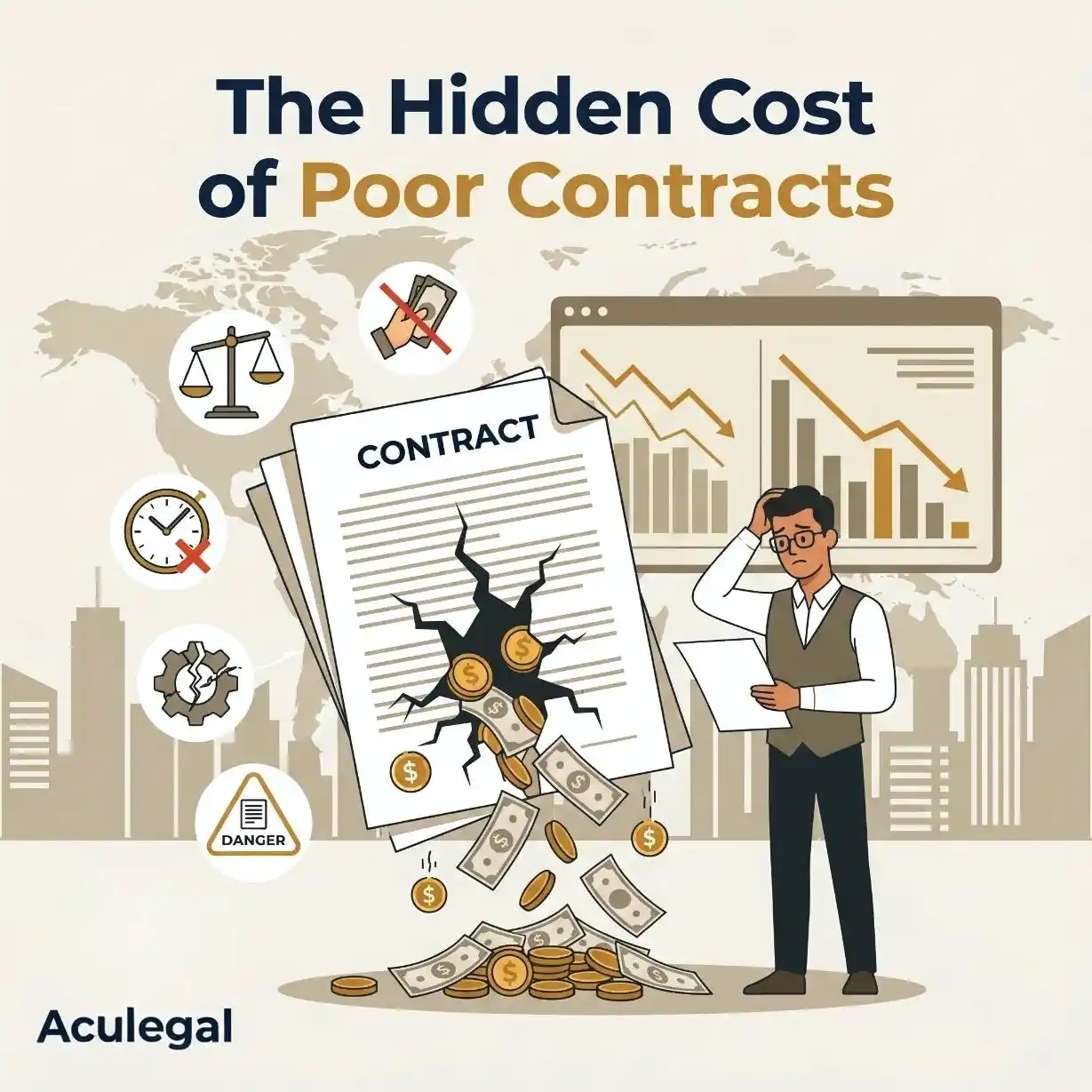
Most business disputes do not begin with fraud or bad intent. They begin with a contract nobody properly read. A vendor agreement with an uncapped liability clause. A client NDA that assigns your IP to the other party. A partnership deed that is silent on exit terms.
These are not edge cases. 64% of U.S. civil lawsuits involve contract disputes, and the pattern is identical across markets worldwide. The clause that looked harmless at signing becomes the clause cited in a ₹50 lakh claim two years later.
♦ 9.2% of annual revenue lost to poor contract management ContractSafe, 2026
♦ 92% of contract management errors are human errors Ironclad Legal Ops Field Guide, 2025
♦ 71% of businesses cannot locate at least 10% of their contracts Loio, 2026
For founders and SMEs, the risk is amplified. Unlike large enterprises with dedicated legal departments, most startups rely on founders reviewing contracts between pitch decks and product sprints — or they simply use a template from the internet and hope for the best.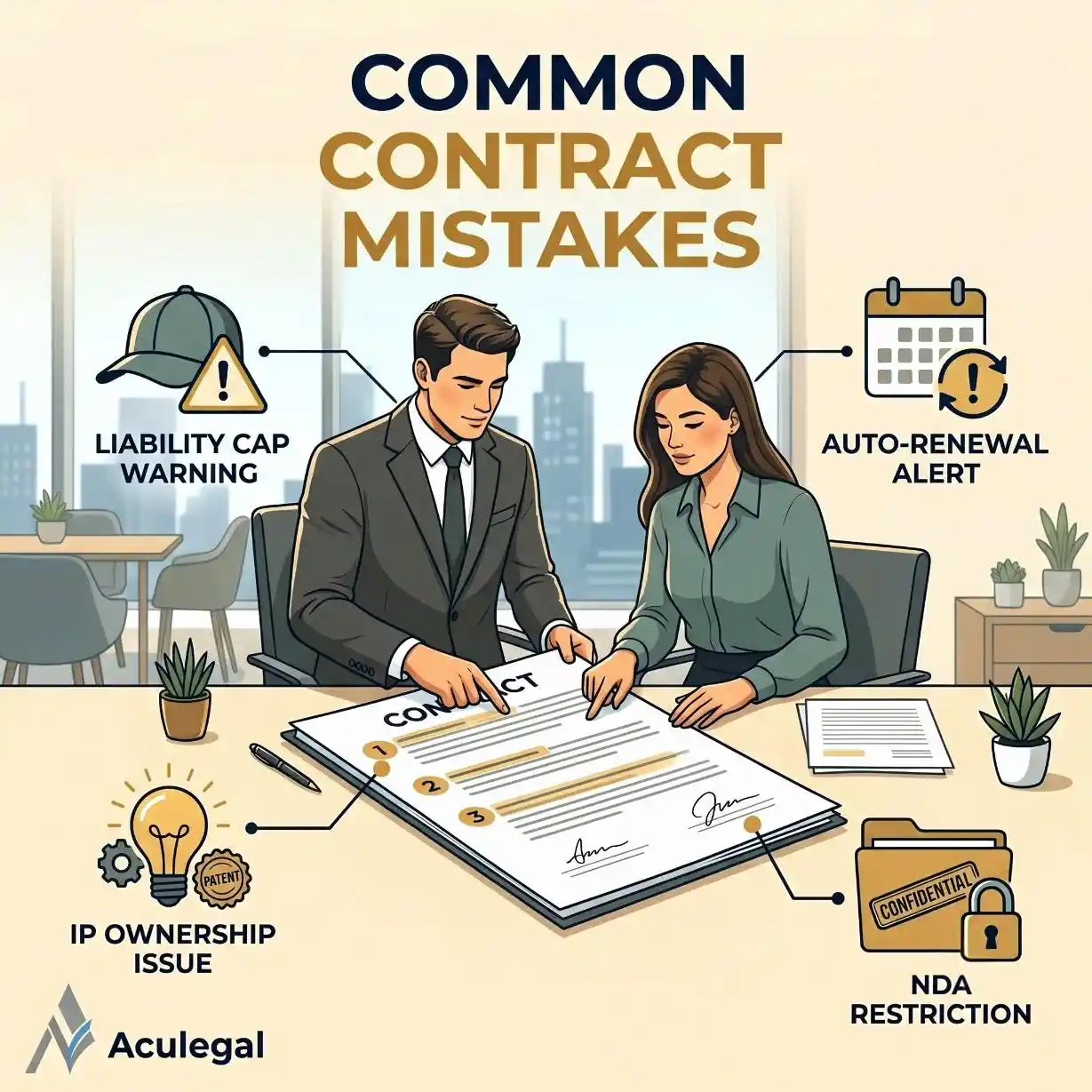
⚠ Common Contract Mistakes by Startups and SMEs
• Accepting supplier contracts without negotiating liability caps
• Using generic templates that do not reflect local law or industry standards
• Missing auto-renewal clauses that lock the business into multi-year commitments
• Leaving IP ownership vague in co-founder or freelancer agreements
• Signing NDAs that restrict your own ability to operate in your market
How Contract Review Reduces Legal, Financial, Data Security, and Compliance Risks
A structured contract review for business risk management systematically addresses risk across four domains. Here is what a professional review catches, and what it protects.
1. Legal Risk: Enforceability, Liability, and IP Protection
Every contract is a legal instrument. An unreviewed contract can be unenforceable, one-sided, or actively harmful to your legal standing. A proper review examines whether clauses are enforceable under applicable law, whether liability exposure is capped and mutual, and whether intellectual property ownership is clearly assigned to the right party.
- Uncapped indemnity clauses can expose your business to unlimited liability for third-party claims
- Vague IP clauses in employment or freelancer contracts often result in disputed ownership of core product assets
- Governing law provisions that force disputes into foreign jurisdictions increase cost and complexity exponentially
- Ambiguous termination terms allow counterparties to exit without notice or penalty, leaving you stranded
One unreviewed clause in a vendor contract can cost more than a year of legal retainer fees.
2. Financial Risk: Missed Payments, Penalties, and Revenue Leakage
Contract review is one of the most direct forms of financial risk management available to a business. Ironclad’s 2025 Contracting Benchmark Report found that organisations lose an average of 8.6% of total spending annually to cost leakage, primarily from missed renewals, auto-renewals on unfavourable terms, and payment milestones that were never tracked.
A review identifies and flags:
- Payment terms and penalties – late payment clauses that could trigger disproportionate penalties
- Price escalation clauses – buried provisions that allow suppliers to raise rates mid-contract
- Renewal traps – auto-renewal periods requiring 60 or 90 days’ notice that are easy to miss
- Scope creep provisions – client contracts with ambiguous deliverables that lead to unpaid additional work
📌 Explore Aculegal Services
Contract Drafting & Review, Protect every agreement before you sign Startup Legal Advisory, Build a solid legal foundation from day one
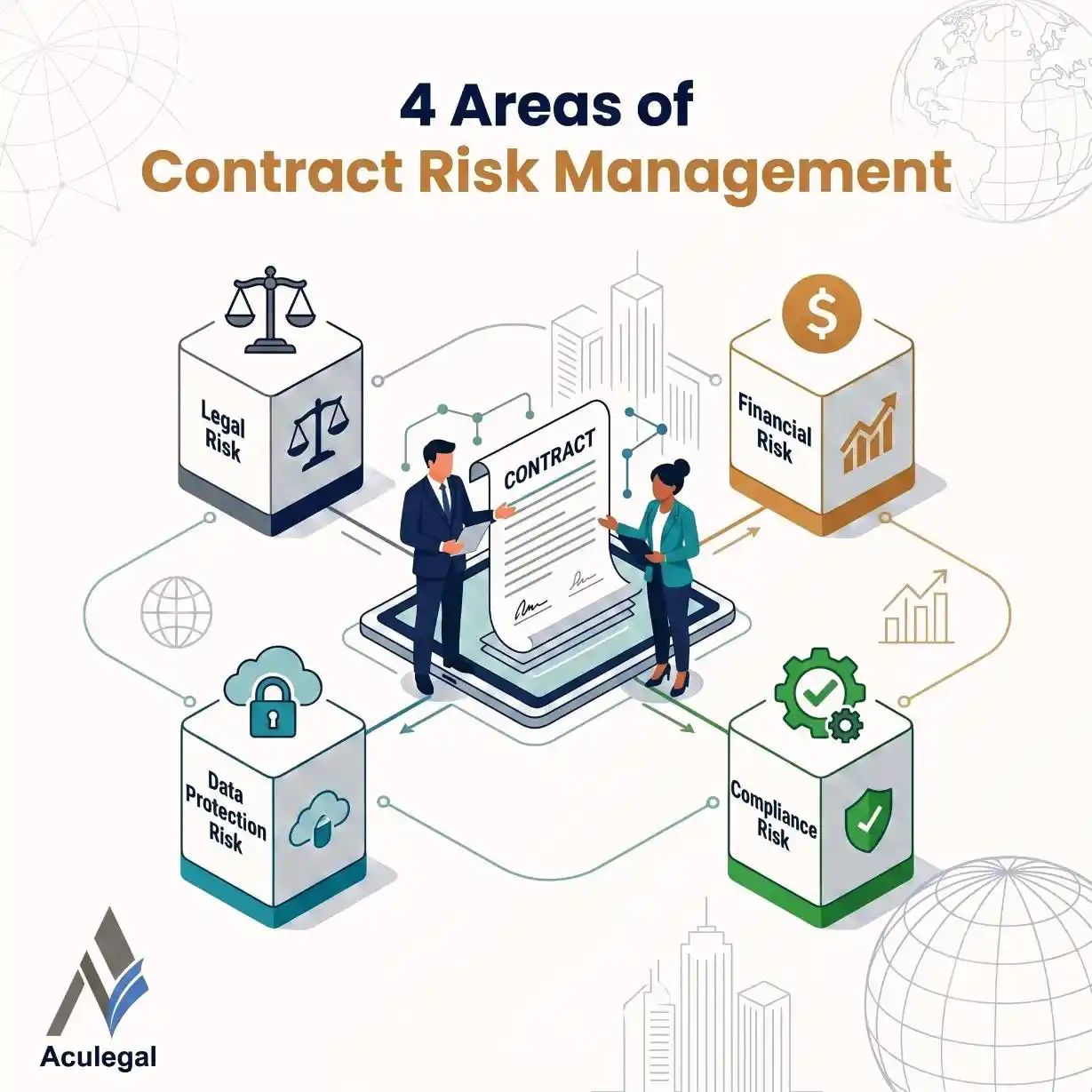
3. Data Security Risk: Privacy Clauses and Third-Party Data Obligations
In an era of DPDP Act compliance in India and GDPR obligations for businesses with global reach, data security provisions in contracts are no longer optional. Vendor agreements, SaaS subscriptions, and client contracts increasingly involve the transfer, storage, or processing of sensitive personal and business data.
According to Lexology’s 2026 CLM Trends analysis, global regulations are becoming more stringent and proactive compliance monitoring in contracts is now critical. A review checks whether:
- Data processing agreements (DPAs) are in place for all third-party vendors who handle customer data
- Breach notification timelines in vendor contracts align with your own regulatory obligations
- Subcontractor clauses prevent vendors from passing your data to undisclosed fourth parties
- Confidentiality provisions cover not just trade secrets but also customer data, pricing, and technical IP
✓ What Good Data Clauses Look Like
A well-reviewed contract specifies: data retention limits, breach notification windows (typically 72 hours), explicit prohibition on sub-processing without consent, and indemnity from the vendor in case of their data breach. Most off-the-shelf templates contain none of these.
4. Compliance Risk: Regulatory Alignment and Sector-Specific Obligations
Compliance risk in contracts is industry-specific and constantly evolving. A fintech startup faces RBI-mandated contractual requirements with payment partners. A healthcare platform must ensure vendor agreements align with data localisation requirements. An e-commerce business has Consumer Protection Act obligations baked into every seller agreement.
Research from Fynk’s 2026 Contract Management Trends Report notes that 88% of SMEs believe large businesses are inflexible in contract negotiations, and in many cases, the terms large corporates push into standard agreements deliberately shift compliance burden onto the smaller party.
Professional contract review identifies:
- Clauses that transfer regulatory liability to your business inappropriately
- Missing mandatory disclosures required under sector-specific regulations
- Non-compete and exclusivity provisions that may breach competition law
- Force majeure clauses that are either too narrow (excluding pandemics, regulatory changes) or dangerously broad
Why Professional Contract Review Pays for Itself
The business case for professional contract review is straightforward. ContractSPAN’s 2025 analysis found that for every ₹1 spent on contract management and legal review, businesses recover between ₹85 and ₹170 in protected revenue. That is not a soft benefit, it is a measurable return on a specific legal investment.
For a startup or SME, the calculus is even more compelling because the cost of one dispute almost always exceeds the cost of every contract review the business ever needed. Litigation in commercial courts is slow, expensive, and reputationally damaging. Prevention is not just better than cure, it is dramatically cheaper.
💡 What a Professional Contract Review Covers
• Clause-by-clause risk flagging with plain-language explanations
• Redline suggestions for negotiation leverage
• Jurisdiction and governing law recommendations
• Data protection and regulatory compliance checks
• Recommendations on missing standard protections (indemnity, liability cap, IP assignment)
When to Get a Contract Reviewed (Hint: Before You Sign)
The most common mistake is treating contract review as a reactive measure, something you do after a dispute arises. By that point, you are not reviewing; you are litigating. The right time for contract review in your business risk management process is always before signature, and ideally during negotiation so you can push back on unfavourable terms.
Key trigger points for review include:
- Entering a new vendor or supplier relationship, especially where the other party provides the template
- Hiring full-time employees or senior contractors, IP assignment and non-compete clauses deserve careful scrutiny
- Signing client agreements, particularly for professional services, software delivery, or long-term retainers
- Raising funding or entering shareholder agreements, investor terms can have decade-long consequences
- Renewing existing contracts, renewal is the best moment to renegotiate terms that no longer serve you
Key Takeaways
- Companies lose up to 9.2% of annual revenue from poor contract management
- Contract review protects against legal, financial, data security, and compliance risk
- IP, liability, data clauses, and compliance obligations are the highest-risk areas for startups and SMEs
- Professional review before signing is the most cost-effective risk management strategy available
- The ROI of contract review is 85x to 170x the investment in protected revenue
Conclusion: Sign Less. Review More. Grow Faster.
Contract review for business risk management is not a legal luxury reserved for corporates with large legal departments. It is the foundational discipline that separates founders who scale from those who spend their growth capital resolving disputes that were entirely preventable.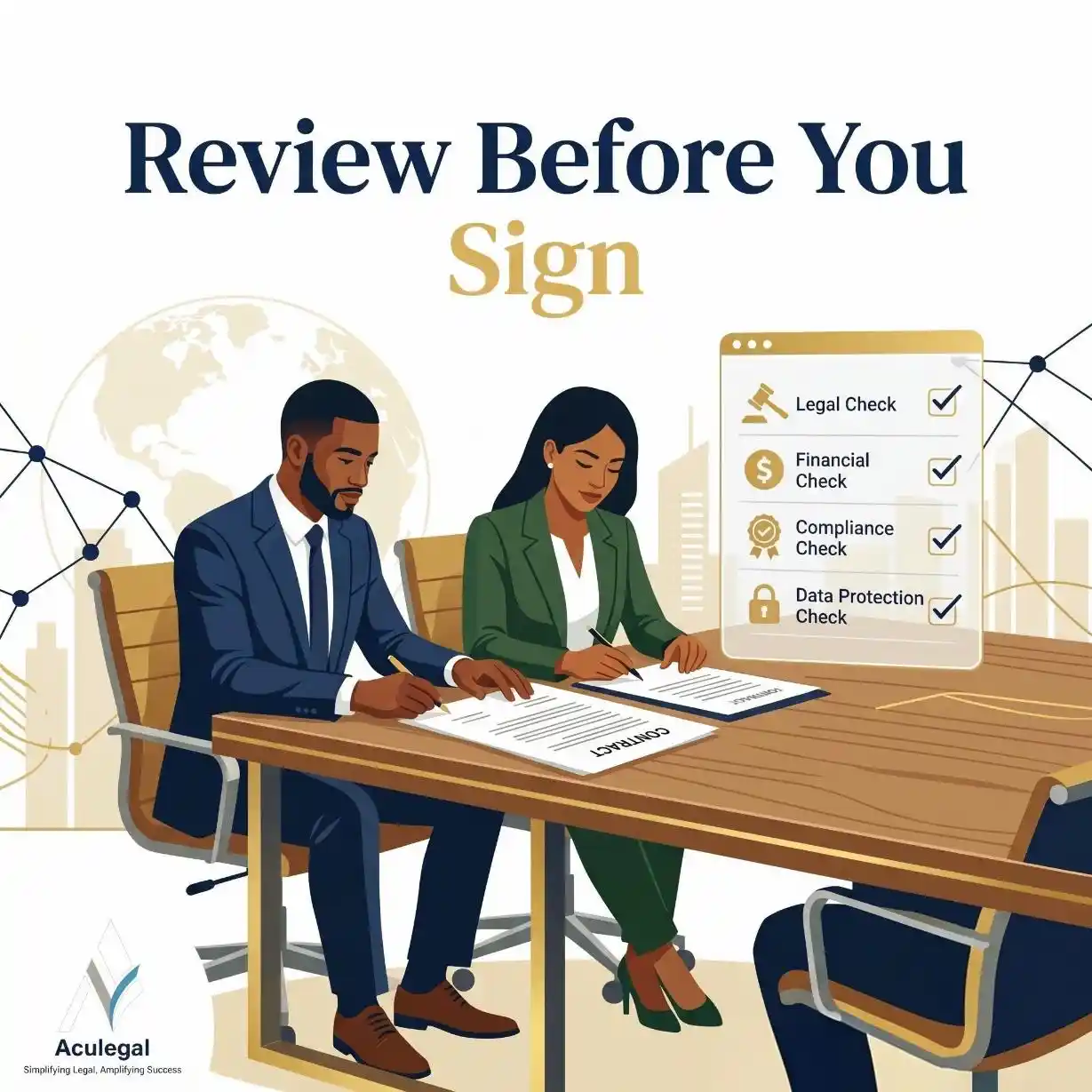
Every contract your business signs is a risk decision. The question is not whether you can afford professional review, it is whether you can afford to skip it. At Aculegal, we work with founders, startups, and SMEs to turn contracts from sources of hidden risk into instruments of business confidence.
Simplifying Legal. Amplifying Success.
Free Consultation Available
Get Your Contracts Reviewed by Aculegal
Don’t let an unreviewed clause become your most expensive business decision. Our team reviews contracts with speed, precision, and plain-language clarity, so you can sign with confidence.