
Introduction
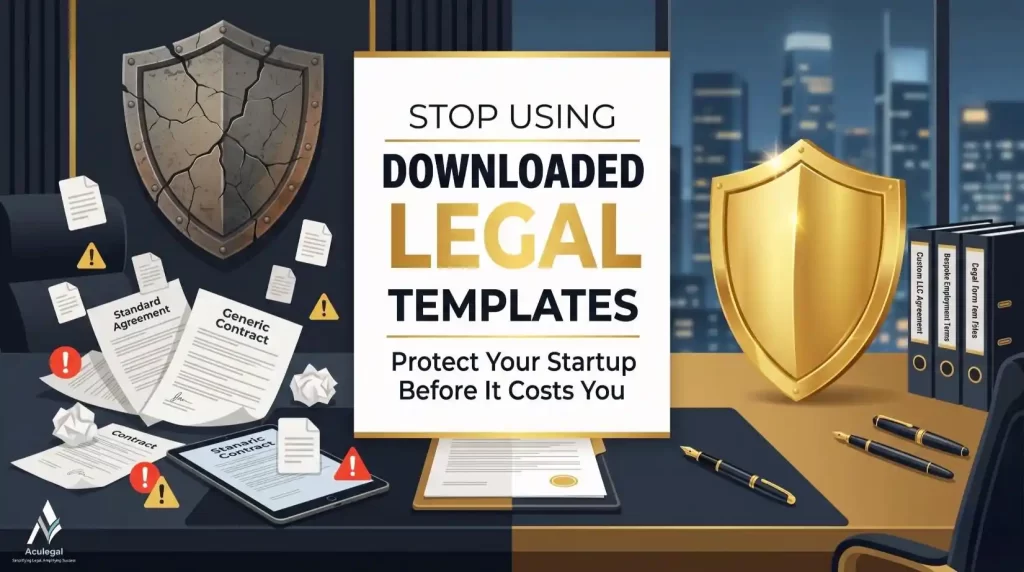
Downloaded legal templates are costing startups more than they save.
You found a free NDA on Google. You tweaked a co-founder agreement from Reddit. You used a client contract template from a legal blog, one that was written for a business in a different country, a different industry, and a different decade.
This is how most early-stage startups handle legal documentation. And this is exactly where the cracks begin.
The hard truth: a legal template downloaded off the internet is designed for everyone, which means it’s optimized for no one. It doesn’t account for your shareholding structure, your payment terms, your IP ownership model, or the regulatory environment you operate in. When a dispute arises, and at some point, it will, that generic document won’t hold.
At Aculegal, our positioning is simple: Simplifying Legal. Amplifying Success. That means helping founders like you build a legal foundation that actually works, not one that merely appears to be in place.
The Real Cost of “Free” Legal Templates
They’re Not Built for Your Business Model
Most templates circulating online are written for generic B2B or B2C scenarios in Western markets. If you’re running a SaaS startup in India, a marketplace platform, or a service-led SME with complex vendor relationships, those documents weren’t designed with your operational reality in mind.
A standard employment contract template, for example, may not include clauses relevant to Indian labour law, ESOP structures, or remote-work IP ownership, all critical concerns for growing tech companies.
What gets missed most often:
- Jurisdiction-specific clauses (Indian Contract Act, IT Act, FEMA regulations)
- IP assignment provisions tailored to your product
- Termination and exit clauses that reflect your actual agreements
- Dispute resolution mechanisms that work in your geography
According to a Business Today survey, contract disputes are among the top five reasons Indian startups face unexpected legal costs in their first three years.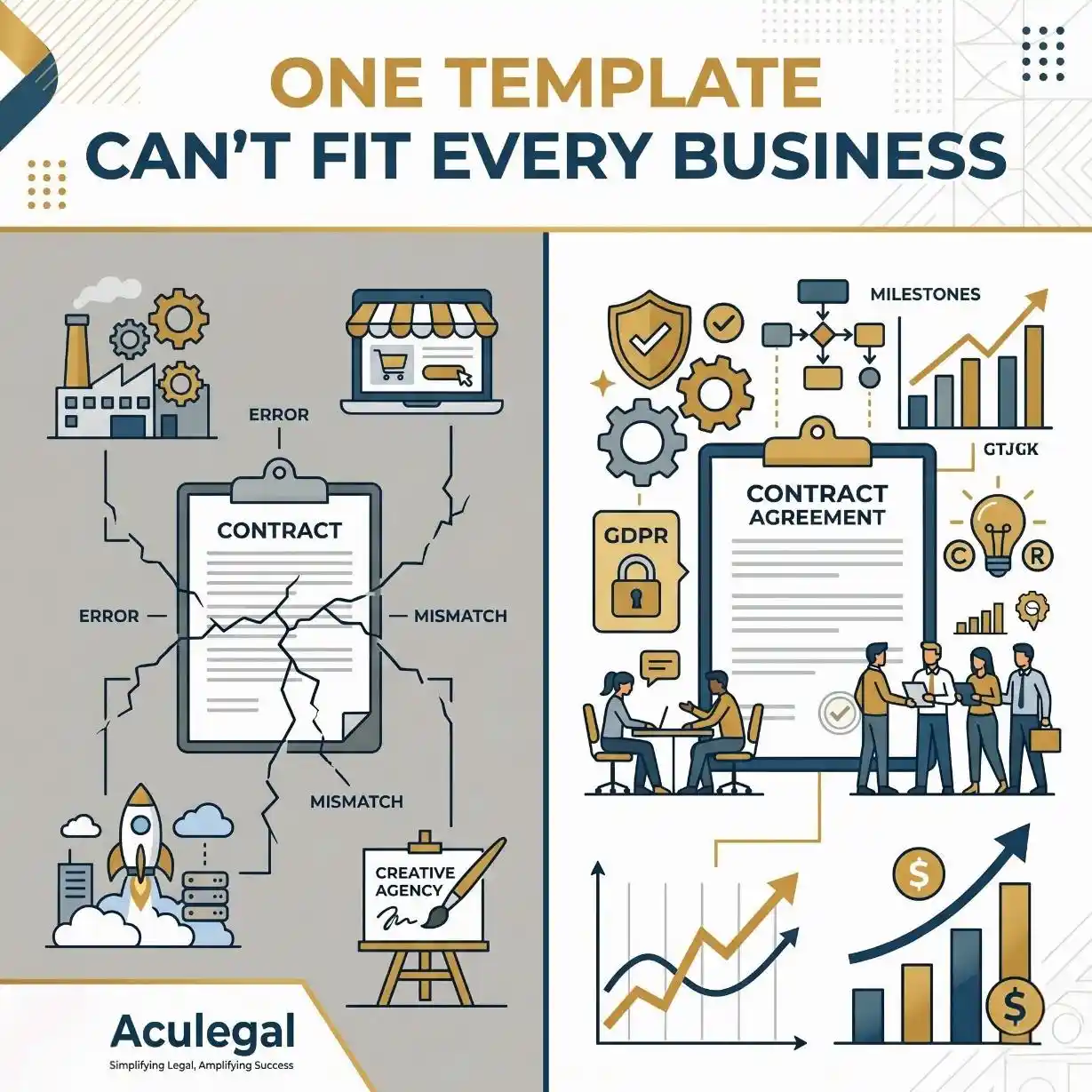
One Clause Can Undo Everything
Contracts are only as strong as their weakest clause. A single ambiguous term around payment liability, IP ownership, or termination notice can invalidate your entire agreement, or at minimum, make it unenforceable in court.
Here’s a scenario founders often discover too late: a co-founder leaves and claims ownership of the core product because the founders’ agreement downloaded from a template site had no proper IP assignment clause. What looked like a formality on paper becomes a multi-month legal dispute.
The Inc42 Startup Legal Mistakes Report highlights that over 60% of early-stage Indian startups have used generic contracts, and a significant portion face legal complications as a result.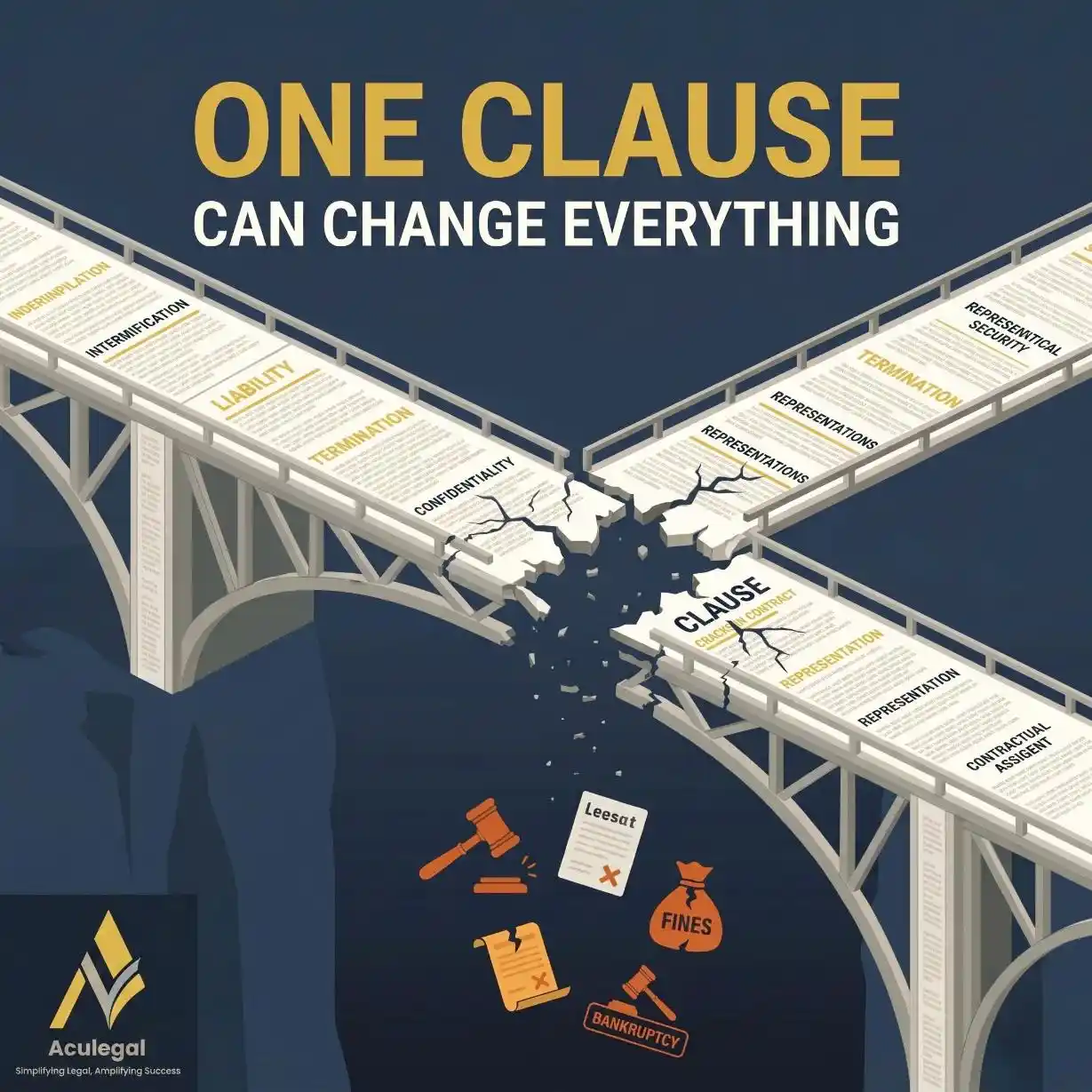
How Customized Contracts Help Startups Scale Safely
Stage-by-Stage Legal Infrastructure
A startup in pre-seed has different legal needs than one entering Series A. Customized contracts evolve with your business. They’re structured to protect you at your current stage while remaining flexible enough to adapt as you grow.
Here’s what stage-appropriate legal documentation looks like:
- Pre-incorporation / Ideation Stage – Co-founder agreements, confidentiality agreements, IP assignment documents
- Early Revenue Stage – Client service agreements, vendor contracts, employee offer letters with ESOP clauses
- Scaling Stage – Master Service Agreements (MSAs), SLAs, partnership agreements, data processing agreements (especially for DPDP compliance)
- Fundraising Stage – Term sheet review, shareholder agreements, due diligence documentation
Aculegal Startup Legal Packages
Protecting IP Before It’s Too Late
Your intellectual property, code, brand, proprietary methodology, and content are your most valuable assets as a startup. Most template contracts either skip IP clauses entirely or include boilerplate language that fails to clearly define ownership.
Custom contracts ensure:
- All IP developed by employees and contractors is clearly assigned to the company
- Founders’ pre-existing IP is properly disclosed and distinguished
- Client work doesn’t inadvertently transfer ownership of your core product
As noted by the World Intellectual Property Organization (WIPO), startups that fail to address IP ownership in early-stage agreements routinely face disputes that impede fundraising and acquisition conversations later.
Contracts That Actually Reflect Your Deals
When you negotiate a deal with a client, partner, or investor, you’re not negotiating a generic deal. You’re negotiating your deal. A customized contract reflects the actual terms agreed upon, removes ambiguity, and gives both parties a clear framework for the relationship.
Downloaded legal templates create gaps between what was agreed verbally and what’s documented legally. That gap is where disputes live.
A well-drafted contract also signals professionalism. Investors, enterprise clients, and serious partners notice the difference between a polished, jurisdiction-appropriate agreement and a visibly generic template.
Regulatory Compliance Is Non-Negotiable
India’s regulatory environment for startups is evolving rapidly. DPDP Act (Digital Personal Data Protection Act), FEMA, SEBI regulations, GST compliance clauses; these are not optional extras. They are baseline requirements that must be reflected in your contracts if you’re doing business at any meaningful scale.
A downloaded template from 2018 or even 2022, almost certainly doesn’t account for the 2023 DPDP Act or updated SEBI guidelines for startup fundraising. Outdated templates create compliance gaps that regulators and counterparties can exploit.
The Ministry of Electronics and Information Technology (MeitY) has outlined strict data handling requirements under the DPDP Act that must now be included in vendor agreements, employee contracts, and client service agreements.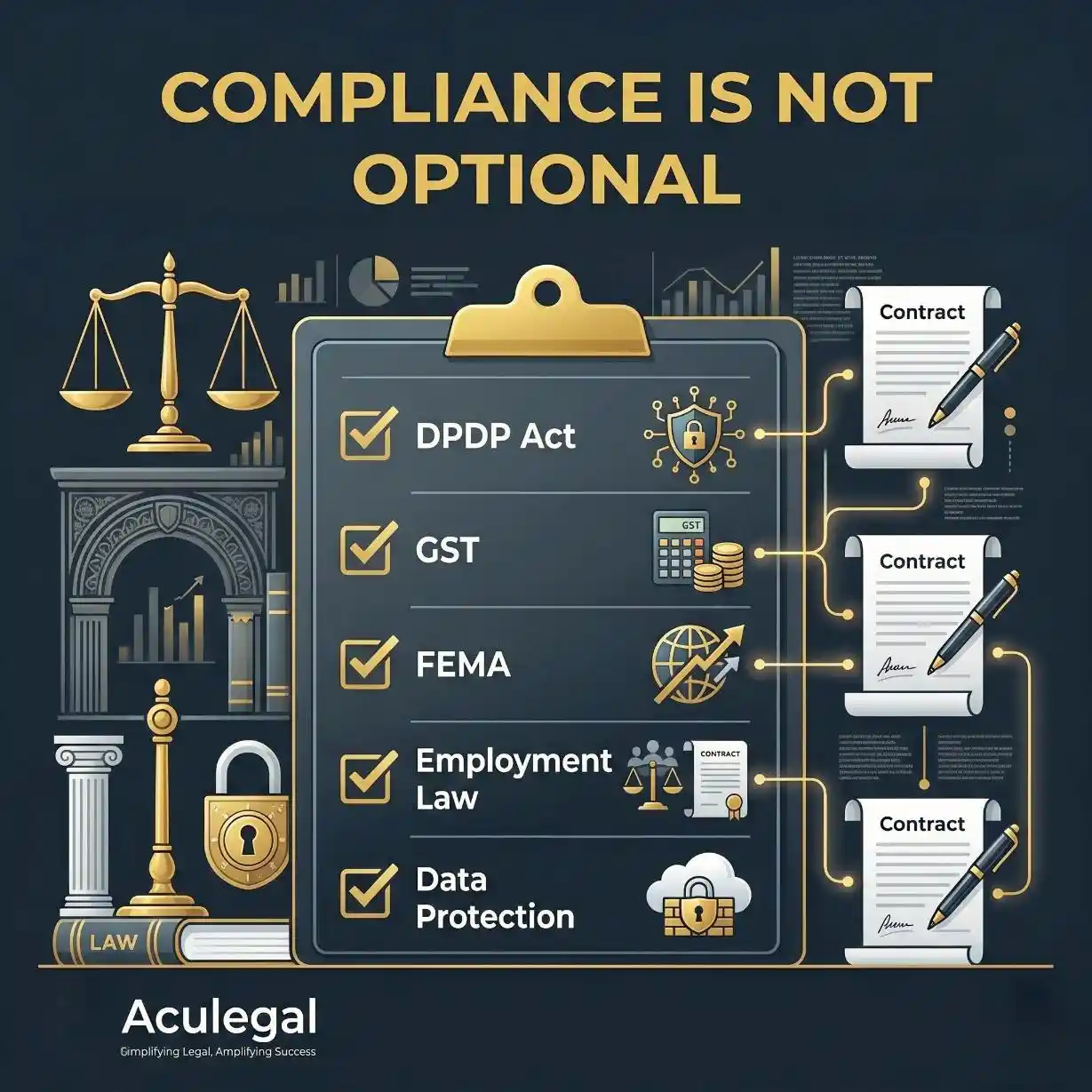
What Founders Get Wrong About Legal Costs
“We’ll Fix It When We Raise”
This is one of the most common and most expensive misconceptions in early-stage startup culture. Investors conduct legal due diligence. When they find poorly structured contracts, missing IP assignments, or non-compliant agreements, they don’t overlook it. They either walk away or demand heavily discounted valuations to account for legal risk.
Fixing legal issues during due diligence is 5–10x more expensive than getting it right from the start.
Legal Is an Investment, Not a Line Item
A customized legal foundation is not an expense. It’s an asset. Properly drafted contracts protect revenue, preserve equity, reduce liability, and support fundraising. That’s not a legal cost, that’s a business return.
Harvard Business Review notes that startups that invest in proper legal infrastructure early significantly reduce operational disruptions and are better positioned for institutional investment.
A Simple Framework: What Your Startup Contracts Should Cover
Whether you’re drafting your first client agreement or preparing for a funding round, here’s a baseline checklist for startup contracts:
Foundational Documents
- Co-founder agreement with IP assignment and vesting schedule
- Shareholders’ agreement
- Employment contracts with IP, confidentiality, and non-compete clauses
Operational Contracts
- Client service agreements / Master Service Agreements
- Vendor and supplier contracts
- Freelancer / contractor agreements
Compliance-Linked Documents
- Privacy policy and terms of service (DPDP-compliant)
- Data processing agreements for B2B clients
- ESOP plan documentation
Conclusion: Build on a Foundation That Holds
Downloaded legal templates are a false economy. They save a few thousand rupees upfront and cost multiples of that in disputes, delays, compliance failures, and lost deals, over time.
As a founder or SME leader, your legal documentation isn’t paperwork. It’s infrastructure. It defines your relationships, protects your assets, and positions your business for the growth you’re working toward.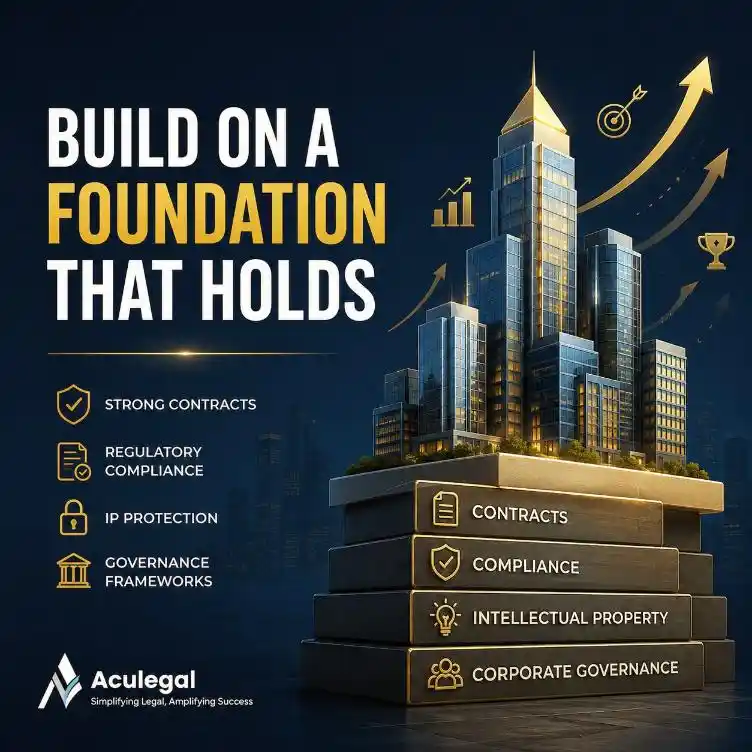
Startups that scale safely are the ones that take legal seriously from day one, not as an afterthought, but as a strategic advantage.
At Aculegal, we work with founders, startups, and SMEs to build legal frameworks that are practical, jurisdiction-appropriate, and built for how your business actually operates. Simplifying Legal. Amplifying Success.
📞 Ready to Build Contracts That Actually Protect Your Business?
Stop relying on templates that weren’t built for you.
Book a Free Legal Consultation with Aculegal, and get expert guidance on the contracts your startup needs right now.
Whether you need a co-founder agreement, client contracts, or a full legal audit before your next fundraise, our team is ready to help.
👉 Explore Aculegal’s Startup Legal Services →
Published by Aculegal | Simplifying Legal. Amplifying Success.