

Every founder clicks “I Agree.” But do you actually know what you’re agreeing to and whether it holds up in court?
Online contracts are now the backbone of modern business. NDAs signed on DocuSign. Vendor agreements completed over email. SaaS terms are accepted with a checkbox. For India’s booming startup ecosystem and its growing SME base, digital agreements have become routine and almost invisible.
But here’s the uncomfortable truth: most founders treat online contracts like formalities, not legal instruments. And that’s exactly when they become liabilities.
So, are online contracts legally valid in India? The short answer is yes, but only when executed correctly. The longer answer involves electronic signatures, authentication standards, and a legal framework most business owners have never read.
At Aculegal, our philosophy is simple: Simplifying Legal. Amplifying Success. That starts with helping you understand the rules before they work against you.
The Legal Foundation: What Indian Law Says About Online Contracts
The Information Technology Act, 2000 – India’s Digital Contract Backbone
The primary legislation governing online contracts in India is the Information Technology Act, 2000 (IT Act). This law was India’s first formal recognition that digital transactions carry legal weight.
Under Section 10A of the IT Act (inserted by the 2008 amendment), contracts formed through electronic means are explicitly valid and enforceable. This means offer, acceptance, and consideration, the three pillars of any valid contract, can all occur digitally.
Key provisions founders should know:
- Electronic records are admissible as evidence under the Indian Evidence Act, 1872 (Section 65B)
- Digital signatures are legally equivalent to handwritten signatures
- Clickwrap agreements (checkbox acceptance) can be enforceable if properly structured
- Email-based acceptance can constitute a valid binding contract
The Indian Contract Act, 1872 remains the governing law for contract validity. Every online contract must still satisfy the essential elements: free consent, lawful object, competent parties, and lawful consideration. Digital form doesn’t override these fundamentals.
Link to Aculegal’s “Contract Drafting & Review” service page
Role of Electronic Signatures and Digital Authentication
This is where most founders get it wrong. Not all electronic signatures are created equal under Indian law, and using the wrong type could make your contract unenforceable in a dispute.
What Counts as a Valid Electronic Signature in India?
The IT Act and its associated rules recognise two categories of electronic signatures:
1. Digital Signatures (Class 2 and Class 3) These are cryptography-based signatures issued by Certifying Authorities (CAs) licensed by the Controller of Certifying Authorities (CCA) under the Ministry of Electronics and IT. They use Public Key Infrastructure (PKI) technology and are the gold standard for legal enforceability.
According to the Controller of Certifying Authorities India, licensed CAs include eMudhra, Sify, and NSDL, the only entities authorised to issue legally valid digital signature certificates in India.
2. Electronic Signatures (Aadhaar-Based eSign) The Second Schedule of the IT Act recognises Aadhaar-based eSign as a valid form of electronic authentication. This allows individuals to sign documents using their Aadhaar OTP, making it highly accessible for B2C and SME use cases.
What does NOT qualify as a legally robust electronic signature:
- A scanned image of your handwritten signature pasted into a PDF
- Typing your name at the bottom of an email
- WhatsApp consent without proper documentation trail
These methods may have evidentiary value in some contexts, but they are legally fragile. In any serious commercial dispute, opposing counsel will challenge them.
Authentication: The Overlooked Layer
Authentication is what proves who signed and when. Without it, even a valid-looking digital signature can be disputed.
Robust digital authentication includes:
- Timestamping – cryptographic proof of when a document was signed
- Audit trails – logs showing IP address, device, location, and sequence of actions
- Identity verification – OTP, video KYC, or Aadhaar-linked authentication
The Ministry of Electronics and Information Technology (MeitY) has published detailed guidelines on electronic signature standards that enterprise and startup contracts should comply with. Most founders have never read them. Your legal counsel should have.
Where Online Contracts Actually Break Down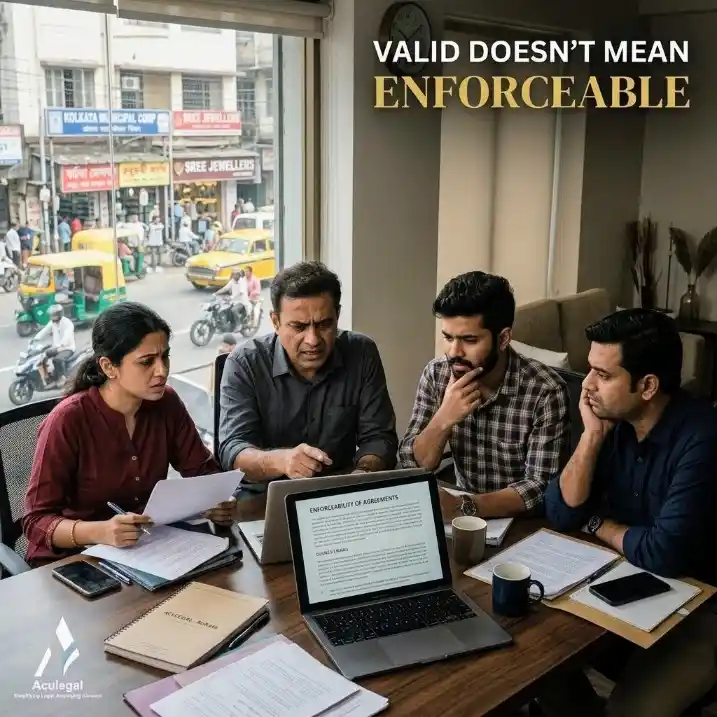
The Enforceability Gap: When “Valid” Isn’t Enough
Here’s the real business risk. A contract can be technically valid under Indian law and still be practically unenforceable if it’s poorly drafted, improperly executed, or missing critical clauses.
Common enforceability failures in online contracts:
- No governing jurisdiction clause – Which court handles disputes? If your vendor is in Mumbai and you’re in Bengaluru, this matters enormously.
- Ambiguous acceptance mechanisms – A browsewrap agreement (where terms are buried in a footer link) is far weaker than a properly structured clickwrap.
- Missing consideration – Free trials and beta access must still document what each party receives.
- Unsigned annexures – Schedules, SLAs, and pricing documents attached to a master agreement but not independently authenticated create gaps.
- No version control – Updated T&Cs without proper notice and re-acceptance protocols can void your original agreement.
According to a Legal Service India analysis of contract disputes, ambiguity in digital contracts is one of the leading causes of unresolved commercial disagreements, precisely because both parties assumed the online agreement was “good enough.”
Sectors With Stricter Requirements
Not every industry is treated equally under Indian law. Some sectors require physical or wet-ink signatures regardless of what the IT Act generally permits.
Online contracts alone are NOT sufficient for:
- Property and real estate transactions – Require registered agreements under the Registration Act, 1908
- Negotiable instruments – Cheques, promissory notes, and bills of exchange under the Negotiable Instruments Act
- Wills and testamentary documents
- Power of Attorney documents
- Court filings and notarised affidavits
If your business touches any of these areas, even indirectly, and you’ve been relying solely on digital contracts, you need a legal audit immediately.
What Smart Founders Do Differently
Build a Contract Infrastructure, Not Just Documents
The most legally protected startups and SMEs don’t just “sign contracts.” They build a contract infrastructure, a system that governs how agreements are created, executed, stored, and enforced.
The five pillars of solid contract infrastructure:
- Standardised templates – drafted and reviewed by legal counsel, not downloaded from the internet
- Approved e-signature platforms – using recognised tools like DocuSign, Adobe Sign, or eMudhra (all of which support Indian compliance requirements)
- Centralised contract repository – with version history, renewal reminders, and counterparty records
- Dispute resolution clauses – specifying arbitration, mediation, or litigation pathways
- Regular legal reviews – annual or bi-annual audits of your standard contracts as laws evolve
The NASSCOM India startup legal readiness framework consistently highlights contract management as a top operational risk for early-stage companies, particularly those scaling into enterprise sales where buyers conduct legal due diligence.
The Due Diligence Test: Will Your Contracts Survive a Funding Round?
Here’s a practical benchmark. When investors or acquirers conduct due diligence on your startup, one of the first things they examine is your contract portfolio.
They will ask:
- Are your customer agreements enforceable?
- Do your vendor contracts have appropriate IP and confidentiality protections?
- Are your employment agreements compliant with applicable labour laws?
- Are your founder agreements – including vesting schedules – airtight?
If your contracts were drafted informally, signed via unverified email threads, or lack key protective clauses, this becomes a valuation risk. We’ve seen term sheets restructured or withdrawn over contract compliance gaps.
India’s Evolving Digital Contract Landscape
What’s Changing and Why It Matters Now
India’s legal and regulatory environment for digital contracts is actively evolving. Founders who stay ahead of these changes protect their competitive position. Those who don’t find themselves retrofitting compliance at the worst possible times.
Key developments to watch:
- The Digital Personal Data Protection Act, 2023 (DPDPA) – Contracts that collect, process, or share personal data must now include specific consent mechanisms and data processing agreements. This affects virtually every SaaS, fintech, and healthtech startup operating in India. The Digital India Corporation has published preliminary compliance guidance that should inform your contract templates.
- The proposed Indian Telecommunication Act, 2023 – Introduces new requirements for OTT platforms and digital service agreements that may impact how consent is captured in online contracts.
- RBI guidelines on digital lending – If you operate in fintech or lend digitally, your loan agreements and KYC consent contracts face specific regulatory requirements beyond the IT Act.
The pace of regulatory change means that a contract that was compliant two years ago may have gaps today. Periodic legal review isn’t optional; it’s operational hygiene.
The Aculegal Perspective: Legal Clarity as a Business Advantage
Most legal advice tells you what you can’t do. At Aculegal, we focus on what you can do and how to do it safely, strategically, and scalably.
Online contracts, when properly structured, give your business:
- Speed – Close deals, onboard vendors, and hire talent faster
- Scale – Standardise agreements across geographies without physical logistics
- Security – Documented, authenticated paper trails that protect you in disputes
- Credibility – Investors, enterprise clients, and partners trust businesses with professional legal infrastructure
The question isn’t whether to use online contracts. Every modern business already does. The question is whether yours are built to protect you or quietly exposing you to risk.
Conclusion: Don’t Let “Valid” Be Your Only Standard
Online contracts are legally valid in India – when they’re properly executed, authenticated, and drafted. But validity is the floor, not the ceiling.
Here’s what to take away:
- The IT Act, 2000 provides the legal foundation for digital contracts – but the Indian Contract Act governs enforceability
- Electronic signatures are not all equal – digital signature certificates from licensed CAs offer the strongest legal protection
- Aadhaar-based eSign and recognised e-signature platforms are compliant for most commercial use cases
- Certain transactions – real estate, negotiable instruments, notarised documents – cannot rely on online contracts alone
- The DPDPA and evolving regulations are reshaping what contract compliance looks like in 2025 and beyond
The founders who treat legal infrastructure as a growth enabler, not a back-office cost, are the ones who scale without friction, close enterprise deals faster, and survive investor due diligence with confidence.
Ready to Make Your Contracts Work for You?
At Aculegal, we work exclusively with founders, startups, and SMEs to build legal infrastructure that scales with your business.
Whether you need a contract audit, investor-ready legal documentation, or expert guidance on digital agreement compliance, our team is here to simplify the complex and amplify your success.
👉 Book your free legal consultation today.
Let’s make sure your agreements are built to win.
Aculegal
Simplifying Legal. Amplifying Success.
Sources & References:
- Information Technology Act, 2000 — Ministry of Law and Justice, Government of India
- Controller of Certifying Authorities — https://cca.gov.in
- Ministry of Electronics and Information Technology (MeitY) — https://meity.gov.in
- Legal Service India — https://legalserviceindia.com
- NASSCOM India — https://nasscom.in
- Digital India Corporation — https://digitalindia.gov.in