

Most funding deals don’t fail in the boardroom. They fail in the data room. Here’s exactly what you need in order before the first investor call.
Due diligence checklist before raising funds – three months of investor conversations. A term sheet is on the table. Then, silence. Not because your product was wrong. Not because the market was off. But because your cap table was messy, your ESOP documentation was missing, and your IP assignment agreement didn’t exist.
This is not a hypothetical. It happens to startups every funding cycle. Investors walk away not from bad ideas, but from bad paperwork.
The good news? Every single one of these issues is preventable. And preparation isn’t just a safety net – it’s a competitive advantage that signals to investors you run a tight, professional ship.
What Is Due Diligence and Why Does It Make or Break Your Round?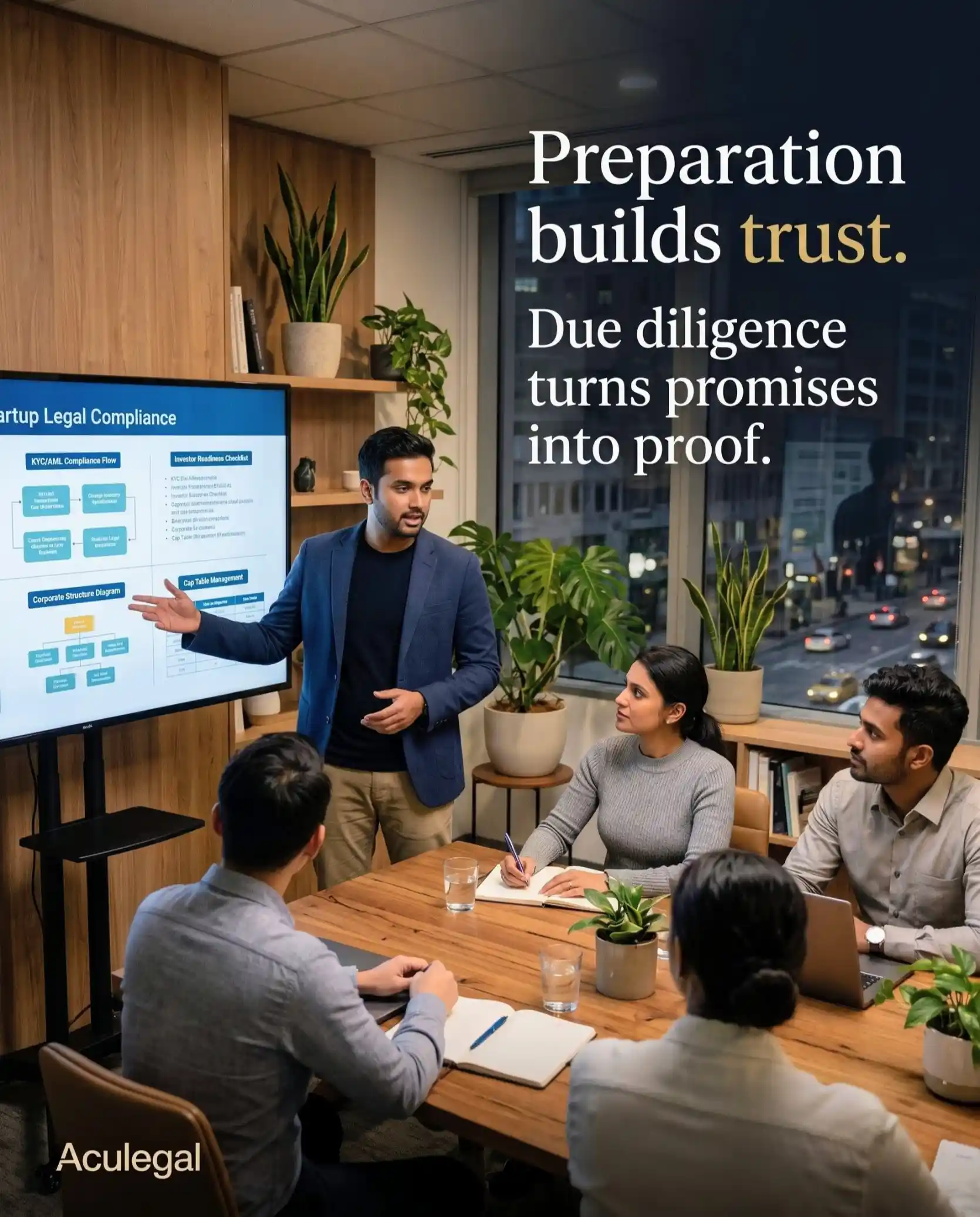
Due diligence is the structured investigation an investor conducts before writing a cheque. It covers your financials, legal standing, intellectual property, team structure, cap table, and compliance history. Every claim you made in your pitch deck will be verified.
Think of it as the investor’s internal audit of your startup. Everything you said, they will verify. Everything you haven’t documented, they will flag. The process typically runs 2 to 8 weeks, but can drag on indefinitely if red flags surface.
The smartest founders don’t wait for a term sheet to start preparing. They build an investor-ready legal and financial foundation from Day One or at the very least, well before they enter any fundraising conversation.
The Due Diligence Checklist Before Raising Funds: 6 Critical Areas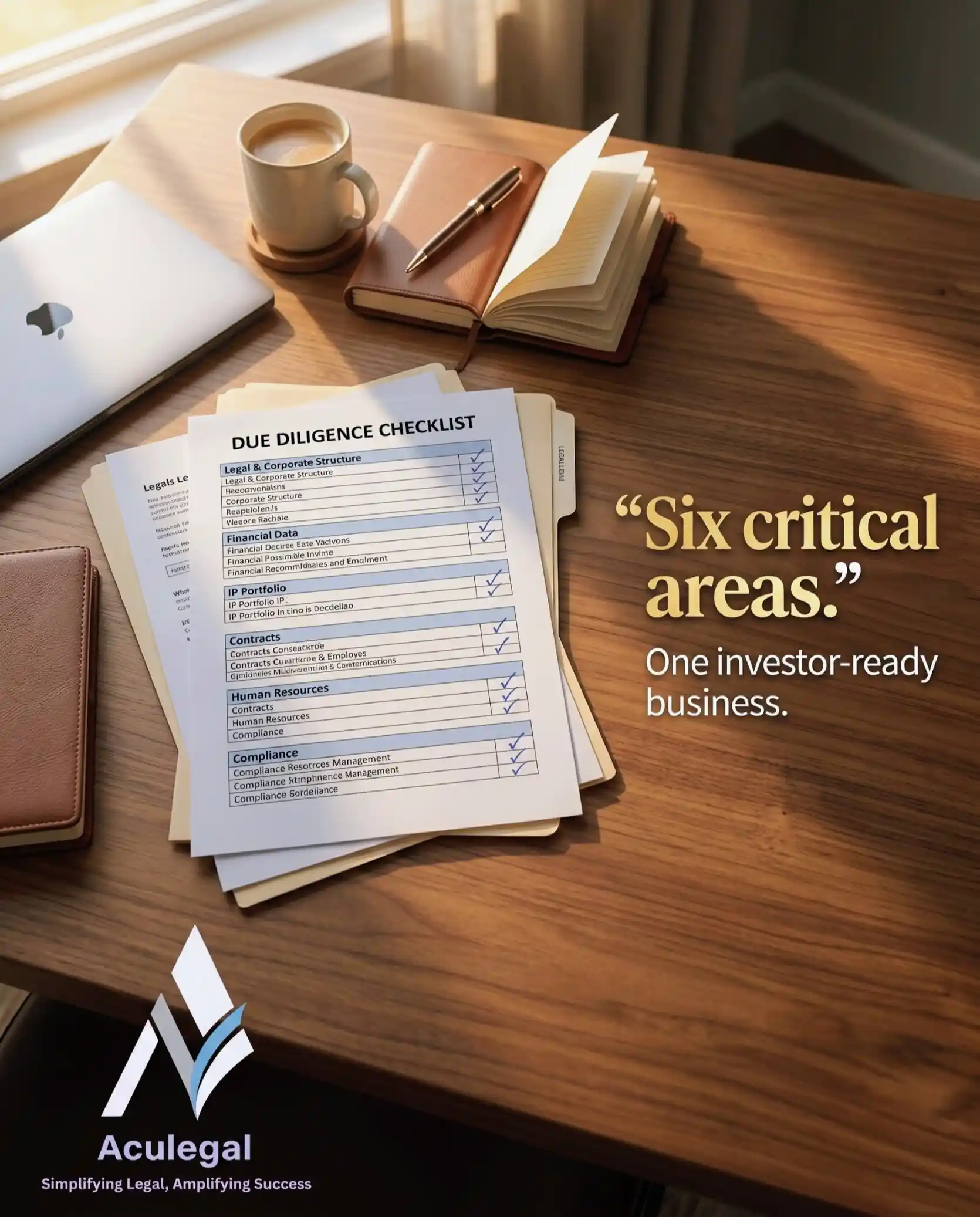
Use this as your pre-fundraise playbook. Work through each area systematically. Where gaps exist, address them before investor conversations begin, not during.
1. Corporate Structure & Legal Foundation
Before anything else, investors verify the basics: Is the company correctly incorporated? Are founder agreements clean? Is the entity structure compatible with VC investment?
♦ Founder shareholder agreements with clear vesting schedules (standard: 4-year vest, 1-year cliff) Critical
♦ Updated Register of Members (Form MGT-1 or equivalent) and all share allotment records
♦ Board and shareholder resolutions for all major decisions (fundraises, director appointments, major contracts)
♦ DPIIT Startup India recognition certificate (if applicable) Important
♦ Foreign ownership structure documented (if applicable) – FEMA and FDI compliance
♦ All director & KYC filings are current with the MCA (ROC) portal
2. Clean Cap Table & Shareholding Structure
Your cap table tells the story of your company’s ownership. Investors will scrutinize it in detail. Any irregularities, undocumented shares, unclear classes, or missing ESOP allocations raise serious flags.
- Fully diluted cap table showing all shareholders, classes of shares, ESOP pool, and convertible instruments
- Documentation for every historical share issuance, transfer, or split
- Proof that all previous investors received valid share certificates and resolutions
- Anti-dilution provisions are clearly documented in existing shareholder agreements
- Clarity on convertible notes, SAFEs, or CCDs issued to date
Pre-funding, a 10–15% ESOP pool is standard. Investors will ask for it and will negotiate for it to be carved out before their investment, which dilutes existing shareholders. Get ahead of this.
3. Intellectual Property (IP) Protection
For most startups, the product is the IP. Investors need certainty that your company owns what it built, not the developers who built it, not a co-founder who left, and not a third party.
- IP assignment agreements signed by all foundersandall developers who worked on the product
- Trademark registrations (or applications) for brand name, logo, and key products
- Patent filings (if applicable) — provisional or complete specifications
- Open-source license audit: ensure no viral licences (e.g., GPL) compromise your proprietary codebase
- Non-disclosure agreements (NDAs) with all contractors, employees, and key vendors
Common Deal-Killer: Investors have walked away from otherwise strong deals when a key developer or departed co-founder had not signed an IP assignment agreement. This is non-negotiable. Fix it before fundraising begins.
4. Financial Records & Compliance
Clean financials are not optional. Investors need to see accurate, well-organised financial records to gauge profitability, burn rate, and runway. Missing statements or inconsistent numbers signal either poor governance or something being hidden.
.
♦ Current management accounts month-on-month for at least the last 12 months Critical
♦ GST registration, all GST returns filed, no outstanding dues
♦ Income Tax Returns (ITRs) filed for all years the company has been operational
♦ TDS compliance records and certificates issued to employees and contractors
♦ Financial model with revenue projections, unit economics, and use-of-funds breakdown Important
♦ Bank statements at least 12 months of company accounts
5. Employment Agreements & Key Contracts
Your team is part of the investment thesis. Investors want to know key people are locked in, conflicts of interest are managed, and there are no hidden employment disputes that could surface post-investment.
♦ Employment agreements for all full-time employees, including IP assignment, non-compete, and confidentiality clauses
♦ Offer letters, appointment letters, and updated job descriptions for C-suite and key hires
♦ Contractor / freelancer agreements with IP assignment clauses
♦ Material customer contracts revenue concentration, auto-renewal, and termination clauses
♦ Vendor and supplier agreements especially for technology, cloud, and logistics partners
♦ Any pending or historical litigation, disputes, or regulatory notices
Why Proper ESOP Documentation Matters?
This is where many growth-stage startups get caught. ESOPs are one of the most powerful tools a founder has to attract talent, conserve cash, and align the team with long-term success. But done without proper legal structure, they become a liability that can derail your funding round.
In India, every Series A term sheet asks about the ESOP pool. Investors typically expect a 10–15% pool to be created pre-funding. Non-compliant or undocumented grants are removed during due diligence, creating a mess that delays closings and erodes trust.
The Legal Framework: What Governs ESOPs in India
ESOP compliance in India sits at the intersection of three regulatory frameworks:
- Companies Act, 2013 (Section 62(1)(b)): Governs the issuance of shares to employees, requiring special shareholder resolution
- Income Tax Act, 1961 (and 2025 edition): Determines perquisite tax at exercise and capital gains at sale
- SEBI Regulations (for listed companies): Mandates independent valuation, annual disclosures, and lock-in periods
For DPIIT-recognised startups, there are meaningful advantages: promoters and founders can receive ESOPs up to 10 years from incorporation, and employees can defer perquisite tax under specific conditions. But only if the documentation is done right.
The ESOP Documentation Checklist
| Document / Filing
|
Purpose | Priority |
|---|---|---|
| ESOP Scheme / Policy Document
|
Master document outlining eligibility, vesting, exercise price, forfeiture, and administration | Critical |
| Board Resolution approving ESOP Scheme
|
Mandatory first step before any grants are made | Critical |
| Shareholder Special Resolution (EGM/AGM)
|
75% shareholder majority required; filed via Form MGT-14 with ROC within 30 days | Critical |
| Form MGT-14 (ROC Filing)
|
ROC filing of the special resolution, options issued before this have no legal standing | Critical |
| Individual Grant Letters
|
Personalised letters to each grantee detailing number of options, exercise price, vesting schedule, and conditions | Required |
| Employee Consent Form
|
Signed acceptance from each employee confirming they understand terms | Required |
| ESOP Register (Form SH-6)
|
Ongoing register of all options granted, vested, exercised, forfeited, maintained, and updated | Required |
| Form PAS-3 (post-exercise allotment)
|
Filed with ROC after shares are allotted following employee exercise | Required |
| Independent Merchant Banker Valuation
|
Required for unlisted companies to determine fair market value of shares at exercise | Important |
| Cap Table Integration
|
Fully diluted cap table updated to reflect ESOP pool, investor-facing and accurate | Important |
Common ESOP Mistakes That Derail Funding Rounds
Based on recurring issues in investor due diligence across Indian startups, these are the most common and most costly ESOP errors:
- Granting options before shareholder approval: Options issued before Form MGT-14 is filed with ROC have no legal standing. Investors will require rectification, causing significant delay.
- No vesting cliff : Without a minimum 1-year cliff, early employees can leave with vested equity within months. This is a governance red flag for investors.
- Incorrect or missing valuation: Unlisted companies must have a merchant banker valuation for shares issued under ESOP. Without this, tax mismatches arise and investors lose confidence in your compliance posture.
- Outdated or missing ESOP register: The SH-6 register must be maintained and updated. Failure to do so is a direct compliance violation under the Companies Act.
- ESOP terms conflicting with shareholder agreements: Misalignment between ESOP policy and existing investor agreements can create disputes during secondary transactions or exits.
Regulatory Compliance: The Area Most Founders Underestimate
Legal compliance isn’t just about avoiding penalties; it’s a direct signal of how professionally you run your business. Investors fund people and processes, not just products. A clean compliance record tells investors that you’re the kind of founder who takes governance seriously.
According to due diligence experts, companies must hold all necessary licences, permits, and contracts, and these must be current and accessible in your data room.
Regulatory Compliance Quick-Check
- All ROC (Registrar of Companies) annual filings current – AOC-4, MGT-7, DIR-3 KYC
- GST registration active; all returns filed; no outstanding demands or notices
- PF and ESI registrations in place for all eligible employees; contributions up to date
- Labour law compliances: Shops & Establishments Act, Contract Labour Act, Sexual Harassment (POSH) Policy
- Data protection and privacy policy aligned with current Indian regulatory expectations
- Any RBI or FEMA filings if foreign investors, foreign currency transactions, or cross-border payments are involved
- All sector-specific licences: NBFC registration, food licences, healthcare permits, telecom approvals depending on your industry
Investor-Ready Signal: Rigorous due diligence frameworks now treat regulatory compliance as a proxy for execution quality. Founders who can demonstrate clean governance close rounds faster and at better valuations.
Building Your Investor Data Room: The Strategic Edge
A data room is a secure, organised repository of all the documents investors need to complete their due diligence. How you structure your data room tells investors as much as what’s inside it.
A disorganised data room signals a disorganised company. A clean, well-indexed data room where every document is current, labelled, and accessible signals a team that operates with precision. Experienced CFO advisors recommend using platforms like DocSend or Notion to manage and track document access.
Data Room Structure: Recommended Folder Architecture
- Corporate Documents: Incorporation, MoA/AoA, Board & Shareholder Resolutions, Share Certificates
- Cap Table & Equity: Fully diluted cap table, all share allotment records, ESOP scheme & register
- Financial Records: Audited accounts, management accounts, tax filings, bank statements
- Intellectual Property: IP assignment agreements, trademark certificates, patent filings
- Employment & HR: Offer letters, employment agreements, POSH policy, org chart
- Customer & Vendor Contracts: Material contracts, NDAs, key partnerships
- Regulatory & Compliance: GST, PF/ESI, ROC filings, sector licences, DPIIT recognition
- Litigation & Disputes: Any pending or historical legal matters (full disclosure is mandatory)
Due diligence specialists emphasise that the process will slow significantly or halt entirely if irregularities surface. Complete transparency, proactively provided, is always the stronger strategy.
When Should You Start Your Due Diligence Preparation?
The answer is: now. Not when you have a term sheet. Not when an investor asks for your data room. Now.
Top VC advisors recommend using a due diligence checklist as a monthly or quarterly operating tool, not a last-minute scramble when an investor calls. Companies that prepare early close rounds faster, at stronger valuations, with far less friction.
At Aculegal, we work with founders at every stage from incorporation to Series A and beyond to build and maintain the legal infrastructure that makes fundraising smooth. Simplifying Legal. Amplifying Success.
Conclusion: Legal Preparation Is a Fundraising Strategy
This due diligence checklist before raising funds is your starting point, not a one-time exercise, but an ongoing discipline. The founders who close rounds with speed and confidence aren’t just the ones with the best products. They’re the ones with the cleanest legal houses.
Here’s what to take away:
- The corporate structure must be VC-investment compatible before you approach investors
- Cap table must be clean, fully diluted, and accurate, including your ESOP pool
- ESOP documentation is not optional; missing or non-compliant grants are removed during due diligence
- IP ownershipmust vest clearly in the company; fix this before the first investor meeting
- Regulatory compliance is a signal of execution quality; investors notice
- Your data room is part of your pitch; how it’s organised matters
Legal preparation is not a back-office function. It is a front-line competitive advantage. Start now, stay current, and walk into every investor conversation with confidence.
Ready to Raise?
Get Investor-Ready with Aculegal
From corporate structuring and ESOP documentation to contract reviews and data room preparation, our legal team works with founders, startups, and SMEs to build the legal foundation that turns investor interest into signed term sheets.
Sources & References
- Kruze Consulting. VC Due Diligence Checklist: Pre-Seed to Series B & Beyond. kruzeconsulting.com (2025)
- 4Degrees. 2026 Venture Capital Due Diligence Checklist. 4degrees.ai (2026)
- Mysa.io. Startup Due Diligence: Preparation Guide + Checklist for Founders. mysa.io (2025)
- DealRoom. Startups Due Diligence: Guide for Founders + Checklist. dealroom.net (2025)
- Qubit Capital. VC Due Diligence Checklist: Guide for Startup Investment Success. qubit.capital (2026)
- Registration Mart. ESOPs in India: A Complete Legal and Strategic Guide for Startups (2025 Edition). registrationmart.in (2025)
- Naraway. ESOPs for Indian Startups: The Complete Founder Guide 2026. naraway.com (2026)
- Equitylist. ESOP Scheme in India: Definition, Structure, Filing Guide. equitylist.co (2026)
- Virtrigo. ESOP Scheme Compliance for Employee Stock Options in Indian Startups: Complete 2025 Guide. virtrigo.com (2025)
- Founder’s CPA. Due Diligence Checklist for Startups. founderscpa.com (2025)