
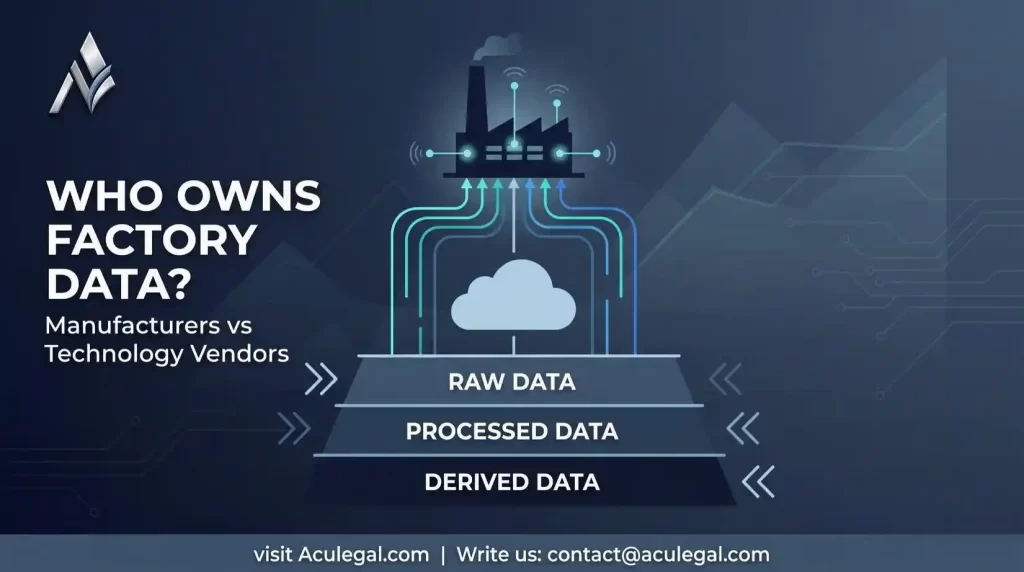
Factory Data Ownership has quietly become one of the most consequential and least understood legal questions facing manufacturers today. Every sensor on your production line, every predictive maintenance alert, every digital twin simulation is generating data. The question nobody asked at the procurement stage is simple: who actually owns it once it’s created?
For decades, this question didn’t matter much. Machines were dumb, data stayed on paper or in a local server, and nobody was fighting over it. That world is gone.
Today’s factories run on connected equipment, cloud dashboards, and AI-powered analytics supplied by third-party vendors. And the contracts governing those relationships were, in most cases, never written with data ownership in mind.
The Problem: Your Machines Are Talking, But Who Owns What They Say?
Modern manufacturing runs on Operational Technology (OT) and Information Technology (IT) convergence; sensors, PLCs, and SCADA systems now feed data directly into vendor clouds for real-time analytics and predictive maintenance. That integration unlocks genuine efficiency gains. It also creates a legal blind spot most manufacturers never see coming.
Here’s the uncomfortable truth: most equipment and software vendor contracts are silent, vague, or one-sided on data ownership. The vendor’s standard terms usually focus on licensing the software, not on who owns the operational data that software collects, stores, and processes.
That gap is no longer theoretical. Legal commentary on AI in manufacturing has flagged that digitizing tacit factory knowledge – process tweaks, optimization heuristics, institutional know-how – turns an operational asset into an attack surface and a legal exposure point all at once.
Manufacturers assume ownership because it’s their factory. Vendors assume ownership because it’s their platform, their algorithm, and their infrastructure that made the data usable in the first place. Both sides can’t be right, and the contract rarely says who is.
Why Vendors Push Back on Data Ownership
Vendors have real commercial incentives to hold onto factory data:
- Training data for AI models – your production patterns improve their predictive maintenance algorithms, which they then sell to your competitors.
- Benchmarking products – aggregated performance data becomes a sales asset across their entire client base.
- Platform lock-in – if you can’t export your own historical data, switching vendors becomes commercially painful.
None of this is illegal. But none of it should happen without your knowledge or your consent, and it usually happens because nobody negotiated the clause.
Raw Data vs Processed Data vs Derived Data: Who Owns What?
This is where most disputes actually get litigated, not over “data” as a single blob, but over which layer of data is in question. Courts and contract drafters increasingly separate data into three distinct categories, and each carries a different default ownership answer.
1. Raw Data
This is the unprocessed signal straight from your sensors: temperature readings, vibration logs, machine uptime, output counts. In most well-drafted contracts, raw data generated by your equipment in your facility should belong to you, the manufacturer or operator, by default.
2. Processed Data
This is raw data that’s been cleaned, structured, and organized, often by the vendor’s platform. Ownership here is murkier. Many vendor contracts claim a license to processed data because their software did the structuring work, even though the underlying signal came from your machines.
3. Derived Data
This is the layer built on top: predictive models, benchmarks, AI-generated insights, digital twin outputs. Vendors almost always claim ownership or exclusive rights here, arguing their algorithms, not your raw signal, created the value.
The practical risk: if your contract doesn’t explicitly separate these three layers, a vendor can claim broad rights over “the data” generically, and you may have no contractual basis to object. This single drafting gap is behind the vast majority of factory data disputes we see.
Why This Battle Is Escalating Right Now
This isn’t a slow-burn issue anymore. Two forces are colliding in 2026, and both push Factory Data Ownership to the top of the boardroom agenda.
The EU Data Act: A Global Wake-Up Call
The EU Data Act (Regulation 2023/2854) took general effect on September 12, 2025, and its “access by design” obligations for newly placed connected products become mandatory from September 12, 2026, effectively now. According to DIHK’s regulatory briefing, data access is becoming a basic technical design requirement for every connected device sold into the EU, from smart appliances to production machinery and agricultural vehicles.
Here’s why this matters even if your factory sits outside the EU: unlike GDPR, which focuses only on personal data, compliance trackers note the Data Act reaches all machine-generated and industrial data, creating obligations for manufacturers, cloud platforms, and service providers that go well beyond traditional privacy compliance. Any vendor selling connected equipment into the EU market, and most global equipment vendors do, now has to rebuild its data-sharing architecture. That ripple reaches every manufacturer using their platforms, anywhere in the world.
As one industrial data analysis put it, you own the machine, and you run the operations, yet accessing your own machine data has typically meant committing to an expensive, bundled vendor ecosystem built around dashboards and predictive tools you may not have needed. Regulation is now forcing that model open, but only for manufacturers who know to ask.
AI’s Appetite for Your Operational Data
The second force is AI. Legal commentary on smart manufacturing has flagged a real risk: generative and agentic AI tools can rapidly turn tacit factory knowledge, process tweaks, optimization heuristics, and institutional expertise into digital form that a competitor’s AI model could theoretically train on.
Every vendor building predictive maintenance, quality control, or digital twin tools needs training data. Your factory floor is the training set. If your contract doesn’t specify how that data can be used, you may be unknowingly funding your competitor’s next AI upgrade.
The Real Risks for Founders and Growing Manufacturers
If you’re running an SME manufacturing operation, here’s what’s actually at stake when Factory Data Ownership isn’t addressed contractually:
- Loss of competitive advantage – your process optimizations become a vendor’s generic product feature.
- Vendor lock-in – you can’t export historical data in a usable format, making switching platforms commercially unviable.
- IP leakage – proprietary process data gets aggregated into vendor-owned “insights” you can never fully reclaim.
- Regulatory exposure – overlapping GDPR and Data Act obligations create compliance gaps nobody assigned responsibility for.
- Zero negotiating leverage – by the time a dispute arises, you’re negotiating from a position of dependency, not partnership.
None of these risks are hypothetical. They’re the direct, predictable result of signing vendor contracts that were never reviewed with data rights in mind.
The Solution: Protecting Factory Data Ownership Before You Sign
The fix isn’t complicated, but it does require discipline most fast-growing SMEs simply don’t have bandwidth for. Here’s the practical playbook.
1. Audit Every Existing Vendor Contract
Start with your current equipment, SaaS, and IIoT platform agreements. Most manufacturers are shocked to find their existing contracts say nothing at all about data ownership — silence that courts often read in the vendor’s favor. This is exactly the kind of systematic commercial contract management work that a proper Contract Lifecycle Management process is built for — tracking every clause, every renewal, and every gap across your full vendor portfolio in one place.
2. Separate the Three Data Layers Contractually
Don’t let “data” stay undefined. Insist your contracts explicitly separate raw data, processed data, and derived data, with clear ownership and license-back terms for each layer. This is precise commercial contract drafting work, not boilerplate — generic templates almost never get this distinction right.
3. Build in Portability and Exit Rights
Require contractual guarantees that you can export your raw and processed data, in a usable format, on reasonable notice, regardless of contract status. Without this, you’re not a customer — you’re a hostage.
4. Negotiate, Don’t Just Sign
Vendor contracts are drafted to protect the vendor by default. Strong contract negotiation services at the procurement stage cost far less than an IP dispute two years into a relationship. This is where AI-assisted contract review, backed by human-verified legal judgment, catches the clauses a busy ops team will miss.
5. Align With Global Data Regulation, Not Just Local Law
If any part of your supply chain, customer base, or vendor stack touches the EU, the Data Act’s obligations likely apply to you indirectly. Legal risk management here means treating data rights as a compliance function, not an afterthought.
Why SMEs Struggle to Do This Alone
Most founders don’t have an in-house corporate legal retainer function reviewing every vendor contract line by line and hiring a full legal department is rarely justified at SME scale. This is precisely the gap a Virtual Chief Legal Officer is built to close.
A Fractional General Counsel or Fractional Legal Team gives you the same strategic oversight a large enterprise gets from its in-house legal department, reviewing vendor contracts, flagging data ownership gaps, and negotiating on your behalf without the overhead of a permanent hire. Whether you need a Fractional Legal Executive for high-stakes negotiations or a Fractional Paralegal and Fractional Legal Researcher for ongoing contract audits, an outsourced in-house legal team structure scales with you as your vendor relationships grow.
This is the practical value of a Virtual Legal Department: dedicated legal support for SMEs that doesn’t require a six-figure hire before you’ve proven the need for one.
Don’t Forget Your IP
Factory process data often overlaps directly with trade secrets and proprietary know-how. If your process optimizations, formulations, or workflow innovations are being captured in vendor systems, that’s an Intellectual Property Protection issue as much as a contracts issue, and the two need to be handled together, not separately.
Proof: What Getting This Right Actually Looks Like
This isn’t abstract legal theory. A well-documented U.S. federal contracting dispute involving Boeing turned entirely on whether the company had proactively protected its data rights during contract formation, rather than waiting to resolve ownership questions once the contract was already underway. The board’s ruling turned on exactly what the contract said, not on what either party assumed. The lesson generalizes far beyond government contracting: ownership follows the contract language, not the intuition of either party.
Manufacturers of connected equipment are increasingly being advised to treat data-access obligations as a competitive advantage rather than a compliance burden, using controlled, auditable data-sharing infrastructure that protects their IP while still meeting new access requirements. The manufacturers moving first on this aren’t just avoiding disputes. They’re negotiating better vendor terms, retaining more value from their own operational data, and building a defensible position well before a regulator or a competitor forces the issue.
At Aculegal, this is exactly the kind of gap we close for our manufacturing and industrial clients, reviewing vendor and equipment contracts, flagging silent data clauses, and building the negotiating leverage founders don’t have time to build themselves.
Conclusion: Don’t Let Silence Cost You Your Data
Factory Data Ownership isn’t a future problem, it’s a present one, sitting unresolved in contracts you’ve probably already signed. Between the EU Data Act’s design-by-default deadline this month and AI vendors hungry for training data, the manufacturers who act now will negotiate from strength. The ones who wait will negotiate from dependency.
The fix starts with one document: your current vendor contract. Most founders have never had it reviewed specifically for data ownership language, and most standard templates simply don’t cover it.
Simplifying Legal. Amplifying Success. – that’s not a tagline, it’s how we approach every contract that crosses our desk.
Get Your First Contract Review FREE.
📄 Scan to Claim Your FREE First Contract Review
Ready to find out what your vendor contracts actually say about your data? Book your consultation with Aculegal today – your first review is on us.