
An EPC Agreement Risk Checklist is the difference between a project that finishes on budget and one that ends up in arbitration. If you are a project owner, developer, or SME sponsoring an engineering, procurement, and construction contract, the terms you accept on page one often decide the outcome on page ninety.
Most owners read an EPC contract the way they read a lease: skim it, trust the header, sign at the bottom. That habit is expensive. EPC agreements are among the densest commercial contracts in existence, and a single missing clause on site conditions or liability caps can shift millions of dollars of risk onto your balance sheet.
This guide breaks down exactly what to check, in what order, and why it matters. No legalese, no filler. Just the 15 points that separate a well-negotiated EPC contract from a liability trap.
Why Most Project Owners Get Burned by Their EPC Contract
Here is the uncomfortable truth: EPC contracts are drafted to protect the contractor first. That is not a conspiracy, it is just how the market works. Contractors negotiate hundreds of these agreements. Most owners negotiate one or two in a career.
The imbalance shows up in three predictable ways.
First, scope ambiguity. When the scope of work is not defined with precision, disputes over what was included and what counts as a “variation” become almost inevitable, and vague language is one of the most common triggers of EPC conflict.
Second, risk transfer. Contract structures exist specifically to shift risks such as design errors, unforeseen site conditions, and delay exposure onto the party better positioned (or willing) to absorb them, and that party is not always the owner.
Third, buried terms. In heavily negotiated procurement relationships, the real risk often sits inside the General Terms and Conditions rather than the commercial purchase order itself, and those terms rarely get the scrutiny they deserve.
None of this means EPC contracts are unfair by design. It means they require a structured, line-by-line review before signature, not a quick read-through.
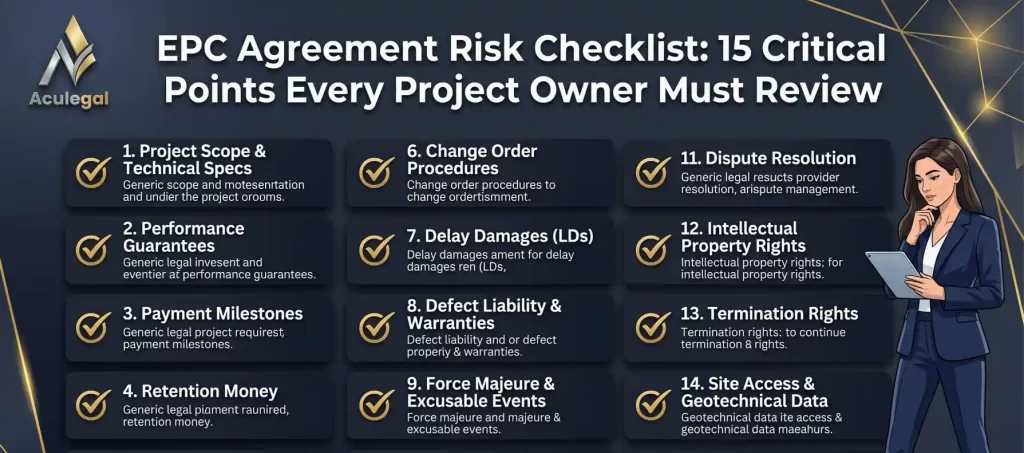
The 15 Critical Points Every EPC Agreement Risk Checklist Must Cover
Whether you are building a manufacturing plant, a renewable energy facility, or a commercial complex, these 15 points form the backbone of any serious risk review.
1. Scope of Work Definition
The scope clause is the foundation the entire contract rests on. It should state, in specific terms, what is included, what is explicitly excluded, and what depends on third parties or owner-supplied inputs.
Where full detail cannot fit in the main body, push it into a technical schedule. Ambiguity here creates disputes later.
2. Price Structure and Payment Milestones
Fixed-price, cost-plus, or a hybrid model each shift risk differently. Confirm:
- What triggers each payment milestone
- Whether retention amounts are reasonable and time-bound
- How price escalation for materials or currency fluctuation is handled
3. Schedule, Delay, and Extension of Time Clauses
Look for three clause types: an owner-caused delay clause, a force majeure clause, and a material changes clause. Each should specify what events trigger a schedule extension and how that extension is calculated.
4. Differing Site Conditions
This clause determines whether the contractor gets additional time or money when actual subsurface or site conditions differ materially from what was disclosed. Without it, owners can end up absorbing costs for conditions they never should have owned.
5. Performance Guarantees and Liquidated Damages
Performance guarantees protect the owner if the finished asset underperforms technical specifications. Liquidated damages (LDs) protect you against delay. Check that LD caps are realistic and not so low that they fail to incentivize on-time delivery.
6. Defects Liability and Warranty Period
Confirm the exact duration the contractor remains liable for defects after handover, and whether that period restarts after a repair. A contract silent on this point can leave you unprotected the moment the ribbon is cut.
7. Limitation of Liability
Total exclusion of contractor liability is rarely acceptable, but a blanket unlimited liability clause is equally unrealistic for the contractor to price fairly. The healthier approach is a negotiated liability cap, often tied to contract value, with carve-outs for gross negligence or fraud.
8. Indemnification Clauses
Indemnity provisions decide who pays when a third party sues over property damage, personal injury, or IP infringement arising from the project. Review these against your insurance coverage, not in isolation.
9. Insurance Requirements
Cross-check the insurance schedule against actual project risk: builder’s risk, third-party liability, professional indemnity, and marine cargo cover for imported equipment, where relevant.
10. Change Order and Variation Procedures
Every EPC agreement needs a documented process for submitting, pricing, and approving variations. Without one, “informal” scope changes discussed in a site meeting can turn into costly disputes about what was actually agreed.
11. Termination Rights
Map out termination for convenience, termination for cause, and the financial consequences of each. One-sided termination rights, where only the contractor can walk away cleanly, are a common red flag.
12. Intellectual Property and Design Ownership
Who owns the engineering drawings, proprietary process designs, and as-built documentation once the project is complete? This point is frequently overlooked until an owner needs those drawings for future expansion or a dispute. A dedicated intellectual property protection services review at contract stage prevents that gap.
13. Dispute Resolution and Governing Law
International EPC contracts routinely default to arbitration, often under ICC or SIAC rules, with a specific governing law and seat. Confirm this matches your risk tolerance, especially for cross-border projects where enforcement of a foreign judgment is not guaranteed.
14. Subcontractor and Supply Chain Risk
Understand how much of the work is being subcontracted, whether the main contractor remains fully liable for subcontractor failures, and what happens if a key supplier goes insolvent mid-project.
15. Regulatory, Environmental, and Permitting Compliance
Confirm which party is responsible for securing environmental clearances, labor compliance, and local permits, and what happens contractually if a permit delay is not the contractor’s fault.
EPC Agreement Due Diligence Checklist Before Signing
A checklist only works if it is applied in the right sequence. Before signature, run through this due diligence process:
- Collect every document that forms the contract – the main agreement, technical exhibits, correspondence, and meeting minutes. In EPC disputes, prior communications are frequently treated as part of the binding record, not just the signed document.
- Cross-check the commercial terms against what was actually negotiated. Verbal understandings that never made it into the written contract create the most avoidable disputes.
- Request the full General Terms and Conditions, not a summary. Never assume “standard terms” are neutral.
- Run the 15-point checklist above against every clause, flagging anything ambiguous, one-sided, or missing entirely.
- Document your findings in a formal risk memo that your board or investment committee can review before approval.
- Get experienced legal counsel to review high-value contracts before you negotiate amendments, not after.
- Negotiate and confirm every amendment in writing before the final signature round.
Owners who skip step six, and try to run this process purely in-house, are the ones who end up calling a lawyer only after the dispute has already started.
Why This Needs More Than a One-Time Legal Review
Here is where most SMEs and growing companies get the model wrong. They either skip legal review entirely to save cost, or they hire outside counsel for a single transaction and lose that expertise the moment the deal closes.
EPC projects do not stay static. Variations get negotiated mid-build. Site conditions change. Subcontractors default. Each of these events needs the same contractual discipline that went into the original signing.
This is exactly the gap a Virtual Chief Legal Officer (VCLO) is built to close. Instead of a one-off consultation, you get continuous, senior-level legal oversight, structured as a fractional legal team rather than a full-time hire you may not need year-round.
A Fractional General Counsel engagement typically covers:
- Ongoing Contract Lifecycle Management across every EPC variation and change order
- Real-time risk flagging as amendments are proposed
- A Fractional Legal Executive and Fractional Paralegal support layer for day-to-day contract queries
- Fractional Legal Researcher capacity for jurisdiction-specific compliance checks on cross-border projects
For founders and SMEs running capital-intensive projects without an in-house legal department, this Virtual Chief Legal Officer model delivers the judgment of a senior in-house lawyer at a fraction of the cost and none of the recruitment overhead.
The Proof: What Structured Contract Review Actually Prevents
The pattern across EPC disputes worldwide is consistent, and it is well documented in construction law literature. Owners who negotiate under FIDIC’s Silver Book, for example, accept that most risk, including design errors and unforeseen site conditions, sits with the contractor, in exchange for price and schedule certainty. That trade-off only works if the owner’s team fully understands what it gave up and what it kept.
Independent industry analysis of EPC procurement consistently points to the same three failure patterns: vague scope language, unreviewed General Terms and Conditions, and one-sided termination or liability clauses. Every one of those failure patterns is preventable with a structured pre-signature review.
That is the entire logic behind Aculegal’s approach: Simplifying Legal. Amplifying Success. We do not just flag risk after the fact. We build the review process into how you contract, so the next EPC agreement, and the one after that, gets stronger instead of starting from zero.
Key Takeaways
- Scope, price, and schedule clauses are the three most common sources of EPC disputes, and each deserves line-by-line scrutiny.
- Liability caps, indemnities, and insurance must be reviewed together, not as separate line items.
- A due diligence process, not a single read-through, is what actually catches risk before signature.
- Ongoing legal oversight, through a Fractional Legal Team or Virtual Chief Legal Officer, protects you through the full project lifecycle, not just at signing.
Get Your EPC Agreement Reviewed Before You Sign
An EPC agreement is not a document you want to negotiate alone, and it is not one you want reviewed after problems surface. If you are about to sign, amend, or renegotiate an EPC contract, get a second set of experienced eyes on it first.
Book a one-on-one consultation with Aculegal and let us walk through your contract against this exact checklist.
Claim your FREE First Contract Review (up to 30 pages) – no cost, no obligation, just a clear picture of where your risk sits.
Scan to Claim Your FREE First Contract Review