

A Data Protection Agreement (DPA) used to be something only enterprise legal teams worried about. Not anymore.
If your business collects emails, processes payments, stores customer records, or works with any third-party software, you are handling personal data. And if you are handling personal data without a proper legal framework in place, you are exposed. Every single day.
Data breaches, regulatory fines, and broken client trust are no longer theoretical risks. They are operational realities that take down businesses that believed they were “too small to be a target.” The truth? Regulators do not grade on size.
This guide is for founders, startups, and SMEs who want to understand what a Data Protection Agreement actually is, why it matters legally and commercially, and how to get one in place before the cost of ignoring it becomes impossible to absorb.
The Problem: Most Businesses Are Legally Exposed Without Knowing It
Here is a scenario that plays out more often than most business owners realize: A fast-growing startup uses a cloud-based CRM, a third-party email tool, and an outsourced payroll provider. Their team is scaling. Their data is flowing. And not a single contract governs who is responsible for protecting it.
According to the IBM Cost of a Data Breach Report 2023, the average cost of a data breach globally is USD 4.45 million, with small and mid-size businesses increasingly becoming primary targets due to weaker security and legal infrastructure.
The legal exposure compounds when you factor in:
- No clear allocation of data responsibility between parties
- No documented consent mechanisms from customers
- No contractual obligation on vendors to report breaches
- No defined process for handling data subject access requests
- No cross-border data transfer clauses (especially relevant for businesses operating with international clients or SaaS vendors)
These are not theoretical gaps. These are the exact gaps that trigger regulatory investigations and million-dollar penalties.
What Is a Data Protection Agreement (DPA), Exactly?
A Data Protection Agreement (DPA) is a legally binding contract between a data controller (your business) and a data processor (a third party that handles data on your behalf). It defines the terms under which personal data is processed, stored, transferred, and protected.
Under frameworks like the EU General Data Protection Regulation (GDPR), India’s Digital Personal Data Protection Act (DPDPA), and various international privacy laws, a DPA is not optional – it is mandatory whenever you engage a third-party processor.
Think of a DPA as the legal spine of your data operation. Without it, if something goes wrong, the question of “who is responsible?” becomes a courtroom argument – one that is expensive, time-consuming, and usually damaging regardless of the outcome.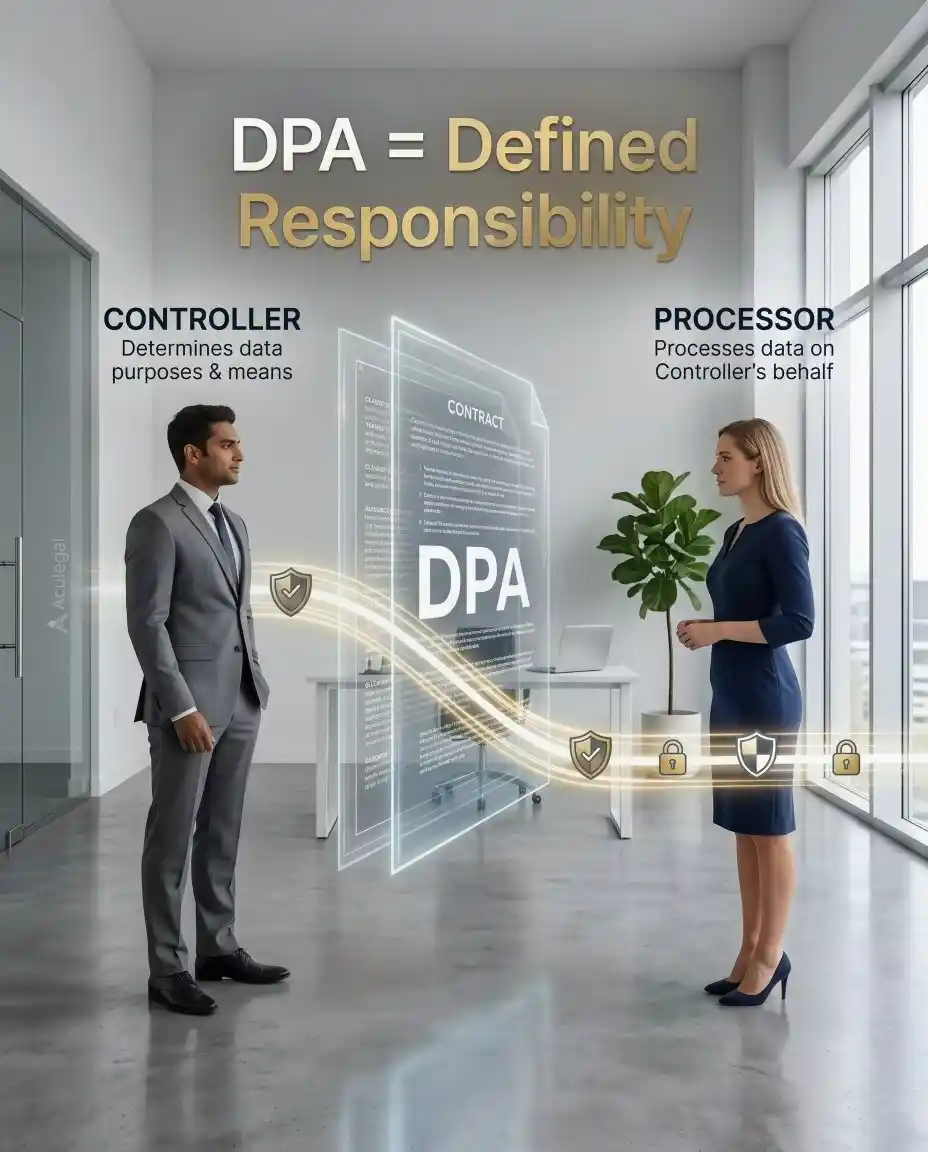
Key Components Every DPA Must Include
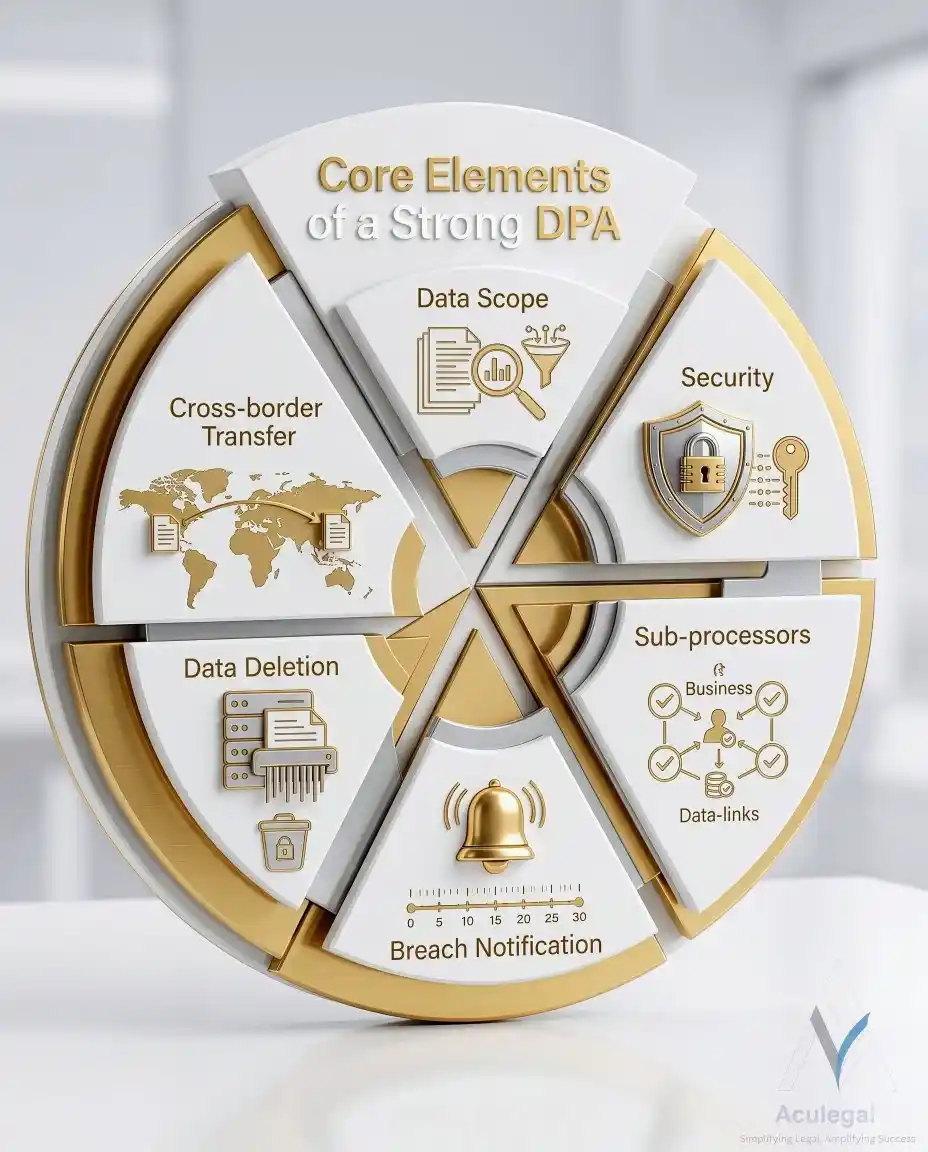
A well-drafted DPA is not a boilerplate download. It must be tailored to your specific business model and jurisdictional obligations. At minimum, it should cover:
- Subject matter and duration of the data processing
- Nature and purpose of the processing activity
- Type of personal data and categories of data subjects involved
- Obligations and rights of the controller
- Sub-processor clauses — who can your vendor engage, and under what terms?
- Data security measures — technical and organizational safeguards
- Breach notification timelines — how quickly must incidents be reported?
- Data return or deletion obligations upon contract termination
- Cross-border transfer mechanisms — standard contractual clauses, binding corporate rules, or equivalent safeguards
Who Actually Needs a Data Protection Agreement? (Hint: Probably You)
The short answer: any business that shares personal data with a third party needs a DPA in place. If you use a CRM, a cloud storage service, an HR platform, a payment gateway, or even a marketing automation tool, you are engaging data processors. Every one of those relationships needs to be governed.
Startups and Early-Stage Founders
Building fast is not a license to build without legal guardrails. Many startups sign up for cloud services, accept vendor terms without reading them, and inadvertently agree to data arrangements that conflict with their own privacy policy. When a data incident hits – and statistically, it will – the absence of a DPA means the liability defaults to you.
Investors increasingly conduct privacy due diligence. A missing DPA framework is a red flag at the term sheet stage.
Small and Mid-Size Businesses (SMEs)
SMEs often assume that compliance frameworks are designed for large corporations. That assumption is wrong – and costly. Regulators across jurisdictions have been clear: the obligations apply equally to businesses of all sizes. The scale of penalties, however, may vary based on revenue.
The UK Information Commissioner’s Office (ICO), for example, has issued fines to small businesses for failing to have adequate processing agreements. According to ICO guidance on controller-processor contracts, the absence of a written contract with processors is itself a violation.
DPA vs. Privacy Policy: Understanding the Difference
These two documents serve completely different purposes, and confusing them is a common (and dangerous) mistake. A Privacy Policy is a public-facing document that tells your customers how you collect and use their data. It is a transparency mechanism aimed at individuals.
A Data Protection Agreement (DPA) is a B2B contract between you and the vendors or processors who touch your data. It is an operational legal document that defines liability, obligations, and remedies.
You need both. Having a privacy policy without a DPA is like having a customer-facing returns policy while having no supplier agreements, it protects your brand narrative but does nothing to manage your actual legal exposure.
The Business Case: DPAs Are Not Just Compliance – They Are Competitive Advantage
Here is what most legal guides will not tell you: a well-structured DPA framework is not just about avoiding fines. It is a commercial differentiator.
Enterprise clients, particularly those in regulated sectors such as finance, healthcare, and legal services, will not sign contracts with vendors who cannot demonstrate data protection compliance. Having your DPA framework in order is often the difference between closing a B2B deal and losing it to a competitor who did the legal groundwork.
According to a Cisco Privacy Benchmark Study, 94% of organizations say their customers would not buy from them if their data were not properly protected. Privacy compliance is no longer a legal checkbox – it is a trust signal.
The strategic upside of getting your DPA right:
- Faster enterprise sales cycles — procurement teams clear compliance checks quicker
- Stronger investor due diligence position — demonstrates operational maturity
- Reduced cyber insurance premiums — insurers reward documented data governance
- Lower liability exposure — contractually shifts risk to the appropriate party
- Brand trust with customers — increasingly a purchasing decision factor

India’s DPDPA and What It Means for Indian Startups and SMEs
India’s Digital Personal Data Protection Act (DPDPA) 2023 marks a fundamental shift in how Indian businesses must think about data. For the first time, there is a comprehensive legislative framework governing digital personal data – and it places clear obligations on businesses of all sizes.
Under the DPDPA, data fiduciaries (businesses that determine the purpose and means of processing) must engage data processors only through valid contracts. These contracts must reflect the obligations under the Act and ensure that processors handle data only as instructed.
For Indian startups and SMEs, this means:
- Vendor contracts must be updated to reflect DPDPA-compliant DPA clauses
- Consent mechanisms must be documented and verifiable
- Cross-border data transfers to countries outside India require explicit government approval or prescribed safeguards
- Breach notification to the Data Protection Board must occur within mandated timelines
Non-compliance penalties under the DPDPA can reach up to ₹250 crore. For startups and growing SMEs, that is not a risk, that is an existential threat.
Aculegal DPDP Compliance Services – Learn how our team helps Indian businesses build DPDPA-compliant data frameworks from the ground up.
5 Common DPA Mistakes That Cost Businesses Dearly
Even businesses that attempt a DPA often get it wrong. Here are the five most frequent errors Aculegal sees in client engagements:
- Using a generic template without jurisdiction-specific clauses. Data protection law varies significantly between the EU (GDPR), India (DPDPA), UK (UK GDPR), and other markets. A one-size-fits-all document creates false security.
- No sub-processor provisions. If your vendor uses sub-contractors to process data on your behalf, your DPA must govern that relationship too. Leaving this out is a compliance gap.
- Failing to update DPAs when vendor relationships change. A DPA drafted in 2021 may not cover new data flows that emerged in 2024. Regular reviews are essential.
- Omitting breach notification timelines. Without contractually mandated timelines, your vendor has no obligation to tell you promptly when something goes wrong.
- Treating DPAs as set-and-forget documents. DPAs must evolve with your business, your vendor ecosystem, and the regulatory landscape.
How to Get Your Data Protection Agreement Right: A Practical Starting Point
Getting a DPA right is not about downloading a template and hoping for the best. It requires a structured approach:
- Data mapping first. Before you can draft a DPA, you need to know what data you hold, where it flows, and who touches it. A data audit is step one.
- Identify all your processors. List every third-party vendor, SaaS tool, or contractor that processes personal data on your behalf. Each relationship may require its own DPA or addendum.
- Engage legal counsel with privacy law expertise. Your DPA must be jurisdiction-specific, business-specific, and drafted with regulatory updates in mind. Generic legal advice is insufficient here.
- Implement a review cadence. Build a schedule for annual DPA reviews — and trigger immediate reviews whenever a vendor relationship changes.
- Train your team. Legal documents are only as effective as the people who implement them. Internal awareness is non-negotiable.
For further guidance on global data protection standards, the European Data Protection Board (EDPB) Guidelines on Controllers and Processors provide authoritative reference material on structuring controller-processor relationships.
Why Growing Businesses Choose Aculegal for Data Protection Legal Work
At Aculegal, we do not just draft documents. We help businesses understand the legal architecture behind their operations, and build frameworks that scale with them.
Our approach is grounded in three principles:
- Clarity over complexity. Legal documents should be understandable by the people who sign them, not just the lawyers who draft them.
- Jurisdiction-specific precision. Whether you are operating under GDPR, DPDPA, UK GDPR, or multiple frameworks simultaneously, our team has the depth to navigate it.
- Commercial alignment. We understand that legal compliance exists within a business context. Our advice is designed to protect you without slowing you down.
👉Aculegal Privacy & Data Protection Practice – Explore how our privacy law practice supports startups and SMEs across India and international markets.
Conclusion: Data Risk Is Business Risk – Get Ahead of It
The era of data being just an operational asset is over. For modern businesses, data is simultaneously the most valuable and the most legally sensitive asset they hold. The legal frameworks governing its use are expanding, and enforcement is accelerating.
Here is what we covered in this guide:
- A Data Protection Agreement (DPA) is a legally mandatory contract governing how third-party processors handle your data
- Without a DPA, businesses face regulatory penalties, commercial liability, and operational disruption
- Indian businesses must now comply with the DPDP, with penalties reaching ₹250 crore
- DPAs are a commercial differentiator, not just a compliance checkbox
- Generic templates and set-and-forget approaches create false security – precision and regular review are essential
The best time to get your DPA right was before your first data incident. The second-best time is now.
Ready to Protect Your Business?
Book a free consultation with Aculegal’s data protection legal team. We will review your current exposure, map your data processing relationships, and help you build a DPA framework that is legally sound and commercially smart.
📞 Book Your Free Consultation → | 📧 contact@aculegal.com | 🌐 www.aculegal.com
Aculegal
Simplifying Legal. Amplifying Success.
Web Sources & References (Outbound / Nofollow)
- IBM Cost of a Data Breach Report 2023: https://www.ibm.com/reports/data-breach
- GDPR Overview — gdpr.eu: https://gdpr.eu/what-is-gdpr/
- ICO Guidance: Controller & Processor Contracts: https://ico.org.uk/for-organisations/guide-to-data-protection/guide-to-the-general-data-protection-regulation-gdpr/contracts-and-liabilities-between-controllers-and-processors-multi-topic-guide/
- Cisco Privacy Benchmark Study: https://www.cisco.com/c/en/us/products/security/privacy-benchmark-study.html
- EDPB Guidelines on Controllers and Processors: https://www.edpb.europa.eu/our-work-tools/our-documents/guidelines/guidelines-072020-concepts-controller-and-processor-gdpr_en