

Introduction: The Foundation No One Talks About
You have the product. You have the team. You have the traction. But here is the uncomfortable truth that most business advisors will not tell you upfront: the hidden legal layer behind every scalable growing business is often what separates companies that break through from those that break down.
Founders, startups, and SMEs spend enormous energy optimising sales funnels, product-market fit, and growth metrics. Yet the legal infrastructure underneath their operations quietly determines whether that growth is sustainable, or a lawsuit, regulatory fine, or investor walkout waiting to happen.
This is not about fear. This is about strategy.
At Aculegal, our philosophy is simple: Simplifying Legal. Amplifying Success. And the first step to amplifying your success is understanding the legal architecture that every scalable business is built on, whether they know it or not.
Why Most Founders Get Legal Wrong
They Treat Legal as a Reactive Cost, Not a Proactive Asset
Most early-stage founders see legal as something you call when things go wrong, a dispute, a terminated employee, or a contract breach. That mindset is expensive.
Building the right compliance and legal infrastructure does not require enterprise budgets. It requires understanding what matters at your stage and implementing processes that scale with growth. The founders who understand this build businesses that raise capital faster, close enterprise deals more easily, and exit on better terms.
The Numbers Do Not Lie
90% of startups crumble within their first five years. A recent study reveals that regulatory and legal hurdles rank as the 5th leading cause of startup failures, closely trailing behind fierce market competition.
That is not a small statistic. That is a business-ending one.
The good news? Every single one of those legal risks is manageable if you build the right legal layer into your business from the start.
What Is the Hidden Legal Layer?
The hidden legal layer is not a single document or a one-time legal review. It is a living system of legal structures, contracts, compliance frameworks, and IP protections that work together to protect your business as it scales.
It operates in the background, but it touches everything:
How your company is structured and who owns what
How your contracts protect you, or expose you
How your intellectual property is secured
How your employment relationships are governed
How you meet regulatory and compliance obligations
From funding rounds to hiring, customer contracts, and data protection, ensuring your business is legally sound is essential for long-term success. The businesses that get this right are not just protected, they are positioned.
The 5 Pillars of the Hidden Legal Layer
1. Entity Structure: The Foundation of Everything
The way your business is legally structured affects your tax exposure, personal liability, fundraising capability, and future exit options. Getting this wrong at the start is not just inconvenient, it can cost you hundreds of thousands in restructuring fees later.
The right entity structure:
- Separates personal and business liability
- Signals credibility to investors and large clients
- Creates a clean framework for equity distribution
- Enables tax efficiency as you scale
If you set this up correctly from Day 1, everything else becomes easier. If you do not, you will pay to fix it later at the worst possible time.
[Internal Link Opportunity: Aculegal Business Structuring & Incorporation Services]
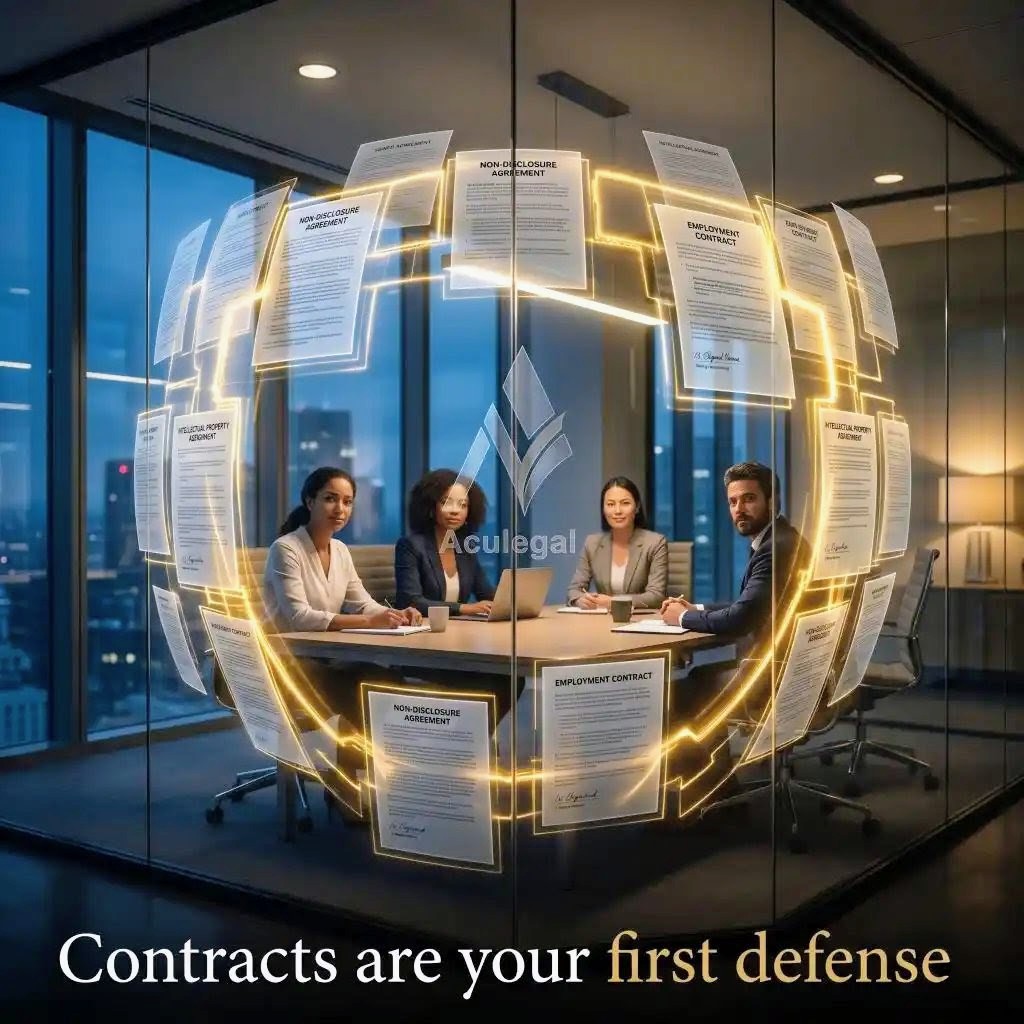
2. Contracts That Actually Protect You
Most SMEs and startups are running on contracts written by the other party’s lawyers, or worse, templates pulled from the internet. That is not a contract strategy. That is a liability strategy.
Clear legal agreements are critical for protecting business interests, including founder agreements defining roles, responsibilities, and equity splits; employment contracts compliant with applicable law; supplier and client contracts outlining terms of service to prevent disputes; and confidentiality agreements that protect sensitive business information.
Your contracts should be working for you, not against you. They should:
- Define scope, deliverables, and payment terms with precision
- Limit your liability where possible
- Include clear IP ownership clauses
- Provide enforceable dispute resolution mechanisms
A well-drafted contract does not just protect you if something goes wrong. It prevents things from going wrong in the first place.
3. Intellectual Property: Your Most Undervalued Asset
For most scalable businesses, the real value is not physical, it is intellectual. Your brand, your software, your processes, your content, your proprietary methods. These are your moats.
Yet a striking number of founders have no formal IP protection strategy.
Protecting your startup’s intellectual property includes registering trademarks for your brand name and logo, securing patents for unique inventions, protecting original content and software through copyrights, and ensuring IP agreements require employees and contractors to assign rights to the business.
Here is the risk most founders do not see: If your IP is not properly assigned from employees and contractors, it may not even legally belong to your company, even if you paid to create it. That is a devastating discovery to make during a due diligence process.
4. Regulatory Compliance: The Non-Negotiable Layer
The regulatory landscape is becoming more challenging and complex for startups. Regulators operate in a strict, unforgiving manner when a company is found to be non-compliant. If a startup is hit with a large monetary penalty or legal action, it could be disastrous for the company’s long-term future.
Compliance is not just about avoiding fines. It is about unlocking growth. Consider:
Enterprise sales: Large corporations will not onboard a vendor that cannot demonstrate compliance. The deal simply does not happen.
Investment readiness: Sophisticated investors run compliance checks during due diligence. Gaps can kill rounds or reduce your valuation.
Customer trust: Particularly in data-heavy industries, your compliance posture is a direct signal of business maturity.
The businesses that treat compliance as a competitive advantage, rather than a checkbox, consistently outperform those that do not.
5. Employment Law: The Layer That Scales With Your Team
Your team is your engine. But every hire introduces legal complexity. Employment contracts, contractor classifications, probation clauses, non-compete agreements, workplace policies, these are not bureaucratic formalities. They are the architecture of your most important relationships.
Common and costly mistakes SMEs make here:
- Misclassifying employees as contractors
- Using generic employment contracts that do not reflect actual working arrangements
- Having no documented performance management process
- No clear IP or confidentiality clauses for staff
Every person you bring into your organisation should be governed by documentation that protects both parties, and your business’s long-term interests.
[Internal Link Opportunity: Aculegal Employment Law & HR Legal Advisory Services]
When Should You Build the Hidden Legal Layer?
The short answer: now.
The longer answer: the best time was before your first customer. The second best time is today.
Here is how legal risk typically compounds by stage:
| Stage
|
Typical Legal Gaps
|
Consequence
|
|---|---|---|
|
Pre-revenue |
No entity structure, no IP assignment |
Founder disputes, investor red flags |
|
Early traction |
Weak contracts, verbal agreements |
Cash flow disputes, client lock-in risk |
|
Scaling (Series A+) |
Compliance gaps, employment issues |
Failed due diligence, regulatory exposure |
|
Enterprise sales |
Missing compliance frameworks |
Lost contracts, revenue ceiling |
|
Exit/M&A |
IP gaps, structural issues |
Valuation erosion, deal collapse |
The legal gaps that feel tolerable at ₹10 lakh in revenue become existential threats at ₹10 crore.

What Investor-Ready Legal Infrastructure Looks Like
Investors, whether angels, VCs, or strategic partners, are not just buying your product. They are buying your business. And a business with a robust legal layer looks fundamentally different in due diligence.
An investor-ready legal foundation includes:
Clean cap table with documented equity agreements, Founder vesting schedules that align incentives, Customer and supplier contracts that are enforceable and assignable IP ownership fully vested in the company entity
Compliance documentation relevant to your industry, Employment agreements for all staff, including early team members Board and governance documentation for structured decision-making. Many investors and venture capitalists, including leading accelerators, demand robust compliance credentials and extensive proper corporate formation documents. This is a major reason why it is so important for startups to develop and deploy a comprehensive legal and compliance programme to reduce investment risks.
None of this is complex when you have the right legal partner. All of it is expensive to retrofit when you do not.
The Strategic Advantage Most Competitors Miss
Here is the insight most founders overlook: legal structure is a competitive advantage.
When your contracts are tighter than your competitor’s, you close deals faster. When your IP is protected, you compete from a position of strength. When your compliance posture is clean, you access enterprise markets your competitors cannot. When your employment relationships are well-governed, you attract better talent.
Compliance certifications play a vital role in establishing customer trust. When you obtain these certifications, you show your commitment to meeting industry standards and regulatory requirements, instilling confidence in customers and making them feel more secure when engaging with your business.
The hidden legal layer is not just protection. It is positioning.
Why Founders and SMEs Choose Aculegal
At Aculegal, we work exclusively with founders, startups, and growing businesses because we understand that your legal needs are not the same as a multinational corporation’s. You need legal counsel that is:
Commercially minded, focused on outcomes, not just compliance. Stage-appropriate, aligned with where you are now and where you are going, clear and practical, no unnecessary jargon, no unnecessary billing, proactively strategic, helping you build the legal layer before you need it. That is not just a tagline. It is the lens through which we approach every client engagement.
Conclusion: The Legal Layer Is the Growth Layer
The hidden legal layer behind every scalable growing business is not a burden, it is a blueprint. It is the difference between a business that grows and a business that grows and sustains that growth.
The founders and business leaders who understand this early do not just avoid problems. They build businesses that attract better investors, close bigger deals, retain stronger talent, and exit on their own terms.
Here is what to take away from this: Legal infrastructure is not a luxury, it is a growth lever every stage of business growth introduces new legal complexity. The cost of reactive legal is always higher than proactive legal
Your legal layer should scale with your ambition. The question is not whether you need the hidden legal layer. The question is whether you build it deliberately or discover it expensively.
Ready to Build Your Legal Foundation?
Aculegal works with founders, startups, and SMEs across business structuring, contracts, IP protection, compliance, and employment law, everything you need to build a business that scales without legal landmines.
📞 Book your free legal consultation today and let us show you exactly where your legal gaps are, before they cost you.
👉 Contact Aculegal | Book a Free Consultation
👉 Explore Aculegal’s Services for Startups & SMEs
👉 Learn About Our Business Structuring Services
Aculegal, Simplifying Legal. Amplifying Success.
Web Sources Referenced
-
Diligent— https://www.diligent.com/resources/blog/compliance-for-startups
-
Hakim Law Group — https://hakimlawgroup.com/navigating-regulatory-compliance-for-tech-startups-in-2025/
-
Sprinto — https://sprinto.com/blog/compliance-for-startups/
-
Seven Legal — https://sevenlegal.io/blog/legal-compliance-for-scaleups-a-founders-guide-to-getting-it-right/
-
CertPro — https://certpro.com/compliance-for-startups/