

“Will AI replace my lawyer?” It is the question every founder, general counsel, and business owner in India is quietly asking right now. The honest answer is: no. But AI is changing what your lawyer spends their time on, and that difference will determine which businesses move faster, spend smarter, and take on less legal risk.
The fear is understandable. Headlines about generative AI disrupting every profession have been relentless. But in practice, what is actually happening inside India’s leading law firms and corporate legal departments tells a very different, and far more useful, story for businesses trying to make decisions today.
This is that story. And more importantly, here is what it means for your next contract, your next board decision, and your next regulatory challenge.
The problem: legal work is drowning in volume
India’s legal system is under extraordinary pressure. As of December 2025, district courts hold over 40 million pending cases. High Courts add another 6.2 million, and the Supreme Court’s backlog exceeds 90,000 matters. A 2018 Niti Aayog paper estimated it would take 324 years to clear India’s judicial backlog at the pace it was moving then.
For businesses, the problem is not just in the courts. It is inside every legal team. A lawyer’s day is consumed by tasks that are necessary but do not require a lawyer’s judgement, and that is precisely where the bottleneck sits.
Think about what consumes a lawyer’s time before they ever get to the strategic work:
- Reviewing contracts that are structurally identical to those reviewed last quarter
- Searching thousands of judgments to find three relevant precedents
- Tracking compliance deadlines across GST, MCA, SEBI, DPDP, and state labour laws simultaneously
- Drafting standard documents from scratch every time
- Summarising hundreds of pages of due diligence material under tight transaction timelines
None of these tasks require a lawyer’s judgement. But all of them consume it. That is the problem AI is now solving, and the reason businesses that understand this shift will hold a genuine commercial advantage.
The solution: AI as the invisible colleague
Kuruvila Jacob, Senior Associate at Trilegal, one of India’s foremost full-service law firms, describes AI as his “invisible colleague.” Present everywhere, but never the decision-maker. That framing captures precisely what well-implemented legal AI looks like in practice today.
When AI is embedded correctly into legal workflows, it does not replace the lawyer’s voice. It amplifies it. Lawyers handle more matters, deliver faster turnaround, provide richer analysis, and spend their energy on the high-value advisory work that genuinely moves business outcomes.
1. Contract review and drafting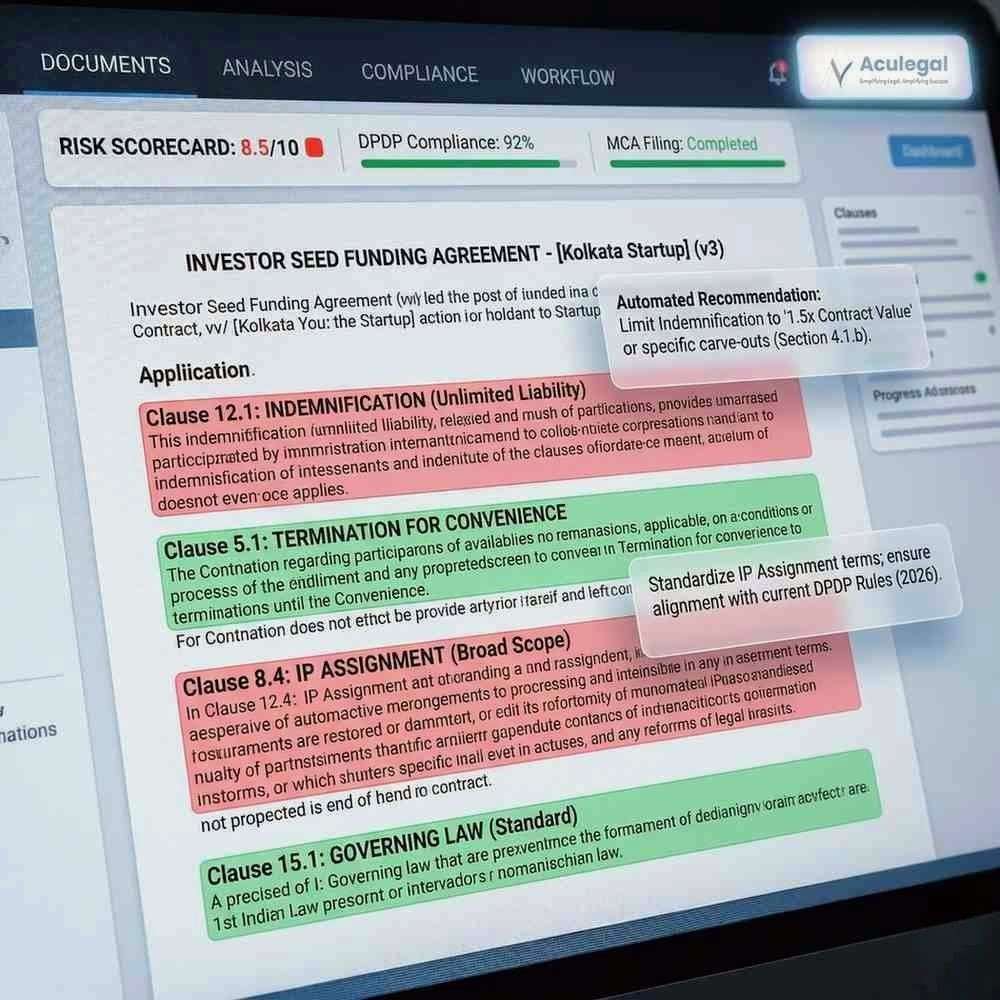
Contract work is where AI delivers the most immediate, measurable return. Tools trained on Indian contract law can review a standard vendor agreement in minutes, flagging missing indemnity clauses, unusual termination rights, and non-standard payment terms, work that would previously take a junior associate several hours.
Platforms operating in India are already enabling businesses to reduce contract drafting time by up to 80 per cent, with AI-generated first drafts reviewed and refined by human lawyers rather than built from scratch. One mid-size firm reported slashing contract review times by 60 per cent within the first year of AI tool deployment.
For businesses, the translation is direct: faster deal closures, lower legal costs, and fewer commercial disputes arising from overlooked contractual obligations.
2. Legal research at scale
India’s legal landscape is vast. SCC Online alone surfaces insights across more than 4 million judgments spanning 400-plus databases. Manually searching this corpus for relevant precedents is not just slow, it is a strategic liability when decisions are time-sensitive.
AI research tools now surface case law in minutes using natural language queries. India-trained platforms provide AI-generated case gists, judge analytics, citation mapping, and, increasingly, predictive insights on litigation outcomes.
For a business deciding whether to litigate, settle, or restructure a contract, faster and deeper legal research means better-informed decisions made sooner, with less uncertainty and lower advisory cost.
3. Compliance automation
For businesses operating across multiple Indian states and regulatory domains, compliance is not a one-time project, it is an ongoing operational challenge. GST reconciliation, MCA annual filings, SEBI disclosure requirements, PF and ESI obligations, each carries its own deadlines, penalties, and procedural requirements.
AI-powered compliance platforms now produce real-time risk maps that give General Counsels a unified view of obligations across business units and jurisdictions. Predictive analytics can flag contracts likely to trigger compliance issues before they do. Automated deadline tracking ensures nothing falls through the cracks.
The shift, as documented in the NASSCOM AI Adoption Index, is from static dashboards to proactive systems that detect anomalies early and suggest corrective actions, a fundamental change in how businesses manage regulatory exposure.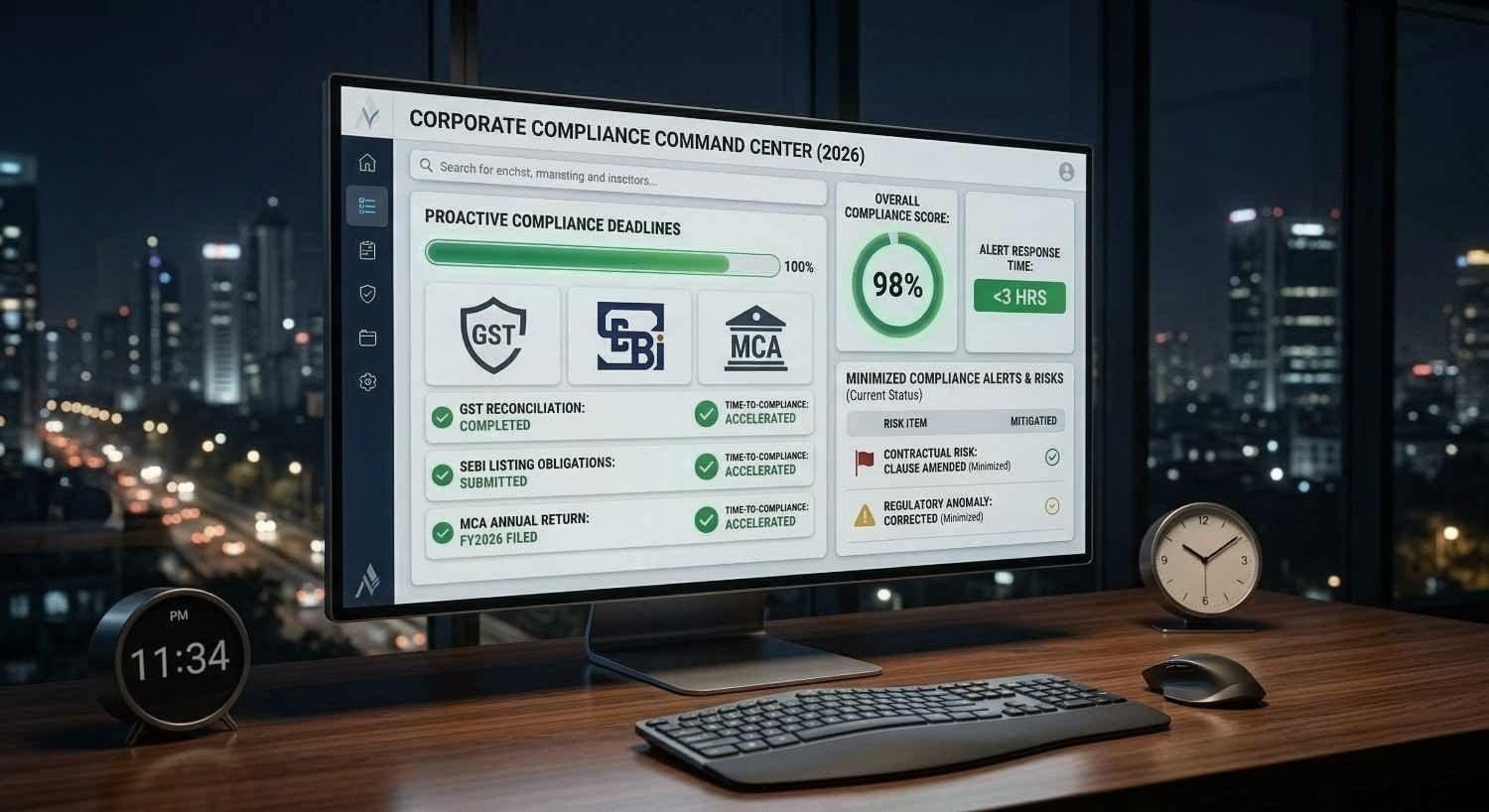
4. Due diligence and transaction support
M&A transactions, funding rounds, and major commercial agreements generate enormous volumes of documents that must be reviewed under tight timelines. AI dramatically accelerates this process. At Cyril Amarchand Mangaldas, one of India’s top-tier firms, AI is now deployed across every practice area, from retrieving key information from contracts and precedents to summarising large document sets for due diligence at scale.
For businesses, this means the legal due diligence that once stretched transaction timelines by weeks can be completed with significantly greater speed and coverage. Human lawyers remain central, but they are reviewing AI-prepared summaries and flagged risks rather than reading every page from scratch.
 The proof: what the data says about India’s legal AI shift
The business case for AI-enabled legal services in India is no longer theoretical. A growing body of current data reflects a sector in accelerating transformation.
- 79% of law firms integrated AI into workflows by mid-2025 Akerman LLP / NASSCOM, 2025
-
315% increase in AI use by law firm professionals, 2023 to 2024 NetDocuments, 2025
-
82% Higher workflow efficiency when tools are fully integrated BharatLaw AI / India Legal Benchmark, 2025
- 53% of legal professionals report measurable ROI from AI Thomson Reuters, 2025
Data points and Sources are mentioned below:
- India legal tech market valued at USD 1.8 billion in 2025 – FlowSense Industry Report, 2025
- Indian legal AI market projected to reach USD 106.3 million by 2030 at ~23% CAGR – Legistify / Market Analysis, 2025
- 75% of legal and compliance teams in India are now using AI tools – FlowSense Industry Survey, 2025
- Contract drafting time reduced by up to 80% with AI-assisted tools – Juro / SpotDraft Platform Data, 2025
- Legal tech sector funding grew 44%, reaching ~USD 3.56 billion in H1 2025 – NASSCOM / Wikipedia, 2025
- 96% of Indian lawyers oppose AI replacing human legal representation – Bar Council of India Survey, 2025
- Supreme Court of India: 36,271 judgments translated using AI into Hindi – The Hindu / SC Confirmation, 2025
- Rs. 53.57 crore allocated for AI and blockchain under e-Courts Phase III – Government of India, 2025
Key insight for businesses
The same Bar Council survey that shows 96% of lawyers oppose AI replacing human representation also shows those same lawyers actively adopting AI tools for research, drafting, and compliance. The profession is not resisting AI, it is defining where AI belongs. That boundary is exactly where smart businesses should be operating.
How does this help a business make a decision?
This is the question most legal AI commentary sidesteps. Here is a direct, practical answer across the four dimensions that matter most to business leaders.
- Speed to decisionWhen a contract needs reviewing before signing, or a regulatory question must be answered before a board meeting, the speed of legal analysis directly affects commercial outcomes. AI compresses that cycle, not by skipping steps, but by completing preparatory steps faster than any human team alone.
- Cost predictabilityWhen routine review, compliance tracking, and first-draft preparation are handled by AI tools, high-cost human hours are reserved for the strategic advisory work that genuinely requires them. Legal budgets become more predictable and legal support more scalable as businesses grow.
- Risk visibilityLegal risk accumulates quietly, a clause that creates unexpected liability, a compliance deadline that passes unnoticed. AI systems that continuously monitor contracts and obligations provide a level of legal risk visibility previously available only to the largest, best-resourced organisations.
- Better human adviceWhen lawyers are not buried in routine tasks, they give better advice. The time spent with legal counsel moves from preparatory tasks to the strategic questions that require genuine expert judgement, deal structure, negotiation strategy, regulatory positioning.
Nishant Parikh, Partner at Trilegal, articulates this precisely: AI allows lawyers to focus on “judgement, negotiation and strategy.” For clients, this means the value they receive from legal counsel is concentrated exactly where it is most needed.
What should a business look for when choosing AI-enabled legal support?
Not all legal AI tools are equal, and not every tool is appropriate for the Indian legal context. These are the five factors that determine whether an AI-assisted legal partnership will actually deliver value.
- India-specific legal training. Generic tools trained on US or UK databases do not understand Indian statutes, GST frameworks, or the procedural nuances of Indian courts. Any AI tool must be trained on Indian case law, including Supreme Court judgments, High Court decisions, SEBI circulars, and MCA filings.
- Human oversight built in from the start. Legal AI hallucination rates range between 17 and 33 per cent in some studies. Any responsible deployment must include structured human review of AI outputs, particularly for filings, litigation decisions, and formal advisory opinions.
- Client confidentiality safeguards. Your legal matters contain commercially sensitive information. Tools must operate within private or secure cloud environments with audit trails and strict access controls. Leading Indian firms like Cyril Amarchand Mangaldas and Trilegal host AI tools within their own secure infrastructure for exactly this reason.
- Workflow integration, not tool sprawl. The most valuable AI tool is one that works inside your existing legal and business workflows. Look for solutions that integrate with contract lifecycle management platforms, document systems, and communication tools your team already uses.
- Measurable ROI from a defined starting point. Begin with a single high-value pain point, contract review turnaround, compliance deadline management, or due diligence volume. Measure time saved. Build from there. Firms that saw meaningful results from AI adoption consistently started with small, targeted pilots before scaling.
Conclusion: the smartest thing AI can do is make your lawyers better
The fear that AI will replace lawyers misunderstands what lawyers are fundamentally for. Legal expertise is not a database to be searched. It is the ability to apply knowledge, judgement, and professional accountability to situations that are inherently uncertain, commercially complex, and often deeply consequential.
No AI system, however sophisticated, can shoulder that responsibility. What AI can do, and is doing right now in Indian law firms and corporate legal departments, is remove the friction that prevents lawyers from doing that work well.
For businesses, this translates directly into a set of advantages that compound over time:
- Faster contracts, deal cycles shortened, not delayed by legal review queues
- Sharper compliance, obligations tracked proactively, not discovered after a missed deadline
- Better-informed decisions, legal analysis available at the speed business actually operates
- Lower cost per matter, AI handles the volume, lawyers deliver the judgement
The legal workflow is being reshaped. The businesses that recognise this early, and partner with legal counsel that is already working this way, will carry a structural advantage over those that do not.
The question for your business is not whether to engage with AI-enabled legal services. It is how soon.

Ready to make smarter legal decisions, faster?
Aculegal combines India-focused legal expertise with modern AI-enabled workflows to give your business the legal support it needs, at the speed your business actually demands.
→ Talk to the Aculegal team today: Book your Free Expert Consultation
→ Explore our services for corporates, startups, and growing businesses
Web sources and references
- Microsoft Source Asia (Jan 2026), Code of law: How AI is helping India’s lawyers work faster, news.microsoft.com/source/asia
- Legistify (Oct 2025), How AI Is Revolutionising Legal Tech in India, legistify.com
- FlowSense (Jan 2025), Legal Software India 2025: Complete Guide, flowsense.solutions
- BharatLaw AI (Jun 2025), How AI Is Transforming India’s Legal System, bharatlaw.ai
- BW Legal World (Jun 2025), Inside the AI Revolution Quietly Transforming Law Firms, bwlegalworld.com
- NASSCOM Community (Feb 2026), Legal Tech at a Turning Point: What 2025 Has Shown Us, nasscom.in
- NetDocuments (Jan 2026), AI-Driven Legal Tech Trends for 2025, netdocuments.com
- Legalspace AI (Dec 2025), Top 9 Legal AI Software for Legal Professionals in 2026, legalspace.ai
- VIDUR AI (Feb 2026), Top 10 AI Tools for Lawyers in India (2026 Edition), vidur.in
- Attorney at Work (Feb 2026), Legal AI Tools 2026: How Law Firms Are Really Using AI Today, attorneyatwork.com
This blog post is for informational purposes only and does not constitute legal advice. For specific legal guidance, please consult a qualified legal professional at Aculegal. © Aculegal.