

Imagine launching your innovative startup in India—only to face criminal prosecution, hefty fines, and months of legal battles over a minor paperwork slip or technical compliance error. For thousands of Indian founders, this was once a daily nightmare. Today, the Jan Vishwas Reforms are rewriting the rules.Cnbctv18

These landmark changes, starting with the Jan Vishwas (Amendment of Provisions) Act, 2023 and amplified by the newly passed Jan Vishwas (Amendment of Provisions) Bill, 2026, decriminalise minor offences, replace jail threats with civil penalties, and usher in trust-based governance. The result? A massive boost to ease of doing business and a safer path for startups to scale without fear.Youtube
If you’re a founder, CTO, or compliance lead in India, this guide shows exactly how the Jan Vishwas Reforms slash legal risks and why acting now can save your startup time, money, and peace of mind.
The Problem: Why Legal Risks Once Crushed Indian Startups

Indian startups have long battled a complex web of central and state laws. Minor lapses, late filings, labelling errors, or procedural oversights often triggered criminal liability, including imprisonment.
Key pain points before reforms:
- Over 1,000 offences across dozens of laws carried jail terms, even for first-time, non-fraudulent mistakes.
- High compliance costs drained precious runway, especially for bootstrapped MSMEs and early-stage ventures.
- Fear of prosecution deterred innovation, delayed hiring, and scared investors wary of regulatory red flags.
- Prolonged litigation clogged courts, tying up founders and capital for years.
In a country racing toward a $5-trillion economy, these outdated rules were holding back the very entrepreneurs building Viksit Bharat.
The Solution: Jan Vishwas Reforms, Decriminalisation at Scale

The Jan Vishwas (Amendment of Provisions) Act, 2023, decriminalised 183 provisions across 42 Central Acts. The Jan Vishwas Bill 2026 builds on this by amending 784 provisions across 79 Central Acts administered by 23 Ministries, with 717 provisions fully decriminalised.Cnbctv18
Together, they mark one of India’s biggest pushes toward trust-based governance.
Core features of the reforms:
- Imprisonment removed for minor, technical, and procedural defaults (57 provisions).
- Jail + fine converted to civil penalties only (113 provisions).
- Warnings for first-time offences in many cases.
- Graded monetary penalties based on turnover or impact – far more proportionate for startups.
- Adjudication by officers (not courts) for faster resolution.
- Compounding of offences and simplified appeals introduced.
- Periodic 10% increase in fines/penalties every three years to maintain relevance.
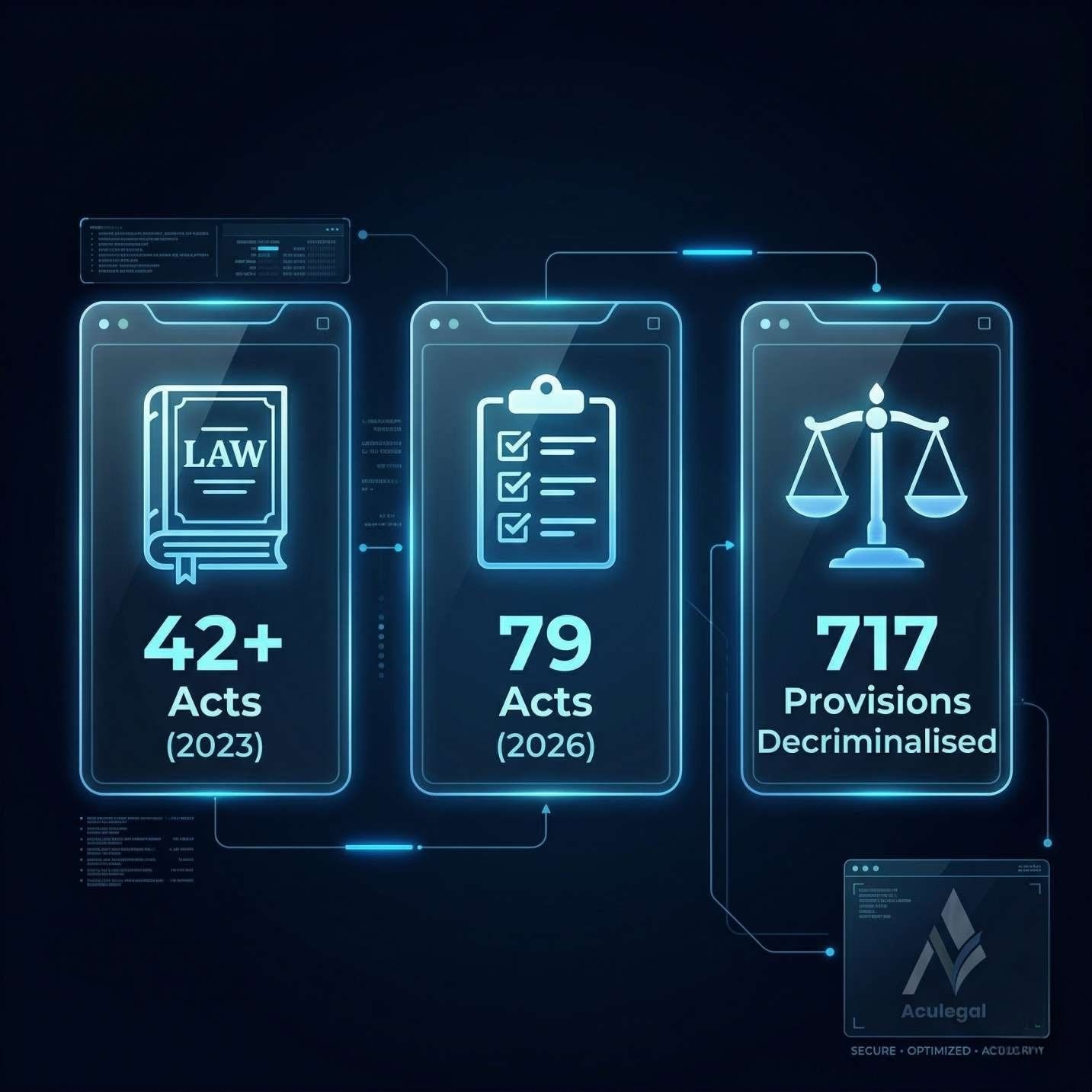
The message is clear: honest mistakes no longer mean criminal records. The government is shifting from fear to trust-based governance. Pib
Key Changes Every Startup Must Know
Intellectual Property Laws Get a Major Overhaul

Startups live and die by patents, trademarks, and copyrights. The 2023 Act decriminalised several offences under the Patents Act, 1970, Trade Marks Act, 1999, Copyright Act, 1957, and Geographical Indications Act, 1999.Aarnalaw
- False statements or minor filing lapses now attract civil penalties (up to ₹10 lakh in many cases) instead of jail.
- Turnover-linked fines ensure that small innovators are not disproportionately punished.
- Faster adjudication means quicker protection, and fewer legal distractions.
Environment, Pollution, and Sustainability Compliance Becomes Manageable

Many deep-tech and manufacturing startups face strict rules under the Environment (Protection) Act, 1986, Air (Prevention and Control of Pollution) Act, 1981, and related laws.
- Minor procedural violations now carry penalties (₹10,000–₹15 lakh) plus daily additions, no imprisonment.
- First-time warnings replace immediate prosecution.
- Appeals go to expert tribunals, streamlined and faster.
Food, Drugs, Cosmetics, and Consumer Laws Simplified
Food-tech, health-tech, and D2C brands benefit from changes in the Food Safety and Standards Act, Drugs and Cosmetics Act, and Legal Metrology Act.
- Labelling errors or minor non-compliances shift from criminal to civil penalties.
- Repeat offenders face graded fines, but honest first-timers get warnings.
- Reduced litigation frees resources for product innovation and market expansion.
Other High-Impact Areas for Startups
- Company law and filings: Minor delays or technical defaults no longer risk director disqualification or jail.
- Labour and wages-related procedural lapses: Rationalised penalties reduce HR compliance stress.
- Motor Vehicles and transport rules: Compounding options speed up logistics for delivery startups.
Bottom line: The Jan Vishwas Reforms cover the exact pain points that once made scaling in India feel like walking a legal minefield.
Proof It Works: Tangible Benefits and Early Wins

India Inc has welcomed the reforms. Industry bodies see them as a “game-changer” bringing clarity, predictability, and proportionality to compliance.
Real impact numbers:
- The 2023 Act + 2026 Bill together rationalise more than 1,000 offences across central laws.Deccanchronicle
- Over 47,000 compliances reduced across the Centre and States since 2014, with Jan Vishwas as a major leap.Devdiscourse
- 717 provisions directly cut litigation load on courts and founders.
Startups and MSMEs now allocate saved time and money to R&D, hiring, and customer acquisition instead of lawyers. Sectors like fintech, healthtech, agritech, and manufacturing, once bogged down by overlapping rules, are seeing accelerated growth and greater investor confidence.
The reforms align perfectly with Make in India, Startup India, and Ease of Doing Business initiatives, positioning India as a global investment magnet.
How Your Startup Can Leverage Jan Vishwas Reforms Today
Reducing legal risk isn’t automatic—you still need smart compliance. Here’s your actionable checklist:
- Audit your current compliance against the amended 79 Acts, focusing on high-risk areas like IP, environment, and consumer laws.
- Train your team on the new warning + penalty regime so minor lapses don’t escalate.
- Appoint a compliance officer or partner with experts who track graded penalties and adjudication timelines.
- Build internal SOPs that prioritise timely filings and documentation, now more important than ever.
- Stay updated on state-level alignments and future 10% periodic penalty revisions.
Pro tip: Document everything. The shift to civil penalties rewards transparency and due diligence.
Conclusion: Turn Legal Risk into Your Competitive Edge
The Jan Vishwas Reforms mark a historic shift from a punishment-first regime to one that trusts entrepreneurs. By decriminalising minor offences (717 provisions), rationalising penalties, and introducing warnings and adjudication, the government has handed Indian startups a powerful shield against unnecessary legal risk.
You can now focus on what matters: building groundbreaking products, creating jobs, and driving India’s growth story.
Don’t leave compliance to chance.
At Aculegal, we specialise in helping Indian startups navigate the Jan Vishwas Reforms with precision. Our team offers:
- Comprehensive compliance audits tailored to your sector
- Risk-mapping against the 79 amended Acts
- Training workshops for founders and teams
- Ongoing advisory to keep you ahead of regulatory changes

Ready to reduce legal risk and accelerate growth?
Book a free 30-minute Jan Vishwas Compliance Strategy Call with our experts today. Visit www.aculegal.com or drop us a line at contact@aculegal.com or schedule a call with this link https://shorturl.at/stv7B
Your startup deserves to thrive without the fear of outdated laws holding you back.
Let’s build the future, legally and fearlessly.