
Who Owns AI-Generated Work Product is no longer a philosophical debate for law review panels. It is a line item in your next client contract, your next funding round, and your next acquisition.
Here is the scene playing out in companies right now. A design agency delivers a campaign built largely with generative tools. The client signs an agreement promising “full ownership of all deliverables.” Eighteen months later, a competitor lifts the campaign visuals almost wholesale. The agency calls its lawyer, ready to send a cease and desist.
The lawyer asks one question: can you prove a human authored this?
That is the moment the problem becomes real. And most businesses are walking into it with contract templates written for a world that no longer exists.
 The Gap Nobody Reads Until It Costs Them
Every major AI platform tells you that you own the output. That sentence is true. It is also answering a completely different question from the one you are asking.
There are two separate issues hiding inside “do I own this?”:
- Between me and the vendor, who holds the rights to this file? That is a contract question. The answer is almost always you.
- Does anyone hold enforceable copyright in this file at all? That is a statutory question. The vendor has no power over it whatsoever.
A licence settles the first. Nothing in a licence can settle the second.
Look closely at the wording. OpenAI’s terms state that the company assigns to the user all of its right, title and interest, “if any,” in the output. Those two words are doing enormous work. Midjourney’s terms grant assets to the fullest extent possible “under applicable law.” Both clauses are honest. Both are quietly conceding that the vendor is handing you whatever rights happen to exist, while declining to promise that any exist at all.
That hedge is the entire risk. And it sits directly underneath the indemnity you just signed.
Where the Law Actually Landed
The legal position has hardened considerably, and most businesses have not updated their assumptions to match.
 The United States: human authorship is the gatekeeper
In January 2025, the US Copyright Office published Part 2 of its report on copyright and artificial intelligence. Its conclusions were unambiguous. Purely AI-generated material is not copyrightable. Prompts alone, no matter how detailed or laboriously refined, do not make you an author. What the law protects is the original human expression in a work, including your selection, arrangement, and modification of AI output.
The courts followed. In Thaler v. Perlmutter, decided in March 2025, the D.C. Circuit held that the Copyright Act requires every eligible work to be authored in the first instance by a human being. The Supreme Court declined to review the case in March 2026, leaving that ruling firmly in place.
The practical translation: a purely machine-produced asset in the US is functionally public domain. Your competitor can copy it and you have no infringement claim.
The United Kingdom: a safety net being withdrawn
The UK has long been the outlier, offering protection for computer-generated works with no human author under section 9(3) of the Copyright, Designs and Patents Act 1988, lasting 50 years from creation.
That outlier status is ending. The government’s March 2026 report on copyright and AI proposed removing section 9(3) altogether, while confirming that AI-assisted works created with genuine human input should continue to be protected. No legislation has been introduced yet, but the direction of travel is clear.
China: a more generous test, with conditions
Chinese courts have gone the other way. In Li v. Liu, the Beijing Internet Court held that an AI-generated image was protectable where the user’s prompting, parameter-setting and selection reflected genuine intellectual investment. More recent decisions have tightened the requirement, insisting that claimants actually evidence their creative effort rather than simply assert it.
The takeaway for any business operating across borders: the same asset can be protected in one market and freely copyable in another. If you are licensing content globally, that asymmetry belongs in your agreements, not in your assumptions.
 The Contracts Most Businesses Are Still Signing
Here is where the exposure becomes expensive. Three standard clauses in circulation today were drafted before any of this mattered.
The IP assignment clause. You promise the client “all right, title and interest in the deliverables.” If a meaningful portion of those deliverables has no copyright in existence, you are assigning something that may not be there. You have not committed fraud. You have created a warranty you cannot honour.
The originality warranty. Standard services agreements often warrant that deliverables are original and do not infringe third-party rights. Generative outputs can occasionally reproduce protected material from training data, and most vendors disclaim any non-infringement warranty. You are absorbing a risk your supplier explicitly refused to take.
The employment and contractor agreements. Work-made-for-hire and assignment provisions transfer employee-created IP to the company. They say nothing about what happens when a contractor uses a personal AI account, on a consumer free tier, to produce your core product copy. Who owns the prompt library? Was your confidential information used as training data?
That last one causes more damage than founders expect. Consumer free tiers frequently permit the provider to use inputs for model improvement. Pushing proprietary code or unreleased strategy through them is a confidentiality problem long before it becomes an ownership problem.
Who Owns AI-Generated Work Product Under Platform Terms and Contracts?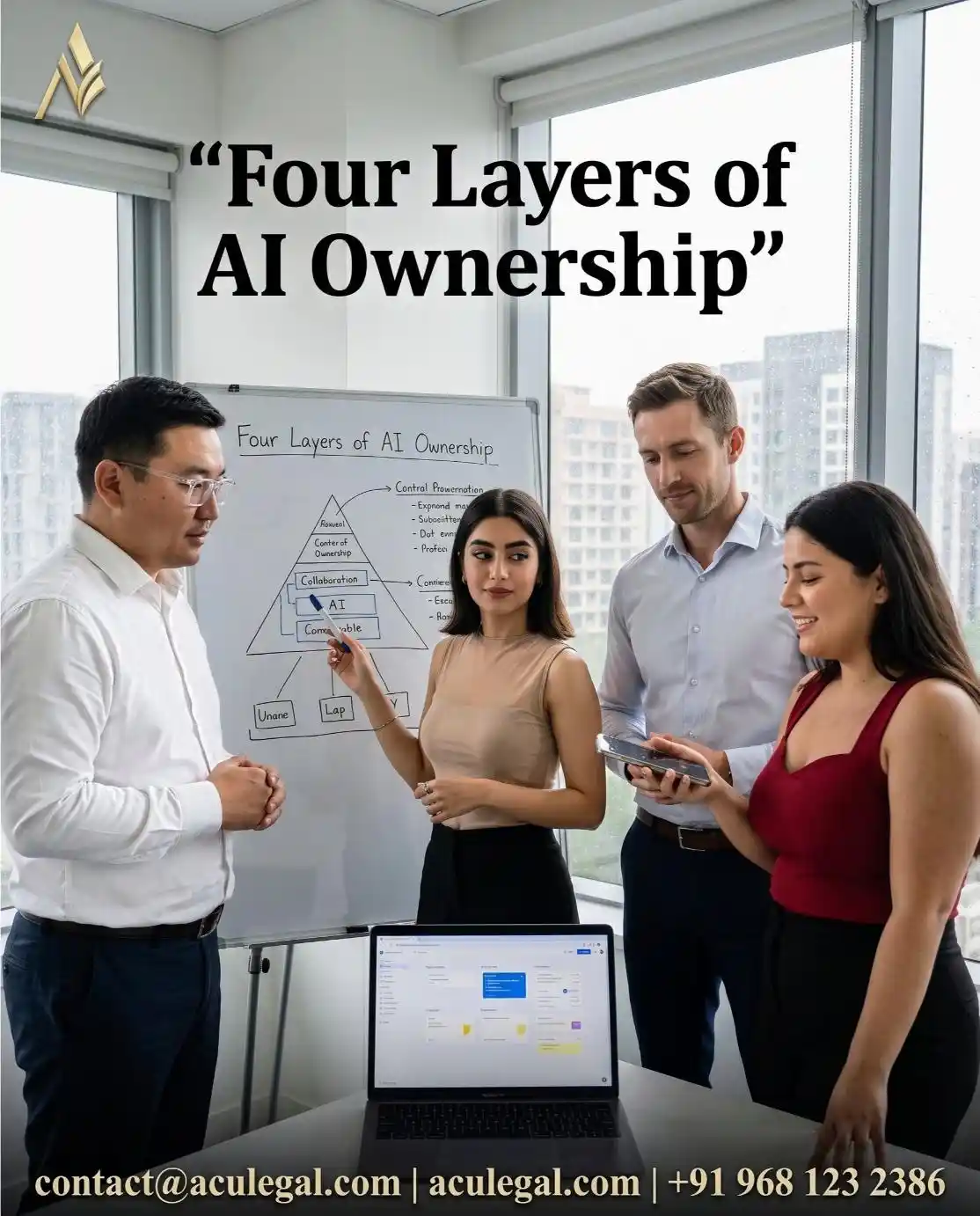
The honest answer is layered, and each layer needs a different fix.
Layer 1: The platform terms
Read the actual clause for the actual plan you are on, not the summary on the pricing page. Enterprise and business tiers typically offer no-training commitments and, in some cases, IP indemnification. Consumer tiers usually do not. If AI touches anything commercially sensitive, the account type is a legal decision, not a procurement one.
Layer 2: The copyright position
Assume that AI-only output carries no enforceable copyright in the US and, increasingly, in the UK. Anything you genuinely need to own must carry demonstrable human authorship: creative direction, substantive editing, original arrangement, human-written material woven into the whole.
Layer 3: Your contracts
This is the layer you fully control, and the one most businesses neglect. Your agreements should:
- Define AI-assisted deliverables as a distinct category, rather than pretending the category does not exist
- Calibrate warranties honestly, warranting the rights you actually hold instead of rights the law may not recognise
- Allocate infringement risk explicitly between supplier and client, because someone will bear it
- Mandate approved tooling and account tiers for anyone touching sensitive work
- Require contemporaneous records of human contribution, since evidence created later always looks like evidence created later
Layer 4: The evidence trail
This is the quiet differentiator. If protection depends on human creative input, then documentation of that input becomes the asset. Version histories, briefs, editorial markups, revision logs. Teams that build this into normal workflow can substantiate authorship. Teams that do not are relying on memory and hope.
Turning a Legal Problem Into an Operating Advantage
The businesses handling this well are not the ones with the largest legal budgets. They are the ones that treated it as a systems problem early.
Start with an audit. Map where AI is actually being used across your business. Marketing, product, engineering, sales collateral, customer support. Founders are routinely surprised by the answer, because adoption happens bottom-up and unannounced.
Fix the paper next. Commercial contract drafting and contract negotiation need to reflect the new position. This is precisely the work that contract lifecycle management services are built for: standardised clause libraries, controlled templates, visibility into what your business has already promised, and a workflow where AI-assisted contract review is paired with human verified review before anything goes out the door.
Protect what is genuinely yours. Copyright is only one instrument. Trade secrets, trademarks, database rights, confidentiality regimes and patents are unaffected by the human authorship debate. A structured approach to intellectual property protection services often reveals that your defensible position rests on assets you had not been treating as assets.
Then build the standing capability. Most SMEs and growth-stage companies cannot justify a full in-house department, yet the questions keep arriving weekly. A Virtual Chief Legal Officer model closes that gap. A VCLO, or fractional general counsel, gives you senior judgment on legal risk management without a permanent executive hire. Around that, a fractional legal team layers in the support you actually consume: fractional legal counsel for commercial contract management, a fractional paralegal for volume contract review services, a fractional legal researcher for regulatory questions across markets. It functions as an outsourced in-house legal team, or a virtual legal department, sized to your stage rather than your ambition.
That is what fractional legal support is designed to deliver. Coverage when you need it, depth when it matters, and no fixed cost when it does not.
The Proof Is Already on the Record
None of this is speculative. The evidence is public and it is consistent.
- The US Copyright Office confirmed in January 2025 that prompts alone do not create authorship, and that only human contributions are protectable.
- The D.C. Circuit confirmed in Thaler that a machine cannot be an author, and the Supreme Court declined to disturb that in March 2026.
- The UK government proposed in March 2026 to remove the one provision that protected authorless computer-generated works.
- Platform terms across the market assign output “if any” and “to the fullest extent possible,” which is contract drafting for we are not promising this is protectable.
- Chinese courts protect AI-assisted work, but now require claimants to evidence real creative effort.
Read together, the message is the same everywhere. Human contribution is the asset. Documentation is the proof. Contracts are the mechanism.
The companies that will have problems are not the ones using AI. Nearly everyone is using AI. The ones with problems are the ones whose commercial contracts still describe a world where every deliverable automatically came with enforceable copyright attached.
What To Do This Quarter
You do not need a six-month project. You need four decisions:
- Audit where AI sits in your delivery chain and which account tiers your team is using.
- Review your client agreements, supplier agreements and contractor agreements for assignment and warranty language that no longer matches reality.
- Document human creative contribution as a standard workflow step, not an afterthought.
- Decide whether you need standing legal capability or one-off support, and get the decision made before a dispute makes it for you.
Legal certainty is not a luxury purchase at this stage. It is what lets you sign larger contracts, survive due diligence, and defend what you have built.
Conclusion: Own What You Built
The question of Who Owns AI-Generated Work Product does not have one answer. It has four layers: what the platform grants you, what copyright law recognises, what your contracts promise, and what evidence you can produce. Get all four aligned and AI becomes a genuine advantage. Leave them misaligned and you are quietly transferring risk onto your own balance sheet.
At Aculegal, we work with founders, startups and SMEs to close exactly this gap. Contract review services, commercial contract drafting, contract negotiation, due diligence support, IP protection and fractional legal teams that scale with your growth. Simplifying Legal. Amplifying Success.
Your First Contract Review is FREE. Send us the agreement you are least confident about and we will tell you plainly where your exposure sits.
Write us: contact@aculegal.com