
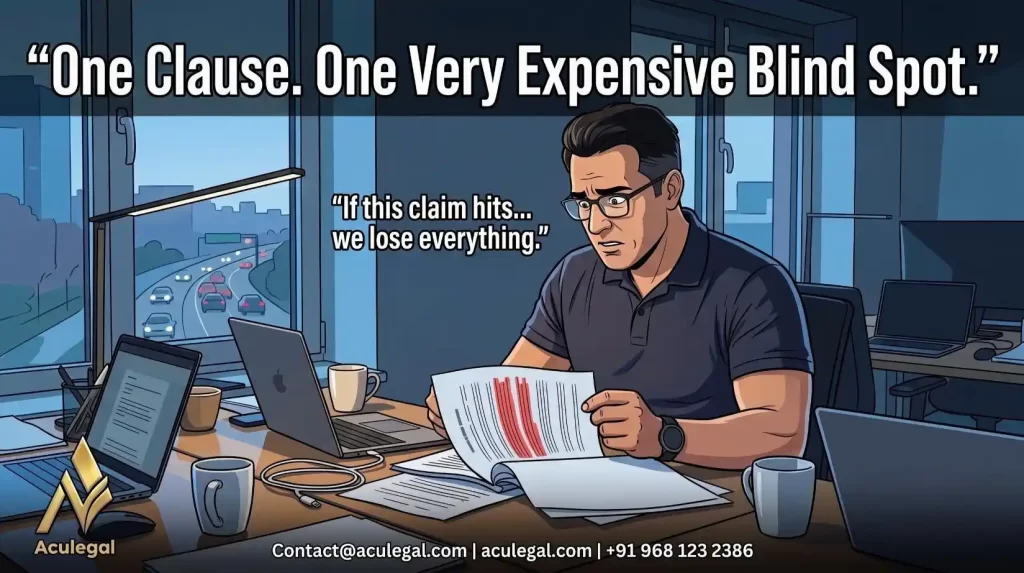
Limitation of liability in SaaS contracts is the one clause that decides who pays when things go wrong – and by how much. Most founders skim past it while racing to close a deal. That’s usually the moment they sign away far more risk than they realize.
If you run a SaaS company, or you’re an SME buying software that touches your customer data, this clause is not boilerplate. It’s the financial ceiling (or floor) on the worst day your business will ever have.
This piece breaks down what a fair cap looks like in 2026, where indemnification fits in, and why “standard terms” from a vendor are rarely standard at all.
The Problem: One Clause, One Very Expensive Blind Spot
Here’s the uncomfortable truth. A limitation of liability clause is quietly the most negotiated term in commercial contracts globally – it has held that position for over a decade, ahead of price and indemnification combined.
Yet most founders treat it as legal filler. They read the price, the term length, the termination notice, and then they gloss over the paragraph that actually determines their exposure if something breaks.
Consider what’s actually at stake:
- A data breach that exposes customer records and triggers regulatory fines
- An extended outage that costs a customer real revenue during a product launch
- A third-party IP infringement claim tied to code, content, or a component in your stack
- A vendor’s negligence that your own customers hold you responsible for
The global average cost of a data breach sat at $4.44 million in 2025, and the technology sector alone averaged close to $4.79 million per incident. Without a properly negotiated cap, a single clause failure can turn one bad month into an existential threat.
This is exactly why legal risk management has moved from a “nice to have” to a founder-level priority. A missing or lopsided limitation of liability clause doesn’t just cost money later, it changes how investors, insurers, and enterprise customers assess your business today.
What Exactly Is a Limitation of Liability Clause?
A limitation of liability clause does two separate jobs, and most people only notice one of them.
First, it caps the dollar amount one party can recover if the other breaches the contract or causes harm. Second, it excludes entire categories of damage, typically indirect, incidental, or consequential loss, from being recoverable at all, regardless of the cap.
Get either piece wrong, and the clause stops protecting you and starts protecting the other side.
The Cap
In most commercial and SaaS contracts today, the market-standard general cap limits each party’s total liability to roughly one times the fees paid in the twelve months before the claim arose. It sounds simple, but two details change the real number dramatically:
- “Paid” versus “payable” – if you haven’t invoiced yet, “paid” can leave you with almost no recovery
- The measurement period – 12 trailing months versus total contract value can be a multi-year difference in exposure
The Exclusions
Consequential, indirect, and lost-profit damages are usually excluded from both sides. This sounds fair until you realize that in a SaaS relationship, lost profits from downtime are often the only real damage a customer suffers. If that category is fully excluded with no carve-out, the cap becomes meaningless for the customer.
The Carve-Outs
Certain risks are simply too severe to cap. Well-drafted agreements pull these outside the general cap entirely, or apply a “super cap” – typically 2–5 times the general cap, reserved for the highest-risk breaches. Roughly a quarter of enterprise contracts now include one.
Common super-cap triggers include:
- Confidentiality breaches
- Data security incidents
- Gross negligence or willful misconduct
- IP infringement claims
Indemnification vs Limitation of Liability: What Is the Difference?
This is the single most confused pairing in commercial contracts, and getting it wrong is expensive.
Indemnification is a promise: if a third party sues you because of the other side’s product, IP, or conduct, they’ll cover your legal fees and any resulting judgment. It’s about who defends and pays for an outside claim.
Limitation of liability is a ceiling: it sets the maximum a party will ever pay for damages arising between the two contracting parties, regardless of the cause.
The tension between them is where deals actually get negotiated:
| Indemnification | Limitation of Liability | |
|---|---|---|
| Protects against | Third-party claims (IP, data breach fallout, regulatory action) | Direct losses between the two parties |
| Typically capped? | Often uncapped or carved out of the general cap | Usually capped at 1x fees, with a super cap for high-risk items |
| Who benefits most | The buyer, when the vendor’s product causes the claim | The vendor, by containing worst-case exposure |
| Common friction point | Vendors want indemnification capped; buyers want it uncapped | Buyers want carve-outs; vendors want a clean, low ceiling |
 A vendor that indemnifies you generously but then caps that same indemnity inside a low general liability cap has effectively given you protection with no teeth. This is precisely the kind of drafting subtlety that a generic template or a rushed in-house review tends to miss.
The Solution: How Much Risk Should You Actually Accept?
There’s no universal “correct” number. What matters is whether the cap reflects the actual risk of the deal – not just what the other side’s legal team dropped into their template.
If You’re the SaaS Vendor
Your job is protecting runway. A single enterprise customer’s uncapped claim can outweigh years of subscription revenue from that same account.
- Set a clear, mutual general cap – one-sided caps get flagged and negotiated anyway, so start fair
- Keep a short, defined list of exclusions, not blanket indirect-damage language that a court could later strike down
- Offer a super cap for data security and confidentiality, since buyers will push hard here regardless
- Never let your indemnification obligations exceed your liability cap without pricing that risk into the deal
If You’re the SME or Startup Buying SaaS
Your job is making sure the vendor’s promise means something if it’s ever tested.
- Push back on caps measured against “fees paid” when your usage is growing – ask for “fees paid or payable”
- Insist on a carve-out for data breaches and confidentiality, especially if the platform touches customer or financial data
- Confirm indemnification for third-party IP claims is not swallowed by a low general cap
- Don’t accept “vendor’s sole remedy is a refund” language for anything beyond minor service issues
 A Quick Negotiation Checklist
- Read the cap basis: total contract value, annual fees, or trailing 12 months?
- Identify what sits outside the cap – and confirm it’s actually meaningful
- Check for mutuality – does the clause protect both sides equally?
- Map the indemnification clause against the liability cap for conflicts
- Get a second, independent read before signing – not just from the party who drafted it
Common Mistakes Founders and SMEs Make
Most disputes trace back to a handful of repeat mistakes, and none of them are complicated to avoid once you know to look for them.
- Accepting the vendor’s first draft without comparing it to market standard
- Assuming “unlimited liability” clauses always favor them – they often cut both ways and expose the buyer too
- Treating indemnification and liability caps as separate issues, when they’re really one negotiation
- Skipping a proper review because the deal feels “too small” to justify legal spend
- Relying on AI-only contract review with no human sign-off on the commercial risk
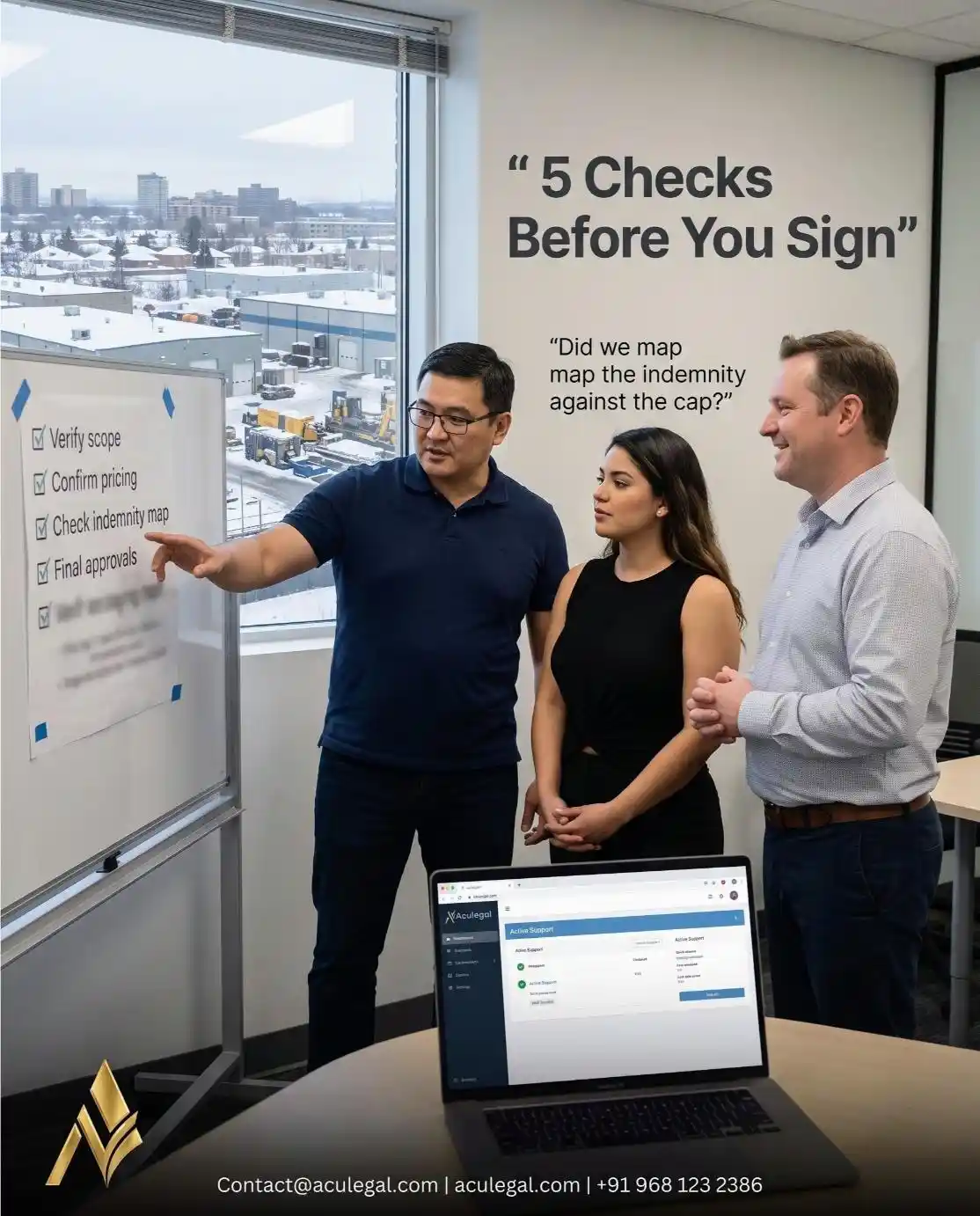
This last point matters more than it seems. AI-assisted contract review is genuinely useful for flagging clauses fast and comparing them against a playbook. But a growing business needs human-verified contract review behind that first pass – someone who understands your specific deal, your customer base, and your risk appetite, not just clause-matching software.
Why Growing Businesses Need a Fractional Legal Team, Not Just a Template
Most startups and SMEs don’t need a full in-house legal department to get this right, but they do need consistent, senior legal judgment on every contract that carries real exposure. That’s the gap a Fractional Legal Team or Virtual Legal Department is built to close.
A Virtual Chief Legal Officer (VCLO) gives founders a Fractional General Counsel relationship without the cost of a full-time executive hire. Instead of scrambling for a lawyer every time a SaaS contract lands in your inbox, you get an outsourced in-house legal team that already understands your business, your risk tolerance, and your growth stage.
This model works because it scales with you:
- A Fractional Legal Executive for high-level contract and risk strategy
- A Fractional Legal Researcher or Fractional Paralegal for faster turnaround on routine reviews
- Commercial Contract Management across your entire vendor and customer stack, not just the deals that feel urgent
If you’re negotiating SaaS agreements regularly, as a vendor selling to enterprise, or a buyer stacking multiple platforms – a dedicated legal team for SMEs pays for itself the first time it catches a bad cap or an uncapped indemnity before you sign. You can explore how this works through Aculegal’s Virtual Chief Legal Officer (VCLO) service.
Proof: How Aculegal Approaches Limitation of Liability Reviews
At Aculegal, limitation of liability in SaaS contracts is one of the clauses we flag most often during commercial contract review – because it’s the one clause most likely to be quietly one-sided.
Our process combines AI-assisted contract review for speed with human-verified contract review for judgment. That means every cap, exclusion, and carve-out gets checked against current market standards before it ever reaches your desk for sign-off.
This sits inside our broader Contract Lifecycle Management Services, which cover everything from commercial contract drafting and contract negotiation services to ongoing tracking of renewal dates, obligations, and risk triggers across your entire contract portfolio. You can see how this works on our Contract Lifecycle Management (CLM) page.
For SaaS businesses specifically, liability exposure rarely stops at the contract. If your platform involves proprietary code, a distinctive brand, or original content, that risk connects directly to how well-protected your underlying assets are. Our Intellectual Property Protection Services are built to work alongside contract review for exactly this reason.
We built Aculegal around one idea: Simplifying Legal. Amplifying Success. For founders and SMEs, that means giving you a fractional legal team that catches the clause everyone else skims past – before it becomes a very expensive lesson.
Conclusion: Don’t Let a Skimmed Clause Define Your Worst Day
Limitation of liability in SaaS contracts isn’t a formality – it’s the financial architecture of your risk. Whether you’re the vendor protecting runway or the buyer protecting downside, the cap, the exclusions, and the carve-outs need to reflect the real risk of the deal, not just whoever drafted the template.
To recap what actually moves the needle:
- Know your cap basis and whether it’s mutual
- Check what’s genuinely excluded – and what’s carved back in
- Map indemnification against the liability cap for hidden conflicts
- Get a human-verified review, not just an AI scan, before you sign anything material
 You don’t need a full legal department to get this right. You need the right fractional legal team looking at the right clause at the right time.
Aculegal is offering a FREE First Contract Review, up to 30 pages, for new clients – the same review process we use to catch the liability gaps founders miss every day.
Scan to Claim Your FREE First Contract Review
Ready to get your SaaS contracts reviewed properly? Book your consultation with Aculegal today.