
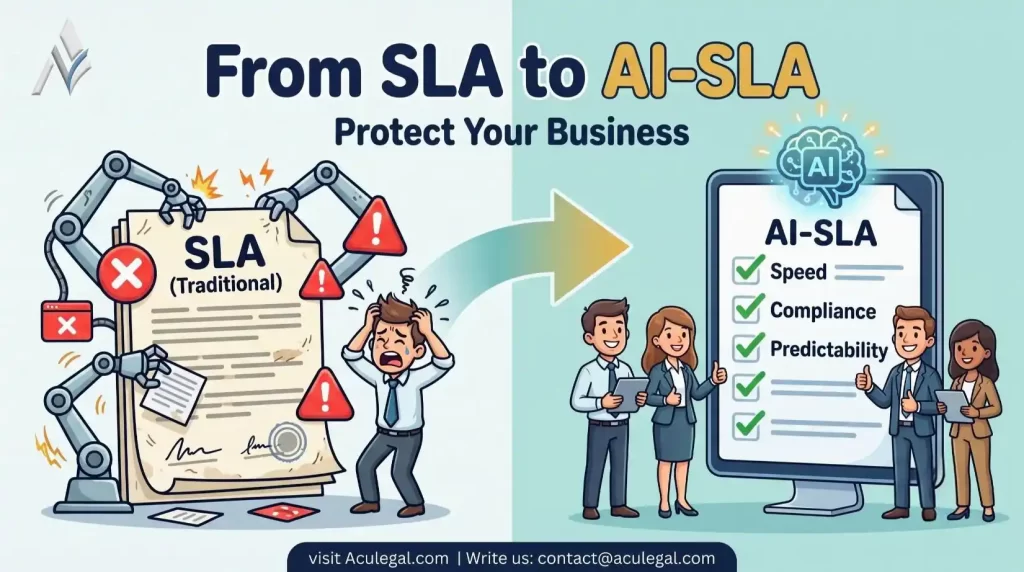
AI-SLA is quickly replacing the standard Service Level Agreement as the backbone of modern IT outsourcing, and if your legal team hasn’t caught up, your business is carrying risk it doesn’t know about.
Here’s the uncomfortable truth: most IT outsourcing contracts sitting in company drawers right now were written for a world where software did exactly what it was told, every time. That world is gone. Your vendor’s chatbot, your outsourced helpdesk’s AI triage tool, your managed IT provider’s automated patching system, all of them make probabilistic decisions, not deterministic ones. And your SLA almost certainly doesn’t account for that.
This isn’t a theoretical compliance exercise. It’s a live commercial exposure. Founders and SME leaders who outsource IT operations, helpdesk, cybersecurity monitoring, cloud infrastructure, DevOps, are signing agreements every quarter that were never designed for AI-driven service delivery. That gap gets expensive the moment something goes wrong.
Let’s fix that.
 The Problem: Your SLA Was Built for Humans, Not Algorithms
A traditional SLA answers simple questions. Did the vendor respond within four hours? Was uptime above 99.5%? Were tickets resolved within the agreed window?
AI-driven service delivery breaks these assumptions in three specific ways.
First, performance becomes probabilistic. An AI model doesn’t fail the same way twice; it drifts, degrades, or produces inconsistent outputs depending on the data it’s fed. A “resolution time” metric means very little if the AI resolved the ticket incorrectly in six minutes.
Second, liability gets murky fast. If an AI system embedded in your outsourced IT stack makes an error, say, misclassifies a security alert or auto-approves a bad configuration change, who’s responsible? The vendor? The AI provider the vendor licensed the model from? You, as the deploying business?
Third, your data is doing more than you think. Traditional outsourcing contracts treat data as something processed and returned. AI systems often use client data to train, fine-tune, or improve models, sometimes without you realizing it’s happening.
Recent legal analysis backs this up. Advisory teams tracking outsourcing contracts have flagged that AI’s emergence has introduced genuine complexities requiring entirely new contractual provisions, not just tweaks to existing ones. Provisions covering IP and customer data, liability and remediation, exit rights, performance monitoring, and subcontracting all need a fresh look once AI enters the picture. (source)
If your contracts haven’t been touched since before your vendor started marketing “AI-powered” service delivery, they’re already out of date.
What Exactly Is an AI-SLA?
An AI-SLA is a service level agreement built specifically to govern outsourcing relationships where artificial intelligence performs, supports, or influences the delivery of the contracted service.
It doesn’t replace your SLA. It extends it, layering in performance metrics, liability structures, and governance clauses that make sense for a system that learns, adapts, and occasionally gets things wrong in ways a rules-based script never would.
Think of it this way: a regular SLA asks “did you do the job?” An AI-SLA asks “did the AI do the job correctly, transparently, and in a way we can audit if something breaks?”
Legal analysts covering the shift describe it plainly, outsourcing relationships now require service-level commitments to be renegotiated alongside IP provisions, liability frameworks, and data governance terms, because a well-drafted AI agreement has to reflect the actual risk profile of the deal rather than relying on a generic disclaimer. (source)
Why This Isn’t Optional Anymore
Three forces are converging to make AI-SLA clauses a business necessity rather than a nice-to-have.
1. The Regulatory Clock Is Ticking
The EU AI Act now imposes direct contractual obligations on parties across the AI value chain. Under Article 25, providers of high-risk AI systems and the third parties supplying components to them are required to put their arrangement in writing, spelling out the information, technical access, and support needed for the provider to meet its compliance obligations under the Regulation. (source)
If your outsourced IT vendor touches employment decisions, biometric data, credit-adjacent processes, or critical infrastructure, this isn’t a “someday” problem — it’s a contract-review problem for this quarter.
2. The Market Is Bigger Than You Think
This isn’t a niche shift. The global IT outsourcing market is valued at roughly $638.65 billion in 2026, projected to reach $752.08 billion by 2031. (source) At that scale, even a small percentage of AI-related contract disputes translates into serious aggregate exposure, and SMEs, with thinner legal bandwidth, absorb a disproportionate share of that risk.
3. Pricing and Liability Models Are Already Shifting
Industry legal commentary points to a direct commercial consequence: as AI reduces manual intervention, pricing models based on headcount or transaction volume become outdated, while liability questions grow more complex because determining fault between a vendor and an AI provider, who may not even be a party to the contract, is genuinely difficult. Data protection and IP clauses need updating for the same reason, particularly where sensitive data trains a vendor-owned model. (source)
The Solution: Building an AI-SLA That Actually Protects You
Here’s where most founders get stuck: they know something needs to change, but they don’t have in-house expertise to know what. This is precisely the gap a fractional legal team exists to close.
You don’t need a full-time General Counsel to get this right. You need a Virtual Chief Legal Officer (VCLO) who has already seen this problem across multiple portfolios, a fractional legal executive who can sit in vendor negotiations on your behalf, and a fractional paralegal or legal researcher who tracks regulatory changes like the EU AI Act rollout so you don’t have to.
A properly structured virtual legal department essentially an outsourced in-house legal team, gives growing businesses the same contract discipline a Fortune 500 legal department has, without the seven-figure overhead. That’s the model behind Aculegal’s Virtual Chief Legal Officer (VCLO) service: fractional general counsel, fractional legal counsel, and a fractional legal team structured around what your business actually needs this year, not a headcount plan built for a company three sizes bigger.
AI-SLA Checklist: 10 Clauses Every IT Outsourcing Agreement Should Include
Use this as your working checklist before you renew, renegotiate, or sign your next IT outsourcing agreement.
- AI Disclosure Clause – The vendor must disclose, upfront and on an ongoing basis, where AI is used in service delivery, including third-party models it doesn’t own outright.
- Model Performance Metrics (Not Just Uptime) – Define accuracy thresholds, drift tolerance, and error rates specific to the AI function, not generic uptime percentages.
- Human Oversight and Escalation Rights – Guarantee a documented path for human review of AI-driven decisions above a defined risk threshold.
- Data Use and No-Training Restrictions – Explicitly prohibit your business data from being used to train or fine-tune the vendor’s models without separate, written consent.
- Liability Allocation for AI Errors – Clarify who bears responsibility when an AI system, not a human agent, causes the failure, including where a third-party AI provider is involved.
- Audit and Explainability Rights – Reserve the right to request an explanation of how a specific AI-driven output or decision was reached.
- Regulatory Compliance Pass-Through – Build in vendor obligations that mirror your own compliance duties under frameworks like the EU AI Act, GDPR, or India’s DPDP Act.
- Change Management for Model Updates – Require advance notice before the vendor updates, retrains, or swaps the underlying AI model powering your service.
- Exit and Data Portability Terms – Define what happens to your data, embeddings, and historical performance records if you terminate; AI-heavy vendors are harder to exit cleanly than traditional ones.
- Indemnification for AI-Specific Harm – Extend indemnification clauses to cover reputational, regulatory, or financial harm caused specifically by AI misbehavior, not just standard breach of contract.
Ten clauses. One negotiation cycle. That’s the difference between a contract that protects you and one that just looks like it does.
Proof: Why the Old Playbook Doesn’t Hold Up
Skeptical this actually plays out in real disputes? Consider what’s already changing in the market.
- Analysts at major law firms are actively advising clients to renegotiate outsourcing contracts specifically because of AI-driven pricing and liability shifts; this is happening at scale, not in isolated cases.
- Regulators have moved from guidance to enforcement. The EU AI Act’s obligations on high-risk AI systems are now live requirements, not draft proposals – and outsourcing arrangements are explicitly in scope for supervisory review. (source)
- Contract frameworks built two years ago are already described as “inadequate” by transactional lawyers advising both buy-side and sell-side clients on outsourcing deals – that’s a fast turnaround for an entire category of agreement to go stale.
If experienced outsourcing counsel is telling enterprise clients to rewrite these agreements, the smaller business on the other side of a similar vendor relationship carries the same exposure, often with far less room to absorb the fallout.
How Aculegal Helps You Get Ahead of This
This is exactly the kind of work Aculegal was built for: legal support for growing businesses that need enterprise-grade contract discipline without an enterprise legal budget.
Here’s how we typically help clients navigate the shift to AI-SLAs:
- Commercial contract review and drafting – We review your existing IT outsourcing agreements, flag where AI exposure isn’t addressed, and draft AI-SLA amendments that hold up under real scrutiny. Our Contract Lifecycle Management (CLM) service keeps every vendor agreement, and its renewal dates, obligations, and risk flags organized in one place instead of buried in inboxes.
- Contract negotiation services – We sit in the room (virtually) during vendor negotiations, so you’re not negotiating AI liability terms against a vendor’s legal team alone.
- IP and data protection alignment – If your outsourced AI vendor touches proprietary data, algorithms, or trade secrets, our Intellectual Property Protection Services make sure your ownership and confidentiality terms are airtight before you sign anything.
- Ongoing legal risk management – Through our fractional legal team and VCLO model, we monitor regulatory shifts like the EU AI Act so your contracts stay current, not just compliant on the day you signed.
This is what Simplifying Legal. Amplifying Success. actually looks like in practice – not a slogan, but a working model where a dedicated legal team for SMEs handles the contract complexity so you can focus on running the business.
The Bottom Line
AI has already changed how your IT vendors deliver service. Your contracts need to catch up, and the ten clauses above are the fastest way to find out how exposed you currently are.
Don’t wait for a dispute to discover your SLA has no answer for an AI-driven failure. A short, focused contract review now is far cheaper than litigation later.
Ready to see where your current agreements stand? Book a one-on-one consultation with Aculegal and let’s walk through your outsourcing contracts together.
Claim Your FREE First Contract Review
Your first contract review is on us, completely FREE.
📱 Scan to Claim Your FREE First Contract Review
** This article is for general informational purposes and does not constitute legal advice. For guidance specific to your outsourcing agreements, speak with the Aculegal team directly.