

Due Diligence Red Flags rarely show up as one dramatic discovery. They show up as a pattern of small, avoidable gaps – an unsigned IP assignment, a cap table nobody can fully explain, a contract nobody can locate that quietly convince an investor to walk away.
You’ve done the hard part. Months of pitching, a term sheet on the table, momentum finally on your side. Then diligence starts, and the questions get sharper than anything in the pitch deck ever was.
This is the moment where founders either prove they run a well-governed business, or accidentally prove the opposite. The good news: almost every red flag that kills a deal is preventable, and preventable early.
Deals Don’t Die in Negotiation. They Die in the Data Room
Founders assume the biggest risk to a deal is a weak valuation argument or a tough negotiation. In reality, most deals that collapse do so quietly, during document review, long after both sides thought they had a handshake agreement.
Industry research puts the scale of this problem in sharp relief: nearly half of all deals collapse during due diligence, often because investors uncover liabilities the founders either overlooked or downplayed. That is not a negotiation failure. It’s a legal readiness failure.
Separate analysis of thousands of startup data rooms found the same story from a different angle – roughly two-thirds of decks reviewed had at least one issue that would surface as a flag in formal diligence, most often tied to unclear economics or unsupported projections. A meaningful share of deals also stall for a very specific and very fixable reason: around a third of transactions collapse at the final hurdle because of preventable cap table or documentation gaps.
If deals are dying over fixable paperwork, the real question isn’t “how do we win the negotiation.” It’s “how do we make sure diligence has nothing to find.”
The Problem: Six Due Diligence Red Flags That Consistently Kill Deals
Investors, acquirers, and enterprise buyers don’t need to find fraud to walk away. They just need to lose confidence. Here are the issues that erode that confidence fastest.

Incomplete or Improperly Documented ESOPs
Employee stock option pools are one of the most commonly mishandled areas in early-stage and growth-stage companies. Missing board approvals, unclear vesting schedules, or option grants that were never formally documented all raise a simple but damaging question for investors: if this wasn’t tracked properly, what else wasn’t?
An improperly documented ESOP can also create downstream dilution disputes that resurface months after a deal closes, which is exactly the kind of open liability a buyer or investor tries to price out of, or walk away from entirely.
Messy or Undocumented Cap Tables
A cap table that doesn’t reconcile across financing rounds is one of the fastest ways to stall a deal. Investors expect a single, defensible source of truth showing who owns what, under what terms, and why.
Common issues include:
- Unresolved founder equity splits that were never formalized in writing
- Convertible notes or SAFEs that were never properly converted
- Side letters or verbal agreements that contradict the official cap table
Unassigned or Unprotected Intellectual Property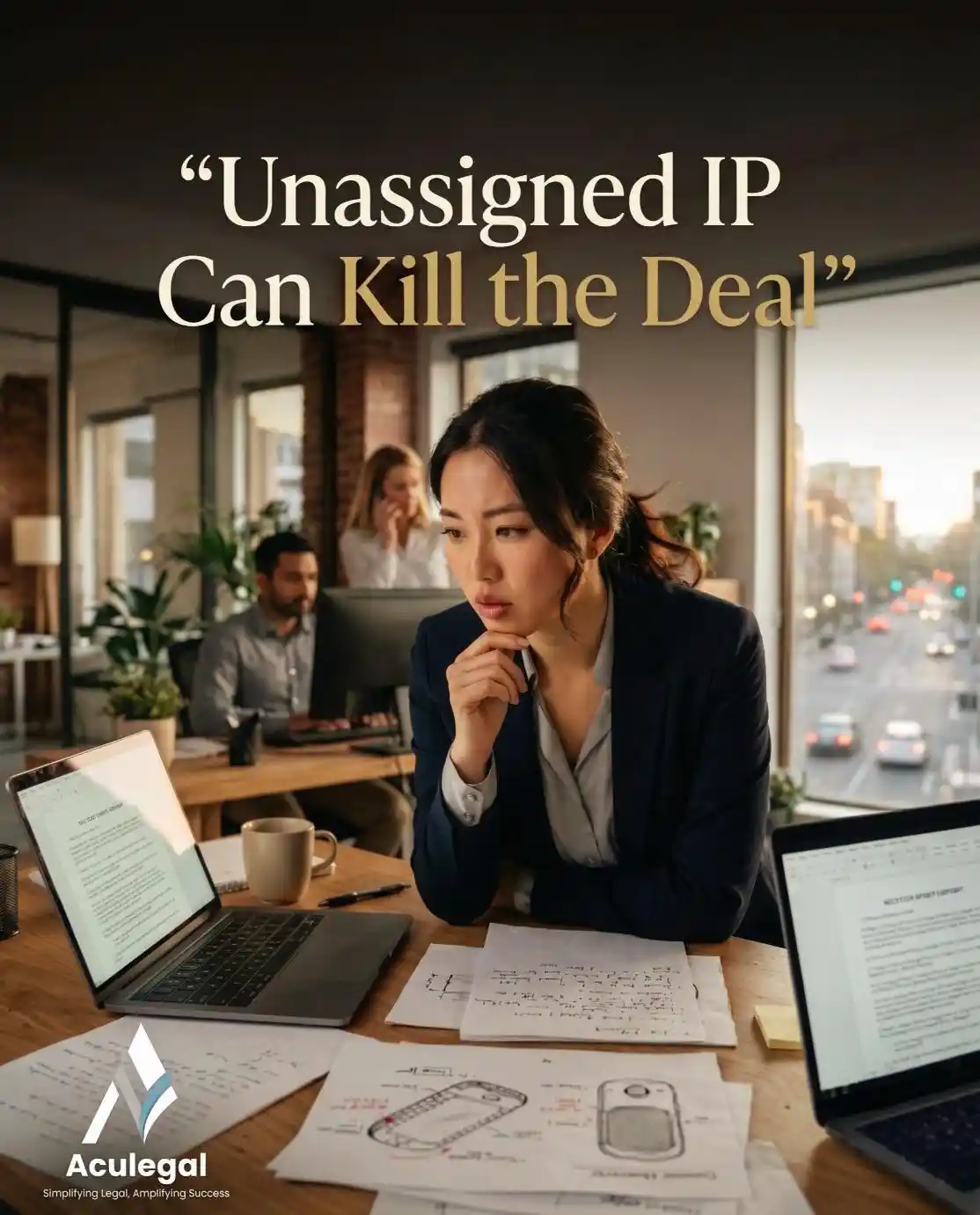
If a contractor, early employee, or co-founder built core product IP without a signed assignment agreement, your company may not actually own what it’s trying to sell. This is one of the most common and most preventable deal-breakers in tech and product-driven businesses.
Strong Intellectual Property Protection Services exist precisely to close this gap before it becomes a negotiation liability rather than a diligence footnote.
Contracts With No Lifecycle Management
Scattered agreements, expired NDAs, missing signature pages, and contracts stored across email threads instead of a central system all signal the same thing to a buyer: operational immaturity. Without proper Contract Lifecycle Management Services, even a fundamentally healthy business can look chaotic on paper.
Regulatory and Compliance Gaps
Cross-border deals face even sharper scrutiny today. Compliance, governance, and regulatory risk factors are now central to deal outcomes, especially where scrutiny is heightened across jurisdictions. Data privacy gaps, expired licenses, and unmet industry-specific requirements are now standard diligence checkpoints, not edge cases.
Ongoing or Undisclosed Litigation
Nothing erodes trust faster than an investor discovering pending litigation the founder didn’t disclose upfront. Even minor, resolvable disputes need to be addressed transparently; concealment reads as far riskier than the dispute itself.

The Solution: Fixing Due Diligence Red Flags Before They Reach the Data Room
The businesses that sail through diligence aren’t the ones with zero history of legal complexity. They’re the ones with a legal risk management function that caught and resolved issues long before an investor asked the first question.
Build a Virtual Legal Department Instead of Reacting Case-by-Case
Most SMEs and startups don’t need a full in-house legal team on payroll, they need consistent, senior-level oversight. A Virtual Legal Department gives growing businesses that same governance discipline as a large enterprise, without the fixed cost of building one internally.
This is where a Virtual Chief Legal Officer (VCLO) model earns its value, acting as your External In-House Counsel, overseeing compliance, contracts, and governance continuously rather than only when a deal is already underway.
Bring In a Fractional General Counsel for Strategic Oversight
A Fractional General Counsel or broader Fractional Legal Team gives founders senior legal judgment on retainer, reviewing structure, flagging risk, and advising on strategy, at a fraction of the cost of a full-time hire. For most SME Legal Services needs, this is the most capital-efficient way to get Legal Advisory for SMEs without overextending a lean budget.
This model works especially well as an Outsourced In-House Legal Team or Corporate Legal Retainer Services arrangement, where the same advisors stay embedded in your business quarter after quarter, building institutional knowledge investors can see reflected in clean documentation.
Get Contract Lifecycle Management Right From Day One
Every agreement your business signs, vendor terms, employment contracts, NDAs, licensing deals, should live in one governed system with clear ownership, renewal tracking, and version control. Proper Commercial Contract Management turns your entire agreement history into an asset rather than a liability.
This includes:
- Contract Review Services to catch unfavorable terms before signature
- Commercial Contract Drafting built on consistent, enforceable templates
- Contract Negotiation Services that protect your position without slowing deals down
- AI-Assisted Contract Review paired with Human Verified Contract Review, so speed never comes at the cost of accuracy
Explore Aculegal’s full Contract Lifecycle Management (CLM) offering to see how this looks in practice for growing businesses.
Lock Down Intellectual Property Early, Not Reactively
Every contributor to your product, brand, or technology should have signed, unambiguous IP assignment documentation from day one. This single step prevents one of the most common reasons Due Diligence Red Flags appear in tech and product-led businesses.
Why Due Diligence Red Flags Are Becoming Harder to Hide
Diligence used to be a slower, more manual process, a lawyer working through a physical or lightly organized folder of documents. That era is over.
Investors now rely on digitised deal assessment tools that surface red flags earlier and adapt to new data points, including cyber and third-party risk signals. Due diligence itself is increasingly treated as a continual process rather than a single event tied to a single funding round.
For founders, this changes the calculus completely. A gap you could once smooth over in a rushed conversation with an investor is now flagged automatically, before the conversation even happens. Legal Risk Management can no longer be a pre-deal scramble, it has to be a standing discipline built into how the business operates day to day.
This shift matters just as much for SMEs pursuing enterprise B2B contracts as it does for startups chasing venture capital. Procurement teams at large companies now run vendor diligence with the same rigor investors apply to a funding round, which means clean contracts and clear governance are no longer optional even outside a fundraise.
Global Context: One Standard, Wherever You’re Raising or Selling

Founders often assume diligence standards vary sharply by geography, but the underlying expectations are converging. Whether a deal is closing in London, Singapore, Dubai, or Delhi, investors and acquirers are asking the same core questions: Is ownership clear? Is IP protected? Are contracts enforceable? Is the business compliant with the regulations that apply to it?
Cross-border transactions raise the bar further. Regulatory frameworks like GDPR and HIPAA, along with industry-specific requirements, are now central to how compliance and governance risk gets evaluated in international deals. A business that has only ever operated with one jurisdiction in mind can find itself exposed the moment a deal crosses a border.
This is precisely why founders building for global investors, global customers, or global expansion need Legal Support for Growing Businesses that already thinks beyond a single market, not legal support that has to be rebuilt every time the business scales into a new one.
The Proof: Why This Approach Works for Founders and SMEs
The pattern in the data is consistent: deals rarely fail because a business is fundamentally weak. They fail because a business looks unprepared. A single missing signature, an unreconciled cap table entry, or an undocumented option grant can outweigh months of strong revenue performance in an investor’s mind.
Founders typically discover diligence issues around three weeks into a six-week review process, the exact point where fixing them becomes expensive and time-pressured. Businesses supported by a Dedicated Legal Team for SMEs avoid that scramble entirely because the documentation was already clean before diligence ever started.
This is the core logic behind treating legal support as infrastructure rather than an emergency service. B2B Legal Services, Startup Legal Services, and Outsourced Corporate Legal Services all exist to give growing companies the same institutional discipline that large enterprises take for granted, so that when an investor, acquirer, or enterprise customer opens the data room, there’s nothing left to find.
For founders and SMEs serious about closing deals without last-minute surprises, the smartest move isn’t hiring a lawyer when a term sheet lands. It’s building the legal function before you need it.
Don’t Let Preventable Gaps Cost You the Deal
Due Diligence Red Flags are almost never about dishonesty; they’re about disorganization. Undocumented ESOPs, messy cap tables, unassigned IP, scattered contracts, and unresolved compliance gaps all send the same signal to investors: risk that wasn’t managed. The fix isn’t complicated, but it does need to start before the data room opens, not after. 
Aculegal exists to close exactly this gap, combining Virtual Chief Legal Officer oversight, Contract Lifecycle Management, Due Diligence Services, and Intellectual Property Protection Services into one dependable, on-demand legal function for founders and SMEs. This is what it means to be Simplifying Legal. Amplifying Success.
Claim Your Free First Contract Review
Get ahead of your next round, acquisition conversation, or enterprise deal. Aculegal is offering a FREE first contract review, up to 30 pages, so you can see exactly where your risk exposure sits today.
📩 Scan to Claim Your FREE First Contract Review contact@aculegal.com
Book Your Free Legal Consultation →
Sources: Investopedia – Due Diligence, WIPO – IP Due Diligence, U.S. SEC – Cap Table & Securities Compliance, GDPR.eu – Regulatory Compliance Overview, Sprinto – Due Diligence Red Flags Report