
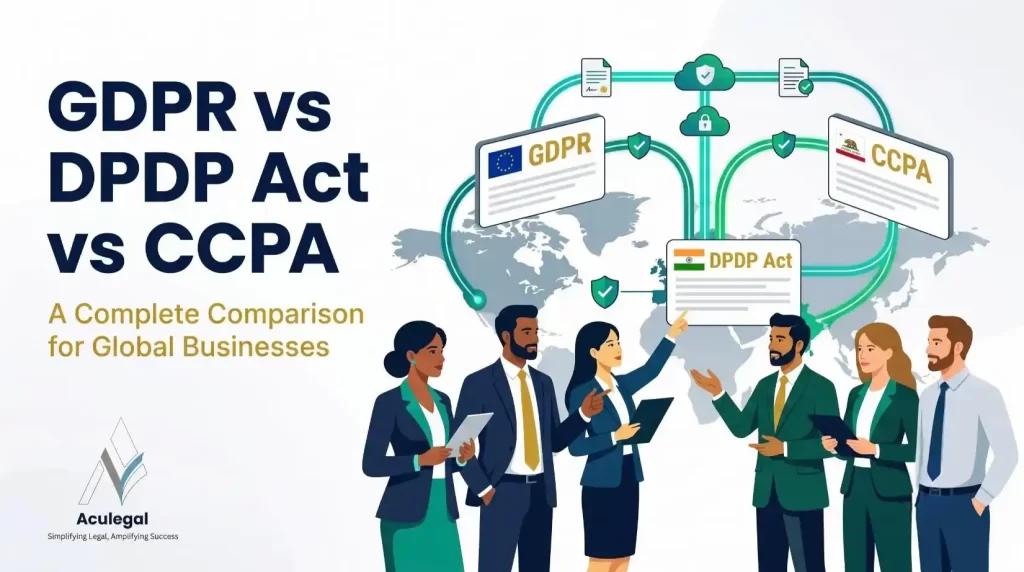
If your business collects even one email address from a customer in Europe, India, or California, you are already inside the reach of a privacy law. GDPR vs DPDP Act vs CCPA is no longer a compliance question reserved for Fortune 500 legal departments, it is a founder-level decision that affects contracts, marketing, product design, and fundraising.
Most SMEs discover this the hard way: mid-way through a due diligence round, a client audit, or worse, a regulator’s notice. This guide breaks down the three laws in plain business language and shows you exactly how to build one lean compliance framework instead of three separate headaches.
 Three Laws, One Global Business, Zero Room for Guesswork
Picture this: your SaaS platform has a customer in Berlin, a reseller in Bengaluru, and a beta user in San Francisco. That single sales stack now touches three different privacy regimes, each with its own definitions, consent rules, and penalty structures.
Founders rarely have the bandwidth to become privacy law experts. But ignoring the differences between GDPR, the DPDP Act, and CCPA is not a risk you can outsource to hope. It is a risk you manage with structured legal support, built once and reused across every market you enter.
The Problem: Compliance Confusion Is Costing Growing Businesses
Here’s the uncomfortable truth: most privacy “compliance” at the SME level is a copy-pasted policy nobody has actually reviewed against current law.
That approach worked when enforcement was rare. It does not work anymore. In 2026 alone, California regulators have issued millions of dollars in fines, including a $12.75 million penalty against General Motors and a $2.75 million settlement with Disney over opt-out failures.
Meanwhile, India’s data protection regime is moving from paperwork to enforcement, and the EU is actively rewriting parts of the GDPR through its Digital Omnibus reform package. Businesses that built compliance once and stopped paying attention are now the most exposed.
Why Founders Get This Wrong
There are three recurring mistakes we see across founder-led and SME businesses:
- Assuming one law covers everything. A US-only privacy policy does not protect you from a DPDP Act complaint if you have Indian customers or employees.
- Treating privacy as a one-time project. Laws change; your policy from 2023 is likely already outdated.
- No single point of legal ownership. Without a dedicated legal team for SMEs or an outsourced in-house legal team, privacy compliance quietly falls between marketing, IT, and “whoever has time.”
Which Privacy Law Applies to Your Business?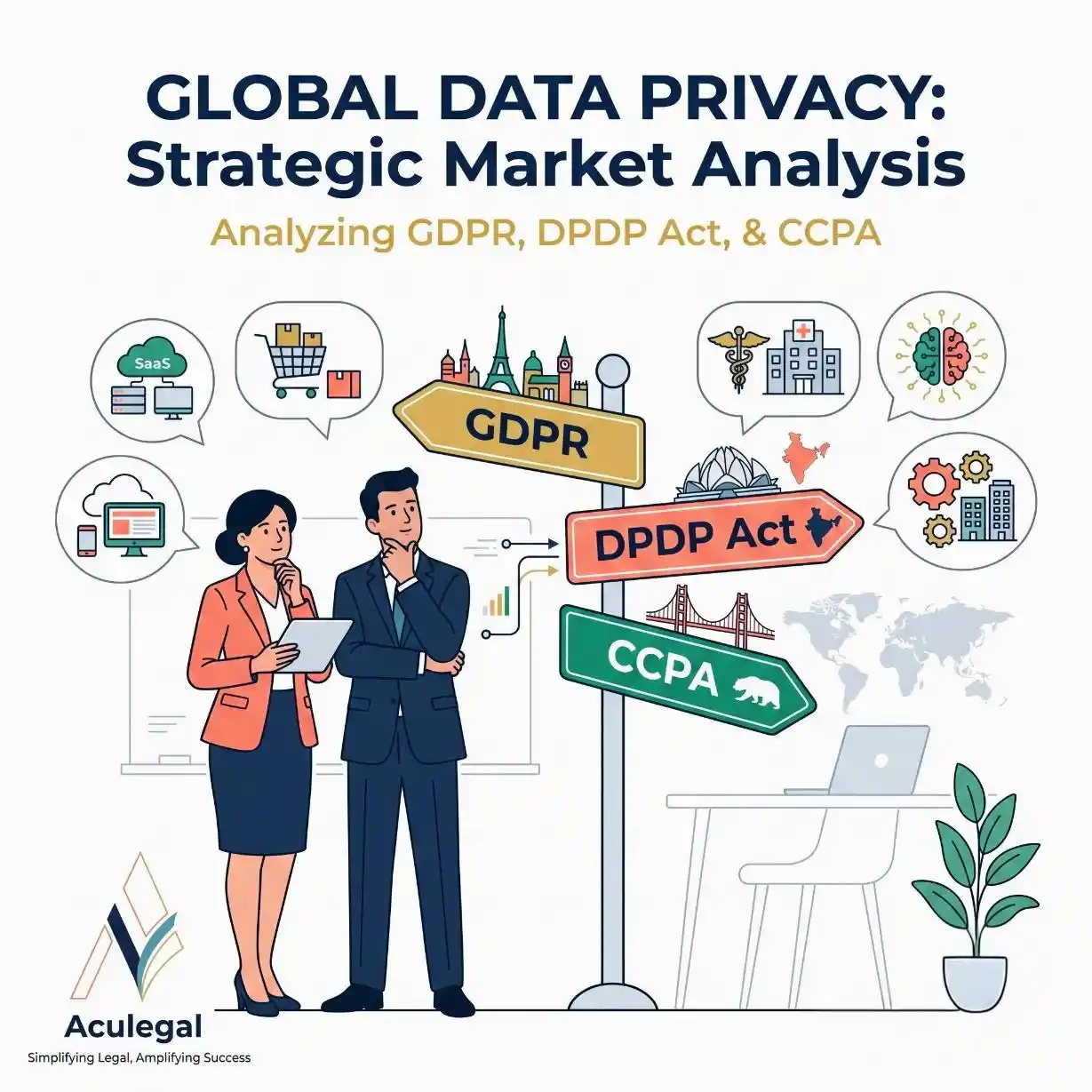
This is the question every founder should be able to answer in one sentence. Here’s how the three laws actually differ.
GDPR: The European Union’s Global Benchmark
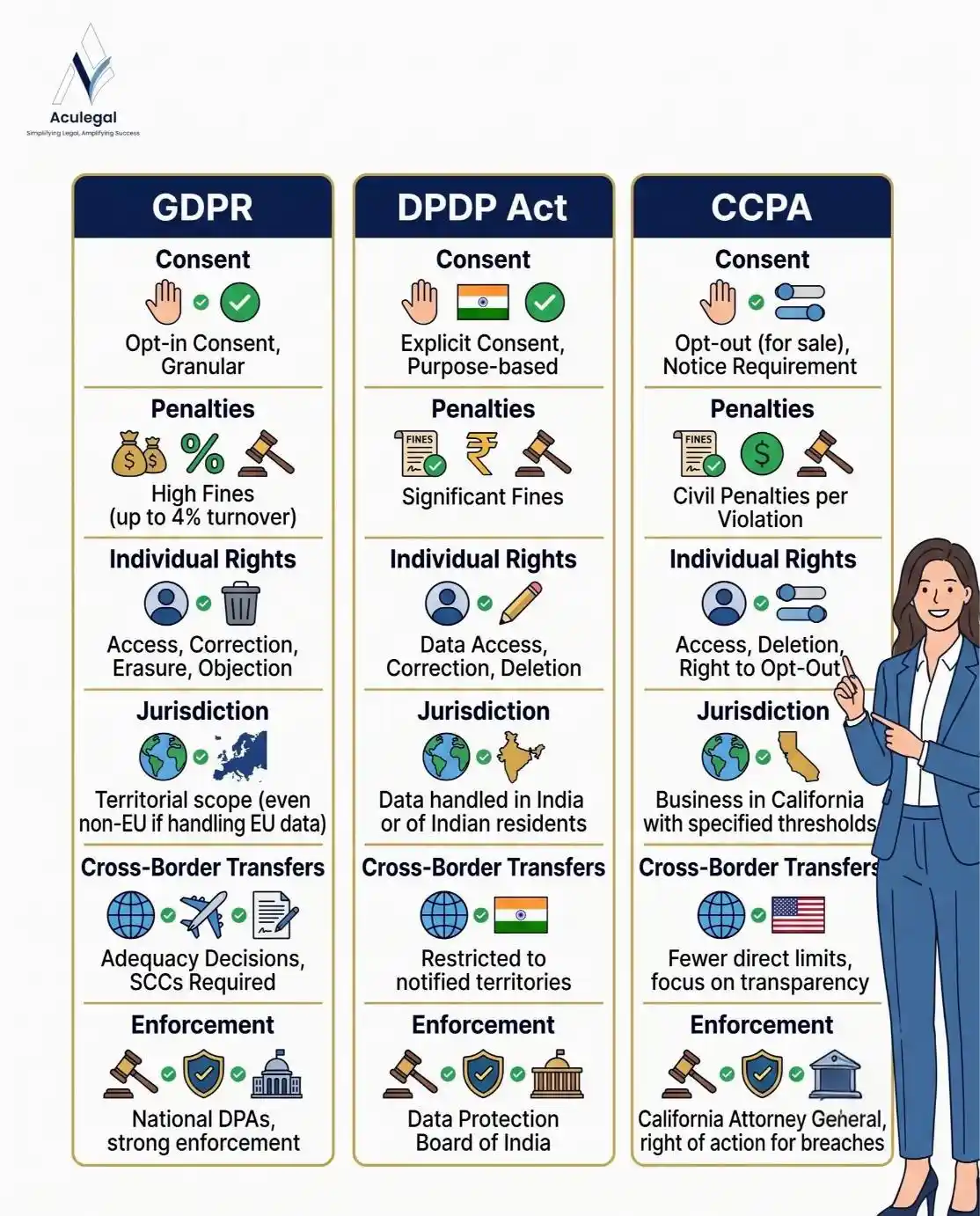
The General Data Protection Regulation (GDPR) applies if you process personal data of individuals in the EU, regardless of where your company is incorporated. It is built on consent, purpose limitation, and individual rights like access, correction, and erasure.
Penalties can reach €20 million or 4% of global annual turnover, whichever is higher. The EU is currently reforming parts of the regulation through the Digital Omnibus proposal, which aims to ease documentation burdens for smaller businesses without lowering the underlying protections.
Key things founders should track:
- Applies extraterritorially, an EU customer triggers GDPR, even without an EU office
- Requires lawful basis for every processing activity, not just consent
- Data Protection Impact Assessments (DPIAs) may apply for higher-risk processing
DPDP Act: India’s Consent-First Framework
India’s Digital Personal Data Protection Act, 2023 (DPDP Act), operationalised through the DPDP Rules, 2025, is being rolled out in phases through May 2027. It applies to digital personal data connected to India, including data collected outside India if it relates to offering goods or services to Indian residents.
The DPDP Act carries penalties of up to ₹250 crore (roughly USD 30 million) for serious violations, and its Consent Manager framework is expected to reshape how businesses handle opt-ins and withdrawals through 2026 and into 2027.
Founders should note:
- Compliance obligations are being phased in; this is a moving target, not a fixed checklist
- The law applies to all industries, not just tech or finance
- Cross-border data transfer rules and Significant Data Fiduciary obligations are still pending final notification
CCPA: California’s Consumer Rights Model
The California Consumer Privacy Act (CCPA), as expanded by the CPRA, gives California residents rights to know, delete, and opt out of the sale or sharing of their personal information. It applies to for-profit businesses that cross specific thresholds, for example, annual gross revenue above $25 million, or handling personal data of 100,000+ consumers or households.
As of 2026, penalties sit at roughly $2,663 per unintentional violation and $7,988 per intentional violation, with no cure period, meaning regulators can act immediately, without giving you 30 days to fix the issue first. Recent enforcement, including multi-million-dollar settlements, shows the California Privacy Protection Agency is not going easy on repeat opt-out failures.
Side-by-Side: The Core Differences
| Factor | GDPR (EU) | DPDP Act (India) | CCPA (California, US)
|
|---|---|---|---|
| Legal basis | Consent + 5 other lawful bases | Primarily consent-based | Opt-out model
|
| Extraterritorial reach | Yes | Yes, if targeting Indian residents | Limited to threshold-qualifying businesses
|
| Maximum penalty | €20M or 4% of turnover | ₹250 crore (~USD 30M) | ~$7,988 per intentional violation
|
| Cure period | No formal cure period | Not yet finalised | None since 2023
|
| Current status | Being reformed (Digital Omnibus) | Phased rollout through 2027 | Actively enforced, new rules from Jan 2026
|
The Solution: One Framework, Three Jurisdictions
You do not need three separate legal teams to manage GDPR vs DPDP Act vs CCPA compliance. You need one structured approach, built by people who understand all three, and revisited regularly as the laws evolve.
1. Map Your Data Before You Map Your Risk
Start with a plain-language inventory: what personal data do you collect, from whom, and why? This single exercise usually reveals which of the three laws actually apply to your business, often it’s more than founders expect.
2. Rebuild Contracts and Consent Language Around All Three Regimes
Your privacy policy, vendor agreements, and consent flows should be drafted, or reviewed, with GDPR, DPDP Act, and CCPA requirements in mind simultaneously. This is where commercial contract drafting and contract review services matter most, because privacy obligations now live inside ordinary commercial agreements, not just standalone policies.
A structured Contract Lifecycle Management process ensures every vendor contract, data processing agreement, and customer terms-of-service is reviewed, versioned, and updated as these laws change, instead of sitting untouched for years.
3. Get Ongoing Legal Oversight, Not a One-Time Audit
Privacy law is not static. The DPDP Rules are rolling out in phases, the EU’s Digital Omnibus could change GDPR documentation requirements later this year, and California’s rules were just updated again in January 2026.
This is exactly the gap a Virtual Chief Legal Officer or fractional general counsel is built to close. Instead of hiring a full in-house legal department, growing businesses get a virtual legal department that tracks regulatory change and keeps contracts current, without the overhead of a permanent hire.
Explore how Aculegal’s Virtual Chief Legal Officer service gives founders external in-house counsel on demand, covering everything from privacy strategy to day-to-day corporate legal retainer services.
4. Protect What Privacy Compliance Touches: Your IP
Privacy compliance and intellectual property protection often intersect, think proprietary data models, customer databases, and product analytics built on personal data. Businesses handling sensitive data pipelines should pair privacy compliance with a proper Intellectual Property Protection strategy so the underlying assets are legally secured too.
The Proof: What Happens When Businesses Get This Right (and Wrong)
The cost of getting GDPR vs DPDP Act vs CCPA compliance wrong is not theoretical.
- California regulators have collected over $24.6 million in cumulative CCPA-related penalties since 2022, with 2026 already producing multiple seven-figure settlements.
- India’s DPDP Act sets penalties as high as ₹250 crore per violation, and enforcement readiness is expected to intensify once the Data Protection Board moves from guidance to active supervision.
- GDPR fines remain capped at 4% of global annual turnover, a number that scales with your growth, meaning the risk gets bigger, not smaller, as your business succeeds.
On the other side of the ledger, businesses that treat privacy compliance as an ongoing legal function, not a one-time PDF, consistently move faster through due diligence, close enterprise deals sooner, and avoid the operational disruption of a regulator inquiry.
Due Diligence Is Where This Really Shows Up
Investors and enterprise buyers now routinely request evidence of privacy compliance during due diligence services and vendor onboarding. A business that can produce a clear data map, updated contracts, and a documented legal review process closes these conversations in days. A business that cannot, stalls, sometimes for months.
Why This Matters More for SMEs Than Large Enterprises
Large enterprises can absorb a six-figure fine and a bad news cycle. Most SMEs and startups cannot. A single CCPA or DPDP Act penalty can wipe out a quarter’s profit, or worse, become the reason a funding round falls through.
This is exactly why legal support for growing businesses needs to be proactive, not reactive. Legal risk management built into your operations from day one is dramatically cheaper than legal risk management built after an incident.
How Aculegal Helps You Navigate GDPR, DPDP Act, and CCPA Together
Aculegal was built around a simple idea: Simplifying Legal. Amplifying Success.
For founders juggling GDPR vs DPDP Act vs CCPA obligations across markets, that means:
- A fractional legal team that already understands cross-border privacy law, so you are not starting from zero
- AI-assisted contract review, backed by human-verified contract review, to catch privacy gaps in vendor and customer agreements fast
- B2B legal services and outsourced corporate legal services structured around your growth stage, not a one-size-fits-all retainer
- A Contract Lifecycle Management process that keeps your privacy-related clauses current as laws in the EU, India, and the US continue to evolve
Whether you need a business contract lawyer to review a single agreement or a full virtual legal department to manage compliance across markets, Aculegal builds the legal infrastructure your growth actually needs, without the cost of a full in-house team.
Conclusion: Turn Privacy Compliance Into a Growth Advantage
GDPR, the DPDP Act, and CCPA are not the same law wearing different names; they have different triggers, different penalties, and different timelines, and all three are actively changing in 2026. Founders who treat this as a one-time checklist are exposed. Founders who build it into their ongoing legal operations turn compliance into a competitive edge with investors, enterprise clients, and regulators alike.
You do not need to become a privacy lawyer. You need the right legal partner reviewing your contracts before they become a liability.
Start with the agreement that carries the most risk: your commercial contracts.
Claim Your Free First Contract Review
First Contract Review FREE – up to 30 Pages. 📱 Scan to Claim Your FREE First Contract Review
Or reach out directly: contact@aculegal.com
Book your free consultation with Aculegal today →
This article is for general informational purposes and does not constitute legal advice. Privacy laws referenced are subject to ongoing regulatory change; consult Aculegal for guidance specific to your business.
Outbound References:
- GDPR full text — gdpr-info.eu
- Digital Personal Data Protection Act, 2023 — Ministry of Electronics and IT, India
- California Consumer Privacy Act (CCPA) — California Attorney General
- California Privacy Protection Agency (CPPA)
- European Data Protection Board (EDPB) — Digital Omnibus opinions