

A Fractional Legal Team is quietly becoming the default legal model for founders who refuse to choose between “no legal support” and “an expensive in-house hire we can’t yet justify.” If you’re running a startup or SME in 2026, that choice is no longer real, and businesses that still think it is are already falling behind.
For years, the legal industry offered founders two bad options: pay a law firm by the hour and watch invoices spiral, or hire a full-time General Counsel and carry a six-figure salary before you’re ready for one. Neither option was built for how modern businesses actually grow. A third model has arrived, and it’s rewriting the rules.
This article breaks down why the fractional model is winning, what a Virtual Chief Legal Officer actually does, and how Aculegal is using AI-assisted, human-verified contract review to give growing businesses enterprise-grade legal protection without the enterprise-grade cost.
The Problem: Traditional Legal Models Are Breaking Under Cost Pressure
Legal costs are rising faster than most founders can absorb. Global legal spend is approaching $1.1 trillion in 2026, and outside counsel billing rates have climbed sharply in recent years, putting law firm retainers further out of reach for lean-growth businesses, where firms lifted billing rates by nearly 46% in 2022, and since roughly half of legal budgets flow to law firms, even modest rate hikes have a significant impact on total spend.
At the same time, in-house legal workloads are climbing without matching headcount with research indicating a 25% increase in in-house workloads over three years, while hiring lags behind, pushing more overflow work to external providers or overtime.
For an SME or startup, this creates three compounding problems:
- Full-time legal hires are premature. A single General Counsel salary, benefits, and tooling can outstrip an early-stage legal budget many times over.
- Ad hoc law firm engagements are unpredictable. Hourly billing punishes exactly the founders who need legal support the most, those negotiating multiple contracts a month.
- Legal risk doesn’t wait for budget readiness. Contracts get signed, IP gets created, and compliance obligations accrue whether or not you have someone watching them.
The Real Cost of “We’ll Deal With It Later”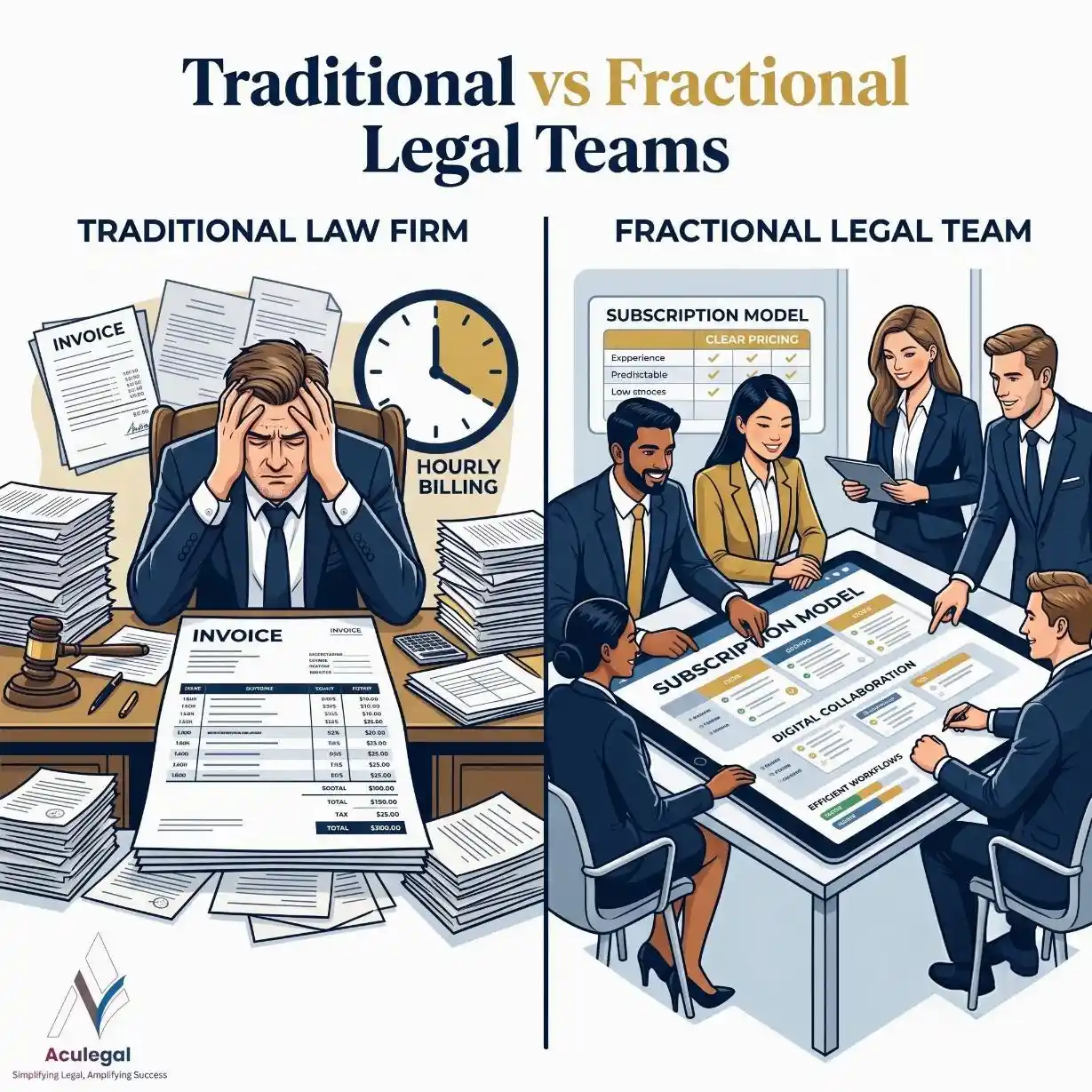
Most founders don’t lose deals to bad terms they saw and rejected. They lose money and leverage in terms they never had anyone review. A single unfavorable indemnity clause or missed IP assignment provision can cost more than years of proactive legal support combined.
This is the gap the fractional legal model was built to close.
The Solution: The Rise of the Virtual Legal Department
Instead of choosing between “too little” and “too expensive,” businesses are now building what’s effectively an Outsourced In-House Legal Team, a Virtual Legal Department that plugs directly into the business, scoped to actual need.
What Is a Fractional General Counsel?
A Fractional General Counsel is a senior legal leader who works with your business on a retained, part-time, or project basis instead of full-time employment. You get strategic legal leadership, contract strategy, risk management, compliance oversight, without carrying a full executive salary.
What Is a Virtual Chief Legal Officer?
A Virtual Chief Legal Officer (VCLO) goes a step further. Rather than reactive advice, a VCLO operates as embedded legal leadership: sitting in on strategic conversations, building your contract playbooks, managing legal risk proactively, and acting as External In-House Counsel across every function that touches legal exposure, sales, HR, procurement, and fundraising.
This is precisely the model behind Aculegal’s Virtual Chief Legal Officer (VCLO) service, built specifically for founders and SMEs who need dedicated legal leadership without the fixed overhead of a C-suite hire.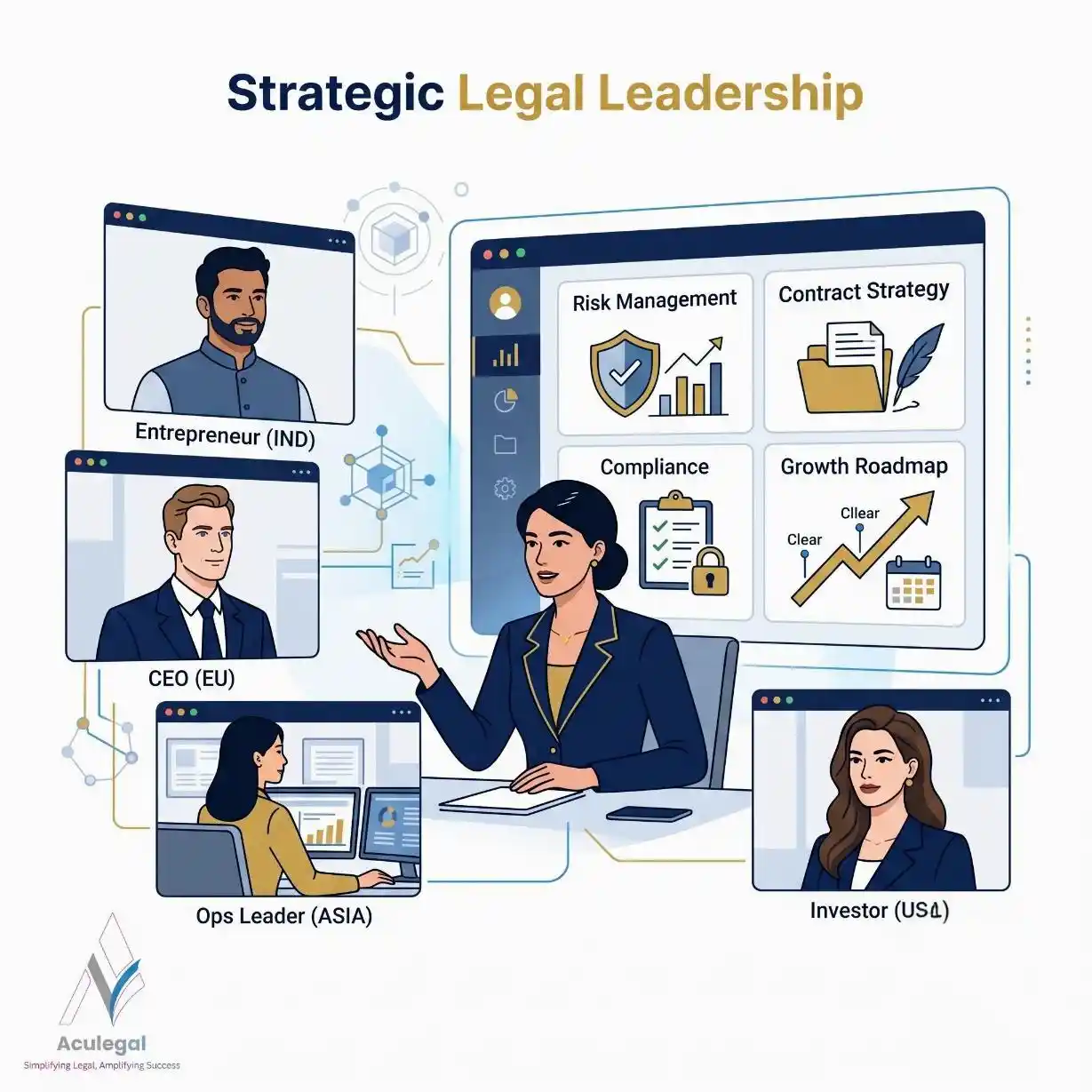
Why Aculegal’s Fractional Legal Team Model Delivers Better Business Outcomes
Growing businesses don’t need “a lawyer on call.” They need a Dedicated Legal Team for SMEs that understands their industry, their contract volume, and their growth trajectory, and that shows up consistently, not only in a crisis.
Here’s what separates a genuinely effective fractional model from a watered-down version of law firm billing:
- Predictable retainer pricing, not surprise invoices.
- Continuity of legal counsel who actually knows your business, contracts, and risk profile.
- Scalable engagement – more support during a fundraising round or expansion, less during quiet periods.
- Cross-functional legal advisory, covering commercial, IP, employment, and compliance under one relationship.
Commercial Contract Management, Done Right
Commercial Contract Management is where most legal risk for SMEs actually lives, not in litigation, but in the contracts signed every week with vendors, customers, and partners. Weak Commercial Contract Drafting and inconsistent Contract Negotiation Services quietly erode margins and expose businesses to liability they never intended to accept.
A properly run Contract Lifecycle Management Services process brings structure to intake, drafting, review, negotiation, execution, and renewal, instead of contracts living in scattered inboxes and shared drives. Explore how Aculegal’s Contract Lifecycle Management (CLM) service standardizes this entire pipeline for growing businesses.
 B2B Legal Services Built for Founders, Not Just Enterprises
Most B2B Legal Services are priced and structured for enterprise buyers. Aculegal’s model flips that: SME Legal Services and Legal Support for Growing Businesses designed around the reality of a lean team, fast turnaround, transparent pricing, and advice that’s commercially useful, not just legally correct.
The Proof: AI-Assisted, Human-Verified Contract Review
Skepticism about “outsourced legal” often comes from one place: speed and accuracy. This is exactly where the fractional model has changed dramatically over the past two years.
AI-Assisted Contract Review is now mainstream inside corporate legal departments, not experimental. According to LegalOn’s 2026 State of AI for In-House Legal report, more than half of in-house legal teams are already using or evaluating AI for contract review, with active usage nearly quadrupling since 2024. Separate analysis puts corporate legal AI adoption for contract work even higher, roughly doubling year over year, per Artificial Lawyer’s coverage of the same survey, with corporate legal AI adoption doubling in one year, from 23% to 52%, according to ACC/Everlaw research, and 64% of in-house teams expecting to depend less on outside counsel because of AI.
That speed only matters if it’s paired with legal judgment. This is why Human Verified Contract Review remains non-negotiable, AI accelerates first-pass analysis and clause comparison; a qualified lawyer verifies every flag, risk, and recommendation before it reaches you.
The result: enterprise-grade Contract Review Services, at SME speed and SME pricing.
Legal Risk Management Beyond Contracts
A genuine fractional legal model also covers what happens around your contracts:
- Due Diligence Services for fundraising, M&A, or new partnerships
- Intellectual Property Protection Services to secure trademarks, copyrights, and proprietary assets before competitors move
- Legal Advisory for SMEs on employment structuring, data compliance, and regulatory obligations
- Corporate Legal Retainer Services so your business always has counsel one call away
If your IP strategy hasn’t been reviewed since you launched, that’s a gap worth closing now, before a dispute forces the conversation. Learn more about Aculegal’s Intellectual Property Protection Services.
The Proof: The Data Behind the Shift
This shift toward fractional and outsourced legal models isn’t a trend, it’s a structural response to how corporate legal spending is evolving.
- Global legal services spending is projected to reach $1.37 trillion by 2031, growing at a 4.56% CAGR, with Small and Medium-sized Enterprise-focused legal providers growing even faster, at a projected 5.87% CAGR, according to Mordor Intelligence’s Legal Services Market Report, which found the legal services market worth USD 1.10 trillion in 2026 growing at a CAGR of 4.56% to reach USD 1.37 trillion by 2031, with small and medium-sized enterprise law firms projected to advance at a 5.87% CAGR through 2031.
- Legal departments are being asked to do more with leaner teams, as the 2026 ACC Law Department Benchmarking Report notes, with the median number of lawyers per US$1 billion in revenue decreasing to 3 in 2026, reflecting a trend toward leaner staffing relative to corporate earnings, and smaller companies now keep the majority of their legal spend flexible rather than locked into fixed outside-counsel arrangements, per outside counsel spend benchmarking data showing smaller companies with under $3 billion in revenue allocate approximately 62% of legal spend internally and 38% externally.
- On the technology side, contract automation is measurably cutting cycle times, with some analyses citing reductions of up to 40% in contract turnaround, with AI contract management reducing contract cycle times by up to 40%, according to Gartner-cited data compiled by AdAI News.
The takeaway is simple: businesses that pair strategic legal counsel with AI-accelerated contract workflows are moving faster and spending smarter than those still relying on the old billable-hour model.
How the Aculegal Engagement Works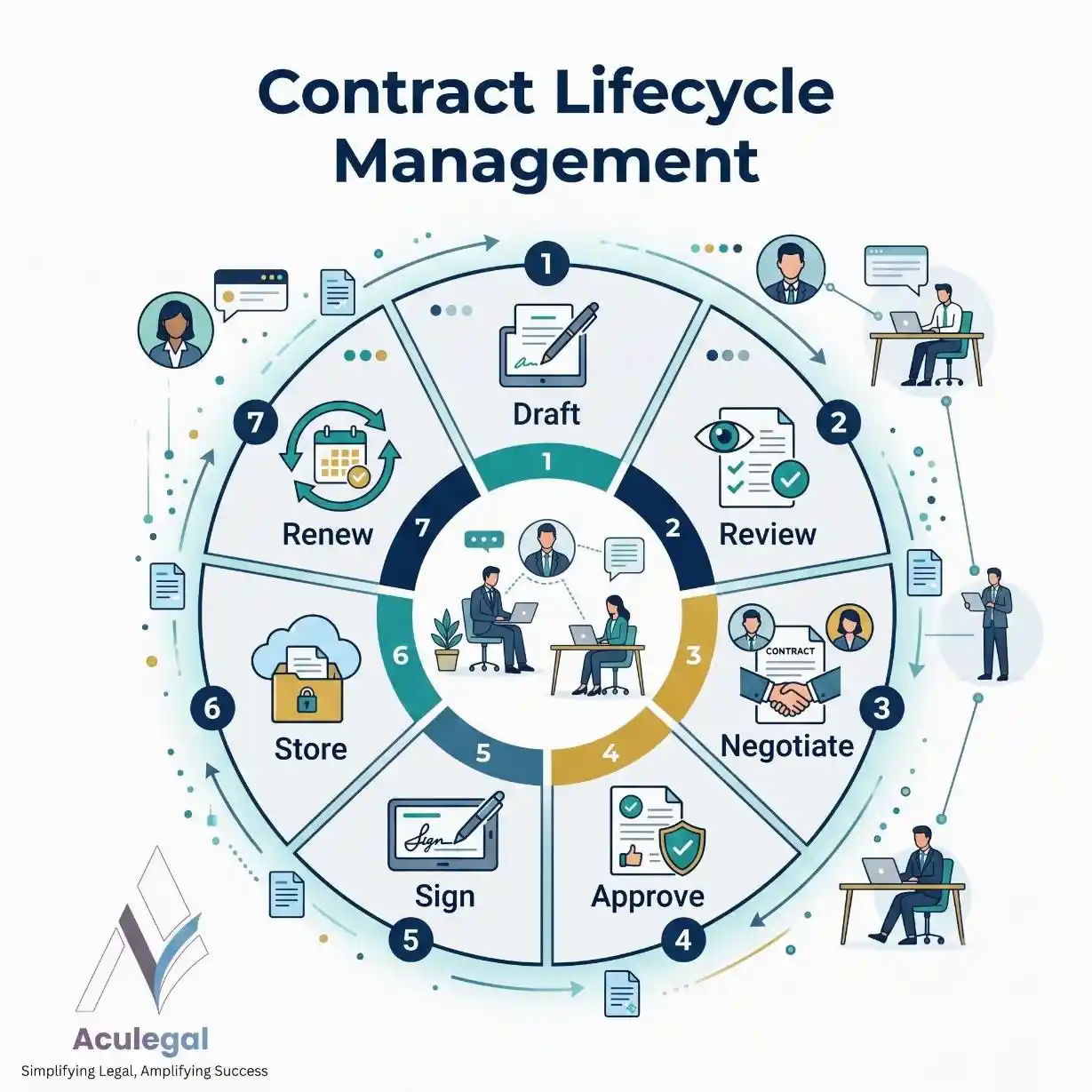
Aculegal’s approach to Outsourced Corporate Legal Services is built around one principle: legal support should scale with your business, not sit as a fixed cost you outgrow or underuse.
The engagement typically covers:
- Diagnostic review – an initial audit of your current contracts, IP position, and compliance exposure.
- Dedicated legal point of contact – a Business Contract Lawyers team assigned to your account, not a rotating call center.
- Ongoing Contract Review Services and CLM – every commercial agreement reviewed, negotiated, and tracked through renewal.
- VCLO-level strategic oversight – legal risk reporting that founders and boards can actually use in decision-making.
This is what turns legal from a reactive cost center into a Startup Legal Services function that actively protects growth.
Conclusion: Legal Leadership Shouldn’t Be a Luxury
The businesses winning in 2026 aren’t the ones with the biggest legal budgets – they’re the ones with the smartest legal structure. A fractional, outsourced legal team gives founders and SMEs what a full-time hire and a traditional law firm retainer both fail to deliver: senior legal judgment, contract discipline, and IP protection, priced and scoped to fit the business as it actually is today.
Aculegal was built on one idea – Simplifying Legal. Amplifying Success. That means giving growing businesses the legal firepower of an enterprise legal department, without the enterprise overhead.
Ready to see where your contracts and legal risk actually stand?
Aculegal is offering qualifying founders and SMEs a free first contract review plus a 15-minute risk consultation, no obligation, no jargon, just a clear picture of where you stand.
👉 Book your free consultation with Aculegal today and find out what a dedicated outsourced legal team can do for your business.