

Proactive legal support is no longer a “nice to have” for growing businesses, it’s a financial decision with a measurable payoff. Most founders treat legal spend as an unavoidable cost, something to minimize until a crisis forces their hand. That mindset is expensive, and the data proves it.
This piece breaks down exactly why waiting for legal problems to happen costs more than preventing them, and what a modern, proactive legal function actually looks like for founders, startups, and SMEs operating on a global scale.
This applies whether you’re a bootstrapped startup in your first funding round, an established SME scaling into new markets, or a founder managing cross-border commercial relationships. Legal risk doesn’t respect geography, and neither should your legal strategy.
The Hidden Price of Reactive Legal Management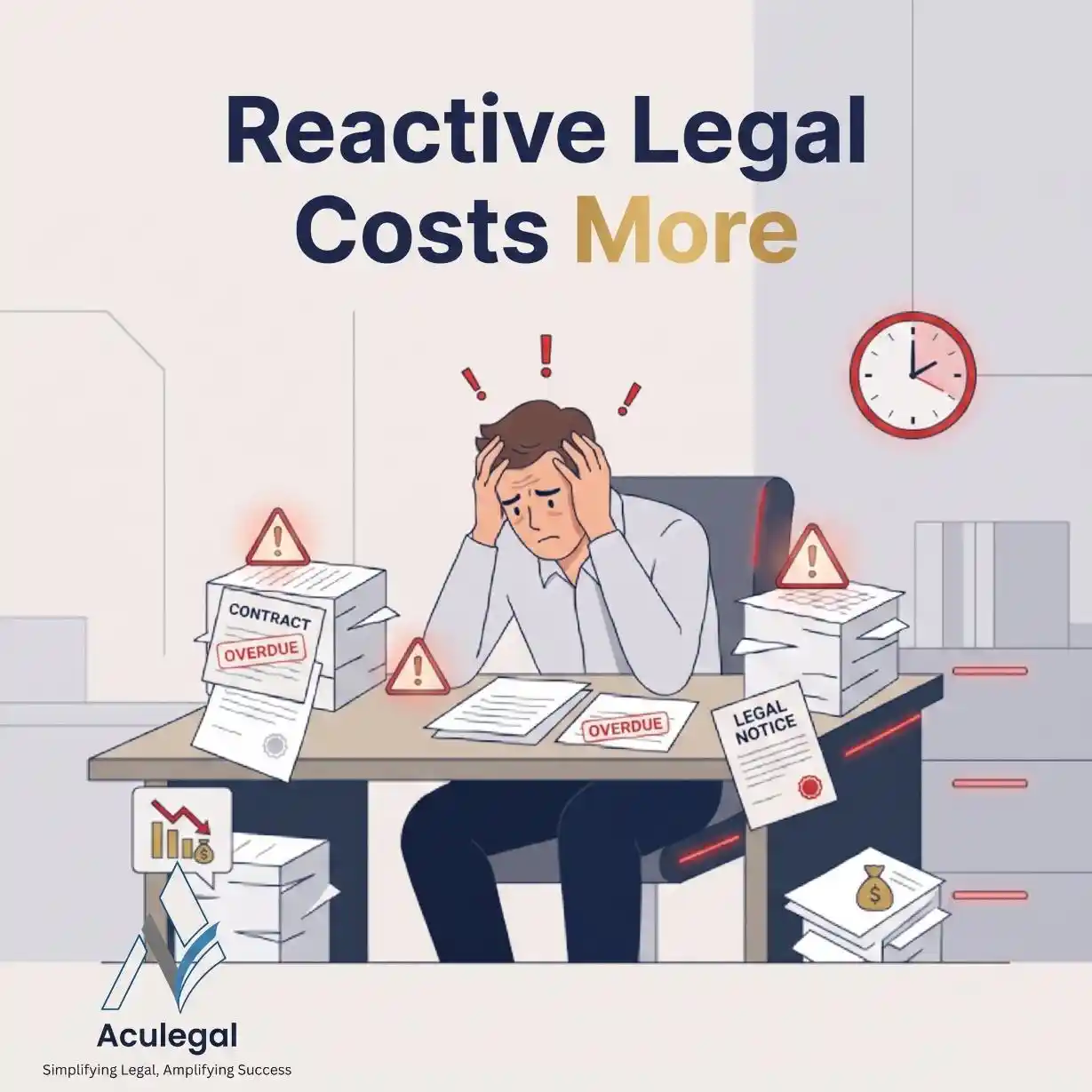
Here’s the uncomfortable truth: most businesses only think about legal support after something has already gone wrong. A vendor contract falls apart. A cofounder dispute escalates. A competitor copies a product feature because there was no IP protection in place.
By the time legal gets involved, the company is no longer preventing a problem, it’s paying to clean one up. That distinction changes everything about the cost.
Why Founders Delay Legal Investment
Founders aren’t reckless. They’re resource-constrained, and legal spend feels abstract compared to product, sales, or hiring. Legal is treated as insurance rather than infrastructure, something you buy only after you’ve been burned once.
This is a rational response to a real constraint. But it consistently backfires, because the cost of a legal problem is almost always higher than the cost of preventing it.
The Real Cost of Waiting for Trouble
The numbers here are not abstract. One 2025 industry survey found that nearly nine in ten small businesses will face a lawsuit, with the average liability claim costing tens of thousands of dollars, and the average contract dispute running even higher.
Closer to home for founders, that same research found that 47% of small business owners lost at least $500 dealing with avoidable legal problems, and one in five lost $5,000 or more. Almost none of that money went toward growth. It went toward damage control.
A separate global study on SME disputes makes the point even sharper: the visible legal bill is rarely the real cost of a dispute, the bigger drain is founder time, cash-flow disruption, and stalled delivery while the business fights fires instead of building.
The pattern is consistent across markets: legal problems that could have been prevented for a fraction of the cost end up consuming management attention, cash reserves, and momentum.
The Compliance Blind Spot
Reactive legal management doesn’t just show up in disputes and contracts, it shows up in compliance gaps that quietly accumulate. Data privacy obligations, employment classifications, industry-specific licensing, and cross-border regulatory requirements all shift regularly.
A business without ongoing legal oversight discovers these gaps the hard way: during an audit, a funding round, or a regulator’s inquiry. By then, the fix costs far more than the original compliance work would have, and it often comes with penalties attached.
Why Proactive Legal Support Delivers a Higher Return on Investment
Once you see legal as infrastructure rather than insurance, the ROI case becomes obvious. Proactive legal support isn’t about spending more, it’s about spending earlier, on the things most likely to prevent expensive failures later.
Think of it the way you’d think about product QA or cybersecurity. Nobody debates whether catching a bug before launch is cheaper than a post-launch outage. Legal risk works the same way.
From Cost Center to Growth Engine
A well-structured legal function does three things a reactive one never can:
- Catches risk before it becomes a liability – in contracts, hiring, IP, and compliance
- Speeds up deal velocity by removing legal as a bottleneck in sales and fundraising
- Frees founder time that would otherwise go into firefighting instead of building
This is why more startups and SMEs are shifting from ad-hoc, hourly-billed legal help toward a fractional legal team, a model that gives them senior-level legal judgment without the overhead of a full in-house department.
Building a Virtual Legal Department vs. Traditional In-House Counsel
Hiring a full-time General Counsel is expensive and often premature for an early-stage or mid-market company. A Virtual Chief Legal Officer model gives founders the same strategic oversight, contract strategy, risk management, compliance planning, without a six-figure fixed salary.
This is effectively an outsourced in-house legal team: dedicated, embedded in your business context, but scaled to your actual legal workload. You get an external in-house counsel relationship instead of a transactional law firm relationship.
If you’re comparing this model to building an internal legal department from scratch, it’s worth exploring how a Virtual Chief Legal Officer engagement is structured before committing to either path.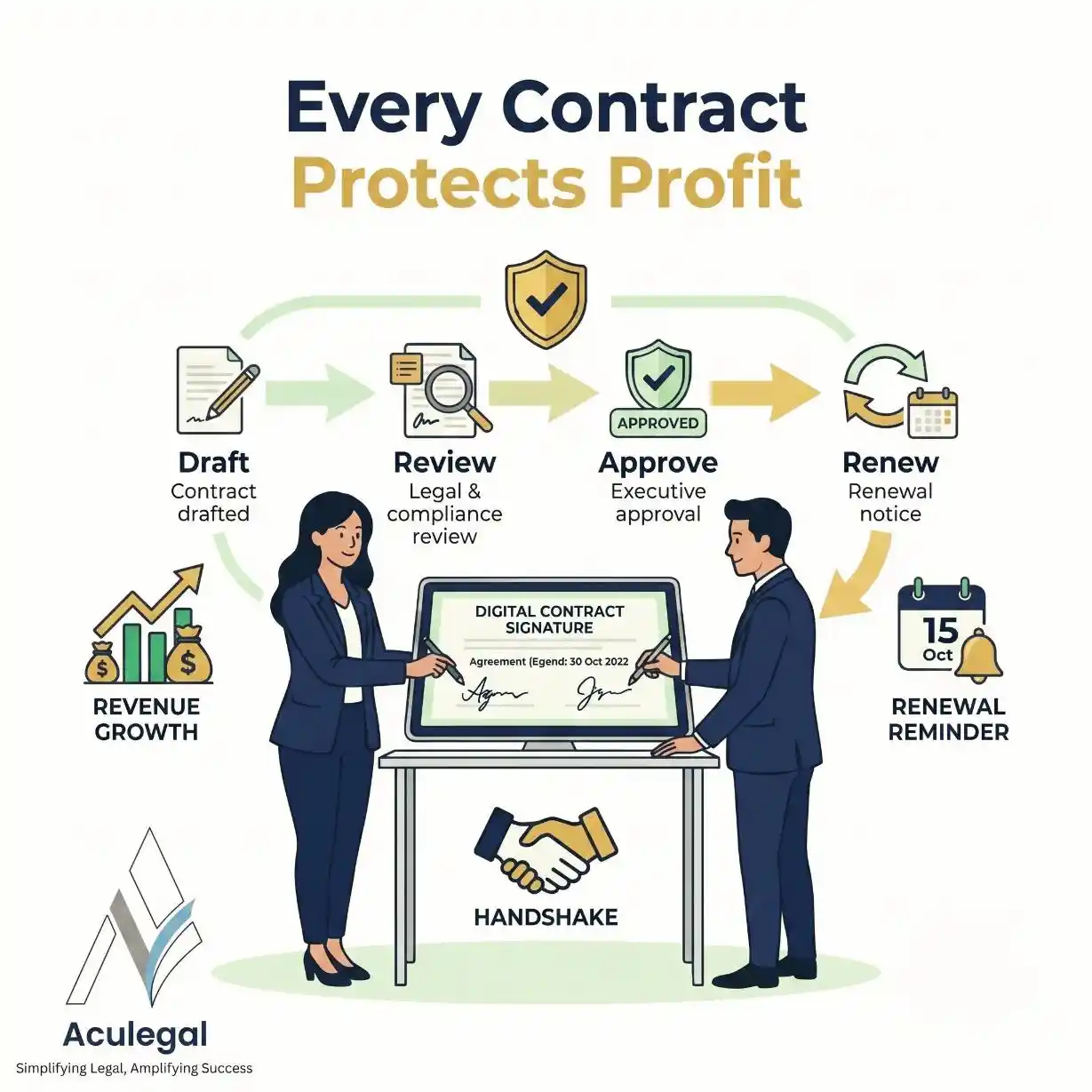
Commercial Contract Management as a Profit Lever
Contracts are where legal risk and revenue intersect most directly. Poorly drafted or poorly tracked agreements don’t just create legal exposure, they leak money.
Global research backs this up. Deloitte’s research across more than 1,200 organizations found average contract value erosion of nearly 9%, meaning businesses routinely lose close to a tenth of contract value to missed renewals, poor terms, and untracked obligations.
Structured Contract Lifecycle Management Services close this gap by standardizing how agreements are created, reviewed, negotiated, and tracked. This isn’t just risk mitigation, it’s margin protection. For businesses managing recurring vendor, client, or partner agreements, Contract Lifecycle Management support turns contracts from a liability into a controlled, revenue-protecting asset.
Protecting IP Before It’s a Crisis
For founders building anything defensible, a product, a brand, a process, intellectual property protection is not optional. Waiting until a competitor copies your work or a dispute arises over ownership is the single most expensive way to handle IP.
Startup legal services around IP should be built in from day one, not bolted on after a threat appears. This includes clear IP assignment clauses in employment and contractor agreements, trademark strategy, and monitoring for infringement before it escalates.
The Proof: What Businesses Gain by Investing Early
This isn’t a theoretical argument. Organizations that invest in structured, proactive legal processes see measurable, repeatable returns.
Time and Cost Savings, Backed by Data
The efficiency gains from proactive, well-managed legal processes are well documented:
- AI-assisted contract review can cut review time by up to 50–80%, according to recent contract management research, freeing legal and business teams for higher-value work
- Organizations mastering structured contract data have achieved ROI well above 300% in the first year of adopting disciplined contract processes
- Nearly 40% of legal teams report significant workload reduction after standardizing contract handling instead of managing agreements ad hoc
Human-verified, AI-assisted contract review, where automation flags risk and a qualified legal professional confirms it, combines speed with the judgment that pure automation still lacks. That combination is where the real ROI shows up.
Risk Reduction That Compounds
Small business preparedness research is blunt about the alternative. SCORE’s guidance for small business owners notes that litigation costs can range from a few thousand dollars into six figures, and that businesses without proper legal preparation absorb the full financial and reputational impact alone.
Proactive legal risk management compounds in the opposite direction. Every contract reviewed correctly, every compliance gap closed early, every IP asset properly protected reduces the surface area for future disputes. The savings aren’t a one-time event, they accumulate every quarter the business operates without an avoidable legal fire.
Due diligence readiness follows the same logic. Startups preparing for fundraising or acquisition with clean, well-documented legal records consistently move faster through investor and buyer scrutiny than those scrambling to assemble records under deadline pressure.
What Proactive Legal Support Looks Like in Practice
For most founders and SMEs, proactive legal support isn’t about building a large in-house department. It’s about assembling the right structure at the right scale:
- A fractional General Counsel or Virtual Chief Legal Officer for strategic oversight and decision-making
- Commercial contract drafting and negotiation support built into your sales and procurement workflows
- Legal advisory for SMEs covering compliance, employment, and regulatory risk before it becomes a violation
- Intellectual property protection embedded from the earliest stage of product or brand development
- Due diligence readiness maintained continuously, not assembled reactively before a raise
Each of these is a targeted, scalable investment, not a blank-check legal budget. That’s the difference between legal as overhead and legal as a growth function.
A Practical Example
Consider two SMEs signing the same volume of vendor and client contracts each year. One relies on ad-hoc legal help, reviewing agreements only when a deal is urgent or a dispute has already surfaced. The other has a dedicated legal team for SMEs reviewing every agreement against a standardized playbook before signature.
The first business will eventually absorb a costly dispute, a missed renewal, or an unfavorable term that goes unnoticed until it matters. The second business catches these issues before they’re signed, at a fraction of the cost of fixing them afterward. Over a few years, that difference compounds into a measurable gap in legal spend, cash flow stability, and deal confidence.
Choosing Between a Law Firm Retainer and a Fractional Model
Many founders default to a traditional law firm retainer because it’s familiar, not because it’s the best fit. Retainers are typically built around hourly billing and reactive requests, which means the incentive structure rewards time spent, not risk prevented.
A fractional General Counsel or Virtual Legal Department model flips that incentive. The relationship is built around ongoing oversight and embedded business context, not isolated transactions, which is precisely why it tends to catch problems earlier and cost less over a full year of operation.
Conclusion: Legal Support Is an Investment, Not an Expense
The evidence is consistent across every market and every dataset: businesses that invest in proactive legal support spend less, move faster, and lose less value to preventable disputes than those that wait for a crisis to justify the spend. The ROI isn’t hypothetical, it shows up in avoided litigation costs, protected contract value, faster deal cycles, and founders who spend their time building instead of firefighting.
At Aculegal, this is the foundation of everything we do: Simplifying Legal. Amplifying Success. Whether you need a dedicated fractional legal team, structured contract lifecycle management, or IP protection built in from day one, the earlier you invest, the more you protect.
Ready to see what proactive legal support could save your business? Book a free consultation with Aculegal today and find out where your legal risk and your legal ROI actually stand.