

A Fractional Legal Team is quickly becoming the default legal setup for founders who need real legal firepower without a real legal department. Instead of hiring a full-time General Counsel, growing businesses are plugging into an outsourced in-house legal team that shows up exactly when needed, for a contract review, a compliance deadline, or a boardroom question that can’t wait.
If you’re running a startup or SME, you already know this tension: you need senior legal judgment on tap, but you can’t justify a six-figure in-house hire for it. That gap is exactly where the fractional model lives.
This isn’t a stripped-down version of “real” legal support. It’s a strategic redesign of how growing companies buy legal expertise, and it’s why the model is spreading fast across startups, SMEs, and mid-market companies worldwide.
The Problem: Legal Support That Doesn’t Fit How Growing Businesses Actually Work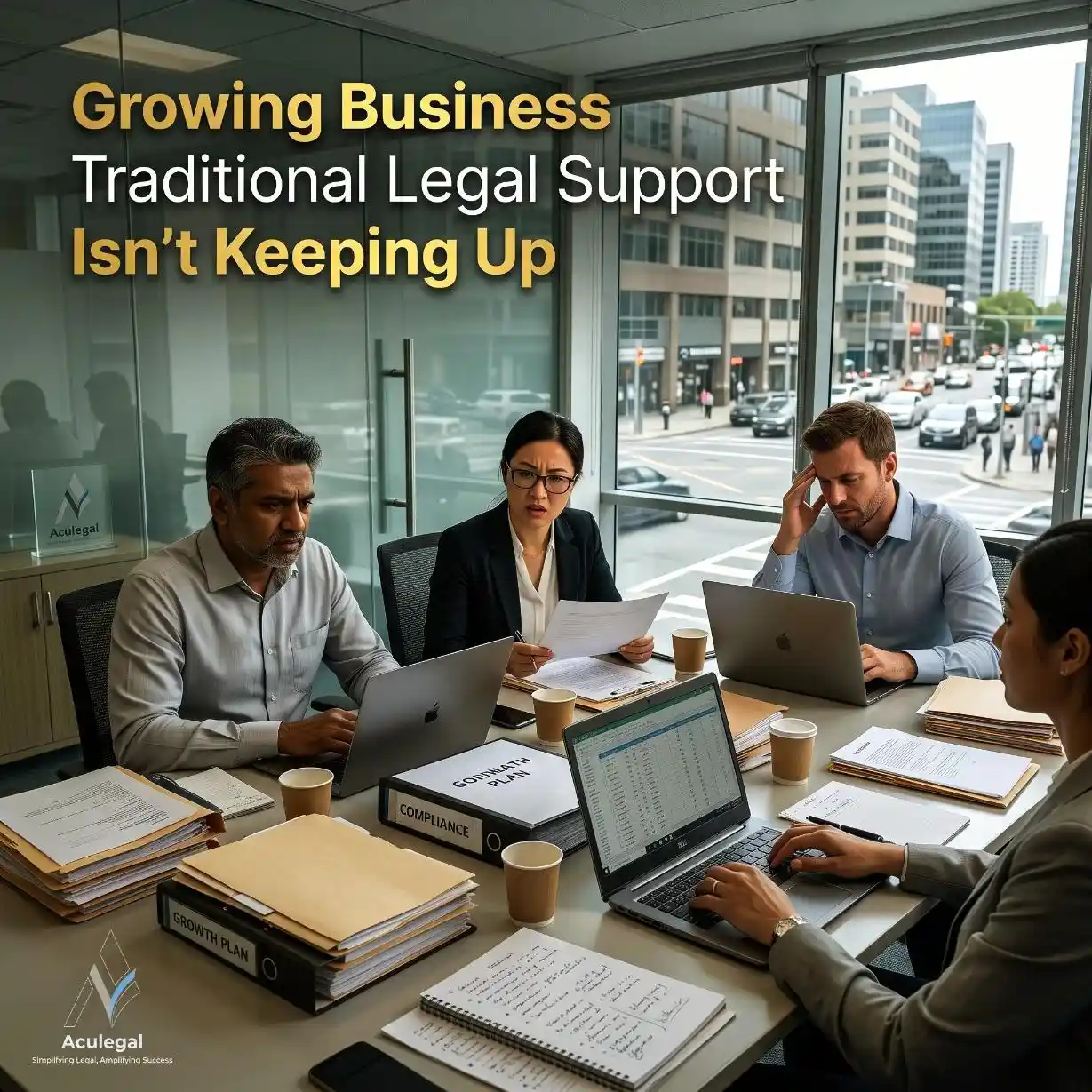
Most legal delivery models were built for large enterprises, not for a 40-person SME closing three commercial deals a month.
Full-time General Counsel is expensive. In 2026, in-house counsel compensation ranges run well into six figures even at small companies, before benefits, tools, or team support are added.
Traditional law firms bill by the hour. Every phone call, redline, or “quick question” adds to an invoice that’s hard to predict and even harder to budget against, especially when law firm worked rates keep climbing faster than inflation.
In-house teams are stretched thin. Even companies that do have internal counsel are being asked to do more with less, which usually means routine contract work sits in a queue while strategic matters wait even longer.
The result is a familiar pattern for founders:
- Contracts get signed with unread clauses because “there was no time to review it properly”
- Compliance deadlines get missed because no one owns them full-time
- IP goes unprotected because trademark and patent filings feel like a “later” problem
- Legal risk quietly accumulates until it becomes a funding, litigation, or reputational issue
None of this is a people problem. It’s a structural problem, the traditional models of legal delivery simply weren’t designed for the pace and budget of a growing business.
Why SMEs and Growing Businesses Are Adopting the Fractional Legal Team Model
Businesses aren’t choosing fractional legal support because it’s cheaper alone, cost is only part of the story. They’re choosing it because it matches how modern SMEs actually operate: lean, fast, and allergic to waste.
1. Senior-Level Judgment Without Senior-Level Overhead
A Fractional General Counsel brings the same strategic thinking as a full-time GC, reviewing high-stakes contracts, flagging regulatory exposure, advising the board, but only for the hours the business genuinely needs.
2. Predictable, Scalable Cost
Instead of one large fixed salary, businesses pay for a Corporate Legal Retainer or subscription-style engagement that flexes with deal volume. That’s a materially different cost curve than carrying a permanent legal headcount.
3. Coverage Across the Full Legal Lifecycle
A well-structured Virtual Legal Department doesn’t just draft contracts. It covers commercial agreements, IP protection, compliance tracking, employment matters, and dispute support, the same scope as a full internal department would own.
4. Speed That Matches Business Reality
Deals don’t wait for legal availability. A Dedicated Legal Team for SMEs is structured to turn around commercial contracts in days, not the weeks that ad hoc law firm engagements often require.
5. A Response to a Genuinely Shifting Legal Market
This shift isn’t happening in isolation. Corporate legal departments everywhere are being pushed to move work in-house, adopt leaner delivery models, and question the assumption that outside counsel is the default answer to every legal need.
The Solution: How a Fractional Legal Team Actually Works
Think of a fractional or Virtual Chief Legal Officer engagement as your External In-House Counsel, embedded enough to understand your business, flexible enough to scale with it.
Commercial Contract Management, Handled End to End
This is usually where the pain is sharpest. A strong Contract Lifecycle Management Services setup covers:
- Commercial Contract Drafting – MSAs, vendor agreements, SaaS terms, and founder agreements built around your actual risk profile
- Contract Review Services – catching one-sided indemnities, auto-renewal traps, and jurisdiction issues before signature
- Contract Negotiation Services – a legal voice at the table so business teams aren’t negotiating blind
- Ongoing tracking – renewal dates, obligations, and expiry alerts so nothing lapses silently
Explore Aculegal’s approach to Contract Lifecycle Management to see how this is structured for growing businesses.
AI-Assisted, Human-Verified Contract Review
Speed matters, but accuracy matters more. The most effective B2B Legal Services providers now combine two layers:
- AI-Assisted Contract Review to flag anomalies, missing clauses, and non-standard terms in minutes rather than hours
- Human Verified Contract Review where a qualified lawyer confirms context, commercial intent, and legal risk before anything is finalized
This hybrid model is quickly becoming the industry standard, since AI tools compress review time on standardized documents while lawyers stay accountable for judgment calls a model can’t make.
A Virtual Chief Legal Officer, Not Just a Vendor
A genuine Virtual Chief Legal Officer engagement functions differently from a transactional law firm relationship. It means one legal partner who understands your business model, your risk appetite, and your growth stage, advising on everything from Legal Risk Management to fundraising documentation.
See how this works in practice through Aculegal’s Virtual Chief Legal Officer (VCLO) service.
Protecting What You’ve Actually Built
Contracts protect transactions. Intellectual Property Protection Services protect the thing that makes your business worth building in the first place, your brand, your product design, your proprietary processes.
For founders who’ve delayed this, Aculegal’s Intellectual Property Protection Services page is a useful starting point before a competitor files first.
Due Diligence That Doesn’t Slow You Down
Fundraising, M&A, and partnership deals all hinge on clean Due Diligence Services. A fractional legal team that already knows your contracts and compliance history can compress diligence timelines dramatically, because there’s no scramble to reconstruct records from scratch.
The Proof: Why This Model Is Winning Right Now
The shift toward outsourced, flexible legal delivery isn’t a trend on the margins, it’s showing up clearly in how corporate legal budgets are being restructured globally.
Legal departments are actively moving work away from expensive, hourly-billed models. Industry data shows worked rates at law firms have been climbing well above inflation, pushing corporate legal buyers toward Alternative Legal Service Providers and leaner internal structures instead of absorbing those increases.
Cost optimization remains a top strategic priority for legal leaders heading into 2026, alongside technology adoption, a combination that favors flexible, tech-enabled legal delivery over rigid, headcount-heavy departments.
The broader legal services market is shifting toward digital and hybrid delivery models, with virtual and technology-assisted legal services projected to grow substantially faster than traditional in-person delivery through the rest of the decade.
For founders and SME leaders, the takeaway is straightforward: the businesses managing legal risk best in 2026 aren’t necessarily the ones with the biggest legal budgets. They’re the ones using Outsourced Corporate Legal Services structured around actual business needs, contracts reviewed on time, IP filed before it’s urgent, and compliance tracked continuously instead of in a scramble.
A Model That Works Across Markets, Not Just One Jurisdiction
Founders today rarely operate in a single legal system. A startup incorporated in one country might have customers in another, contractors in a third, and investors asking questions from a fourth.
A Fractional Legal Team built for this reality doesn’t just draft one-size-fits-all templates. It structures agreements to hold up across jurisdictions, flags where local counsel input is genuinely required, and keeps compliance calendars aligned to more than one regulatory clock.
This matters most for:
- SaaS and tech companies selling into multiple countries with different data protection and consumer laws
- Cross-border startups raising capital from international investors who expect clean, enforceable documentation
- Import/export and services businesses managing vendor and distribution agreements across markets
- Remote-first teams hiring contractors and employees under different labor frameworks
An Outsourced In-House Legal Team that’s used to working across borders becomes a genuine advantage here, it’s already built the muscle memory that a single full-time hire, however senior, usually hasn’t.
What Founders Get Wrong About “Doing Legal Later”
Many founders treat legal infrastructure as something to fix once the business is bigger. In practice, that delay is where most of the damage happens.
Contracts signed early set the template for every deal that follows. A weak vendor agreement or founder agreement doesn’t just create one problem, it becomes the pattern every future negotiation inherits, until someone finally rewrites it under pressure.
IP left unfiled is IP left unprotected. Trademarks, product names, and proprietary processes are only as safe as the paperwork behind them. Competitors and even former employees can file first if a business waits too long.
Compliance gaps compound quietly. A missed filing or an outdated policy rarely causes an immediate problem, until it surfaces during a fundraising round, an audit, or a dispute, at which point it’s far more expensive to fix.
A Business Contract Lawyer engaged early costs far less than a litigation team engaged late. That’s the core economic argument for building legal capability into the business from the start, not bolting it on after something breaks.
Is a Fractional Legal Team Right for Your Business?
A Fractional Legal Team tends to be the right fit if:
- You’re a startup or SME without the budget (yet) for full-time senior counsel
- Your contract volume is growing faster than your ability to review them properly
- You’ve delayed IP protection because it never felt “urgent enough”
- You want Legal Advisory for SMEs that scales with fundraising rounds, new markets, or headcount growth
- You need Legal Support for Growing Businesses that feels embedded, not transactional
If two or more of these sound familiar, it’s worth a conversation before the next contract, compliance deadline, or IP filing turns into a costlier problem.
Conclusion: Build Legal Capability, Not Legal Overhead
The Fractional Legal Team model exists because growing businesses needed something between “no legal support” and “an expensive full-time department.” It gives founders and SMEs senior legal judgment, structured contract management, and IP protection, priced and paced to match the business, not a legacy law firm model.
At Aculegal, this is the operating philosophy behind everything we build for founders, startups, and SMEs: Simplifying Legal. Amplifying Success.
If unpredictable legal costs, unreviewed contracts, or unprotected IP are quietly sitting on your risk list, it’s time for a structural fix, not another one-off engagement.
Book a free consultation with Aculegal and find out what a Fractional Legal Team could look like for your business.
Sources
- Thomson Reuters Institute & Georgetown Law, 2026 Report on the State of the US Legal Market — via Thomson Reuters Institute, “5 Critical Insights for In-House Counsel
- LegalBillReview. com, “Legal Billing Rates in 2026: Benchmarks, Trends & What to Negotiate“
- Chambers and Partners, “Legal Challenges 2026” — In-house counsel priorities survey
- Mordor Intelligence, “Legal Services Market Size, Growth, Share & Research Report 2031“
- Association of Corporate Counsel & Major, Lindsey & Africa, “Law Department Management Benchmarking Report” via Legal. io