
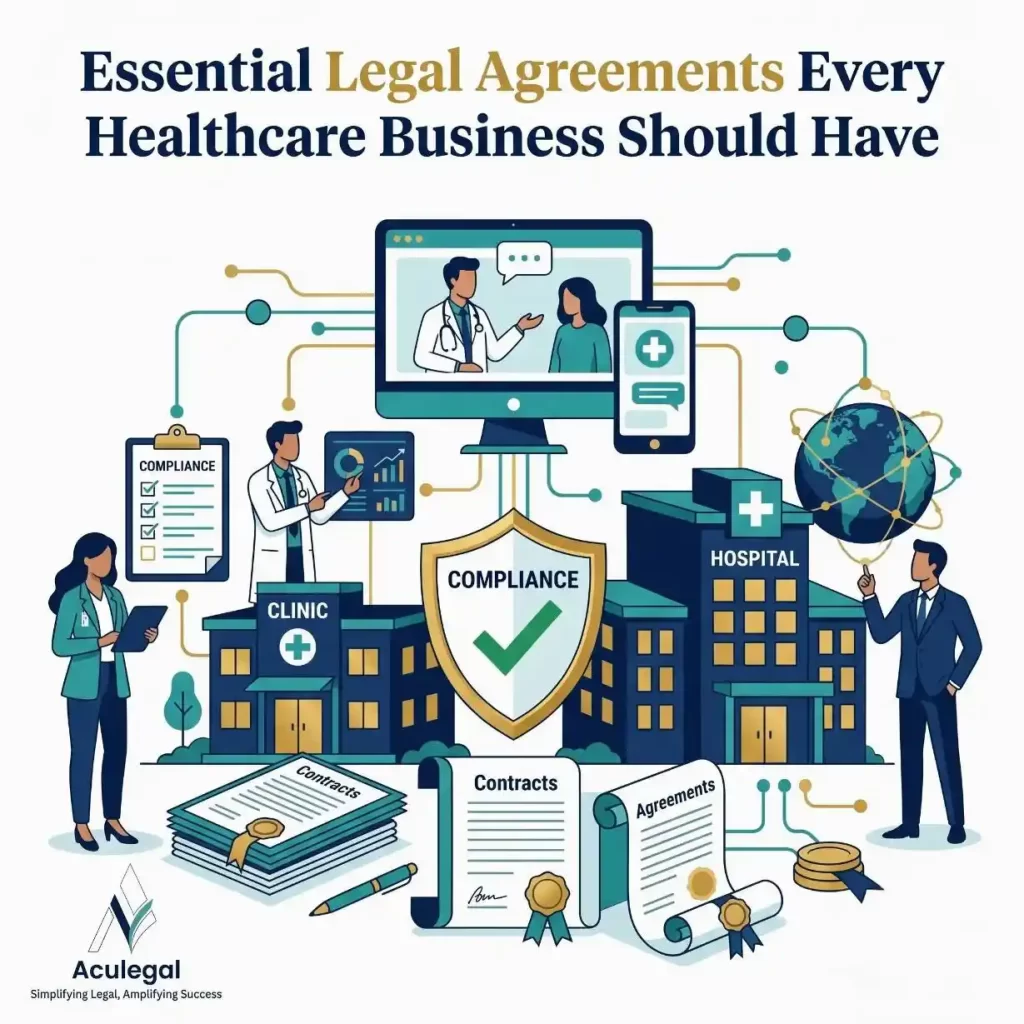
Legal agreements for healthcare businesses are not paperwork; they’re the infrastructure that keeps a hospital, clinic, diagnostics chain, or health-tech startup standing when something goes wrong. And in healthcare, something will go wrong eventually: a vendor mishandles patient data, a doctor leaves and takes a client list, a telehealth platform gets audited, or a partnership turns into a dispute.
The healthcare businesses that survive these moments aren’t the ones with the best intentions. They’re the ones with the best contracts.
This guide breaks down the legal agreements every healthcare business, from a single-location clinic to a multi-country digital health platform, needs to operate safely, scale confidently, and stay compliant across jurisdictions.
Why Healthcare Businesses Can’t Afford to Skip Legal Documentation
Healthcare is the most heavily regulated, most data-sensitive, and most litigation-prone sector a founder can operate in. Patient information, clinical outcomes, insurance reimbursements, and licensed professionals are all involved in a single transaction, and each one carries legal exposure.
The numbers make the case better than any warning could. Healthcare has held the unwanted title of the costliest industry for data breaches for 14 consecutive years, with breach costs running well above the global average across every recent report. That cost isn’t just regulatory fines, it’s lawsuits, lost trust, and operational shutdowns, almost all of it traceable back to contracts that were missing, outdated, or never enforced.
Here’s the uncomfortable truth most founders only learn the hard way:
- A missing vendor agreement turns a data breach into a liability nightmare.
- An undocumented partnership turns a disagreement into a courtroom battle.
- A poorly drafted employment contract turns a resignation into an IP leak.
The problem isn’t that healthcare businesses don’t value compliance. It’s that legal documentation is treated as a one-time formality instead of an ongoing operational discipline.
Real enforcement actions show how this plays out. Regulators have repeatedly penalized healthcare organizations not because a breach occurred, but because the underlying vendor relationship was never backed by a properly executed data-handling agreement in the first place. The breach is the headline; the missing contract is almost always the root cause.
The Core Legal Agreements for Healthcare Businesses
Every healthcare business, regardless of size or geography, needs a baseline set of agreements. Think of these as your operational armor.
1. Data Processing and Business Associate Agreements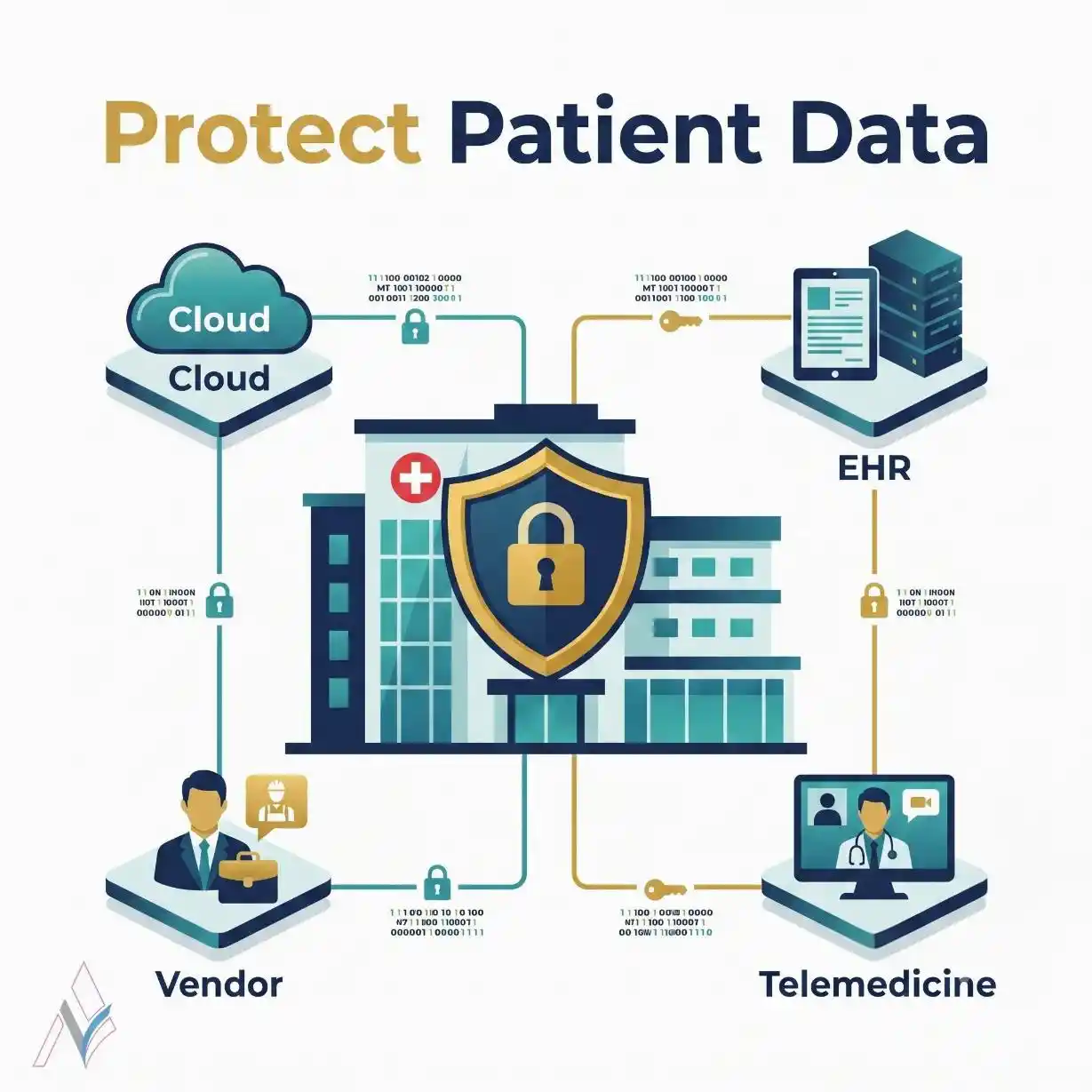
Any vendor, software platform, or contractor that touches patient data needs a binding agreement defining how that data can be used, stored, and protected. In the US, this is formalized through the Business Associate Agreement (BAA) requirement under HIPAA; under federal rules governing covered entities, a written contract is mandatory before any protected health information changes hands.
Outside the US, the equivalent obligation is just as real. India’s healthcare sector now falls squarely within the scope of the Digital Personal Data Protection Act, which applies to hospitals, telemedicine platforms, diagnostic labs, and any business processing patient data, including organizations based outside India that serve Indian patients or customers.
Europe and the UK take a similarly strict approach, treating health information as a “special category” of personal data requiring heightened protection under data protection frameworks overseen by dedicated regulatory authorities. For healthcare businesses operating across borders, this means a single domestic agreement template is rarely enough, your contracts need to flex across regulatory regimes, not just one.
Bottom line: if a vendor touches health data, you need a signed agreement before that data flows. No exceptions.
2. Vendor and Technology Service Agreements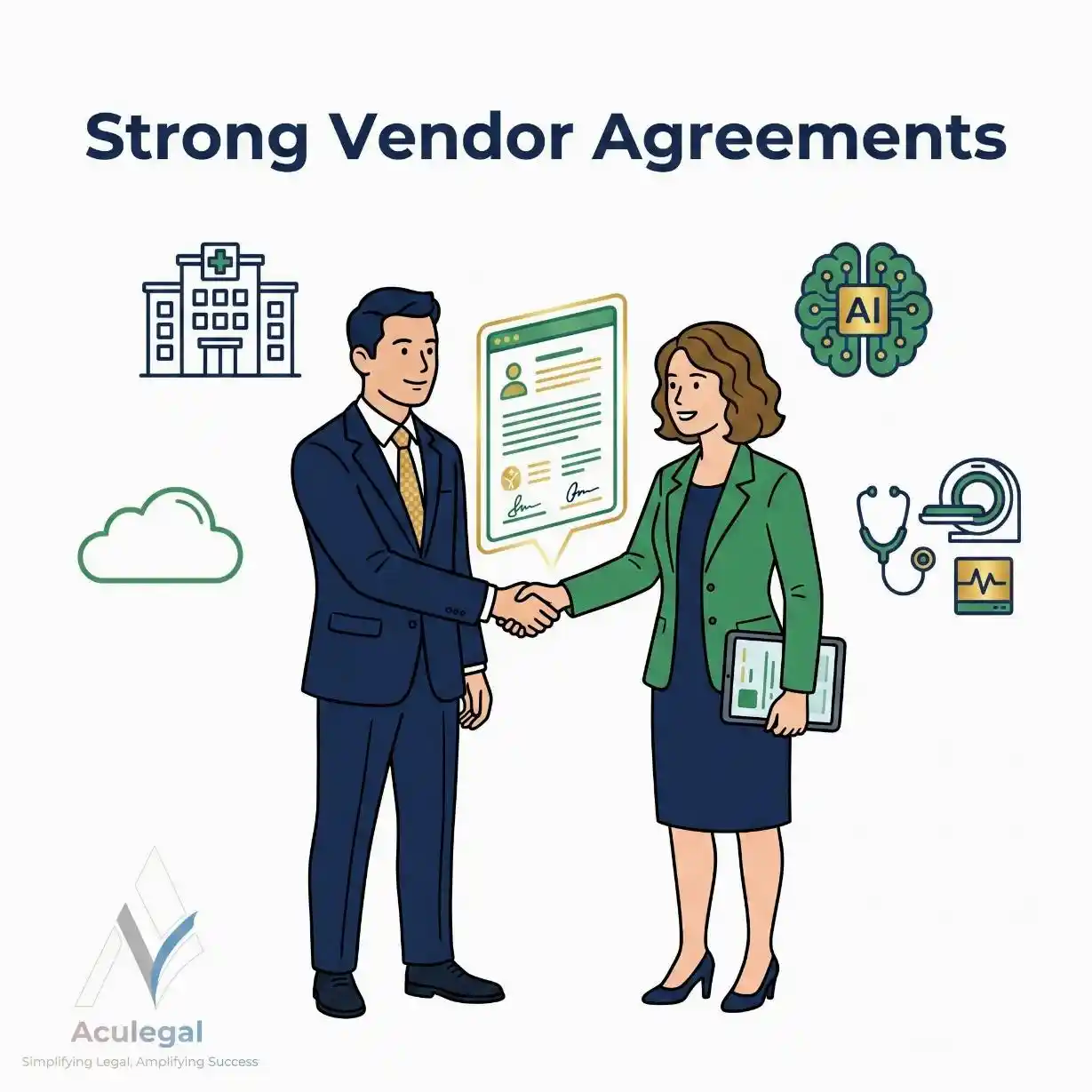
Healthcare businesses depend on a growing web of third-party vendors, EHR providers, billing platforms, cloud hosts, AI diagnostic tools, lab interfaces. Each one is a potential point of failure if the underlying contract doesn’t clearly assign responsibility.
A solid vendor agreement should cover:
- Service levels and uptime guarantees
- Data security and breach notification obligations
- Liability caps and indemnification
- Termination rights and data return/destruction terms
3. Employment, Contractor, and Non-Compete Agreements
Clinicians, administrative staff, and contractors all interact with sensitive systems and confidential processes. Clear employment agreements protect against wrongful termination claims, IP disputes, and the risk of a departing employee walking off with patient lists or proprietary protocols.
This is especially critical for healthcare businesses that rely on visiting consultants, locum physicians, or contracted specialists, relationships that often go undocumented until a dispute forces the issue.
4. Patient Consent and Telehealth Service Agreements
Informed consent isn’t just an ethical obligation, it’s a legal one. Every patient-facing healthcare business needs documentation covering treatment consent, data usage consent, and (for digital health platforms) terms of service that hold up under regulatory review.
Telehealth platforms carry an added layer of complexity: agreements must account for cross-border consultations, jurisdiction-specific licensing rules, and platform liability if a remote diagnosis goes wrong.
5. Intellectual Property and Licensing Agreements
Healthcare innovation, proprietary treatment protocols, diagnostic algorithms, medical device designs, branded clinical programs is a business asset that needs formal protection. Without registered trademarks, patents, or clear licensing terms, that value is exposed the moment a competitor or former partner decides to use it.
This is where many founders underestimate their risk. Clinical IP, software algorithms, and even your brand identity need the same legal rigor as your compliance program. Aculegal’s intellectual property protection services help healthcare businesses lock down ownership before it becomes a dispute.
6. Partnership, Referral, and Joint Venture Agreements
Hospitals partnering with diagnostic chains, clinics co-branding with insurers, or health-tech startups entering joint ventures with hardware manufacturers all need agreements that define revenue splits, decision rights, exit terms, and liability allocation, clearly, in writing, before the relationship begins.
How can legal contract management improve healthcare compliance?
This is the question most founders ask only after something has already gone wrong, but it’s the one that matters most before it does.
Legal contract management is the discipline of tracking, reviewing, and renewing every agreement your business depends on, instead of letting them sit forgotten in a folder. For healthcare businesses, this directly improves compliance in three concrete ways.
First, it closes the gaps regulators look for. Auditors and regulators don’t just check whether you have agreements, they check whether those agreements are current, properly executed, and consistently enforced across every vendor relationship. A structured contract management process catches the BAA that expired two years ago before an auditor does.
Second, it reduces breach exposure. Most healthcare data incidents trace back to a third party, a vendor, a contractor, a subcontractor several layers removed from direct oversight. Active contract management means knowing exactly who has access to patient data at all times, and ensuring every one of them is contractually bound to protect it.
Third, it turns legal risk into operational speed. When agreements are standardized, tracked, and reviewed on a schedule, healthcare businesses can onboard new vendors, partners, and staff faster, without each new relationship becoming a fresh legal fire drill.
This is precisely the gap Aculegal’s Contract Lifecycle Management (CLM) service is built to close, giving healthcare businesses a single, structured system for drafting, tracking, and renewing every agreement that keeps them compliant.
Building a Repeatable Legal Framework with Expert Support
Most healthcare founders aren’t lawyers, and they shouldn’t have to become one to stay compliant. But hiring a full-time General Counsel before you have the budget for it isn’t realistic either, especially for clinics, startups, and SMEs operating on lean teams.
This is the gap a Virtual Chief Legal Officer (VCLO) model is designed to fill. Instead of stitching together one-off contracts from generic templates, a VCLO gives healthcare businesses ongoing access to senior legal strategy: reviewing vendor contracts before they’re signed, flagging compliance gaps before regulators do, and building a documentation system that scales as the business grows.
For founders managing multi-jurisdiction operations, a clinic in India serving patients abroad, or a health-tech platform expanding into new markets, this kind of embedded legal oversight isn’t a luxury. It’s the difference between scaling smoothly and scaling into a compliance crisis.
Aculegal’s VCLO services are built specifically for this, giving healthcare businesses senior legal oversight without the overhead of a full-time hire.
The Cost of Getting It Wrong: Why This Isn’t Optional
Skeptical that legal documentation is worth the investment? Look at what happens when it’s skipped.
- Breach costs are brutal. Healthcare data breaches carry the highest average cost of any industry tracked globally, year after year, driven in large part by regulatory penalties and prolonged containment timelines tied directly to vendor and compliance failures.
- Regulators are widening their net. Healthcare-specific data protection rules are tightening across jurisdictions, from HIPAA enforcement in the US to India’s newly notified Digital Personal Data Protection Rules, and both apply obligations not just to hospitals, but to every vendor and processor in the chain.
- Litigation follows undocumented relationships. Disputes over partnerships, referrals, and IP almost always trace back to one root cause: an agreement that was assumed, verbal, or never properly executed.
None of this is hypothetical risk. It’s the predictable outcome of treating contracts as paperwork instead of protection. The healthcare businesses building durable trust with patients, regulators, and investors are the ones putting legal agreements for healthcare businesses at the center of their operating model, not at the bottom of their to-do list.
Conclusion: Don’t Wait for a Breach to Build Your Legal Foundation
Every healthcare business, whether you’re running a single clinic or scaling a digital health platform across borders, needs the same core legal infrastructure: data processing agreements, vendor contracts, employment terms, patient consent documentation, IP protection, and partnership agreements that are reviewed and renewed, not signed once and forgotten.
The businesses that get this right don’t just avoid fines. They move faster, partner more confidently, and build the kind of trust that turns patients and investors into long-term relationships.
Aculegal exists to make that foundation simple to build. Simplifying Legal. Amplifying Success. That’s not a tagline, it’s how we work with founders, startups, and healthcare businesses every day: turning legal complexity into a system that protects and accelerates growth.
Ready to audit your legal agreements before a regulator or a breach does it for you? Book a free consultation with Aculegal today and let’s build the legal framework your healthcare business actually needs.
Outbound Sources
- HHS.gov — Business Associate Contract requirements
- HIPAA Journal — BAA enforcement and breach causation
- IBM Cost of a Data Breach Report 2025 (referenced twice for two distinct stats)
- Atlas Systems — India DPDP Act compliance guide
- Discover Public Health (Springer Nature) — GDPR/UK ICO global comparison