

Introduction
Did you know that intangible assets now make up over 90% of the total value of the S&P 500? Despite this staggering global economic shift, a shocking number of founders and SMEs remain entirely focused on physical assets and short-term revenue generation. They pour millions into product development, aggressive marketing campaigns, and talent acquisition. Yet, they leave their most crucial competitive advantage completely legally unprotected.
Welcome to the costly reality of Intellectual Property: The Business Asset Many Companies Underestimate. In today’s hyper-competitive, borderless global market, having a brilliant idea is simply no longer enough to secure your company’s future. If you do not legally own the exclusive rights to your brand, your software, or your internal processes, you do not truly own your business.
Every day that passes without formal protection is a day your competitors can legally erode your market share. This blog explores why shifting your mindset from reactive legal defense to proactive asset management is the ultimate growth hack for modern enterprises. We will break down exactly how you can weaponize your intellectual property to drive valuations and command industry dominance.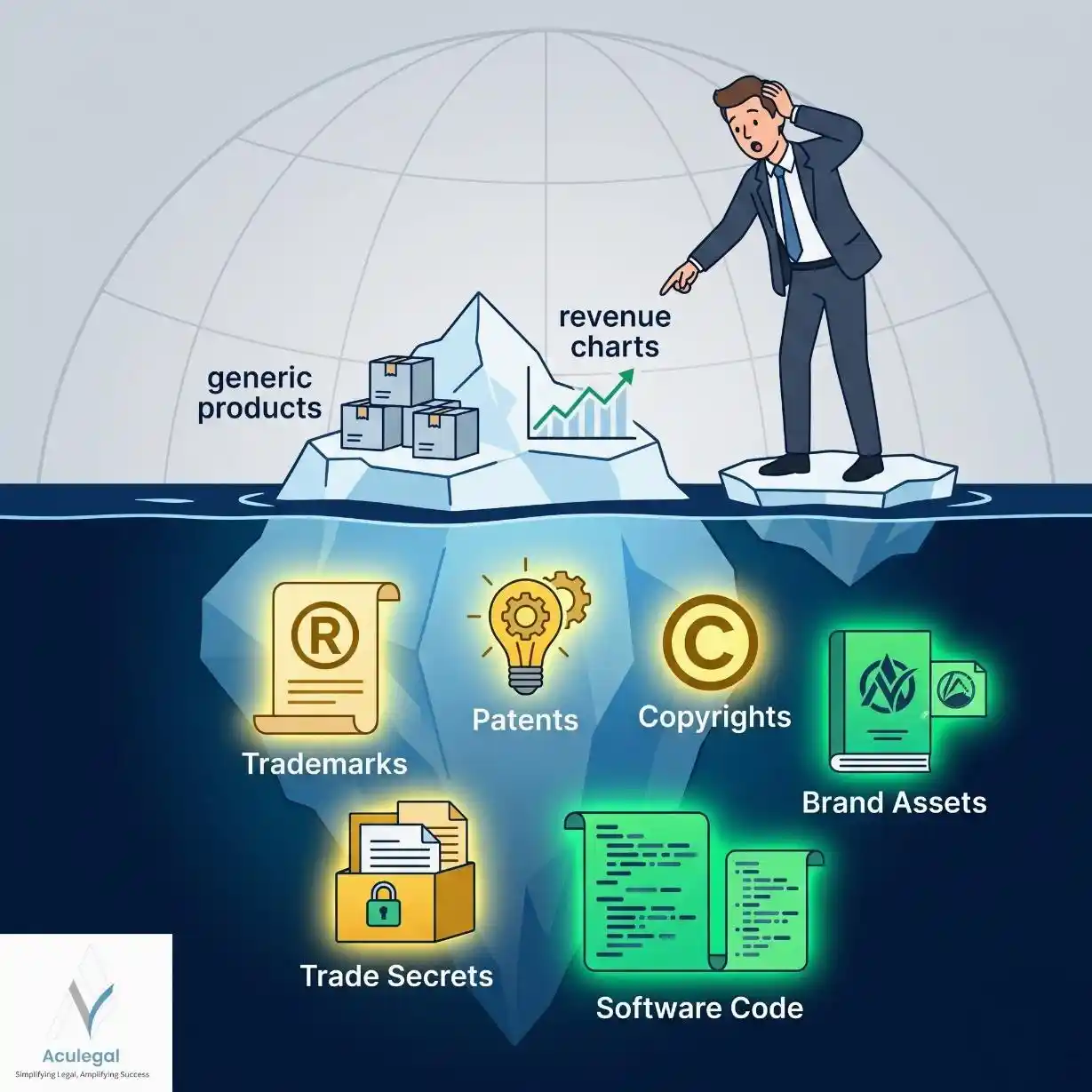
The Problem: Why Ambitious Startups Hemorrhage Value
Most startup founders and SME owners view the law as an administrative burden rather than a strategic offensive weapon. They treat legal compliance as an unavoidable expense, something to be addressed only when a crisis or a lawsuit magically appears. This fundamentally flawed, reactive approach is a critical mistake that can permanently cripple a scaling enterprise. When intellectual property is treated as a secondary thought, companies expose themselves to devastating, business-ending risks.
Competitors can legally reverse-engineer your flagship product, hijack your brand identity, or poach your trade secrets without facing any immediate legal repercussions. By the time a founder realizes their unique value proposition has been stolen, the damage is already irreversibly done. Litigation after the fact is exceptionally costly, time-consuming, and highly distracting for executive teams trying to scale.
Furthermore, failing to secure IP early on creates a massive, glaring blind spot during fundraising or acquisition talks. Sophisticated venture capitalists and private equity investors do not just invest in a clever idea or a charismatic founder. They invest in a legally defensible market monopoly that can scale without interference. If a startup cannot definitively prove ownership of its core technology or its brand assets, its valuation plummets instantly.
In many documented cases, a lack of clear IP ownership can completely derail multi-million-dollar exit strategies or Series A funding rounds. The core problem is a severe lack of alignment between an SME’s business growth strategy and its underlying legal foundation. Founders are often intimidated by the perceived cost and bureaucratic complexity of global IP registration.
They mistakenly believe that patents and international trademarks are only reserved for massive multinational corporations with bottomless legal budgets. This dangerous misconception leads them to voluntarily abandon their legal rights before they even begin to truly compete. By ignoring IP, SMEs are essentially leaving the front doors to their business wide open, warmly inviting aggressive competitors to steal their hard-earned market share.
Why Intellectual Property Is One of Your Company’s Most Valuable Assets
Your intellectual property is far more than just a defensive legal shield; it is a highly dynamic financial instrument. It is the absolute foundation upon which your long-term market dominance, brand equity, and commercial valuation are aggressively built. First and foremost, IP creates a legally enforced barrier to entry against established competitors and new market entrants. It allows you to confidently operate in a unique, highly profitable space where others simply cannot replicate your success.
This legal exclusivity directly and predictably translates into higher profit margins. When you are the only company legally permitted to offer a specific technical innovation or use a highly trusted brand name, you command ultimate premium pricing power. Consumers and B2B clients will gladly pay more for the original, verified product, knowing they cannot secure the exact same value elsewhere.
Moreover, intellectual property is a heavily scrutinized focal point for institutional investors and acquiring entities. During rigorous legal due diligence, investors will aggressively examine the depth and breadth of your IP portfolio. A robust, well-documented IP portfolio signals to the market that your management team is strategic, incredibly forward-thinking, and highly capable of protecting investor capital. It transforms your abstract, conceptual business ideas into tangible, heavily quantifiable assets sitting proudly on your balance sheet.
Additionally, IP opens up highly lucrative secondary revenue streams that many scaling companies completely overlook. Through strategic domestic and international licensing agreements, you can actively monetize your IP by allowing non-competing businesses to utilize it for a recurring fee. This powerful strategy allows you to generate massive passive income and rapidly expand your brand’s global footprint.
You can achieve this international expansion without ever taking on the heavy operational costs of entering those new foreign markets yourself. To manage these complex, ongoing licensing agreements effectively, implementing a robust Contract Lifecycle Management (CLM) system is absolutely essential. Proper CLM protocols ensure that your highly valuable IP licensing contracts are properly tracked, aggressively enforced, and renewed on time, preventing critical revenue leakage.
 The Four Strategic Pillars of Intellectual Property
To build a truly formidable, legally untouchable business, founders must deeply understand the different categories of intellectual property. Each unique type serves a highly distinct strategic purpose and legally protects a different, vital facet of your enterprise.
1. Trademarks: Protecting Your Brand Identity and Consumer Trust
-
Your primary brand name, visual logo, catchphrases, and even specific, distinctive color schemes are the vital cues that connect you with your loyal customers.
-
Trademarks legally protect this crucial brand identity from marketplace confusion and deliberate imitation.
-
Without a registered trademark, a competitor can adopt a confusingly similar name, quietly siphoning off your hard-earned customers and destroying your stellar reputation.
-
Securing global trademarks ensures your brand remains exclusively yours across international borders. For insights into global trademark databases, ambitious founders should explore resources provided by the World Intellectual Property Organization (WIPO).
2. Patents: Securing Your Technical Innovations and Market Monopoly
-
If your ambitious startup has invented a brand-new physical product, software process, or technical solution, patents are your absolute strongest legal defense.
-
A successfully granted patent grants you a temporary, legally binding monopoly to manufacture, use, and sell your specific invention.
-
While the rigorous patent application process can be complex and time-consuming, the ultimate commercial payoff is simply immense.
-
It legally prevents massive, well-funded corporations from reverse-engineering your core technology and crushing your startup with their superior global distribution channels. To understand complex patent landscapes, founders frequently consult guidelines from the United States Patent and Trademark Office (USPTO).
3. Copyrights: Safeguarding Your Original Content and Digital Assets
-
In today’s digital-first economy, original content is a massive driver of inbound marketing, thought leadership, and organic customer acquisition.
-
Copyrights legally protect original works of authorship, directly including proprietary software code, high-converting marketing materials, technical whitepapers, and website copy.
-
While basic copyright protection is technically generated automatically upon creation, formally registering your copyrights with the government provides significantly stronger legal leverage.
-
This formal registration is often mandatory if you ever need to aggressively litigate against a competitor who steals your digital assets or scrapes your website.
4. Trade Secrets: Defending Your Confidential Business Information
-
Not every single valuable piece of business information should be made public through a highly visible patent application.
-
Trade secrets are legally designed to protect highly confidential business information, such as exclusive client lists, proprietary internal algorithms, and unique manufacturing techniques.
-
The legendary Coca-Cola recipe remains the ultimate, historic example of a flawlessly executed trade secret strategy.
-
Aggressively protecting these hidden assets requires implementing strict internal company policies, airtight Non-Disclosure Agreements (NDAs), and rigorous employee onboarding and offboarding protocols. You can dive deeper into how trade secrets impact corporate valuations in this comprehensive Harvard Business Review analysis on intangible assets.
 The Solution: Designing a Proactive, Bulletproof IP Strategy
Understanding the theoretical importance of intellectual property is only the very first step in your journey. To truly safeguard your scaling business, you must deliberately design and implement a proactive, comprehensive intellectual property strategy. This dynamic strategy must be seamlessly integrated into your daily executive operations, not just relegated to a rushed, annual legal review. Here is exactly how ambitious founders and SME leaders can immediately take aggressive control of their most valuable assets.
Execute a Comprehensive, Organization-Wide IP Audit. You simply cannot legally protect what you do not comprehensively know you actually own. The first highly actionable step is executing a thorough, merciless IP audit across your entire organization. You must carefully identify every single unregistered trademark, piece of original software code, proprietary operational process, and brand asset your company utilizes.
Meticulously document exactly who created it, when it was originally created, and its current, precise legal status. This deep-dive audit will immediately highlight your most critical vulnerabilities, such as missing independent contractor assignment agreements. It will also reveal highly dangerous blind spots, like operating with unregistered trademarks in your most profitable international target markets.
Align Your Legal Posture with Your Commercial Business Goals. Your overarching IP strategy must directly and aggressively support your specific commercial objectives. Do not blindly waste precious startup capital attempting to patent a minor, secondary feature that does not drive actual revenue. Instead, tightly focus your legal budget on comprehensively protecting the core, fundamental differentiators that make your company totally unique.
If your primary goal is rapid global expansion, strategically prioritize international trademark registrations in your top three target markets. If your internal team currently lacks the sophisticated legal expertise to properly map this out, you do not have to struggle alone. Engaging a highly experienced Virtual Chief Legal Officer (VCLO) provides the strategic executive guidance your startup needs, entirely without the crippling overhead of a full-time, in-house hire.
Implement Airtight Employee and Contractor Agreements. One of the most frequent and devastating ways startups lose their intellectual property is through poorly drafted employee and contractor agreements. If you hire a freelance developer to build your app and do not have a specific “work for hire” IP assignment clause, they may legally own your entire codebase.
Every single employee, consultant, and third-party agency you hire must sign legally binding agreements transferring all IP creation rights directly to your company. This ensures that as your team innovates and builds daily, the enterprise itself retains 100% legal ownership of those highly valuable assets. Failing to secure these specific signatures early on guarantees a catastrophic legal nightmare during future fundraising rounds.
Secure Professional IP Registration Immediately. Time is absolutely of the essence when it comes to officially securing your intellectual property rights. The longer you intentionally wait to formally register your vital trademarks or properly file your patents, the higher the risk becomes. In many global jurisdictions, IP rights are strictly granted on a “first-to-file” basis, meaning the first person to submit the application wins the legal right.
This remains true regardless of who actually invented the brilliant concept or designed the original logo first. Do not let mere procrastination or a false sense of security eventually cost you your entire business empire. Leverage expert Intellectual Property Protection Services to absolutely ensure your filings are totally accurate, highly comprehensive, and fiercely legally binding.
 The Proof: How Strategic IP Drives Tangible, Real-World Business Success
The overarching legal theory behind IP is undoubtedly compelling, but the real-world, financial proof is completely undeniable. Companies that strategically prioritize their intellectual property consistently and dramatically outperform those that blissfully ignore it. Consider the modern global startup ecosystem and the harsh realities of venture capital funding.
According to numerous respected industry reports, startups armed with early-stage provisional patents and globally secured trademarks command significantly higher financial valuations. Investors actively view these secured, registered assets as powerful, necessary risk mitigators for their capital. They confidently know that even if the startup ultimately pivots its business model, the underlying IP can still be liquidated to recoup their massive investment.
Conversely, the intentional failure to secure fundamental IP has directly led to countless, tragic startup fatalities. There are numerous thoroughly documented cases where a brilliant founder heavily outsourced their core software development without securing the proper IP assignment clauses. When that ambitious startup finally attempted to raise Series A capital, the rigorous investor due diligence quickly uncovered the fatal flaw.
The investors discovered the founder did not actually own their own product’s source code; the third-party developer did. The critical funding was immediately pulled, and the once-promising company tragically collapsed almost overnight. For a much deeper look into the severe, ongoing pitfalls of early-stage legal mistakes, TechCrunch frequently covers the devastating impact of IP oversight on emerging, high-growth tech companies.
The absolute proof is incredibly clear: strategic IP protection is never a luxury expense to be delayed. It is a fundamental, non-negotiable pillar of corporate survival and sustained, hyper-growth in a competitive landscape. High-growth enterprises deeply understand that maintaining a proactive IP strategy is an ongoing, vital executive priority. As frequently highlighted in various Forbes leadership insights on strategic asset management, legally protected intangible assets are the true, undisputed currency of the modern global economy.
Simplifying Legal. Amplifying Success.
At Aculegal, we deeply understand that ambitious founders and scaling SMEs require legal solutions that are intensely business-focused, highly strategic, and easily accessible. We do not just hand you a massive stack of confusing, overly complex legal documents and walk away. We actively partner with your executive team to meticulously build a legally defensible, impenetrable market fortress around your innovations.
Our core, driving mission is clearly defined: Simplifying Legal. Amplifying Success. We deliberately strip away the highly intimidating, unnecessary legal jargon that paralyses founders. Instead, we provide you with crystal-clear, highly actionable, and commercially viable steps to aggressively protect your vital commercial interests.
Whether you need expert help negotiating complex, cross-border licensing agreements, meticulously securing global trademarks, or require ongoing oversight, we deliver. By leveraging the strategic executive power of a VCLO, we possess the precise legal expertise necessary to aggressively drive your business forward. Your brilliant innovations absolutely deserve to be fiercely protected. Your brand completely deserves to dominate its specific niche entirely without the constant, lingering threat of cheap copycats and devastating intellectual property theft.
Conclusion
In the fast-paced, highly aggressive modern business landscape, relying strictly and solely on a great product is a guaranteed recipe for failure. To permanently secure your dominant market position, you must proactively and aggressively protect the intangible assets that make your unique company valuable. From establishing a crystal-clear, legally protected brand identity with registered trademarks to securing your technical innovations with robust patents, every action matters.
Every single proactive legal step you confidently take directly and exponentially strengthens your overall commercial valuation. You must never forget the harsh reality of Intellectual Property: The Business Asset Many Companies Underestimate. It is the absolute, unshakeable legal foundation of your company’s future financial success and market dominance.
Do not foolishly leave your most valuable, revenue-generating assets legally exposed to your competitors for even one more day. Take definitive, aggressive control of your scaling business’s future right now, before your competitors do it for you. Ready to permanently secure your competitive advantage? Contact Aculegal today for a strategic, business-focused consultation and let us transform your legal framework into a powerful engine for unstoppable growth.
Web Sources:
-
World Intellectual Property Organization (WIPO) – Global Trademark and Patent Guidelines for SMEs
-
United States Patent and Trademark Office (USPTO) – Patent Landscapes and First-to-File Regulations
-
Harvard Business Review – The Strategic Valuation of Intangible Assets in Modern Business
-
TechCrunch – Common Legal Pitfalls and IP Oversights Destroying Tech Startups
-
Forbes – Executive Leadership Strategies for Corporate Intangible Asset Management