

The Hidden Bottleneck to Exponential Growth
In the early days of building a startup, founders are obsessively focused on one thing: survival. You hustle for product-market fit, close deals on a handshake, and treat compliance as a bridge you will cross later. This scrappy approach works perfectly when you are a small team operating out of a single room. However, what gets you from zero to one will actively sabotage your journey from one to ten. As revenue grows and headcount expands, the absence of a structured legal framework becomes a silent killer of momentum.
Implementing Legal Process Outsourcing (LPO) from the very beginning is not just an administrative checkbox; it is a fundamental growth strategy. Startups and SMEs that fail to systematize their legal operations eventually hit a wall. Sales cycles stall because contracts are stuck in manual review, intellectual property becomes vulnerable to theft, and compliance gaps invite massive financial penalties.
The most successful founders do not view legal counsel as a break-glass-in-case-of-emergency tool. Instead, they view it as a strategic lever that accelerates growth while mitigating risk. They understand that a scalable business requires scalable infrastructure, and that includes the legal foundation supporting every transaction, hire, and product launch. This article explores why your current approach is holding you back and how structured legal frameworks are the ultimate catalyst for sustainable success.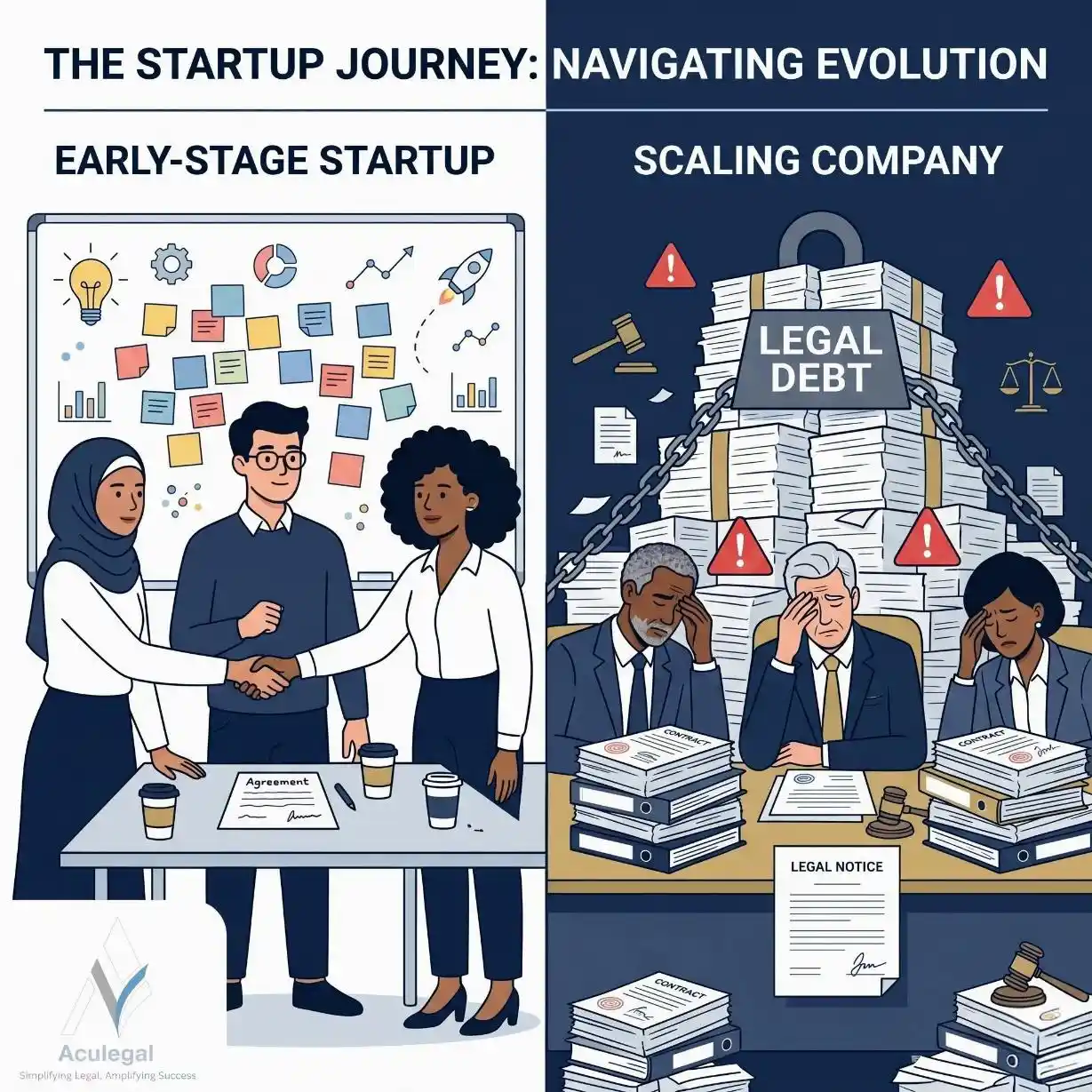
The Problem: The Accumulation of “Legal Debt”
Every founder understands the concept of technical debt, taking shortcuts in code to launch faster, knowing you will have to fix it later. Very few founders, however, recognize the equally dangerous accumulation of “legal debt.” When you rely on downloaded contract templates, ignore proper employment agreements, and skip trademark registrations, you are borrowing against your company’s future valuation. You are making a dangerous gamble that nothing will go wrong before you have the cash flow to fix it.
This legal debt compounds rapidly as you scale. What started as a minor oversight in an early vendor agreement can spiral into a catastrophic liability when that vendor scales alongside you. Furthermore, when it is time to raise venture capital or seek acquisition, this debt comes due in the most painful way possible. Investors are incredibly thorough, and they will penalize disorganized cap tables, ambiguous IP ownership, and non-compliant labor practices by slashing your valuation. In many cases, unresolved legal debt is one of the primary reasons startups fail during critical transition periods.
The breaking point usually happens right when the business is experiencing its most exciting momentum. The sales team lands a massive enterprise client, but the deal takes three months to close because you lack a standardized negotiation playbook. Your top engineer leaves for a competitor, and you realize their non-compete clause is entirely unenforceable. These are not just legal problems; they are severe operational crises that distract leadership and bleed revenue.
How Legal Process Outsourcing (LPO) Helps Businesses Scale Faster and Reduce Risk
The traditional solution to mounting legal debt has always been to hire a full-time, in-house General Counsel. However, for most startups and SMEs, absorbing a massive executive salary before reaching critical mass is simply not financially viable. The alternative, sending every minor query to a traditional law firm that bills by the hour, leads to unpredictable costs and hesitant decision-making. Founders simply stop asking vital questions because they are afraid to start the billing clock.
This is exactly where the modern legal paradigm shifts. By outsourcing specific, high-volume legal functions to specialized partners, companies can access top-tier legal infrastructure without the overhead of a full-time department. This strategy transforms legal expenses from an unpredictable, anxiety-inducing variable cost into a streamlined, predictable operational expense. It allows you to focus on scaling operations efficiently rather than drowning in paperwork.
When you plug into a structured outsourcing model, you are not just buying hours of legal advice; you are installing an entire legal operating system into your business. This proactive approach standardizes your contracts, secures your assets, and establishes compliance protocols that operate quietly in the background. It allows the core executive team to run fast and break things in the market, not in the courtroom.
Shifting from Reactive to Proactive with a VCLO
The most impactful way to implement this system is through fractional leadership. A Virtual Chief Legal Officer acts as a dedicated executive partner who understands your business model deeply. Unlike external counsel, who only respond to specific prompts, a VCLO sits at the strategic table with you. They look around corners to identify risks before they materialize and structure your operations for long-term viability.
This model provides startups with the exact amount of legal firepower they need, precisely when they need it. A VCLO can oversee funding rounds, structure complex joint ventures, and guide the board of directors through corporate governance matters. They provide the authoritative, business-focused counsel required to negotiate on equal footing with enterprise clients and institutional investors.
To learn how this fractional model can transform your leadership team and protect your bottom line, explore our Virtual Chief Legal Officer (VCLO) services. Having a strategic legal mind in your corner is the ultimate unfair advantage in a crowded market.
Taming the Paper Trail: Contract Lifecycle Management
Contracts are the lifeblood of any commercial enterprise. They dictate revenue recognition, define liability, and govern every relationship you have with employees, vendors, and clients. Yet, most growing businesses manage this critical asset through chaotic email threads, scattered hard drives, and disjointed verbal agreements. This friction slows down the entire business.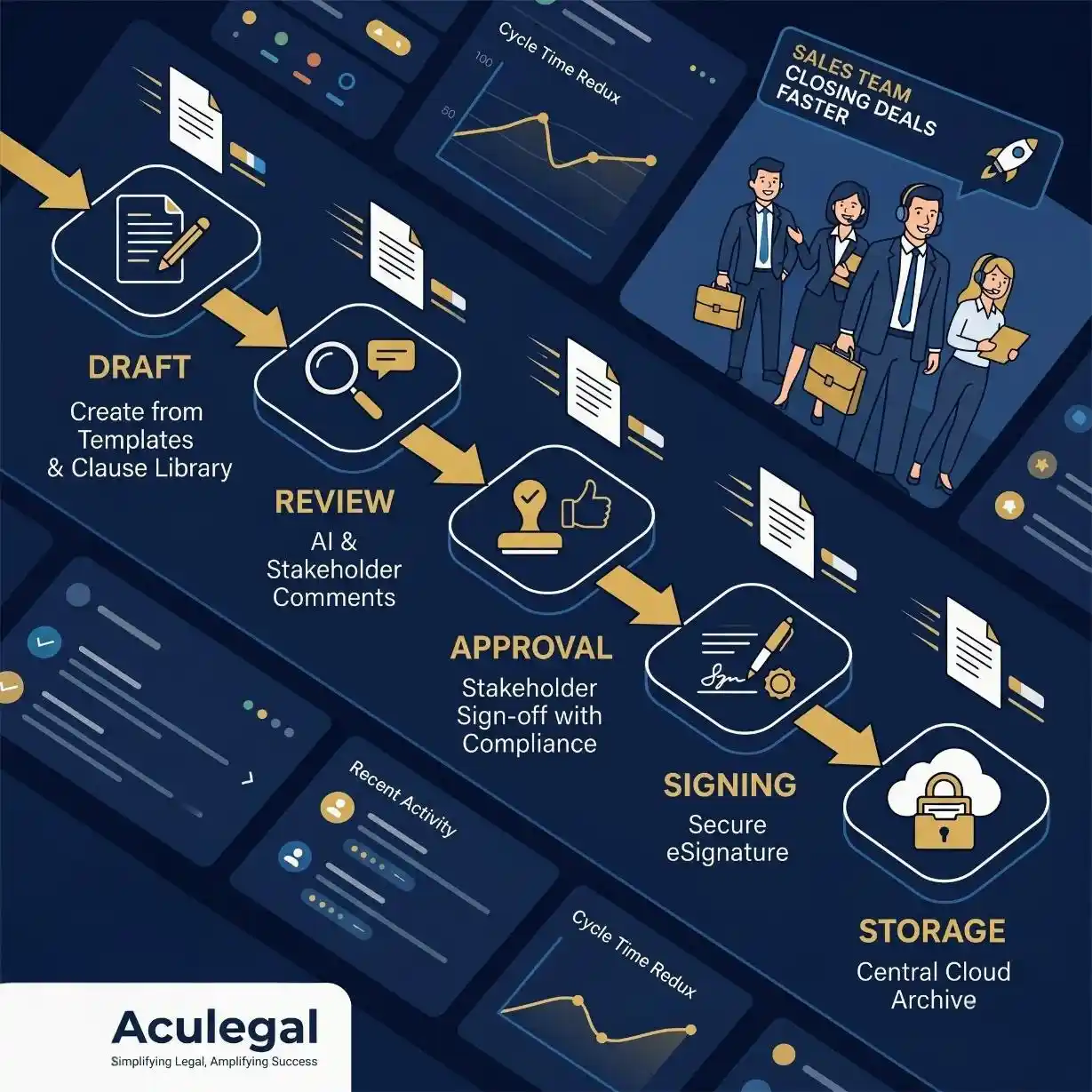
A robust Contract Lifecycle Management system acts as a central nervous system for your commercial agreements. It is not just about storing documents; it is about standardizing language, automating renewals, and accelerating the negotiation process. When your sales team has pre-approved legal templates and a clear escalation matrix, they can close deals in days instead of weeks.
-
Standardization: Eliminates rogue clauses and ensures brand protection across all agreements.
-
Velocity: Accelerates the sales cycle by providing clear guidelines on acceptable risk and negotiation limits.
-
Visibility: Ensures you never miss a renewal date or a compliance deadline hidden in page 40 of a vendor agreement.
-
Security: Centralizes all critical documents for immediate retrieval during audits or due diligence.
Stop letting administrative chaos choke your revenue engine. Discover how implementing professional Contract Lifecycle Management (CLM) systems can streamline your operations and empower your sales team.
Defending Your Competitive Edge: Strategic IP Protection
For modern startups and SMEs, your most valuable assets are rarely physical. They are your brand identity, your proprietary algorithms, your customer lists, and your unique methodologies. Unfortunately, many founders treat intellectual property protection as an afterthought, mistakenly believing that being “first to market” is enough of a defense. It is not.
Without formal, structured protection, your innovations are essentially up for grabs. Competitors can hijack your brand name, former employees can walk away with trade secrets, and patent trolls can halt your operations entirely. According to the World Intellectual Property Organization (WIPO), safeguarding these intangible assets is critical for maintaining market differentiation and securing premium valuations. Securing your IP is a proactive offensive strategy, not just a defensive one.
Investors look closely at IP ownership. If your foundational code was written by a contractor who never signed a formal IP assignment agreement, your company does not actually own its core product. We have seen multi-million dollar funding rounds collapse overnight due to this single oversight. Do not leave your greatest assets exposed to the open market. Secure your competitive advantage with comprehensive Intellectual Property Protection Services.
The Proof: Real-World ROI of Robust Legal Frameworks
The most common objection from founders is that building these legal systems takes time and money away from product development. But when we look at the data, the exact opposite is true. The return on investment for establishing structured legal operations early is staggering, primarily because it removes the hidden friction points that drag down scaling companies.
Consider the reality of a Series A funding round. The due diligence process is notoriously grueling. Institutional investors will scrutinize every contract, employment record, and compliance document your company has ever generated. Companies with fragmented, DIY legal histories spend months cleaning up their “legal debt,” incurring massive reactive legal fees, and risking investor fatigue. Conversely, companies with established legal systems breeze through due diligence, closing rounds faster and often at higher valuations because they present as mature, derisked investments.
Beyond fundraising, the ROI is measured in daily operational efficiency. When HR has a standardized, legally compliant onboarding process, employee disputes drop to zero. When sales teams operate within a tight CLM framework, the time-to-revenue metric shrinks significantly.
Compliance as a Competitive Differentiator
We have entered an era where compliance is no longer just a regulatory burden; it is a competitive differentiator. Enterprise clients will not sign software agreements with startups that cannot prove their data privacy compliance. Top-tier talent will not join companies with ambiguous equity structures. By prioritizing legal hygiene, you signal to the market that you are a serious, enterprise-ready organization.
-
Trust Generation: Enterprise clients require rigorous vendor screening. A tight legal framework proves you are a safe bet.
-
Talent Acquisition: Clear, legally sound stock option plans and employment contracts attract and retain elite performers.
-
Risk Mitigation: Proactive systems prevent the kind of minor regulatory infractions that can spiral into brand-destroying headlines.
-
M&A Readiness: If your ultimate goal is an exit, maintaining pristine legal records ensures you never leave money on the negotiation table.
Following strict due diligence checklists from day one ensures that when the big opportunity arrives, you are entirely prepared to seize it.
The Cost of Doing Nothing vs. Strategic Investment
Founders must shift their mindset regarding legal expenditures. Paying a premium to untangle a messy lawsuit or fix a broken cap table is a sunk cost that yields zero forward momentum. However, investing in a VCLO, a robust CLM platform, and solid IP protection is a capital investment in the structural integrity of your business.
The businesses that scale from $1M to $10M and beyond share a common trait: they do not rely on luck to avoid legal pitfalls. They build systems. They recognize that a legally sound business is an agile business, capable of pivoting quickly without tripping over poorly drafted legacy contracts.
Do not wait until a crisis forces your hand. The cost of doing nothing always eclipses the cost of strategic preparation. Start treating your legal framework with the same level of obsession you apply to your product roadmap and your sales funnel.
Conclusion
Scaling a business successfully is about moving fast without breaking the things that actually matter. While hustle and innovation are the engines of your growth, a structured, proactive legal framework is the steering wheel that keeps you from driving off a cliff. From taming contract chaos to securing your most valuable intellectual property, integrating high-level legal strategy into your daily operations is non-negotiable for modern startups and SMEs.
By adopting strategic legal models, like fractional executive leadership and automated lifecycle management, you transform legal from a frustrating roadblock into a powerful business accelerator. You eliminate the legal debt that torpedoes funding rounds and empower your team to close deals with absolute confidence.
At Aculegal, we are committed to one clear mission: Simplifying Legal. Amplifying Success. We partner with visionary founders to build the resilient legal infrastructures necessary for exponential growth. If you are ready to stop reacting to legal problems and start leveraging legal strategy to scale, it is time to have a conversation. Reach out today to Contact Aculegal and book your free consultation to discover how we can fortify your business for the future.