

An in-house legal team for startups sounds like a luxury reserved for Series B companies with deep pockets. It isn’t. It’s the single most underrated lever for protecting revenue, closing deals faster, and surviving due diligence. Most founders only discover this after a contract dispute, a compliance notice, or a funding round nearly falls apart over legal gaps that no one was watching.
You don’t need a corner-office General Counsel on a ₹30 lakh salary to get this protection. You need the function, not necessarily the headcount. And that distinction is exactly where smart founders are now winning.
The Hook: Your Business Has Outgrown “We’ll Handle Legal Later”
Every founder starts the same way, a friend who’s a lawyer reviews contracts on the side, templates get pulled off Google, and legal becomes a once-a-quarter fire drill. It works fine when you’re three people in a co-working space.
It stops working the moment you:
- Sign your first enterprise client with a 40-page MSA
- Bring on a co-founder or raise outside capital
- Hire your fifth employee
- Cross a state or international border with your product
At that point, “we’ll handle legal later” isn’t a strategy. It’s a liability sitting quietly on your balance sheet, waiting to surface at the worst possible time, usually during due diligence, a dispute, or a regulator’s notice.
The Problem: Legal Risk Scales Faster Than Most Founders Realize
Compliance Failures Are More Common Than Funding Failures
Founders obsess over product-market fit and burn rate. Few obsess over whether their last board resolution was filed on time. That’s a mistake; a significant share of startups that shut down in India do so not because the business failed, but because legal and compliance mistakes were left unmanaged until they became existential, according to Registration Mart’s analysis of startup failures. These issues are often ignored early simply because they don’t show immediate impact, until they quietly compound into something that does.
This isn’t abstract. India’s regulatory environment has become stricter, not simpler. As Legal Service India notes, automation across MCA and GST filings now imposes strict liability with minimal human-level discretion for technical or minor errors — meaning a missed filing date is no longer a “we’ll fix it next quarter” problem. It’s a penalty, automatically triggered.
The Paper Trail Investors Actually Check
If you’ve raised or plan to raise institutional capital, your legal hygiene gets audited line by line. As Corrida Legal explains, when you raise your first institutional round, investor counsel will request board resolutions and statutory filings, and any mismatch with MCA records creates legal gaps that are expensive to fix at that stage. By the time a term sheet is on the table, it’s too late to start organizing three years of missing paperwork.
The Real Cost of “Going It Alone”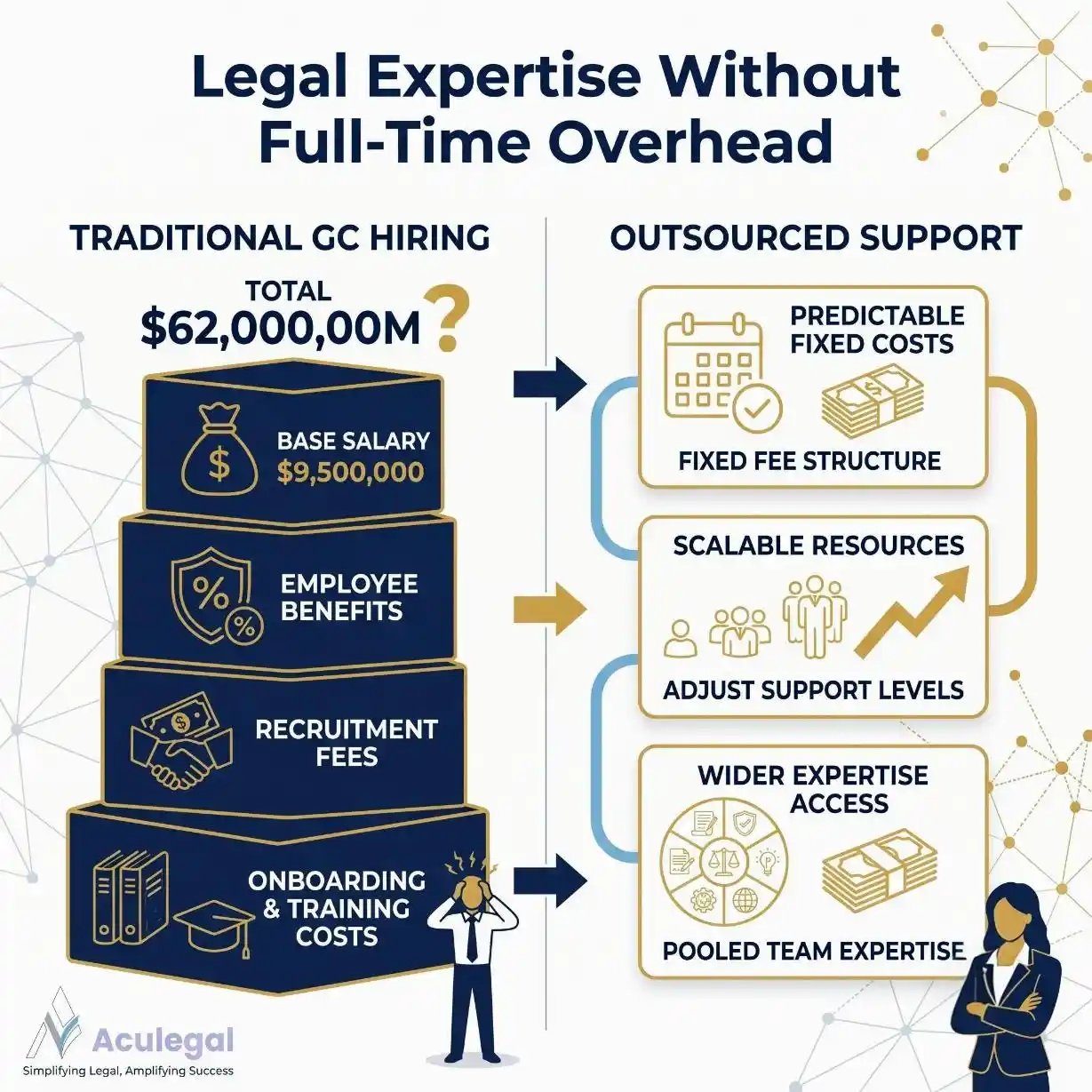
Founders often believe hiring legal help means hiring a full-time General Counsel. Here’s the reality of what that actually costs in India, based on 2026 salary benchmarking data:
| Role | Average Annual Cost (India, 2026)
|
|---|---|
| Entry-level In-House Counsel | ₹18,43,753
|
| Mid-level In-House Counsel (average) | ₹26,32,488 + ₹1,73,744 average bonus
|
| General Counsel | ₹32,01,601 + ₹2,11,306 average bonus
|
| Senior General Counsel | ₹37,45,995
|
That’s before recruitment fees, benefits, software, paralegal support, or the six-month gap while you search for the right hire. For a startup or SME watching every rupee of runway, that’s not a legal budget; that’s a Series A-sized commitment for a single hire.
The Solution: You Don’t Need a Department. You Need a System.
This is the shift smart founders have made globally, and it’s accelerating fast in India too. Instead of hiring legal in-house, they’re plugging into outsourced legal models that deliver the same coverage, contract review, compliance monitoring, litigation support, regulatory filings, without the fixed-cost burden of a full department.
The numbers back this up. India’s legal process outsourcing market is projected to reach US$49,136.7 million by 2030, growing at a compound annual growth rate of 33.6% from 2024 to 2030. Businesses aren’t outsourcing legal because it’s cheaper alone; they’re doing it because specialized external teams now move faster and catch more than a single generalist hire ever could.
 How Aculegal Delivers In-House Legal Support Without the Traditional Overhead
Aculegal was built specifically for this gap, for founders and SMEs who need genuine legal depth, not a single overworked hire or a law firm billing by the hour for every email. Here’s how that plays out in practice:
1. A Dedicated Legal Point of Contact, Not a Ticketing Queue You get consistent access to professionals who understand your business context, your contracts, your risk profile, your industry, instead of re-explaining your company to a new associate every time.
2. Predictable, Transparent Pricing No hourly billing shocks. No surprise invoices after a “quick call.” You know your legal spend before the month starts, which makes it a line item you can actually plan around, not a risk you’re hoping doesn’t materialize.
3. Full-Spectrum Coverage, On Demand. From contract drafting and review, to compliance calendars, to litigation support when disputes do arise, you get the breadth of an in-house department’s coverage, scaled to what your business actually needs this quarter.
4. Built-In Scalability As you grow from 10 employees to 100, from one state to five, your legal support scales with you, without the lag time, recruitment cost, or risk of a single point of failure that comes with one in-house hire.
5. Technology-Enabled, Not Technology-Replaced Modern legal outsourcing increasingly uses AI-assisted tools for faster contract review and compliance tracking, but the judgment, negotiation, and accountability stay human. That combination is exactly what scaling businesses need: speed without losing oversight.
The Proof: This Isn’t a Trend. It’s Where the Market Is Already Headed
Skeptical founders should look at where the broader market, not just isolated case studies, is moving.
- The global Legal Process Outsourcing market is forecast to grow from $23.6 billion in 2025 to $29.2 billion in 2026, with continued acceleration through the decade.
- AI-enabled legal outsourcing specifically is growing even faster, Mordor Intelligence data shows AI-enabled LPO services expanding at a CAGR of 33.1%, reflecting how quickly technology is making outsourced legal support faster and more precise.
- Closer to home, Indian legal service providers are positioned to capture significant growth by leveraging cost advantages and English-language proficiency, particularly in fintech, compliance, and emerging regulatory areas — exactly the terrain startups and SMEs operate in daily.
This is a structural shift in how growing businesses access legal expertise, not a stopgap for companies that can’t afford a “real” legal team. The data suggests the opposite: well-run companies are choosing this model deliberately, because it outperforms the traditional one on speed, cost, and flexibility.
What This Looks Like for Your Business
Picture the difference across a single quarter:
Without structured legal support:
- Contracts get signed with unreviewed liability clauses
- A compliance deadline gets missed because no one owned the calendar
- A dispute escalates because there was no documented Show Cause or response strategy in place
- Your next fundraise stalls in due diligence over avoidable gaps
With Aculegal’s model:
- Every contract gets reviewed before signature, with risk flagged in plain language
- Your compliance calendar is monitored proactively, not reactively
- Disputes are met with prepared documentation and a clear strategy from day one
- Due diligence becomes a formality, not a fire drill
The difference isn’t legal philosophy. It’s operational discipline, applied consistently, by people whose job is exactly this.
Frequently Asked Questions
Is outsourced legal support as reliable as an in-house hire?
Yes, often more so. A single in-house hire is one person covering contracts, compliance, litigation, and HR-related legal issues alone. An outsourced model gives you a team with specialized expertise across each of those areas, which means fewer blind spots, not more.
What’s the difference between hiring a law firm and a Virtual Chief Legal Officer (VCLO) model?
A traditional law firm typically bills per matter or per hour, with no ongoing ownership of your overall legal posture. A VCLO model gives you continuous oversight, someone tracking your compliance calendar, contract pipeline, and legal risk proactively, the way an in-house General Counsel would, but at retainer-based, predictable pricing.
At what stage should a startup get structured legal support?
Earlier than most founders think. The right time isn’t after your first dispute or your first funding round — it’s once you have your first paying enterprise customer, your first employee, or your first external contract on the table. Waiting until a problem surfaces is almost always more expensive than preventing it.
Can this model handle litigation, not just contracts and compliance?
Yes. A properly structured legal partner should be able to support you across the full spectrum, from day-to-day contract review and compliance filings to representation and documentation if a dispute ends up before a court or tribunal.
Where to Start
You don’t need to overhaul your entire legal function overnight. Most founders start with one of three entry points:
- Contract Review & Drafting – Get every MSA, vendor agreement, and employment contract checked before it becomes a liability.
- Compliance Management – Put a system in place so MCA filings, board resolutions, and statutory deadlines never slip again.
- Virtual Chief Legal Officer (VCLO) Services – For businesses ready to formalize this into an ongoing relationship, a structured retainer gives you continuous legal oversight at a fraction of a full-time GC’s cost.
Conclusion: Simplifying Legal. Amplifying Success.
The businesses that scale cleanly aren’t the ones that hired the most expensive General Counsel. They’re the ones that built a reliable legal system early, one that catches problems before they become headlines, deal-breakers, or shutdown notices.
An in-house legal team for startups doesn’t have to mean a six-figure hire and a six-month search. It can mean a partner who already has the playbook, the people, and the pricing model built for exactly where your business is today.
That’s the gap Aculegal exists to close. Simplifying Legal. Amplifying Success.
Ready to stop treating legal as an afterthought? Book a free consultation with Aculegal and find out what a properly structured legal function actually costs, and what it saves you.
Artical sources:
- Registration Mart — Why 90% Startups Fail Legally in India
- Legal Service India — Navigating Startup Law in India
- Corrida Legal — Legal Compliances for Startups in India
- ERI SalaryExpert — General Counsel Salary in India (2026)
- Grand View Research — India Legal Process Outsourcing Market Outlook 2030