
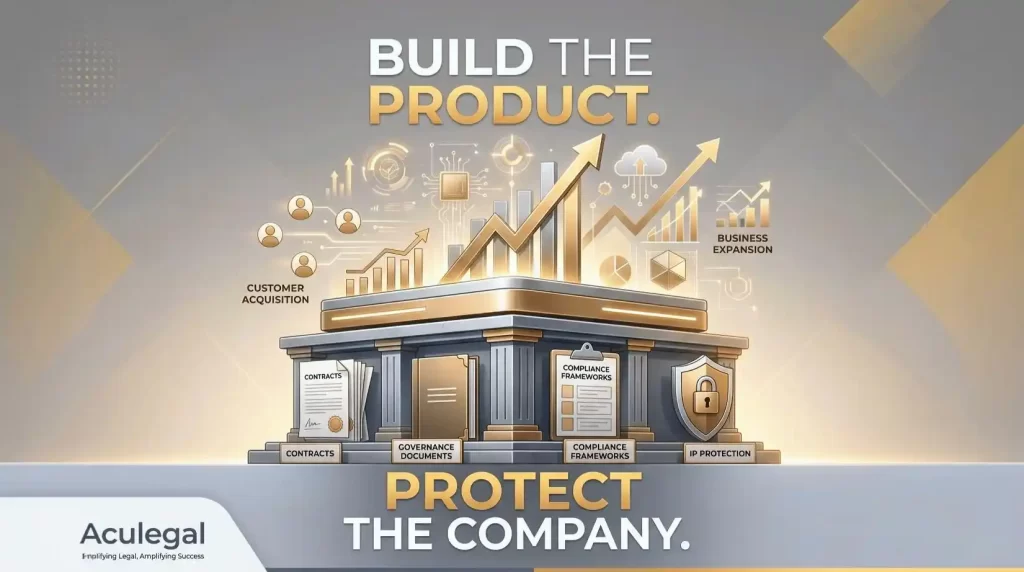
Legal infrastructure for startups is not a cost centre. It is your competitive moat, and most founders don’t realise that until it’s already too late.
You’ve built the product. You’ve closed the first customers. The pitch deck is polished, and the runway looks manageable. But there’s a question every investor will ask in the next due diligence call that no amount of traction can answer for you: Is this company legally clean?
That question exposes a gap most founders quietly carry, the gap between building a product and building a company. One runs on code and customers. The other runs on legal infrastructure.
 Why Legal Infrastructure Matters for Startup Growth
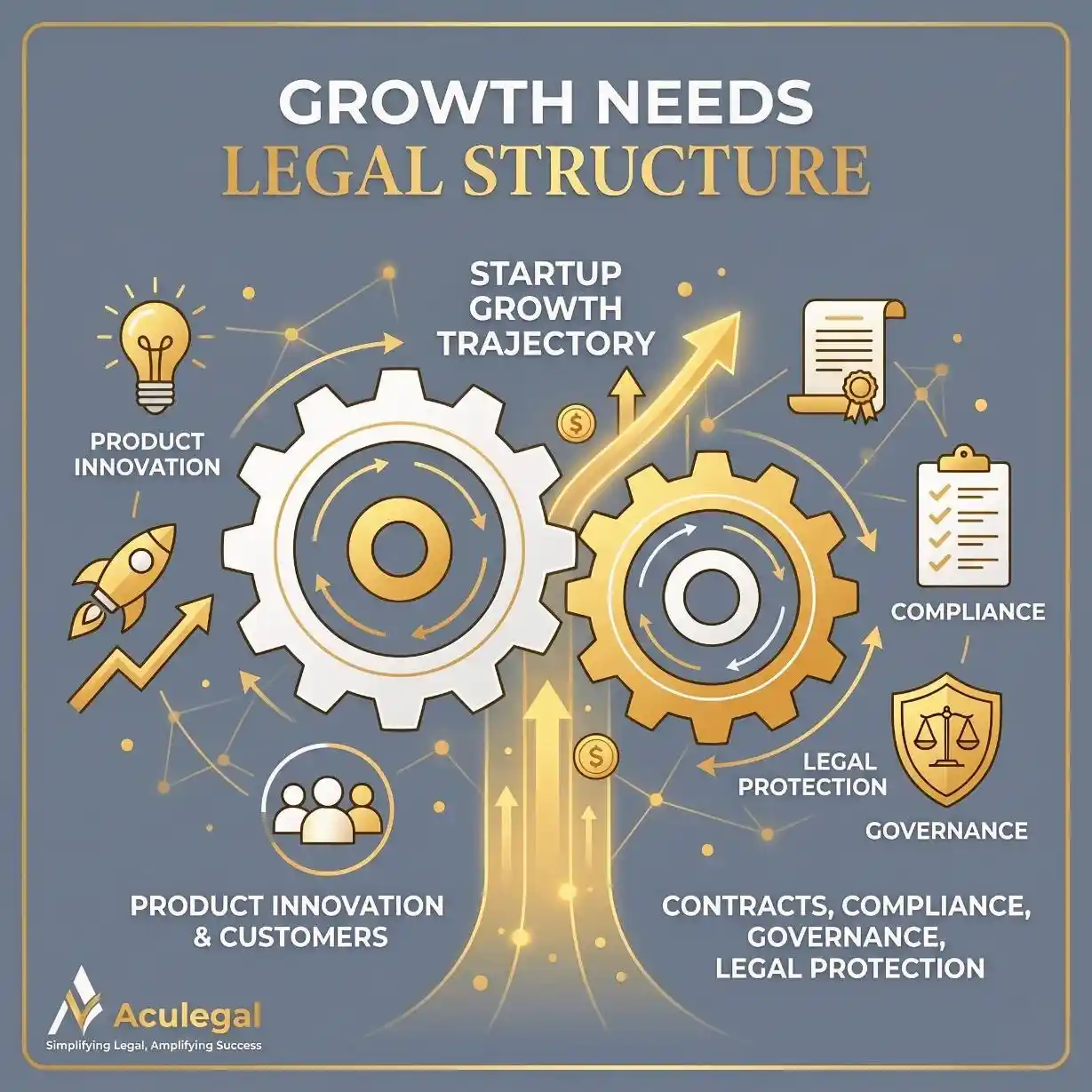
Every high-growth company has two engines running in parallel. The first is the product engine, the team, the roadmap, and the GTM motion. The second is the legal engine, the structures, agreements, and protections that make the first engine scalable, fundable, and defensible.
Most founders obsess over the product engine. The legal engine gets treated like a formality, something to sort out when there’s time, budget, or a problem to fix. That’s the trap.
TechCrunch’s analysis of common founder legal mistakes points out that “fixing these problems dwarfs the cost of avoiding them.” The founders who scale without blow-ups are the ones who treat legal structure as foundational infrastructure, not post-traction housekeeping.
The 5 Pillars of Legal Infrastructure Every Startup Needs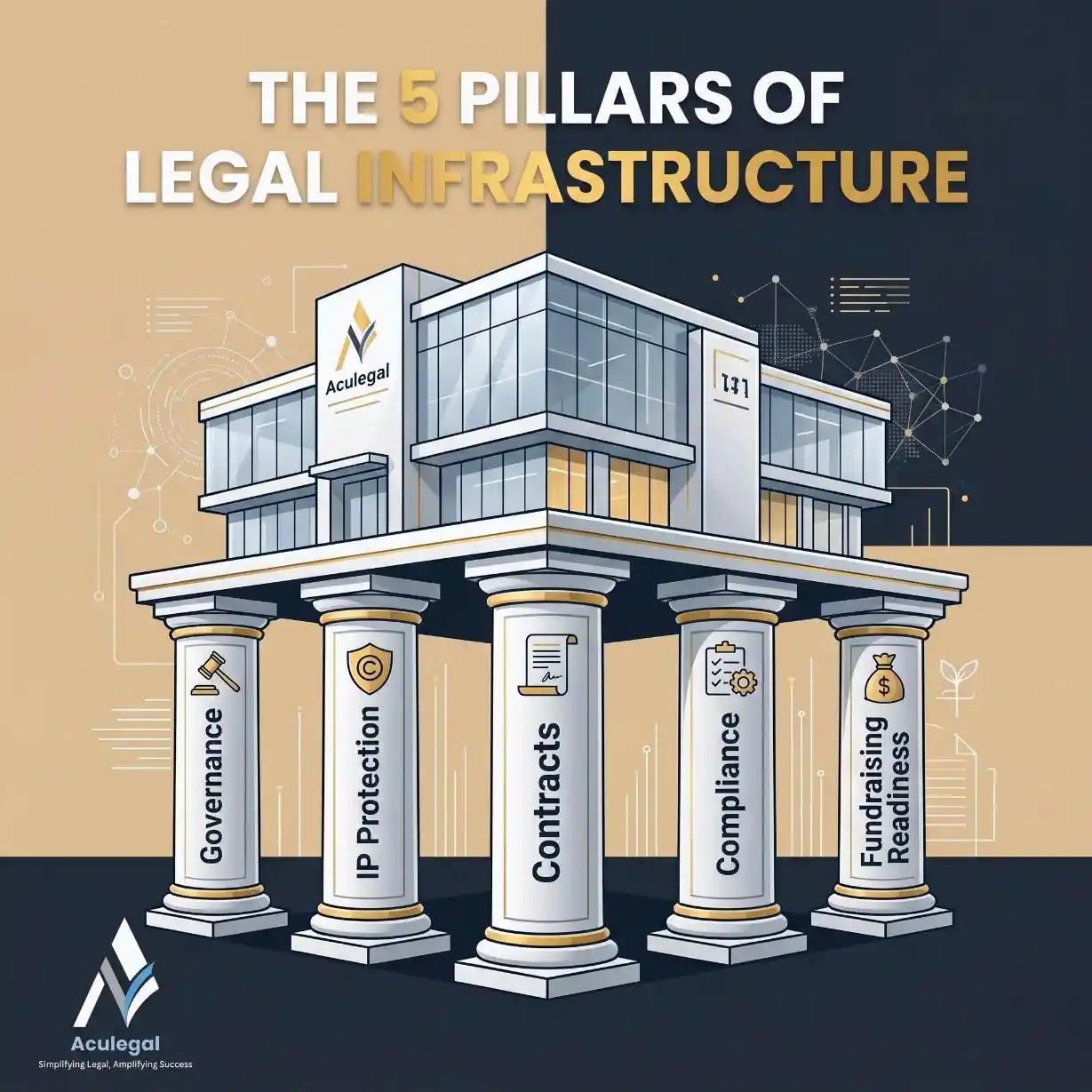
1. Company Formation and Governance
Your corporate structure is the foundation everything else rests on. Getting it wrong at formation creates compounding problems, in fundraising, in co-founder disputes, in cap table management, and in eventual exits.
What this includes:
- Choosing the right entity type (Private Limited, LLP, OPC) aligned with your funding strategy
- Drafting a shareholders’ agreement that defines equity splits, vesting schedules, and exit scenarios
- Establishing a board structure that protects founder interests while remaining investor-ready
According to LegalNodes’ investor due diligence research, around 65% of startups fail due to co-founder conflicts, most of which could have been prevented or managed with a proper founders’ agreement in place from day one.
2. Intellectual Property Assignment and Protection
Your IP is your most valuable asset. But if it isn’t formally assigned to the company, you don’t fully own it, even if you built it.
Faison Law Group’s breakdown of startup fundraising legal errors identifies unclear IP ownership as one of the most dangerous and commonly overlooked issues at the early stage. When developers, co-founders, or contractors contribute to a product without IP assignment agreements, those individuals may retain legal ownership of the code, branding, or design they created.
What needs to be in place:
- IP assignment agreements for all founders at incorporation
- Contractor and employee agreements with clear work-for-hire and IP transfer clauses
- Trademark registration for your brand name, logo, and key product identifiers
- Patent strategy assessment for proprietary technology
The moment an investor begins due diligence, or a co-founder exits, unresolved IP becomes a liability, not an asset.
3. Contracts That Actually Protect You
Founders move fast on relationships. Contracts follow slowly, or not at all. This is one of the most expensive habits an early-stage company can develop.
StartupNation’s roundup of founder legal errors includes a recurring pattern: founders who prioritised trust over documentation found themselves in disputes that stalled operations, damaged relationships, and cost far more to resolve than a well-drafted contract would have cost upfront.
Every startup needs solid contracts for:
- Customer agreements – SaaS terms, service agreements, MSAs, and SLAs
- Vendor and supplier contracts – with clear deliverables, payment terms, and IP clauses
- Employment agreements – including non-disclosure, non-solicitation, and IP assignment
- Co-founder agreements – equity vesting, roles, decision-making authority, and exit provisions
A contract isn’t just a legal document. It’s a business instrument that defines what success looks like for both parties, and what happens when it doesn’t.
 4. Regulatory Compliance and Licensing
Regulatory exposure is the risk most founders don’t see coming, until they’re in the middle of it. Whether you’re handling customer data, operating in a regulated sector, or scaling across state or national borders, compliance isn’t optional.
Crunchbase’s analysis of regulation as a startup advantage makes a powerful point: regulation-ready startups attract smarter capital. Venture funds now assess regulatory maturity and governance readiness early in the investment process. A startup that has designed compliance into its operations has a demonstrable valuation edge over one that hasn’t.
Key compliance areas for Indian startups and SMEs:
- Data protection and privacy obligations (DPDP Act, 2023)
- GST compliance and financial record-keeping
- FEMA compliance for foreign investment and cross-border transactions
- Sector-specific licensing (fintech, edtech, healthtech, and others)
- Employment law and labour code compliance
Compliance is not a one-time event. It’s an ongoing operational function, and the earlier you build it in, the cheaper it is to maintain.
5. Fundraising Readiness: Your Legal Due Diligence Checklist
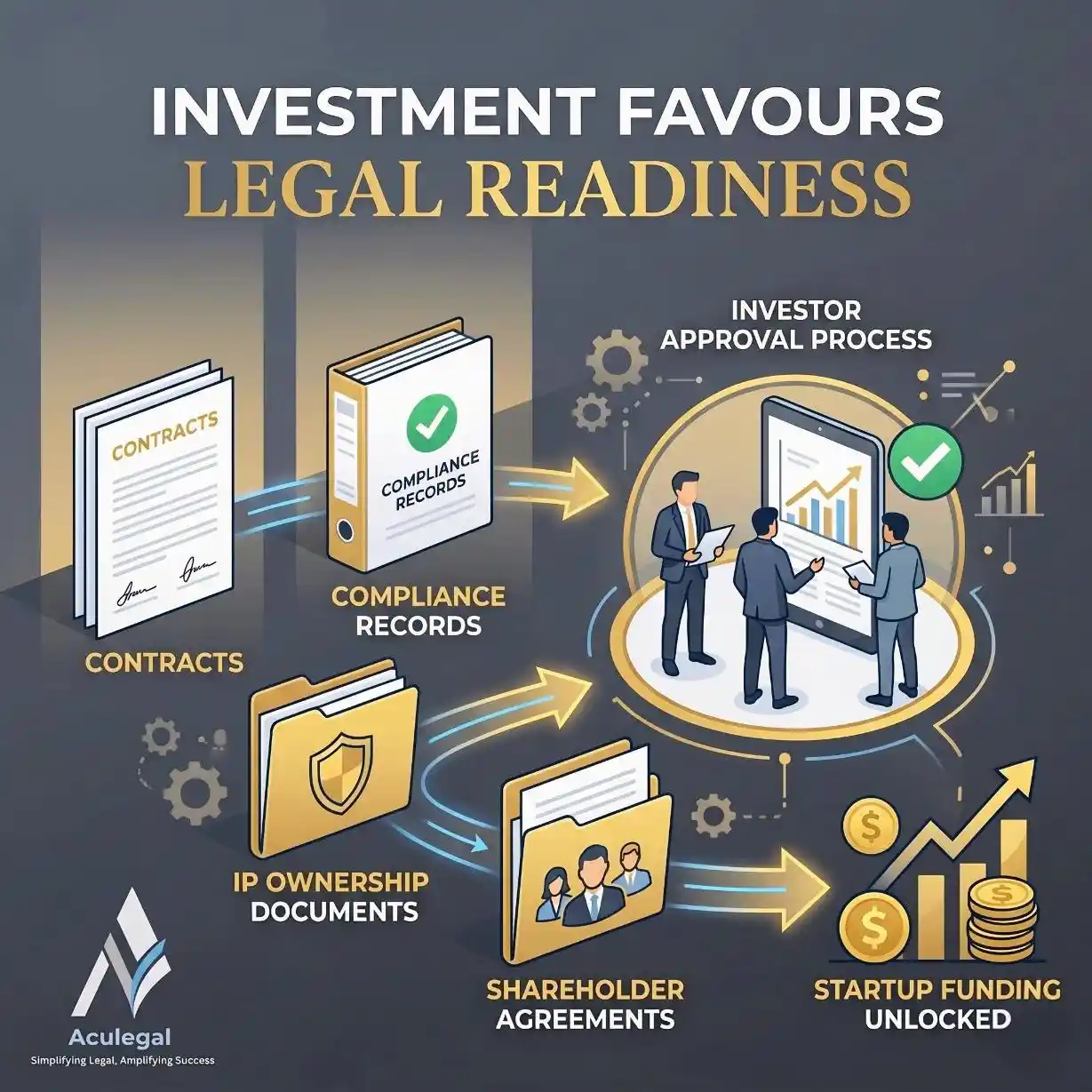
The moment you enter a fundraising conversation, you are also entering a legal audit. Investors and their counsel will examine your corporate documents, cap table, IP ownership, contracts, employment agreements, and compliance status before a single rupee is wired.
What investors expect to find:
- Clean, properly documented equity structure with vesting schedules
- All IP formally assigned to the company
- No unresolved founder or employee equity disputes
- Proper regulatory filings and statutory compliance
- Signed NDAs and confidentiality agreements with relevant parties
Founders who delay building this legal foundation often find themselves scrambling to fix three to four years of gaps in the four weeks before a funding close, a process that’s stressful, expensive, and sometimes fatal to the deal.
The Hidden Cost of Skipping Legal Infrastructure
Here’s a number worth keeping in mind: Arnold LaRochelle law firm’s research on first-year startup legal mistakes consistently shows that legal problems identified at the point of crisis cost five to ten times more to resolve than they would have to prevent, in legal fees, in equity given up to settle disputes, in time lost from building.
The startups that scale without catastrophic legal interruptions are not the ones that got lucky. They’re the ones that treated legal infrastructure as a priority from day one.
Legal neglect compounds in three specific ways:
- Operational paralysis – Disputes over equity, IP, or contracts can halt decision-making at exactly the moment speed matters most.
- Investor deal failure – Due diligence findings that surface late in a fundraising process frequently kill deals that took months to build.
- Founder dilution and liability – Poorly structured agreements mean founders absorb risk that should have been managed at the company level.
What “Legal Infrastructure” Actually Looks Like in Practice
For a founder in the early stages of building, legal infrastructure for startups doesn’t need to be a 200-page document or a year-long engagement. It looks like a focused, structured effort across six to twelve months to get the right things in place, and a reliable legal partner who understands your stage and your sector.
At pre-seed / early stage:
- Company formation with the correct entity type
- Co-founder agreement with vesting provisions
- IP assignment for all contributors
- Basic NDA and contractor template agreements
At seed stage / first hires:
- Employment agreements with IP and non-compete clauses
- Customer contracts and standard terms
- Data protection policy and compliance framework
- Cap table documentation and shareholder register
At Series A/growth stage:
- Full governance documentation
- Investor rights agreement and shareholder protections
- Regulatory compliance audit
- Legal health check ahead of fundraising
Each stage builds on the last. The founders who move into a funding conversation with clean legal infrastructure consistently reach a close faster, negotiate from strength, and retain more equity.
Simplifying Legal. Amplifying Success.
At Aculegal, we work with founders, startups, and SMEs who are serious about building companies, not just products. Our approach is built around one principle: legal infrastructure for startups should be a growth enabler, not a growth blocker.
We combine deep startup law expertise with a practical, business-first mindset. We speak your language, work at your pace, and structure legal solutions around where you’re going, not just where you are.
Whether you’re incorporating a new venture, preparing for your first fundraise, or cleaning up legal gaps before a growth phase, Aculegal is the legal partner built for founders who move fast and think long-term.
Conclusion: Build the Product. Protect the Company.
Every great startup story starts with a product. But the ones that make it, that raise funding, retain talent, defend their IP, and build lasting value, are the ones that built legal infrastructure alongside the product, not after it.
The five pillars are clear: company formation, IP protection, contracts, compliance, and fundraising readiness. Each one is preventable before it becomes a problem. Each one is expensive after it does.
Legal infrastructure for startups is not a luxury for later. It’s a decision you make now, and a decision that compounds in your favour every year you get it right.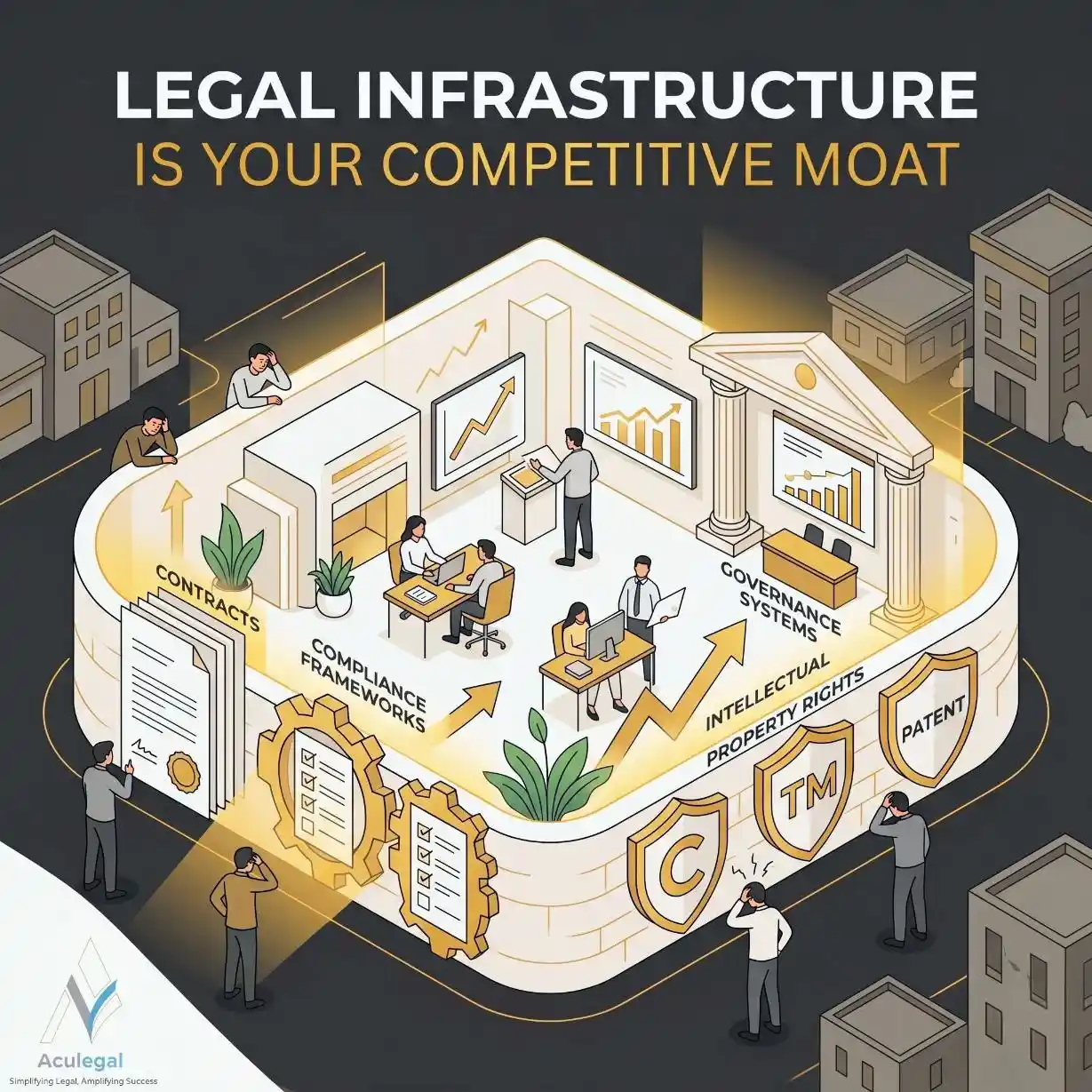
📞 Ready to Build Your Legal Foundation?
Book a free consultation with Aculegal today. Our startup-focused legal team will assess your current position, identify the gaps, and give you a clear roadmap, in plain language, without the jargon.
👉 Book Your Free Consultation →
Aculegal
Simplifying Legal. Amplifying Success.
Web Sources Referenced:
- TechCrunch — Startup founders often make these legal mistakes: https://techcrunch.com/2024/01/09/startup-founders-often-make-these-legal-mistakes/
- LegalNodes — 7 Most Common Legal Mistakes During Investor Due Diligence: https://www.legalnodes.com/article/startup-investor-due-diligence
- Faison Law Group — 10 Legal Mistakes Startups Make When Raising Seed or Series A: https://faisonlawgroup.com/blog/10-legal-mistakes-startups-make-when-raising-seed-or-series-a-funding/
- StartupNation — 15 Legal Mistakes First-Time Founders Should Avoid: https://startupnation.com/manage-your-business/legal-insurance-compliance/15-legal-mistakes-first-time-founders-should-avoid/
- Crunchbase — Regulation as Alpha: Why Startups Build Legal Strategy Into Their DNA: https://news.crunchbase.com/startups/legal-strategy-federal-regulation-solomon-amplify/