
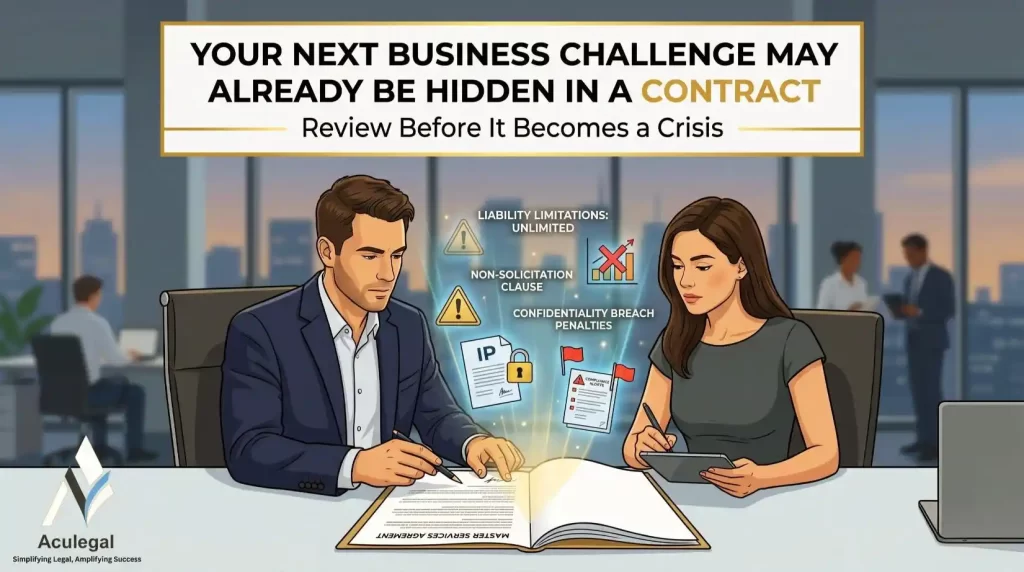
Contract review for startups is not a box you tick at the end of a deal. It’s a strategic weapon, or when neglected, a slow-burning liability. The contract you rushed through six months ago may be quietly limiting your equity, exposing your IP, or locking you into terms you never intended to honor.
Most founders don’t lose their businesses in a courtroom. They lose them in a PDF. A single poorly drafted clause in a vendor agreement, a vague termination provision in a co-founder contract, or an undefined IP assignment in a freelancer agreement can unravel years of work in a matter of months.
If you’re a startup founder, SME owner, or early-stage business leader, this is the legal conversation no one’s having with you, until it’s too late. At Aculegal, we’ve seen it firsthand. And we’re here to change that.
How Poor Contract Review Increases Legal and Financial Exposure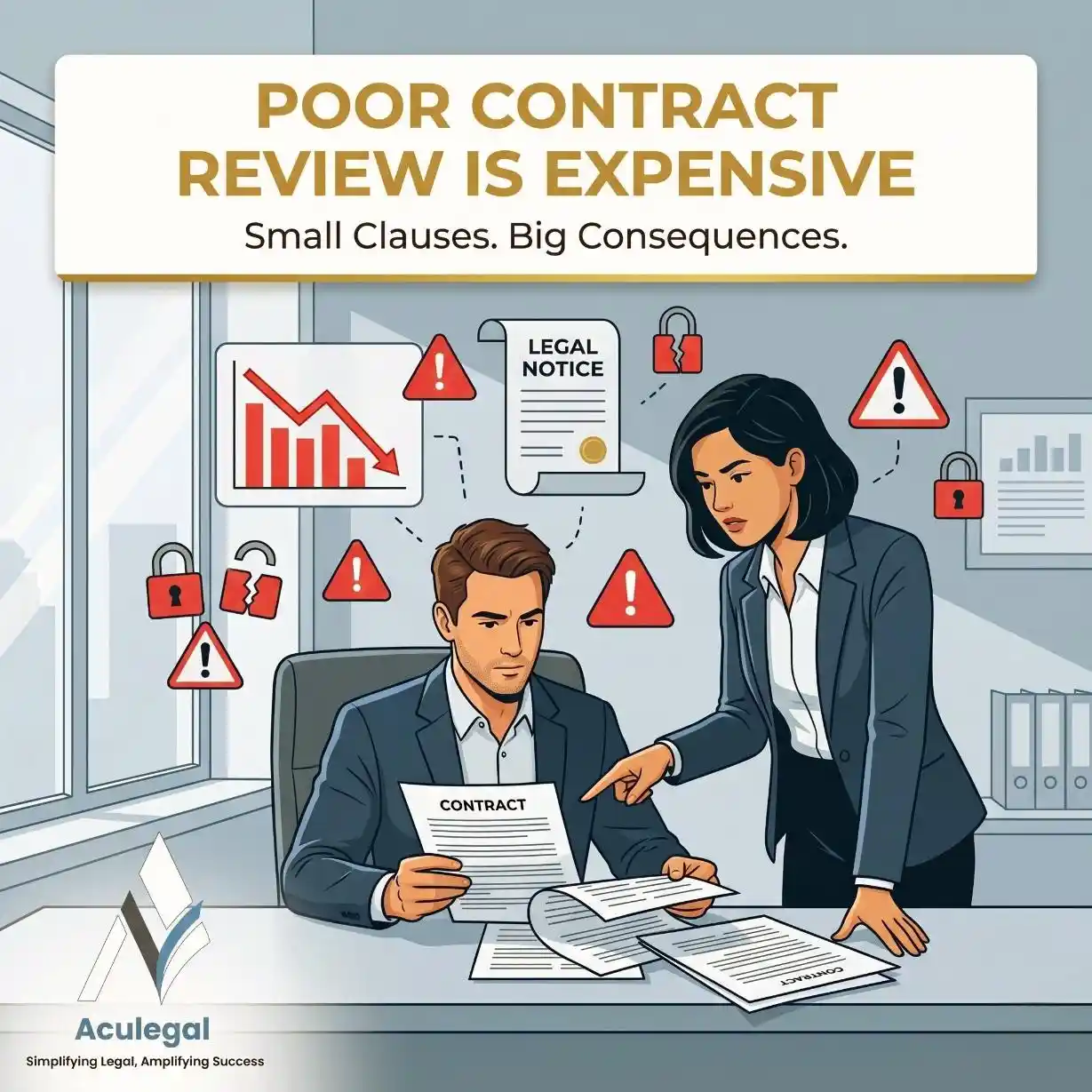
Let’s be direct: most early-stage businesses treat contracts as formalities. You get a template, make minimal edits, both parties sign, and move on. That approach works until it doesn’t.
The problem isn’t just what a contract says. It’s what it doesn’t say. Ambiguous language doesn’t sit neutrally; it becomes ammunition for the side with more resources, better legal counsel, or less to lose.
♦ 57%of SMEs have experienced a contract dispute that cost them money or time
♦ 3–5×the cost to litigate a contract vs. reviewing it upfront
♦ 1 in 3startup failures involve a contractual or legal dispute at some stage
The Clauses That Are Quietly Costing You
Here are the most common contract vulnerabilities we see in early-stage businesses:
- Undefined IP ownership clauses: When your developer, designer, or contractor builds something for you, who owns the final product? If the contract doesn’t specify, you may not.
- Auto-renewing vendor agreements: You assumed you could cancel after 12 months. The agreement says 90 days’ notice, minimum 24 months, and you missed the window.
- Vague non-compete or exclusivity provisions: Broad exclusivity can block you from pivoting, partnering with new clients, or entering adjacent markets.
- No limitation of liability cap: One data breach, one missed delivery, and you’re exposed to damages that could exceed the total value of the contract.
- Jurisdiction misalignment: Your contract says all disputes go to courts in a different state or country. Your ability to defend yourself just became exponentially more expensive.
The honest truth: These aren’t edge cases. They’re patterns Aculegal’s legal team encounters regularly in contracts submitted by founders who thought they’d covered their bases.
Why Founders and SMEs Avoid Proper Contract Review, And Why That Logic Is Broken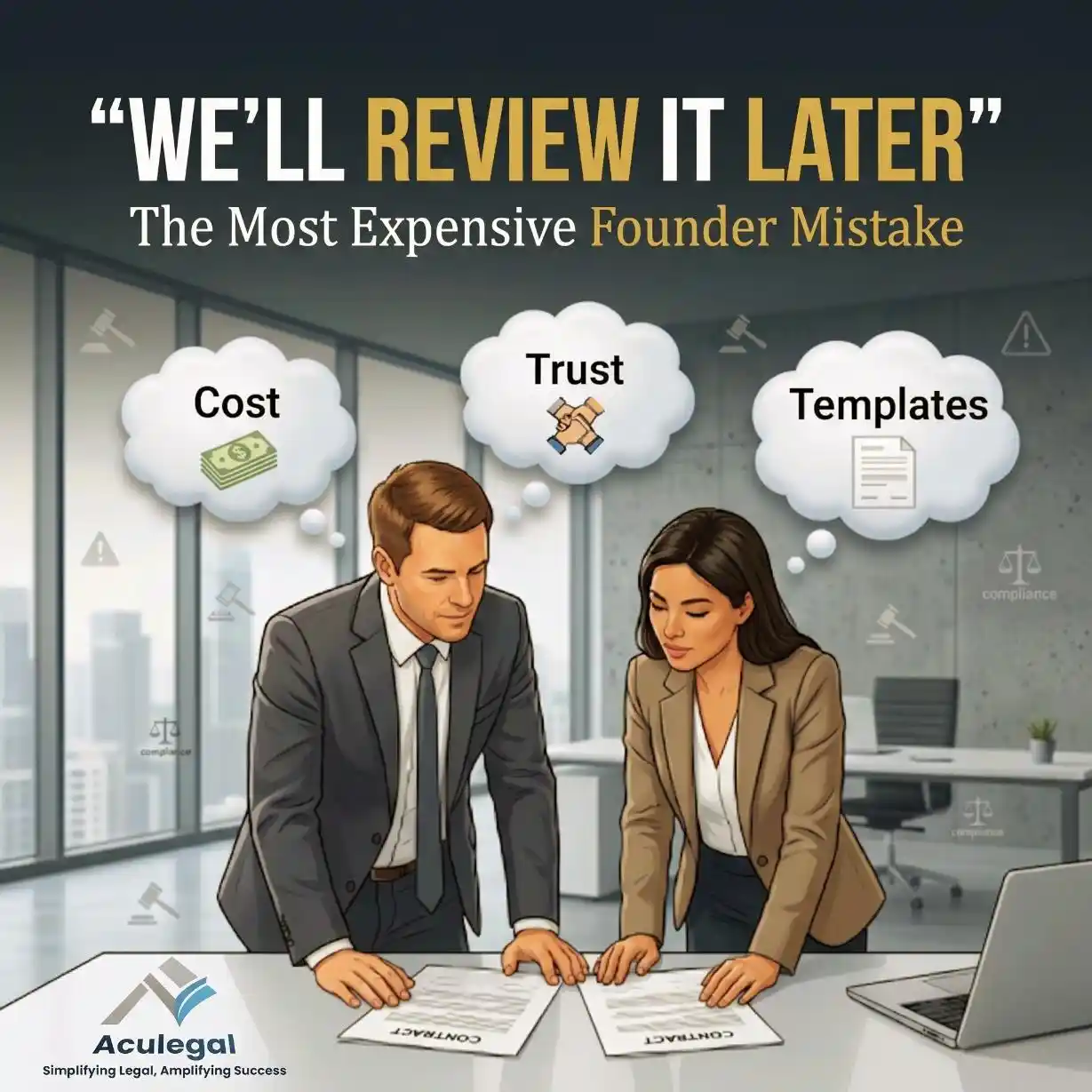
There are three reasons startups skip thorough contract review. Let’s address all three, and dismantle them.
1. “We Can’t Afford a Lawyer Right Now”
This is the most common objection, and the most costly assumption. The question isn’t whether you can afford legal review upfront. It’s whether you can afford a dispute, broken partnership, or legal claim later.
According to McKinsey’s Risk & Resilience research, the cost of resolving a commercial dispute after it escalates is typically 3–5x higher than prevention. Preventive legal review is ROI-positive, full stop.
2. “We Trust the Other Party”
Trust is critical in business. But trust doesn’t survive a change in ownership, a cash crunch, or a disagreement over deliverables. Contracts aren’t written for good days, they’re written for the bad ones.
The International Chamber of Commerce reports that the majority of commercial arbitration cases involve parties who had long-standing business relationships. Trust is not a substitute for clarity.
3. “Templates Are Good Enough”
Templates are starting points. They’re built for generic use cases, not your industry, your jurisdiction, your deal structure, or your risk profile. A template SaaS agreement is not a substitute for a properly reviewed software services contract that reflects your actual obligations and protections.
Need a contract reviewed before you sign? Explore Aculegal’s Contract Review Services, which cover NDAs, founder agreements, vendor contracts, and commercial deals with fast turnaround and business-first advice.
The Strategic Framework: What Proper Contract Review Actually Covers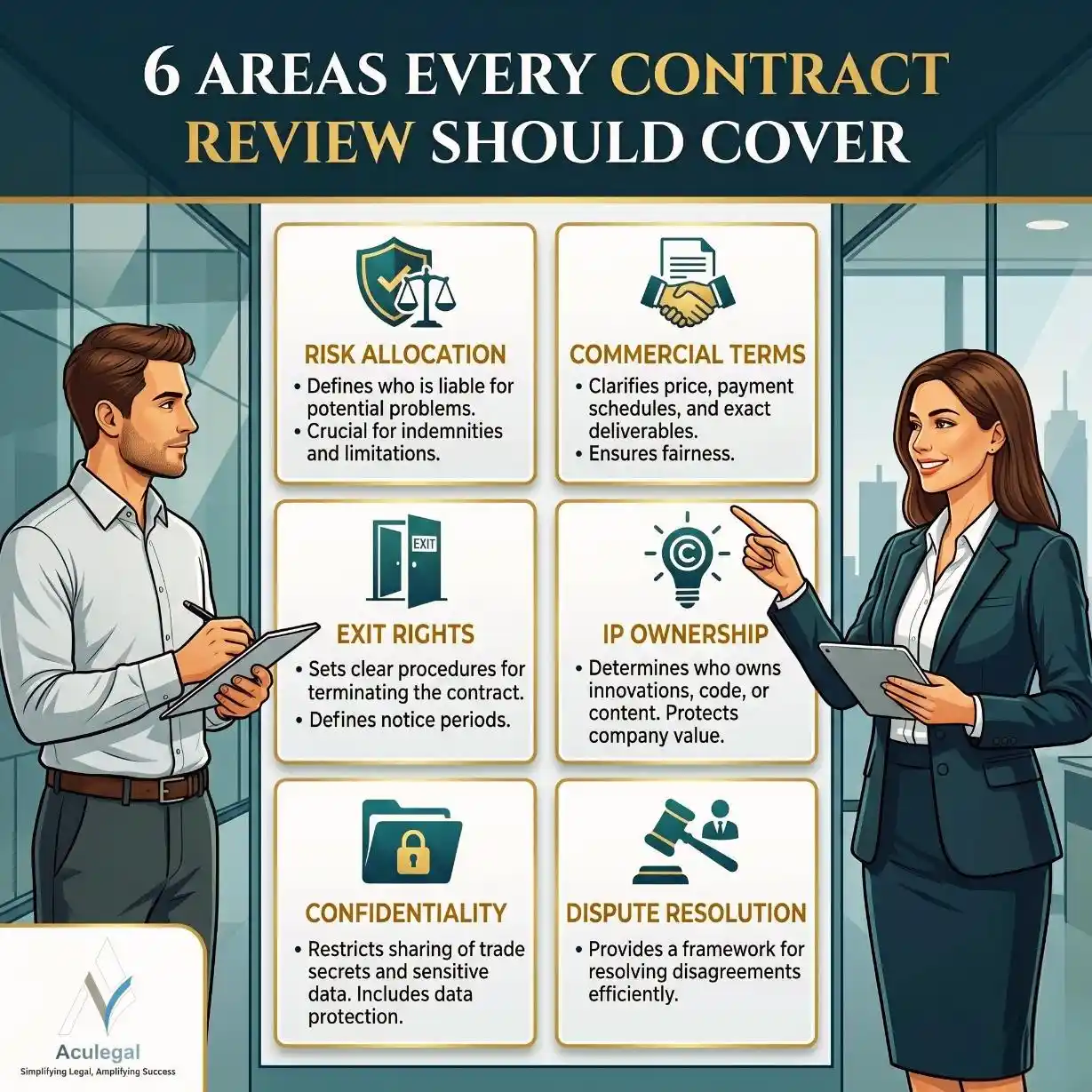
Strong contract review for startups is not just about finding errors. It’s about understanding what you’re agreeing to, strategically, financially, and operationally.
At Aculegal, a proper contract review covers six dimensions:
- Risk Allocation – Who bears liability for what, under which circumstances, and at what cap?
- Commercial Terms – Are payment timelines, milestones, and deliverables clear enough to enforce?
- Exit and Termination Rights – Can you exit cleanly, at low cost, without being locked in indefinitely?
- Intellectual Property – Are ownership, licensing, and usage rights unambiguous for all outputs?
- Confidentiality & Data – Is your proprietary information properly protected? Are data handling obligations clearly defined?
- Governing Law & Dispute Resolution – If something goes wrong, where and how will it be resolved?
Each of these dimensions represents a category of risk that could materially impact your business. Reviewing only the commercial terms, which most founders do, leaves five other risk categories unaddressed.
What “Red Flags” Look Like in Practice
Red flags aren’t always dramatic. Sometimes they’re mundane-looking phrases that carry disproportionate weight:
- “All intellectual property created under this agreement becomes the sole property of the Client”, This can strip you of your own technology or processes if you’re not careful about scope.
- “Either party may terminate with 30 days’ notice”, Fair on the surface; not if your deliverables require 90-day lead times or you’ve incurred upfront costs.
- “Governing Law: Delaware / England / Singapore”, Legitimate for some deals, expensive for an early-stage Indian startup defending itself in a foreign jurisdiction.
According to the International Association for Contract & Commercial Management (IACCM), companies that invest in structured contract management report up to 9% improvement in revenue protection. Contract review isn’t overhead; it’s a value-preservation strategy.
The Hidden Cost of IP Exposure for Tech Startups and SaaS Founders
If your business is technology-driven, IP risk deserves special attention. IP ownership disputes are among the most expensive legal battles a startup can face. They can delay funding rounds, block acquisitions, and spook investors at the worst possible moment.
IP exposure typically arises from three sources:
- Contractor agreements without explicit work-for-hire or IP assignment clauses
- Co-founder agreements where contributions aren’t clearly attributed and vested
- Licensing agreements with open-source or third-party software that impose unexpected restrictions on commercial use
The World Intellectual Property Organization (WIPO’s SME resource centre) highlights IP clarity as one of the top three legal priorities for growing businesses. Aculegal’s approach ensures that before you scale, you actually own what you’ve built.
Concerned about IP ownership in your tech contracts? Aculegal’s IP Advisory Services help founders lock down ownership, manage licensing risk, and structure IP clauses that protect your competitive edge.
When to Bring in Legal Counsel: A Practical Timeline for Founders
Most founders ask the wrong question: “Do I need a lawyer for this contract?” The right question is: “What’s the cost if this contract goes wrong without legal review?”
Here’s a practical framework for when to prioritize legal review:
Stage 1: Incorporation and Founder Agreements (Pre-Revenue)
Before you build anything or bring on team members, founder agreements and shareholder documents must be legally watertight. This is where most equity disputes originate.
Stage 2: First Vendor and Client Contracts (Early Revenue)
Your first paying customer relationship sets the tone for all future agreements. Don’t use a verbal understanding or a template when real revenue is at stake. Proper contract review here protects your payment terms, deliverable scope, and liability exposure.
Stage 3: Growth-Phase Agreements (Scaling)
Partnership agreements, SaaS subscription terms, employment and NDA frameworks, and investor side letters all require structured legal review as you scale. One poorly written partnership agreement at this stage can dilute your control or limit your strategic flexibility.
Stage 4: Pre-Investment or M&A Due Diligence
Investors and acquirers conduct legal due diligence. Every contract in your data room will be scrutinized. Problematic clauses, even from two years ago, can kill a deal or force you into renegotiations at the worst possible time.
The Aculegal Difference: Legal Advice That Speaks Business
Most founders don’t want a lecture on the law. They want to know: what does this clause actually mean for my business, my money, and my next move?
That’s the Aculegal philosophy. We don’t translate legalese into more legalese. We translate it into business decisions.
Our approach to contract review is built around four principles:
- Speed without corners cut: We deliver reviews with context and clarity, not just a redline with no explanation.
- Commercial awareness: Our team understands startups, funding structures, SaaS models, and growth dynamics, not just black-letter law.
- Proactive risk identification: We don’t just flag what’s wrong. We explain the real-world consequences and offer alternative drafting suggestions.
- Accessible, transparent pricing: No mystery billing. No hidden hourly charges that make you afraid to ask a follow-up question.
According to World Bank research on business enabling environments, access to affordable legal services is one of the defining factors in startup survival and growth in emerging markets. Aculegal exists to close that gap for Indian founders and SMEs.
Conclusion: The Contract You Overlooked Is the Risk You’re Carrying Right Now
Here’s what this comes down to: contract review for startups is not a luxury for when you have more time or more money. It is the strategic baseline that protects everything you’ve built.
The risks are real. The clauses are already in your agreements. The question is whether you find them before they find you.
Let’s recap what we covered:
- Poor contract review exposes you to financial, legal, and IP risk that compounds over time
- The three founder objections to legal review, cost, trust, and templates are all false economies
- Proper review covers six dimensions: risk, commercial terms, exit rights, IP, confidentiality, and jurisdiction
- IP exposure is a startup-killer that often hides in plain-language contractor and co-founder agreements
- Legal review at the right stage, not just any stage, is what separates companies that scale from companies that stall
Aculegal
Simplifying Legal. Amplifying Success.
We work with founders, startups, and SMEs who want legal counsel that actually speaks their language and protects their business like a partner, not a vendor.
Don’t Let a Contract Clause Be Your Next Business Crisis
Book a free consultation with Aculegal today. We’ll review your most pressing contract, flag the risks, and give you a clear path forward, in plain English, with commercial context.
References & Sources