
Introduction
Legal mistakes first-time founders make don’t announce themselves. They hide inside unsigned co-founder agreements, unprotected IP filings, and handshake deals that feel fine until they aren’t.
Here’s the uncomfortable truth: most early-stage startups don’t fail because of a bad product. They fail, stall, or lose investor confidence because of legal gaps that could have been closed at the beginning for a fraction of what they cost to fix later.
According to a CB Insights report on startup failure, issues around team, legal structure, and investor relations consistently appear among the top reasons startups shut down. Legal problems aren’t a side issue, they’re a core business risk.
At Aculegal, our positioning is simple: Simplifying Legal. Amplifying Success. We’ve seen what happens when founders treat legal as an afterthought. This blog is your roadmap to making sure that never happens to your business.
Why First-Time Founders Get Legal Wrong
Most founders are product-obsessed, sales-driven, or deep in fundraising mode. Legal feels like a cost center, not a growth lever. That mindset is the first mistake.
The reality? Legal structure determines:
- Who owns your company (and how much)
- Who controls decisions as you grow
- Whether investors will touch you with a ten-foot pole
- Whether your IP belongs to you or technically to a former co-founder
The founders who scale fastest are the ones who locked down their legal foundations before they needed to.
The 7 Legal Mistakes First-Time Founders Make
1. Skipping the Co-Founder Agreement
This is the number one legal mistake first-time founders make. Two people agree to build something together, split equity 50/50 on a napkin, and get to work.
Six months later, one co-founder stops contributing. Now what?
A proper Co-Founder Agreement covers:
- Equity split and vesting schedules
- Roles, responsibilities, and decision-making authority
- What happens if someone exits
- IP ownership and assignment
Without this document, you’re one disagreement away from a company crisis. Most investors will ask for it upfront and walk if it doesn’t exist.
2. Choosing the Wrong Business Structure
Registering as a sole proprietor because it’s quick and cheap seems reasonable at zero revenue. It becomes a liability nightmare the moment you raise money, hire staff, or sign a major contract.
The right structure depends on:
- Your funding goals (bootstrapped vs. investor-backed)
- Your liability exposure
- Your tax planning strategy
- Whether you plan to issue equity to employees or investors
In India, most venture-backed startups operate as Private Limited Companies, primarily because it’s the structure investors expect, and because it enables ESOPs, term sheets, and structured fundraising rounds. Startup India’s registration guide provides a useful overview of entity types, but structure alone doesn’t protect you, the agreements behind it do.
3. Not Protecting Intellectual Property Early
Your product, your brand, your code, these are your most valuable assets. Yet most early-stage founders do nothing to protect them.
What you risk without IP protection:
- A competitor registering your brand name before you do
- A former employee claiming ownership of code they wrote
- Investors discovering unresolved IP disputes during due diligence and pulling out
At minimum, first-time founders should:
- File for trademark protection on their brand name and logo
- Ensure all technical work done by employees or freelancers is covered by IP assignment clauses
- Consider provisional patent filing if your product has a unique, protectable mechanism
The Intellectual Property India portal handles trademark and patent filings, but navigating the process without legal guidance often leads to incomplete applications or missed deadlines.
Link to Aculegal’s “Trademark & IP Protection” service page.
4. Ignoring Employment and Contractor Agreements
Startups move fast. It’s tempting to onboard people with a verbal commitment or a casual email thread. This is one of the most common and costly legal mistakes first-time founders make.
Why it matters:
- Without a proper employment agreement, you have no enforceable non-compete or non-disclosure clause
- Misclassifying employees as contractors can trigger significant tax and labor law penalties
- IP created by contractors may legally remain with the contractor if there’s no written assignment
Every person who touches your product, your data, or your customers should have a written agreement before they start. Non-negotiable.
5. Skipping Shareholder Agreements
Your cap table might look clean right now. But shareholder agreements govern what happens when things get complicated, a funding round, an acquisition offer, a shareholder who wants out.
Key clauses every shareholder agreement needs:
- Vesting schedules – so equity is earned, not gifted
- Right of First Refusal (ROFR) – so you control who new investors are
- Drag-along and tag-along rights – so exits don’t get blocked
- Anti-dilution provisions – so early investors are protected in down rounds
According to VCCircle’s startup legal basics guide, shareholder disputes are among the most common reasons Indian startups face funding roadblocks. A solid shareholder agreement drafted early prevents most of them.
6. Not Having a Founders’ Vesting Schedule
Giving away equity without vesting is one of the legal mistakes that costs founders the most financially and strategically.
Vesting schedules ensure that co-founders and early employees earn their equity over time, typically over 4 years with a 1-year cliff. If someone leaves in month three, they don’t walk away with 25% of your company.
This protects everyone:
- Remaining founders retain meaningful ownership
- Investors see a cap table that makes sense
- There’s no incentive to “coast” after getting equity
Many founders avoid vesting conversations because they feel awkward. Investors use the absence of a vesting schedule as a red flag.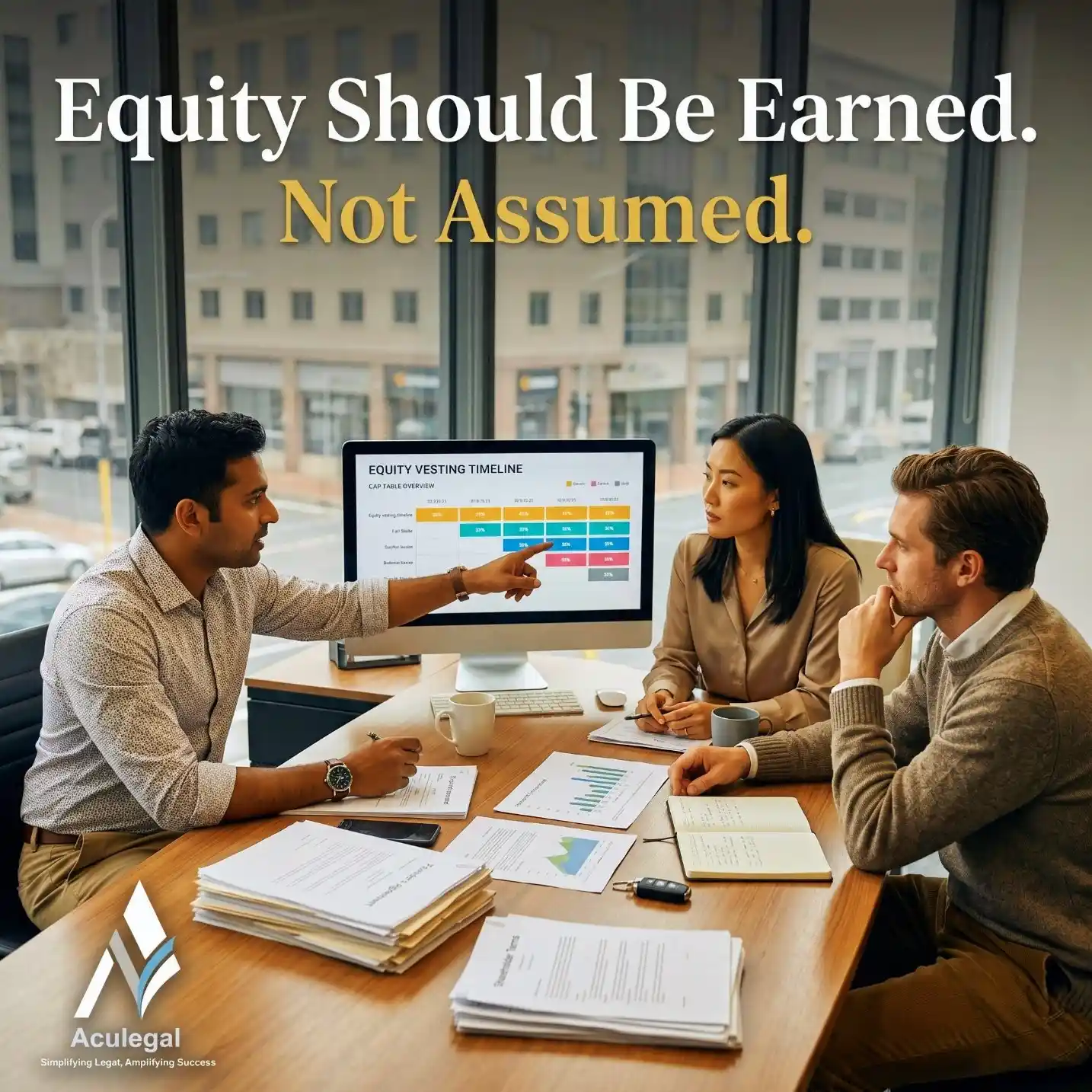
7. Treating Compliance as Optional
GST registration, MSME registration, FEMA compliance for foreign investment, data protection obligations, these are not optional extras. They are legal requirements that, if ignored, can result in penalties, blocked accounts, or regulatory action.
Founders often miss:
- Annual ROC filings and board resolutions
- Statutory registers and compliance calendars
- DPDPA (Digital Personal Data Protection Act) obligations for startups handling user data
The Ministry of Corporate Affairs portal contains the official filing requirements, but keeping track of deadlines without a legal partner is how founders end up with penalties they didn’t see coming.
Legal Documents Investors Expect From Startups
Getting investor-ready isn’t just about your pitch deck. Before any serious investor writes a cheque, they will conduct legal due diligence, and they will expect a clean, organized legal data room.
What Belongs in Your Legal Data Room
| Document
|
Why Investors Need It |
|---|---|
| Certificate of Incorporation
|
Confirms company is legally registered |
| MOA & AOA
|
Outlines the company’s scope and governance |
| Shareholder Agreement
|
Shows equity structure and investor protections |
| Co-Founder Agreement
|
Confirms equity allocation and vesting |
| IP Assignment Agreements
|
Proves your IP is owned by the company |
| Employment Agreements (key staff)
|
Confirms NDAs, non-competes, IP clauses |
| Cap Table
|
Breaks down ownership clearly |
| Past Board Resolutions
|
Shows proper governance has been maintained |
| Compliance Certificates
|
Confirms filings are up to date |
| Term Sheets (if any prior rounds)
|
History of funding and deal terms |
Investors don’t just look at what’s there – they look at what’s missing. Gaps in your legal data room signal operational immaturity and often lead to lower valuations or failed deals.
The Documents Investors Will Scrutinize Most
Beyond the checklist, investors pay closest attention to:
- Vesting schedules – Is the team actually committed long-term?
- IP ownership – Is there any ambiguity about who owns the core product?
- Capitalization table – Is the equity structure clean and scalable?
- Previous agreements – Are there side deals, promises, or verbal commitments that could complicate things?
A well-structured legal foundation signals to investors that you understand how to build a real business, not just a product.
How to Build Your Legal Foundation the Right Way
Getting legal right doesn’t have to be overwhelming. The founders who do it well follow a simple sequence:
Stage 1 – Entity Setup (Day 0)
- Choose and register the right entity structure
- Draft and sign a co-founder agreement
- Set up founder vesting schedules
- Register trademarks on brand name and logo
Stage 2 – Operational Agreements (First Hire Onwards)
- Employment agreements with IP assignment, NDA, and non-compete clauses
- Contractor agreements with clear IP ownership terms
- Terms of Service and Privacy Policy for your product
Stage 3 – Investor-Ready Legal (Pre-Fundraise)
- Shareholder agreement with standard VC-friendly clauses
- Clean cap table with full documentation
- Legal data room assembled and audited
- Compliance calendar running on schedule
Stage 4 – Ongoing Compliance (Always)
- Annual ROC filings
- GST returns and tax filings
- Board resolutions and statutory registers
- Regulatory updates (DPDPA, FEMA, etc.)
Each stage builds on the last. The founders who skip stages find themselves paying exponentially more to fix problems in the next one.
Conclusion: Your Legal Foundation Is Your Competitive Advantage
The legal mistakes first-time founders make are predictable, preventable, and expensive to fix in hindsight. But the founders who get ahead of these issues don’t just avoid problems, they create a structural advantage.
A clean legal foundation means:
- Investors trust you faster
- You retain more control of your company
- Your team’s commitments are enforceable
- You can scale without legal drag
At Aculegal, we work with founders, startups, and SMEs to build legal structures that match their ambition, not just their current size. Whether you’re incorporating for the first time, preparing for a funding round, or cleaning up a cap table before an acquisition, we bring the clarity and precision your business deserves.
Simplifying Legal. Amplifying Success.
📞 Ready to Build on Solid Legal Ground?
Don’t let preventable legal mistakes slow your growth.
✅ Book a Free Legal Consultation with Aculegal
Talk to an Aculegal expert today and build your startup the right way, from the start.